There are two ways to write about a serial killer and only one of them belongs on a horror site.
A crime novel asks who did it and whether they’ll be caught. The killer is a puzzle with a solution, and the pleasure is in the closing of the trap. That’s a fine form and it has its own shelf.
Horror asks a different question, which is what this person actually is, and then refuses to make it comfortable. The serial killer books below are almost all narrated by the killer, or spend so long inside his logic that the distinction stops helping. There’s no reassurance in them and frequently no capture.
On true crime, since this page includes some. The genre has a real problem: it turns murdered people into set dressing for a study of the man who killed them, and it has produced an enormous amount of work that is functionally fan material. I’ve included four and every one of them is here because it refuses that. The rest of the true crime serial killer books you can find anywhere. I haven’t read these. What follows is the critical consensus.
Fiction by René Rehn


The Fiction
The serial killer books that built the fictional version, and most of them arrived before the FBI had a working vocabulary for the real thing.
The Killer Inside Me (1952)

Lou Ford is a deputy sheriff in a small West Texas oil town, and everybody likes him because he is slow, friendly, and prone to boring people with clichés he has memorized for exactly that purpose.
He tells you in the first chapter that this is a performance. What he calls the sickness has been with him since childhood, and the novel is his account of what he does about it over a few weeks.
Thompson’s decision was to narrate entirely from inside, in the first person, in a voice that is calm, self-aware, and completely without appeal to the reader. Lou explains his reasoning, and the reasoning is coherent, and that is the horror.
The violence, when it arrives, is brief, sudden and considerably harder than anything in the paperback crime of its period. The first killing was censored in the original edition.
Published as a Fawcett Gold Medal paperback original in 1952 and dismissed as pulp. It is now regularly named the best American crime novel of the century.
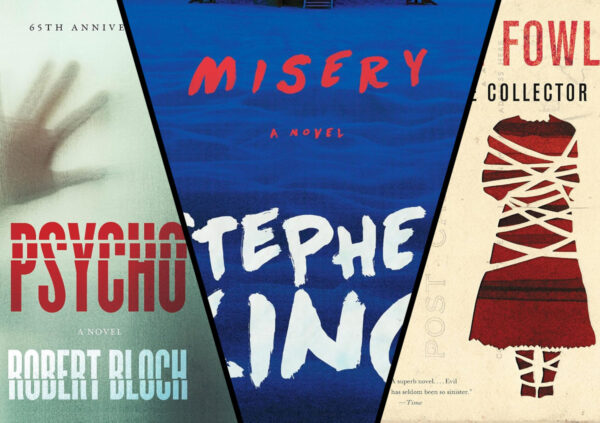
Psycho (1959)

When Bloch wrote it in 1959, he was living some forty miles from the Wisconsin farmhouse where Ed Gein had been arrested two years before, and by his own account he knew almost nothing of the specifics.
What he had instead was a single premise, one he repeated in interviews for decades: such a man might live next door, and no one around him would ever suspect. The whole modern serial killer novel sits inside that premise, and everything below it on this page is downstream.
Bloch’s Norman runs contrary to memory: fortyish, heavy, sour, occult-dabbling, drinking, and Perkins is nowhere in him. The page is the colder portrait.
The structural decision that made it famous is Bloch’s rather than Hitchcock’s: the one-third-mark murder of the heroine was on his page first, and the film’s addition was the audience’s eyes.
And Mother is no offstage rumor; Bloch writes her lines out, temper included, long before the accounting arrives.
The Collector (1963)

Frederick Clegg, butterfly collector, council clerk, pools winner, purchases a Sussex property that comes with a cellar, and takes the art student he has spent two years watching.
He is not a serial killer and he opens this section anyway.
Fowles is interested in the collecting rather than the killing: the specimen case, the pin, the pleasure of complete possession, and the fact that Clegg’s hobby and his crime are the same activity applied to different material. That is a genuine insight and it predates the FBI’s own vocabulary for it by twenty years.
The first half is his own account, cruelty-free by his lights: attentive, generous, wounded by ingratitude.
Every subsequent fictional killer who keeps trophies, keeps victims alive, or explains himself in a reasonable voice is working from this book, and it was Fowles’s first novel.
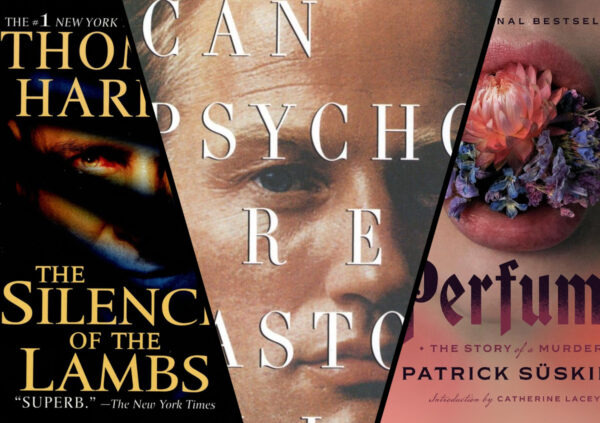
Perfume (1985)
1985 · translated by John E. Woods · 1986

Paris, 1738. Beneath a fish stall, Jean-Baptiste Grenouille comes into the world carrying two anomalies: a nose finer than any human has owned, and no odor of his own at all.
The second one is why he kills. He is not driven by sadism, rage or sexual compulsion, and Süskind is explicit about this. Grenouille wants to construct a scent for himself, because he has none and has worked out that this is why nobody can bear to be near him, and the raw material he requires is the smell of young women.
No other killer on this page resembles him. Conventional interiority, conscience, cruelty, he has none of them, and Süskind handles him the way you’d handle weather, an organism doing what its nature dictates, which unsettles far more deeply than any motive could.
The prose about smell is why it sold twenty million copies. Eighteenth-century Paris arrives as an assault.
The closing scene has few rivals anywhere in modern fiction for sheer audacity.
The Wasp Factory (1984)
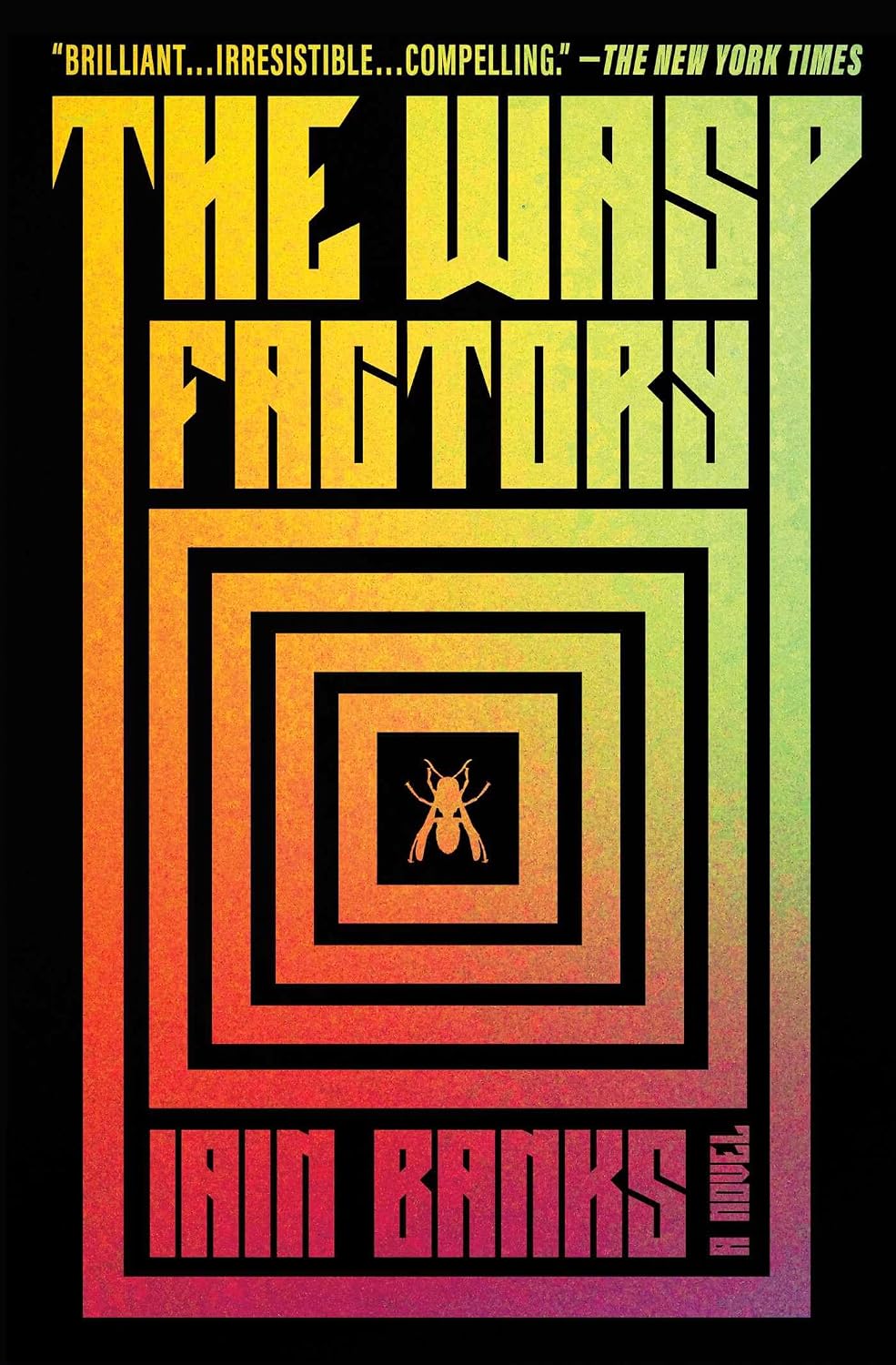
Sixteen years old, sharing a small Scottish island with his father, Frank Cauldhame admits to three killings before page two is out, committed at eight, nine and ten, reported in the tone of a weather observation, with the firm rider that he gave it up because it was only a phase.
That is what puts him on this page and makes him unlike everybody else on it. Frank is a child murderer who has retired, and Banks lets him be funny, precise, methodical and good company for three hundred pages.
The Sacrifice Poles and the Factory, his wasp-run oracle in the loft, are the best-invented private religion in fiction.
What the father turns out to have done either completes the novel or knocks it off balance, and the readership has never agreed which. The 1984 press treated it as an outrage, which Banks enjoyed for the rest of his life.
Red Dragon (1981)

The novel that invented the modern profiler and Hannibal Lecter, in that order of importance.
Will Graham is retired and living in Florida because catching Lecter nearly killed him, and Jack Crawford brings him back to work a case in Atlanta and Birmingham where entire families are being killed in their homes on the lunar cycle.
Harris’s method is the reason everything on this page after 1981 looks the way it does. He did the research with the FBI Behavioral Science Unit, and the reasoning Graham does, working from crime scene arrangement to a picture of the man, was a genuine technique that almost nobody outside the Bureau had heard of.
Francis Dolarhyde is also the better antagonist. Harris gives him a childhood, a cleft palate, a grandmother, a job in a film processing lab and a relationship with a blind woman, and the reader ends up understanding him completely.
Lecter is in it for about twenty pages and is a supporting character in his own debut.
The Silence of the Lambs (1988)

Clarice Starling is a trainee at Quantico sent to interview Lecter in Baltimore, ostensibly for a questionnaire and actually because Crawford wants something from him about the killer the press are calling Buffalo Bill.
The quid pro quo is the structure, and nothing in crime fiction beats it. Lecter trades information for autobiography, and the novel alternates between two investigations, one for a killer and one into Clarice, and the second is the one that matters.
The killer is the reason the book is on this page rather than the previous one. Harris built Buffalo Bill from three real cases: Gein for the skinning, Bundy for the arm cast and the van, and Gary Heidnik for the pit in the basement.
Spoiler warning for the rest of this paragraph, which touches on who the killer is. The depiction of him as gender-confused was criticized at the time and Harris has a line in the novel explicitly stating he is not transsexual, which does not entirely settle it and is worth going in aware of.
Won the Bram Stoker Award.
American Psycho (1991)

Twenty-six and employed in mergers and acquisitions, Patrick Bateman itemizes his existence for you: suits, labels, restaurant reservations, business cards, the skincare regimen.
Murder arrives in the ledger voice, brand-tagged, particular, tonally level with the skincare, and Ellis never flags which entries count.
Nothing is confirmed. The confessions bounce, the lawyer dines in London with a dead man, and Bateman is mistaken for other men on every third page, because interchangeability is the subject.
The gore is not what makes it hard. What makes it hard is four hundred pages spent listening to a voice with nothing behind it.
Simon and Schuster paid and then walked after staff read it; Vintage caught it, NOW boycotted, and Australian shops still shrink-wrap it.
Also on psychological horror books.
Zombie (1995)

Quentin P. is thirty-one, works as a caretaker at a college in Michigan, lives in his dead grandmother’s house, and is on probation for molesting a boy.
He is also attempting to create what he calls a zombie: a compliant sexual companion produced by a transorbital lobotomy performed with an ice pick, on subjects he abducts, and he has not succeeded yet.
Oates narrates entirely from inside him, in a journal, with hand-drawn diagrams, capitalizations, and a flat repetitive voice that circles the same phrases. There is no investigation, no counterweight, no detective and nobody coming.
It is drawn directly from Dahmer, whose case had broken four years earlier and who had attempted exactly this, and Oates does not soften any of it.
It won the Bram Stoker Award for best novel, and apart from Brite it’s the hardest thing on this page. A hundred and eighty pages, and there is no relief in any of them.
Exquisite Corpse (1996)

Andrew Compton is an English serial killer who escapes custody by faking his own death and travels to New Orleans. Jay Byrne is an American doing the same thing with family money and better facilities. They find each other.
What puts this at the hard end of the page is that Brite removes the investigator entirely. There is no detective, no procedural counterweight and nobody closing in. You are inside the collaboration for the length of the book and there is nothing to cut away to.
The other subject is the AIDS epidemic in the French Quarter in the early nineties, and one of the intended victims is HIV positive, and the novel’s treatment of that is deliberately provocative and was received badly at the time.
It reached print only after her American house sent it back, more or less unopened.
Nilsen and Dahmer sit behind both men, acknowledged. If the description has already put you off, that is the correct response.
The Butcher Boy (1992)

Francie Brady is twelve in a small Irish border town in the early sixties. His father is an alcoholic, his mother is suicidal, and his best friend Joe is starting to grow away from him.
McCabe narrates the entire novel in Francie’s voice, unpunctuated, comic, headlong, full of comics and films and Nugent family grievances, and the reader watches him deteriorate without a single sentence stepping outside to comment.
What makes it belong here is that Francie is a child, and the novel is entirely clear about the sequence: the town fails him, the institution he is sent to abuses him, his mother dies, his father dies, and by the time he does what he does there is nothing left of him.
It is very funny for two hundred pages, which is what makes the ending land.
Booker shortlisted, and Neil Jordan filmed it in 1997 with McCabe co-writing. The film cannot reproduce the voice, which is the whole book.
The Last House on Needless Street (2021)

One house with its windows covered, one man with a drinking problem, one girl long missing, and a narrator who has earned none of your trust.
It is on this page under protest and that is deliberate. Ward sets the book up to be read as one kind of novel, and every assumption a reader brings from a serial killer shelf is a trap she has laid. Read it having read nothing about it.
Also on haunted house books.
The True Crime
The serial killer books that deal with the actual cases, and the good ones are largely about the people investigating rather than the people investigated.
The Stranger Beside Me (1980)

Ann Rule was writing a book about a series of unsolved murders of young women in the Pacific Northwest when she realized she already knew the man responsible.
Ann had worked night shifts with Ted Bundy at the Seattle Crisis Clinic in 1971, alone in a two-person office, talking people out of suicide over the phone. She liked him. She described him as kind, empathetic and unusually good at the work, and she wrote him a reference.
That is the entire value of the book and no other true crime title has anything like it. It is a first-person account by somebody who was inside the friendship while the investigation was happening, who saw the composite sketch and did not believe it, who visited him in custody, and who took his phone calls afterwards.
She is also honest about her own failure to see it, repeatedly, and about the fact that she profited from the relationship.
It is the founding text of modern American true crime and it remains the best of them.
I’ll Be Gone in the Dark (2018)

Michelle McNamara spent years identifying the man who committed at least thirteen murders and fifty rapes across California in the seventies and eighties, and she gave him the name the Golden State Killer, which is now the one everybody uses.
The book is unfinished. She died in 2016 while writing it, of an accidental overdose, and it was completed from her notes and files by two researchers and her husband.
What makes it exceptional is the honesty about the obsession. She writes about the online communities, the eBay lots of forensic material, the nights at the computer, and the effect on her marriage and her sleep, and she is clear that this was not healthy.
The other achievement is the victims. She interviewed survivors, and the book is structured to give them the space that true crime usually gives the perpetrator.
Joseph DeAngelo was arrested two months after publication, by DNA genealogy rather than by anything in the book, and pleaded guilty in 2020.
Mindhunter (1995)

John Douglas was one of the first FBI agents to interview convicted serial killers systematically, and this is his account of building the discipline that everything else on this page assumes.
He and Robert Ressler drove around America in the late seventies with no budget and no authorization, dropping in on prisons and asking to speak to whoever they had. Manson, Berkowitz, Kemper, Speck. There was no protocol. They took notes and worked out the questions as they went.
The technique that emerged, reading crime scene arrangement backwards to a personality, is the thing Harris put in Red Dragon, and Douglas was the model for Jack Crawford.
He is also candid about the cost. He collapsed with viral encephalitis in Seattle during the Green River investigation, was in a coma, and lost the use of one side of his body temporarily.
The Netflix series is drawn from it. The book is better on the actual reasoning and worse on the personalities.
My Friend Dahmer (2012)

Derf Backderf went to high school with Jeffrey Dahmer in Bath, Ohio, in the late seventies, and this is his graphic memoir about it.
They were not close friends and they were in the same orbit. Backderf and his group treated Dahmer as a mascot because of his party trick, which was imitating an interior decorator with cerebral palsy who worked at his mother’s office, and they encouraged him to perform it in shopping malls.
He was also drinking heavily by fifteen, alone in the woods behind his house dissolving roadkill in acid, and the marriage in his home was collapsing.
The argument Backderf makes carefully is that Dahmer was a boy nobody helped, that every adult in his life failed to notice or declined to, and that this does not excuse anything. He is explicit that his sympathy ends the moment Dahmer kills.
It took him a decade of research including police records and interviews, and it is genuinely well made.
Where to Start
Read Red Dragon rather than The Silence of the Lambs, and be surprised.
If you want the best-written, read Perfume. If you want the one that will unsettle you longest, read The Collector.
For true crime, read I’ll Be Gone in the Dark, which is the book that shows what the genre can do when it takes the victims seriously.
And if you want the foundation everything else is built on, read The Killer Inside Me, which takes an evening.
My best horror books list ranks the rest of the genre. The interior version of the same thing is on my psychological horror list.
A note on support: this page mentions suicide. If you’re struggling, you don’t have to handle it alone. In the US you can call or text 988, the Suicide and Crisis Lifeline. Elsewhere, the International Association for Suicide Prevention keeps a directory of crisis centers at iasp.info.