The witch trials are the one horror subject where the nonfiction is worse than the fiction, and it isn’t close.
Every novel on this page has to invent something. The witch trials histories don’t, because the record is extensive: trial transcripts, confessions extracted under torture, execution accounts, and the paper trail of ordinary neighbors giving evidence against each other. What the documents show is not a society gripped by superstition so much as a society that had found a legal mechanism for dealing with inconvenient people, and used it.
Two corrections worth having before you start, because both are repeated constantly.
The figure of nine million executed witches is a myth. It originates with an eighteenth-century German estimate that was wrong by two orders of magnitude and then circulated for two hundred years. Modern scholarly estimates put executions across Europe at roughly forty to sixty thousand over about three centuries, with prosecutions perhaps double that.
And Salem is not representative. Twenty people died there, nineteen hanged and one pressed to death, which makes it a small event by European standards. It looms large because the documentation survives, because it happened in English and in a place that later became powerful, and because Arthur Miller needed a metaphor in 1953.
I haven’t read most of these. What follows is the critical consensus.
Fiction by René Rehn


Witch Trials Books at a Glance
| Year | Title | Author |
| 1487 | The Malleus Maleficarum | attributed to Heinrich Kramer |
| 1859 | Lois the Witch | Elizabeth Gaskell |
| 1952 | The Devils of Loudun | Aldous Huxley |
| 1953 | The Crucible | Arthur Miller |
| 1975 | Europe’s Inner Demons | Norman Cohn |
| 1986 | I, Tituba, Black Witch of Salem | Maryse Condé |
| 1995 | A Delusion of Satan | Frances Hill |
| 2002 | In the Devil’s Snare | Mary Beth Norton |
| 2002 | Speaks the Nightbird | Robert McCammon |
| 2004 | Caliban and the Witch | Silvia Federici |
| 2014 | The Penguin Book of Witches | Katherine Howe (ed.) |
| 2015 | The Witches: Salem, 1692 | Stacy Schiff |
| 2017 | The Witch: A History of Fear | Ronald Hutton |
| 2017 | The Witchfinder’s Sister | Beth Underdown |
| 2020 | The Mercies | Kiran Millwood Hargrave |
| 2021 | The Manningtree Witches | A. K. Blakemore |
| 2021 | Hour of the Witch | Chris Bohjalian |
| 2021 | Slewfoot | Brom |
The History
The Witches: Salem, 1692 by Stacy Schiff (2015)

The best single-volume narrative account of Salem, and Schiff’s decision was to tell it as it happened rather than explaining it first.
Nine months, 1692. Somewhere around a hundred and fifty people accused, nineteen hanged, one man pressed to death under stones over two days for refusing to plead, and several more dead in jail including an infant.
What Schiff establishes that most accounts skip is the context. Massachusetts had no legal charter for several years and no legitimate government. There was a war on the Maine frontier and refugees from it were in the village. Winter had been severe. And the accusers were mostly girls between eleven and twenty, in a society where they had no standing to speak in public about anything, who were suddenly the most listened-to people in the county.
The Pulitzer-winning biographer’s eye is on the detail: what people wore, what a meeting house smelled like, how long a journey took.
Her position on the cause is deliberately unresolved and she is explicit that the records do not permit certainty.
In the Devil’s Snare by Mary Beth Norton (2002)

Norton’s argument is the single most persuasive explanation anybody has offered for Salem, and it is a war thesis.
King William’s War had been running on the Maine frontier since 1688. Wabanaki raids had destroyed English settlements, and refugees had come south into Essex County, and several of the accusing girls were orphans of those raids who had watched their families killed and had been taken in as servants by Salem families.
Norton traced the connections person by person. The judges had military and political responsibility for the failed defense of the frontier. The accused were disproportionately connected to that failure. And the descriptions the girls gave of the devil match Wabanaki appearance and practice closely enough that Norton argues they were describing what they had actually seen.
The case is built from documents rather than asserted, and the middle section is genuinely gripping.
It is an academic history and reads like one, and it’s what you hand somebody who thinks Salem was about superstition.
A Delusion of Satan by Frances Hill (1995)

The most readable general account of Salem and the best starting point on this page.
Hill covers the whole affair chronologically, from the first afflictions in the parsonage through the trials to the collapse and the later apologies, and she is very good at keeping the individuals distinct, which is the hardest problem in writing about it.
Her argument is about Puritan childhood. Children in that society were subject to total authority, had no permitted outlet, were told constantly about hell in specific terms, and were beaten. The afflictions started with two girls, Betty Parris and Abigail Williams, in a minister’s house, and Hill’s position is that what began as attention-seeking became something the adults then took over and made lethal.
She is also excellent on the economics: which families accused which, where the property lines ran, and how neatly the accusations follow existing village disputes between the Putnams and the Porters.
Short, clear and unsentimental, and it does not pretend to a single cause.
The Witch: A History of Fear by Ronald Hutton (2017)

Hutton is the best historian working on this subject and this is the widest-angle book on the page.
His argument is that you cannot understand European witch trials by looking only at Europe. So he starts with the global anthropology, examining societies across Africa, Asia and the Americas that have witch beliefs, and establishes what is actually universal: the idea of the malevolent neighbor working harm through unseen means, which turns up nearly everywhere.
Then he narrows. Ancient Mediterranean magic, the shamanic traditions of Siberia and Lapland, the fairy beliefs of Britain and Ireland, and finally the specific conditions in early modern Europe that turned an ordinary and ancient fear into a legal machinery that killed perhaps fifty thousand people.
The chapter on the ceremonial magic tradition and how it differed from village cunning-folk is the clearest explanation of that distinction anywhere.
He is also careful about numbers, which matters because the figures in popular accounts are frequently wrong by an order of magnitude.
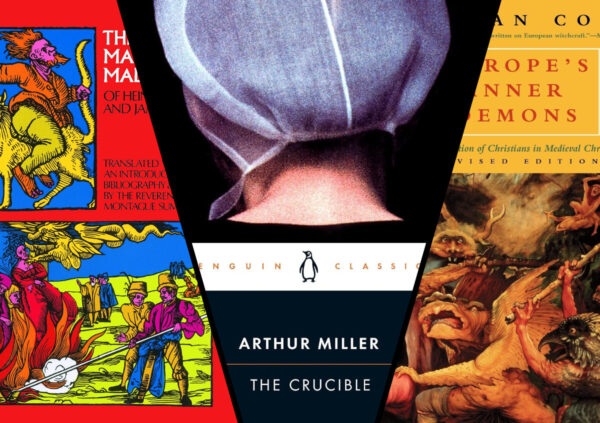
Europe’s Inner Demons by Norman Cohn (1975)

Cohn’s book is the one that demolished the thing everybody believed, and the field has not recovered from it.
Before 1975 the explanation with the widest public currency, drawn largely from Margaret Murray, was that the witch trials had persecuted a real surviving pagan fertility religion. Cohn went back to the sources and showed that Murray had quoted selectively, omitted material that contradicted her, and in places simply misrepresented what the documents said.
What he demonstrated instead is that the stereotype of the witches’ sabbath was assembled from a much older template. The same accusations, secret nocturnal meetings, orgies, infanticide, cannibalism, had been made against early Christians by Romans, then against heretical sects by the medieval Church, then against Jewish communities, and finally against witches. The content was recycled.
That means the sabbath never happened anywhere, ever, and the confessions describing it were produced by torture and by leading questions.
It is a scholarly book and it is where any serious reading on this subject has to start.
Caliban and the Witch by Silvia Federici (2004)

Federici’s argument is Marxist, no book on this page draws more dispute, and that’s exactly why it belongs alongside the others rather than instead of them.
Her position is that the witch hunts were not a survival of medieval superstition but a component of the transition to capitalism. The enclosure of common land destroyed the subsistence economy that women had operated in. The new order required a growing labor supply, so reproduction had to be brought under control, which meant criminalizing contraception, abortion and midwifery. And the women who held that knowledge were the ones accused.
She reads the hunts as a disciplinary project running in parallel with the slave trade and the conquest of the Americas, which is where the Caliban of the title comes from.
Historians of the period generally consider the chronology strained and the evidence selective. It has been enormously influential outside the field and is regularly assigned in gender studies rather than in history departments.
Read it for the argument and read Hutton or Cohn for the record.
The Primary Sources
The Malleus Maleficarum, attributed to Heinrich Kramer (1487)
1487 · translated by Montague Summers, 1928, and by Christopher Mackay, 2006

The primary source, and it is worth confronting how ordinary the prose is.
Heinrich Kramer wrote it after being thrown out of Innsbruck by a bishop who considered his methods improper and his obsession with the sexual conduct of the accused unhealthy. He wrote the book partly to justify himself, attached the name of a more respected theologian who may have had little to do with it, and had a papal bull bound into the front to imply approval it did not carry.
It is in three parts: an argument that witchcraft is real and denying it is heresy, a catalog of what witches do, and a legal manual on obtaining and prosecuting a confession, including the use of torture and the specific deceptions permitted.
Part two is where the misogyny is most explicit and the reasoning is stated openly rather than implied.
The Mackay translation is the scholarly one. Summers is a period curiosity and Summers himself believed in witches.
The Penguin Book of Witches, edited by Katherine Howe (2014)

The documents, edited by Howe, and the most useful book on this page for anybody who wants to see the material rather than read about it.
It runs from Tudor and Stuart sources through to Salem, and includes trial transcripts, examination records, depositions, indictments, ministers’ accounts and pamphlets, with Howe’s headnotes establishing what each one is and what to watch for.
The Salem material makes up the bulk, and it’s what changes how people think about the trials. The examinations are transcribed as spoken, so you get the actual exchanges: leading questions, magistrates telling the accused what they already know, and the specific mechanism by which a denial becomes evidence.
Bridget Bishop’s examination is the one to read first. She is the first person hanged, she denies everything consistently, and the record shows exactly how little that was worth.
Howe is a novelist as well as an editor and is a descendant of two accused women, which she mentions once and does not dwell on.
The best value on the page.
The Fiction
The Crucible by Arthur Miller (1953)

Miller wrote it in 1952 while the House Un-American Activities Committee was subpoenaing his friends, and he was called before it himself four years later and convicted of contempt for refusing to name people.
The play is Salem and it is not a documentary. Miller says so in a note. He compressed the timeline, merged characters, and raised Abigail Williams from eleven to seventeen so that an affair with John Proctor was possible, and that affair is invented.
The parallel is the purpose, and it holds. What the play is actually about is the mechanism: that confession is the only exit, that confession requires naming others, and that the innocent are therefore the ones who hang, because they will not participate.
Proctor’s refusal at the end, about his name, is the most quoted speech in American theater and it is about exactly that.
Read it knowing the history is adapted, a fair criticism of it as history and irrelevant to it as a play. It is on this page because it is the reason most people have heard of Salem at all.
Conjure Wife by Fritz Leiber (1943)

Every witch panic in the history section above ran on the same conviction, that somewhere in the community, women were secretly working magic. Leiber’s novel takes that conviction at face value and plays it completely straight: they are. All of them. A sociology professor at a small college discovers his wife has been protecting his career with charms through their whole marriage, makes her burn them like a rational man, and learns within days what her protection had been holding off.
What makes it land on a witch trials list is the social mechanics. The witchcraft runs on faculty politics, promotion committees and campus rivalries, conducted entirely by the wives while the husbands congratulate themselves on their reason. It’s the suspicion that burned Salem, inverted into the fear of the suspicion being right.
It ran in Unknown in 1943, collected a Retro Hugo in 2019, and has been filmed more than once, best as Burn, Witch, Burn. Still the sharpest witchcraft novel anyone has written, and the full case for it is on my Fritz Leiber page.
I, Tituba, Black Witch of Salem by Maryse Condé (1986)
1986 · translated by Richard Philcox · 1992

Tituba is the enslaved woman in the Parris household whose confession started Salem, and the historical record on her is almost nothing. She was enslaved, she confessed, she named others, she survived, and she was sold to pay her jail fees and disappears.
Condé’s novel gives her a life. It begins in Barbados with her mother’s rape aboard a slave ship, follows her through the household in which she is property, into Salem, into the jail, and then back out to a Barbados uprising, which is entirely invented.
The argument the novel makes is that Tituba was written out. Every account of Salem centers the white girls, and the woman at the origin of it is a footnote whose ethnicity has been variously reported as African, Indigenous and both, because nobody recorded it accurately.
Condé has said the tone is deliberately parodic in places and that critics who read it as straight historical fiction missed the joke.
Won the Grand Prix Littéraire de la Femme.
The Manningtree Witches by A. K. Blakemore (2021)

Essex, 1643. The men are away at the war, the harvest has failed, and a young man named Matthew Hopkins has arrived in Manningtree and taken rooms at the Thorn Inn, and he is watching.
Rebecca West is the narrator. She is poor, unmarried, sharp-tongued, lives with her mother Beldam West who is worse, and she has the specific vulnerability of a woman with no property, no husband and a reputation for answering back.
Blakemore is a poet and the prose is the reason to read it. The seventeenth-century voice is convincing without being pastiche, and the Essex landscape, the mud, the estuary, the cold, is rendered exactly.
What she is precise about is the mechanism. The accusations come from neighbors with grievances about small sums and old insults, the watching for the devil’s mark is described in detail, and the swimming test is what it was, which is a drowning with paperwork.
Hopkins killed more people in three years than the English trials had managed in the previous century. Won the Desmond Elliott Prize.
The Witchfinder’s Sister by Beth Underdown (2017)

Alice Hopkins returns to Manningtree in 1645, widowed and pregnant, to live with her younger brother Matthew, who has become someone she does not recognize.
The premise does the heavy lifting. Matthew Hopkins is a documented figure who between 1644 and 1647 was responsible for the deaths of around three hundred women, more than in the entire preceding century of English trials, and then died at twenty-seven of tuberculosis. Almost nothing is known about him personally, which gives Underdown room.
Alice is invented and the novel is her attempt to understand and then to stop him, from inside the household, with no legal standing and total financial dependence on him.
The interrogation material comes straight from the surviving records, and nothing in the book is stronger: the watching, in which a suspect is kept awake for days on a stool until an imp appears, and the walking, and the searching for marks.
Underdown is very good on how ordinary the machinery was and how many local men were happy to be paid to help.
The Mercies by Kiran Millwood Hargrave (2020)

Vardø, on the Arctic coast of Norway, Christmas Eve 1617. A storm comes up while the men of the island are out fishing and forty of them drown within sight of the shore in a few minutes.
That happened. The storm is documented and so is what followed.
For eighteen months the women run the island alone, and they do it well, which is the problem. They fish, they slaughter, they wear trousers because dresses are impractical, and the Sámi women among them keep their own practices. Then Absalom Cornet arrives from Scotland, where he has burned witches already, with a wife called Ursa who is twenty and has been married to him for weeks.
The relationship between Ursa and Maren is the novel and it is handled with real care.
Between 1600 and 1692 around ninety-one people were executed for witchcraft in Finnmark, out of a tiny population, and a memorial by Louise Bourgeois and Peter Zumthor stands at Vardø.
Hour of the Witch by Chris Bohjalian (2021)

Boston, 1662, thirty years before Salem, and the setting is chosen for exactly that distance.
Mary Deerfield is twenty-four and married to a man twice her age who is respected, prosperous and violent when drunk. She petitions for divorce, which was legally possible in the colony and almost never granted, and the court proceeding is the first half of the novel.
The evidence against her husband is that he drove a fork through her hand. The evidence against her is that she owned three-tined forks, which were unusual, foreign and associated with the devil, and that she was seen collecting herbs.
Bohjalian’s argument is that the two proceedings are the same proceeding. A woman who asks the court for anything invites the court to examine her, and the divorce petition is what produces the witchcraft accusation.
The legal detail is researched properly and the Puritan Boston material is convincing without being showy.
It is a courtroom novel with a witch trial in it rather than the reverse, and that is why it works.
Speaks the Nightbird by Robert McCammon (2002)

The witch-trial novel at maximum scale, and the book that brought McCammon back from a decade of silence.
Fount Royal, 1699, a dying settlement in the Carolina colony. An aging magistrate and his twenty-year-old clerk, Matthew Corbett, arrive to try Rachel Howarth for witchcraft and for the murders behind the charge, and the evidence looks damning, which is exactly the problem. Matthew starts pulling threads, and the town turns out to be full of people with better reasons than the devil.
Stephen King called it “a rarity in popular fiction.” Be warned that it is seven hundred-plus pages, unhurried, and a historical mystery before it is horror. The Matthew Corbett series it launched ran to ten volumes and wrapped in 2025 with Leviathan. More on the Robert McCammon page.
Lois the Witch by Elizabeth Gaskell (1859)

A hundred pages, written in 1859 by the author of North and South, and almost nobody knows it exists.
Lois Barclay is orphaned in Warwickshire and sent to relatives in Salem in 1691. She is English, Anglican, pretty, and entirely alone. Her uncle dies, her aunt dislikes her, her cousin proposes and is refused. And when the afflictions begin, everything about her that made her a curiosity becomes evidence.
Gaskell is writing forty years before the modern historiography and she gets the mechanism right by instinct. The accusation comes from within the household, from people with reasons, and the community accepts it because refusing would require them to defend an outsider.
The most upsetting material is not the trial. It is Lois’s slow realization that the family she was sent to are the ones doing this, and that there is nobody in the colony who will speak for her.
It is in most collections of Gaskell’s gothic fiction and it is free. Read it before the modern novels above.
Slewfoot by Brom (2021)

It is the only book on this page that is unambiguously on the side of the accused, and it does not hedge.
Abitha is not a witch when the novel opens and the village decides otherwise for reasons of property and debt. Brom’s Puritans are not misguided, they are cruel and self-interested, and the thing in the woods becomes what they insist she already is.
The author’s own paintings run throughout.
Also on folk horror.
The Devils of Loudun by Aldous Huxley (1952)

Huxley’s account of the Ursuline convent at Loudun, and the nonfiction anchor for this whole page.
It is the best available demonstration of how these cases actually worked. The accusation begins with a group of enclosed women, it is amplified by exorcists performing in public, and it is finished by a political faction who needed a particular priest removed. The supernatural is the vehicle and the machinery underneath is entirely mundane.
Huxley grants the nuns full personhood instead of filing them as symptoms, which is why it still reads.
Also on possession books.
Where to Start
Of all the witch trials books here, read The Witches by Stacy Schiff if you want Salem, and The Witch by Ronald Hutton if you want to understand why any of it happened.
Read The Manningtree Witches if you want the best novel, and The Crucible if you want the one everybody else has read.
Read Europe’s Inner Demons if you want the argument that will change how you think about the whole subject.
And if you only have an evening, read Lois the Witch, which does in ninety pages what most of this page takes four hundred to do.
Questions About the Witch Trials
How Many People Actually Died in the Witch Trials?
Roughly forty to sixty thousand executed across Europe over about three centuries, with prosecutions perhaps double that. The nine-million figure that still circulates comes from an eighteenth-century estimate wrong by two orders of magnitude. Salem killed twenty people, which makes it small by European standards and enormous only in documentation.
What’s the Best Book About the Salem Witch Trials?
Schiff’s The Witches for the narrative, Norton’s In the Devil’s Snare for the most persuasive explanation anybody has offered, and Hill’s A Delusion of Satan as the starting point. Read all three and you’ll know more than most documentaries will ever tell you.
Are There Good Novels About the Witch Trials?
The Manningtree Witches is the best of them, The Crucible is the one everybody has read, and Lois the Witch does the whole mechanism in a hundred free pages written a century before the modern scholarship caught up with her.
Where to Go Next
For the wider canon, see my horror classics page. The fiction side of it runs straight into my folk horror list.