Adam Nevill is the best living British horror novelist, and he has spent the last decade publishing himself.
That’s not a failure story. He was with Pan Macmillan, won the August Derleth Award four times, had The Ritual filmed (Netflix took it worldwide after its UK cinema run) and No One Gets Out Alive made as a Netflix original after it, and then set up Ritual Limited and started releasing his own books, because it gave him control over what he wrote and when. The recent novels are as good as the earlier ones and considerably less widely reviewed as a result.
What the Adam Nevill books do better than anyone currently working is dread in a real place. The forest in The Ritual, the Devon coast in The Reddening, the specific horror of a bad rented room in No One Gets Out Alive. He researches locations properly, he writes weather and exhaustion and physical discomfort exceptionally well, and the supernatural arrives into an environment that was already grinding you down.
And he’s genuinely frightening, which sounds like a low bar and isn’t. Several of his books contain sequences that readers report having to put down and walk away from.
I haven’t read these. What follows is the critical consensus.
Fiction by René Rehn


The Short Version
Read The Ritual. It’s the famous one, the first half is the best lost-in-the-woods writing anyone has done, and the film is good and different.
Then The Reddening if you want his most ambitious, or No One Gets Out Alive if you want the most frightening.
And he’s still producing: Monumental arrived in April 2026.
The Adam Nevill Books in Order
| Year | Book | What it is |
| 2004 | Banquet for the Damned | The Jamesian debut |
| 2010 | Apartment 16 | The bad flat |
| 2011 | The Ritual | The famous one |
| 2012 | Last Days | The cult documentary |
| 2013 | House of Small Shadows | The puppets |
| 2014 | No One Gets Out Alive | The most frightening |
| 2015 | Lost Girl | The climate thriller |
| 2016 | Some Will Not Sleep | The first collection |
| 2017 | Under a Watchful Eye | The last Pan book |
| 2019 | The Reddening | The folk horror statement |
| 2021 | Cunning Folk | The neighbor war |
| 2022 | The Vessel | The screenplay novel |
| 2024 | All the Fiends of Hell | The apocalypse |
| 2026 | Monumental | The new one |
The Life, Briefly
Born in Birmingham in 1969, raised between England and New Zealand, and the day jobs built the books: from 2000 to 2004 he worked as a nightwatchman and day porter in upscale west London apartment blocks, which became Apartment 16 almost without translation. Before the horror sold, he wrote erotica under a pen name, about a novel a year, which he has said gave him the belief that he could publish at all.
The awards made him the most decorated British horror novelist of his generation: the August Derleth Award for best horror novel four times, for The Ritual (2012), Last Days (2013), No One Gets Out Alive (2015) and, after he went independent, The Reddening (2020), plus the British Fantasy Award for best collection for Some Will Not Sleep (2017). No other living writer has that shelf.
He left the big houses after Under a Watchful Eye (2017), founded Ritual Limited (the collections started in 2016, the novels from The Reddening in 2019), studied screenwriting in 2018, and now publishes from Devon, where he lives, and where the recent books keep finding things in the landscape.
The Essential
The Ritual (2011)

Four university friends, now in their late thirties and no longer really friends, take a shortcut through old forest in northern Sweden.
The first half comes close to perfect. The bickering, the wet, the exhaustion, one man’s knee giving out, the specific misery of being outnumbered by trees. The famous opening line, “And on the second day things did not get better,” tells you the register. Then they find something nailed up in a clearing, and a house with something in the attic.
The second half divides readers hard, and it’s where the novel stops being a survival story and becomes about what the people living out there actually believe. Opinion splits roughly down the middle, and the creature, when it finally shows itself, is one of very few in modern horror that lives up to its build.
It won the August Derleth Award, and Publishers Weekly caught the method: “the power of suggestion rather than explicit images.” The debt to Blackwood’s “The Wendigo” is real and acknowledged.
The novel has its own page here: The Ritual, with the two halves and the film given a full treatment.
Also on monster books and folk horror.
The Reddening (2019)
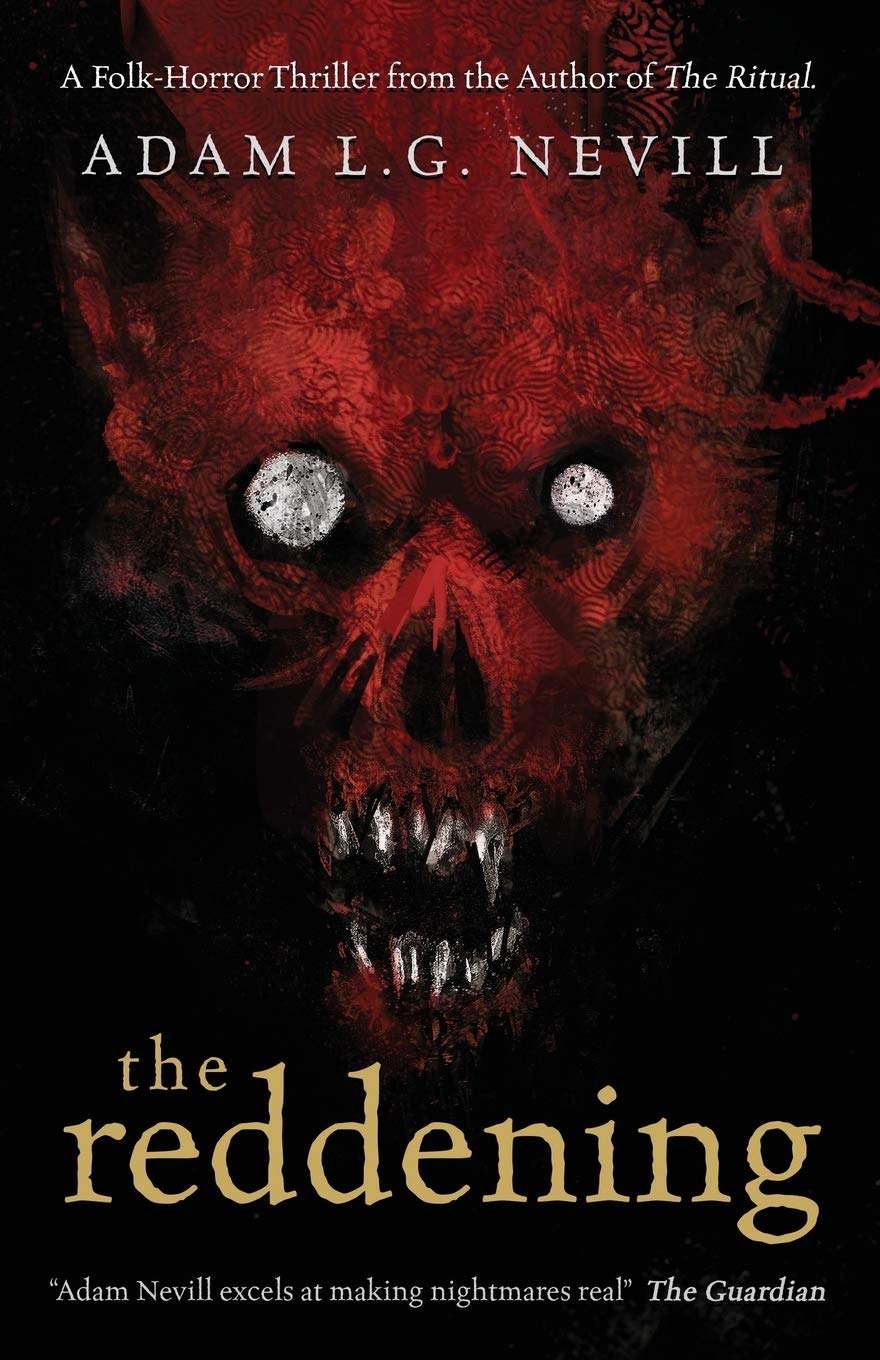
A journalist and the locals around her get drawn into what a cave system in south Devon contains, and into what the people near it have been continuing since deep prehistory.
It’s the most thoroughly researched horror novel of the last decade. The prehistory is real, the archaeology is real, and Nevill’s argument is that the deep past isn’t metaphorically present in the English landscape but literally so, and that some of it never stopped.
Long, patient, and the most convincing depiction of a surviving cult anyone has written. This Is Horror’s verdict was physical: “It grips from the start and holds you down.” Cemetery Dance kept it simpler: “Adam Nevill is a special writer.”
His own term for what he does is folk horror, and this is the fullest statement of it. It won his fourth August Derleth Award, the first for a self-published novel, which quietly proved the Ritual Limited point.
No One Gets Out Alive (2014)

Stephanie is twenty-something, broke, in Birmingham, and takes a room in a house on Edgware Road because it’s the only thing Stephanie is twenty-something, broke, in Birmingham, and takes a room in a rotting house because it’s the only thing she can afford and the deposit is low.
The landlord is Knacker McGuire. His cousin lives there too. The rooms are damp, the other tenants are women who don’t come out, and there are noises from the room next door.
The first half is one of the most sustained pieces of dread in modern British horror, and there’s almost nothing supernatural in it. It’s about being a young woman with no money and nowhere else to go, in a house owned by a man who has worked out exactly how little power she has, and Nevill is unbearable about how slowly the trap closes.
The second half turns and becomes something else entirely, and readers divide on whether that’s a betrayal. Publishers Weekly, approving overall, still found the 640 pages “an unnecessary hundred pages” too long, which is the common complaint.
It won the August Derleth Award, and Netflix filmed it in 2021, relocated to Cleveland.
Last Days (2012)

Kyle Freeman is a documentary maker with no money who gets offered an unusually well-funded commission to make a film about the Temple of the Last Days, the cult that ended with nine deaths at its Arizona headquarters in 1975.
He’s sent to the sites in a specific order, with specific interviews arranged, and things start being filmed that weren’t there when he shot them.
The found-footage structure is why it works. Nevill writes the technical process properly, the cameras, the lighting, the review of the rushes, and the horror arrives on the playback rather than in the room.
The cult material draws on Charles Manson and the Process Church, and it’s well researched. Kirkus filed it as “well-crafted paranormal horror,” and it won the August Derleth Award.
The general verdict runs that the last act over-explains and that the first two thirds are superb. It’s the most conventional of his novels structurally, and the best entry point for a reader who wants pace.
The Rest
Banquet for the Damned (2004)

His first novel, published by PS Publishing in 2004 and largely unavailable until it was reissued, and it’s a considerably better debut than most.
St Andrews, Scotland. A failing musician and a postgraduate researcher arrive separately in the town, where an occult scholar called Eliot Coldwell wrote a notorious book about the occult decades ago and now teaches, and where students have started disappearing from their beds.
What’s taking them is the best thing in it, and it’s drawn from folklore rather than invented.
The M. R. James debt is explicit, and Nevill has said so himself. The academic setting, the scholar who has read too far, the thing that follows, and the coastal town in winter are all Jamesian, and Nevill is doing them at novel length.
It’s rougher than his later work, and the university satire is heavy-handed. For readers who like the folklore strand, this is where it starts.
Apartment 16 (2010)

Barrington House is a Knightsbridge mansion block where a flat has stood empty for fifty years, and a night porter starts hearing things in it. The artist who lived there, Felix Hessen, died mysteriously in the building decades ago, and his paintings were an attempt to depict something he had seen.
Nevill worked those buildings himself, nightwatchman and day porter from 2000 to 2004, and the below-stairs texture is the real thing.
The trades were rough on it: Publishers Weekly filed it under “formulaic horror novel.” The Guardian, by way of the publisher’s jacket, had him “Fast becoming Britain’s answer to Stephen King,” and the readers who rate it, rate it for the Hessen material and the porter’s-eye view of money. It picked up his first August Derleth nomination.
House of Small Shadows (2013)

Catherine is a valuer for an auction house, sent to catalog a collection at a remote house in the Welsh marches, where an elderly woman keeps the taxidermy and puppets made by her uncle, who staged theatrical performances with them.
The doll and taxidermy material is genuinely unpleasant, and the Red House is one of the better invented buildings in British horror. Kirkus: “Nevill’s talent for horror resonates ominously in every scene.”
It runs slower than The Ritual, and readers who want pace should start elsewhere. Another Derleth nomination.
Lost Girl (2015)

The outlier: a near-future thriller set in a 2050s Britain collapsing under heat and migration, following a father hunting the men who took his four-year-old daughter from the front garden two years earlier.
The horror is mostly the world itself, and the Lancashire Evening Post called it “a gripping, multi-faceted thriller.” A Derleth nominee, the least-known of the Pan novels, and the one to read if you want to see him work without the supernatural carrying any weight.
Under a Watchful Eye (2017)

A writer’s unwelcome former friend arrives at his coastal house, having spent years inside an organization devoted to astral projection, and having brought something back with him.
The cult material is good, the middle sags, and the trades were at their coolest: Publishers Weekly found it “generates few scares.” It was his last book for Pan Macmillan, and in hindsight the clean break reads like the right call for both sides.
Cunning Folk (2021)

Short and vicious. Tom buys a wreck of a house at auction that he can’t afford to renovate, moves his wife and small daughter in, and the elderly couple next door, the Moots, begin a campaign against them that starts with property boundaries and becomes something else.
The neighbor dispute is what makes it. Everything in the first half stays legally deniable, petty and infuriating, and Nevill draws directly on the ordinary British experience of a boundary argument before he lets the witchcraft in.
Cemetery Dance’s advice stands: “Just wait until you get to the chainsaw scene.”
The Vessel (2022)

A care worker, Jess, takes a job tending an elderly woman at a house called Nerthus House, and brings her young daughter into range of what lives there.
It began life as one of his film scripts and was novelized, which shows in the best way: short, visual, and built in scenes. Cemetery Dance: “Nevill doesn’t hold back on this one.”
All the Fiends of Hell (2024)

The apocalypse, finally. Blood-red skies, an infestation of predatory things that never originated on earth, and an ordinary man named Karl who survives the first night and has to keep surviving.
It’s his biggest canvas since Lost Girl, and Cemetery Dance framed the ambition exactly: “This might be his Swan Song or The Stand.” After several quieter books, the scale is the point.
Monumental (2026)

The new one, published April 2, 2026, billed as a novel of pagan terror: six kayakers on a private Devon estuary, roughly fifteen hours, and a creature that is enormous, ancient and visible, which for Nevill is a departure in itself.
HorrorDNA found it “quickly develops into a solid page-turner” while granting the kayakers are “none of whom are particularly likable,” which readers of his group-under-pressure books will recognize as a feature.
Some Will Not Sleep (2016)
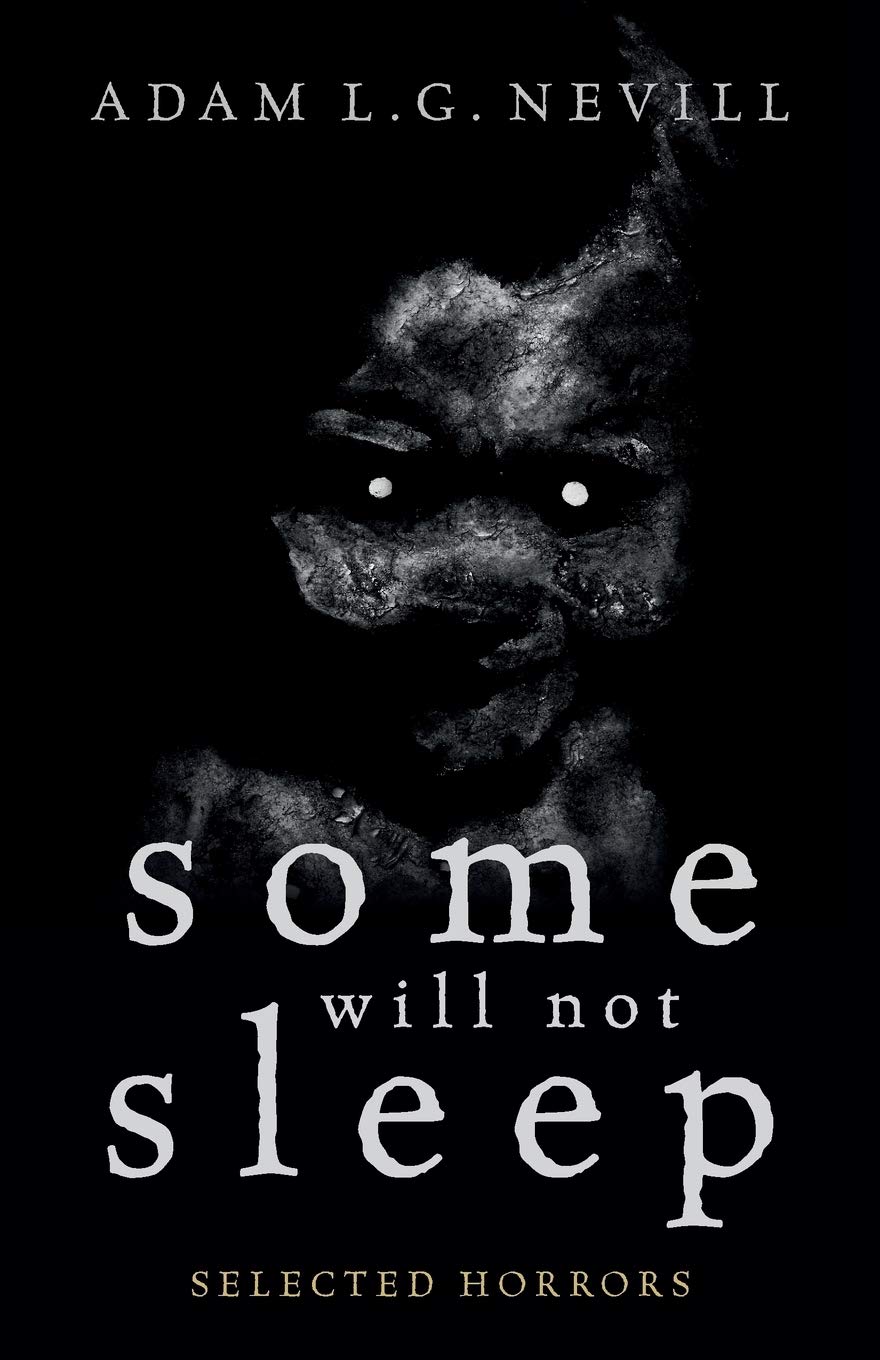
His first collection, and it won the British Fantasy Award for best collection in 2017.
Eleven stories, several written early and published in small-press anthologies across two decades, and they’re where the influences show most clearly.
“Where Angels Come In” is the best of them, and it’s the one people name. Two boys break into a derelict house in a Midlands town, something in it takes one of them, and the survivor tells it decades later. It’s the closest Nevill has come to writing a story in the M. R. James mode.
“Yellow Teeth” is a flatmate who won’t leave. “Pig Thing” is a family in New Zealand and something in the bush.
Hasty for the Dark (2017) is the second collection, and Wyrd and Other Derelictions (2020) is the third and strangest. This Is Horror on the first: “They are beautifully crafted, original and complete works.”
It was the founding release of Ritual Limited, his own imprint, which is why the later books are harder to find in shops and easy to get directly.
Adam Nevill: Deep Dive and FAQ
What Runs Through the Books
Place before monster. The forest, the coast, the block, the estuary: the environment is doing the grinding before anything supernatural arrives, and the research is why the dread holds.
Poverty as the trap. His protagonists are broke, precarious, or one bad invoice from it, and the horror usually enters through the only door they could afford. Nobody in British horror writes money this well.
And the old thing continuing. Not returning: continuing. The cults in Last Days and The Reddening, the folk in Cunning Folk, the presence in The Ritual never went away, and the books are about the moment the modern world notices.
On Screen
The Ritual (2017): directed by David Bruckner, produced by the Imaginarium, a UK cinema release through eOne, and then Netflix bought it for the rest of the world and put it up in February 2018, which is how most people met it. Rafe Spall leads. It compresses the novel’s second half into something faster and smaller, and it works on its own terms.
No One Gets Out Alive (2021): a Netflix original, directed by Santiago Menghini, relocated from Birmingham to Cleveland, with Cristina Rodlo as an undocumented immigrant in the house, which keeps the novel’s power mechanics intact while changing the passport.
Both came through the Imaginarium, and his own site says more is in development there without naming titles, so treat anything beyond these two as rumor.
Questions About the Adam Nevill Books
Why Is He Self-Published Now?
By choice, after a decade with Pan Macmillan: he founded Ritual Limited (collections from 2016, novels from The Reddening in 2019) for control over what he writes and when. The fourth Derleth Award, won by a self-published novel, settled whether the quality traveled.
How Different Is the Ritual Film From the Book?
The first half is remarkably faithful, the second half is a different and simpler invention. Most readers rate the book’s back half stranger and more ambitious, and the film’s tighter.
What’s the New Adam Nevill Book?
Monumental, published April 2, 2026: six kayakers, a Devon estuary, and a creature he lets you see.
What’s the Most Frightening One?
No One Gets Out Alive by a wide margin of reader testimony, and the first half barely needs the supernatural to do it.
Where Do the Collections Fit?
Some Will Not Sleep won the British Fantasy Award and holds his best single story, “Where Angels Come In.” Read it after two or three of the novels, when you can see the influences being metabolized.
Where to Start
Everything else worth reading is on my best horror books list. The rural dread he keeps returning to is on my folk horror list.