Bram Stoker wrote twelve novels and you have heard of one of them, which is roughly the correct ratio.
He was a Dublin civil servant, then a theater critic, then for twenty-seven years the business manager of the Lyceum Theatre in London, running the affairs of the actor Henry Irving, who was the most famous man on the English stage and who treated him as a highly competent employee. Stoker wrote in the gaps. He researched Dracula over seven years, in libraries, on holiday in Whitby, working from Transylvanian travel books he had read rather than been to.
It is the only one that matters, and it matters enormously. The rest of the Bram Stoker books are worth knowing about, occasionally worth reading, and in one case genuinely notorious for reasons that have nothing to do with quality.
He died in 1912, largely forgotten, and the vampire industry his novel created has now run well over a century without him.
I haven’t read these. What follows is the critical consensus.
Fiction by René Rehn


Dracula (1897)

The novel everyone has an opinion about and comparatively few have read.
It is not written the way people expect. There is no omniscient narrator and no gothic voice. It is assembled entirely from documents: journal entries in shorthand, letters, telegrams, ships’ logs, newspaper cuttings and phonograph recordings, transcribed and collated by the characters themselves. It is a document thriller with the most advanced technology of 1897 all through it, and Mina Harker is a typist who makes the case solvable by putting the paperwork in order.
The shape of it is well established and worth knowing before you start. The first four chapters, Jonathan Harker’s journal at the castle, are as good as gothic horror has ever been: the coach ride, the wolves, the three women, the crawl down the wall face-first. Then the action moves to England and the middle third sags noticeably under the weight of Lucy’s illness and Van Helsing’s speeches. Then it recovers for a chase across Europe.
Dracula himself appears in remarkably few scenes, which is the single most important thing about him and the thing every adaptation gets wrong. He is offstage for most of the novel, and the terror is largely a matter of consequences arriving with no visible cause.
The invasion anxiety is not subtle and it is genuinely part of the book: an aristocratic foreigner arrives by ship, buys English property through English solicitors, and begins consuming English women. So is the anxiety about female sexuality, which is what the Lucy material is actually doing.
More on vampire books and gothic fiction.
Dracula’s Guest

Two things worth knowing before you buy.
The text is stable and there is no scholarly controversy, so any reputable edition will do. The Penguin Classics, Oxford World’s Classics and Norton Critical editions all carry proper notes, and the Norton includes contemporary reviews and source material, which is the most useful of the three if you want the context.
The second thing is Dracula’s Guest. It is a short story published in a posthumous 1914 collection assembled by Stoker’s widow Florence, who described it as a chapter cut from the novel before publication because the book was too long.
That claim has been disputed for a century. The style is different, the unnamed narrator does not obviously fit Harker, and several scholars think Florence assembled it from unrelated material to sell a collection.
It is genuinely good regardless. A traveler in the countryside outside Munich on Walpurgis Night, a deserted village, a tomb, and a wolf. Read it after the novel.
The Rest of the Novels
The other Bram Stoker books run to eleven novels and several collections, and almost nobody reads any of them. Two are worth the time.
The Jewel of Seven Stars (1903)

His second-best novel and the one that founded the mummy story as a form.
Abel Trelawny, an Egyptologist, is found unconscious beside his safe with his wrist torn open, and cannot be woken. His daughter Margaret calls in a young barrister, and the household settles into a vigil around a man who will not wake while the objects he has collected sit in the room with him.
The mummy is Queen Tera, and Trelawny has been preparing for years to attempt her resurrection.
What makes it work is the domestic siege. Most of the novel is people sitting up at night in a London house, taking watches, and the horror is that Trelawny’s collection is not inert.
The ending is the famous problem. The 1903 original ends catastrophically for almost everybody. Stoker’s publisher required a happier one for the 1912 reissue, and that version circulated for decades. Buy an edition with the 1903 text, which most modern ones now use, and check.
The Lady of the Shroud (1909)

Marketed as a vampire novel by his publisher and it is not one, which is the reason it disappoints most people who seek it out.
Rupert Sent Leger inherits a fortune on condition he lives for a year at a castle in the Land of the Blue Mountains, a fictional Balkan state. A woman in a shroud starts visiting him at night, wet and cold, and asks to be let in and warmed.
She is not undead. The explanation is political and Stoker gives it about two thirds of the way through, and everything supernatural in the book evaporates with it.
What the novel is actually about is the Balkans, modernization and empire. Rupert arms the country, industrializes it, defeats the Turks, and is made king, and the last third is a straight-faced imperial adventure written by an Irishman about a small nation acquiring the means to defend itself.
It is a strange book and it is not good, and the first hundred pages are genuinely atmospheric.
The Lair of the White Worm (1911)

His last novel, published a year before he died, and it is genuinely incoherent.
Adam Salton comes from Australia to inherit an estate in Derbyshire and finds an ancient conflict between local landowners. Lady Arabella March is a woman who is also a prehistoric white worm of enormous size living in a hole on her property, and this is not treated as a metaphor.
There is also a mesmerist, a black servant character written in terms that are difficult to read now, a kite used to frighten pigeons, and a plot involving mongooses.
Nothing connects. Characters are introduced and dropped, the worm’s rules change, and the resolution involves dynamite and a storm.
Stoker was ill when he wrote it, possibly from the syphilis some biographers believe killed him, and it shows on every page.
The 1925 edition cut it by a third and is more coherent and no better. Ken Russell filmed it in 1988 as a comedy, which was the correct decision.
The Snake’s Pass (1890) and The Mystery of the Sea (1902)

The two that are not horror at all, and they are here because they show what he actually was.
The Snake’s Pass is his first novel and the only one set in Ireland. A young Englishman arrives in Connemara, hears the local legend about Saint Patrick driving the King of the Snakes into a shifting bog, and gets involved in a land dispute, a treasure hunt and a romance.
It is a regional novel about land ownership, absentee landlords and Irish poverty, published during the Land War, and Stoker knew exactly what he was writing about. The bog itself, which moves and swallows things, is the best thing in it and is a genuine geological phenomenon.
The Mystery of the Sea is a Scottish adventure with cryptography, the Spanish Armada, second sight and a kidnapping, and it is considerably longer than it needs to be.
Neither is essential. The Snake’s Pass is the more interesting of the two and has been reissued with proper scholarly apparatus.
The Nonfiction Curiosity
One of the Bram Stoker books is not fiction at all, and it is responsible for a conspiracy theory that has outlived everything else in it.
Famous Impostors (1910)
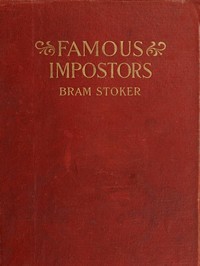
His non-fiction, published in 1910, and it is on this page because of one chapter.
The book is a survey of historical frauds: pretenders to thrones, false messiahs, women who lived as men, magicians and charlatans, written in a popular register for a general readership.
The chapter everybody knows is the last one, which sets out the Bisley Boy story. The claim is that Elizabeth I died as a child at Bisley in Gloucestershire while in the care of a governess, that the household substituted a local boy to avoid Henry VIII’s anger, and that the boy went on to reign for forty-five years.
Stoker presents it seriously and it is nonsense, and it has been circulating ever since largely because he wrote it down.
He spent twenty-seven years as business manager to the actor Henry Irving at the Lyceum Theatre in London, which is the day job that funded all of this, and it is where the fascination with performance and impersonation comes from.
Where to Start
Read Dracula, and go in knowing three things: it’s built from documents, the castle section is the best part, and the middle sags. Push through it.
Then read “Dracula’s Guest”, which takes twenty minutes and is in most editions.
If you want a second novel, read The Jewel of Seven Stars, and make sure you have the 1903 ending.
And if you want to understand why he isn’t ranked with the writers he influenced, read The Lair of the White Worm, which answers the question in about fifty pages.
For the wider canon, see my horror classics page. Everything Dracula set running is on my vampire books list.