Grady Hendrix writes horror novels that are funny for about a hundred pages and then stop being funny, and the switch is always deliberate.
That’s the shape of nearly all the Grady Hendrix books. A premise that sounds like a joke, delivered with real comic timing, and then somewhere around the midpoint the book turns and you realize the joke was load-bearing. A haunted IKEA. A book club that has to deal with a vampire. A possessed guitar. A demon in an exorcism narrated by teenage girls in 1988.
Underneath the gimmicks, the Grady Hendrix books keep writing about the same thing, which is who gets believed. His protagonists are almost always women or teenage girls whose accounts are dismissed by the men around them, and the horror is generally that they are correct and it doesn’t help.
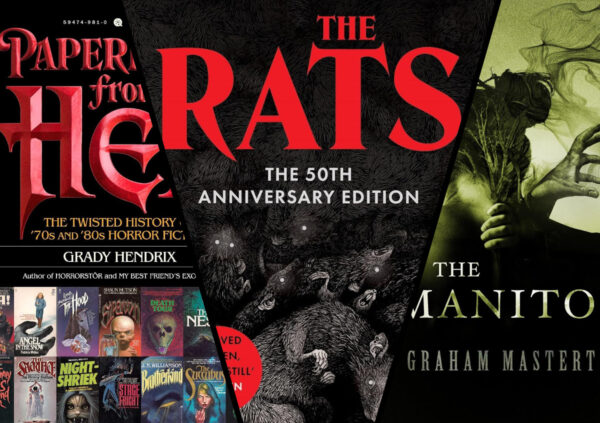
He also wrote the book that recovered an entire era. Paperbacks From Hell won the Bram Stoker Award for Non-Fiction and is directly responsible for a dozen forgotten seventies and eighties novelists being back in print.
One of these I’ve read. I’ve said which.
Fiction by René Rehn


The Short Version
Read The Southern Book Club’s Guide to Slaying Vampires. It’s his best novel and the tonal switch works better there than anywhere else.
Read Paperbacks From Hell regardless of whether you read the fiction, because it’s the best book about horror publishing that exists.
And know that Horrorstör is the one people start with and it’s not the best one.
The Nonfiction
Paperbacks From Hell (2017)

An illustrated history of the American horror paperback boom, roughly 1974 to 1991, with several hundred cover reproductions and a genuinely serious critical argument underneath the jokes.
It’s organized by subject rather than chronology, so there are chapters on satanic children, animals in revolt, real estate, medical horror and the Nazi obsession, and each traces how a fad started and burned out.
The critical observation that matters most is about class: Jackson and Matheson sent psychic investigators to abandoned mansions, and the boom sent families who couldn’t afford anywhere better and made the horror about the mortgage.
It won the Bram Stoker Award for Non-Fiction. Buy it as an object as much as a book. Much more on paperbacks from hell.
The Novels
The Grady Hendrix books split between the Charleston ones, which are the best, and the high-concept ones, where the premise sometimes outruns the execution.
The Southern Book Club’s Guide to Slaying Vampires (2020)

Charleston, the early 1990s. A book club of housewives who read true crime, and a charming new neighbor who has moved in with his elderly aunt and keeps unusual hours.
The tonal switch is the sharpest he has managed. It is very funny for about a third of the book and then it is not funny at all, and the moment it turns is a set piece involving rats that a great many readers report having to put down.
The real subject is which women in that town are considered worth protecting. The vampire is preying on children in the Black neighborhood across the bridge, and nobody with any power cares until he moves closer. The husbands’ response to their wives’ investigation is the most genuinely upsetting material in the novel and it is entirely non-supernatural.
Also on southern gothic and vampire books.
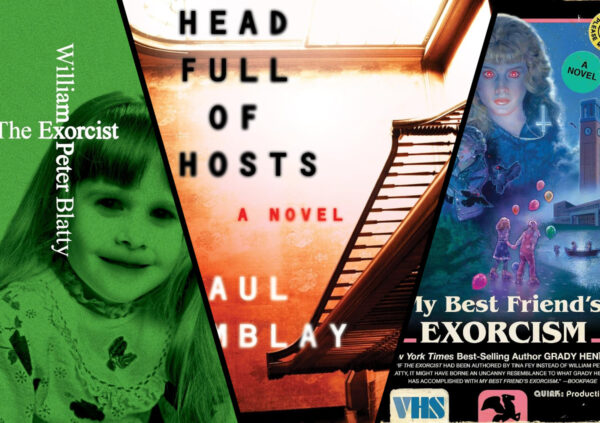
My Best Friend’s Exorcism (2016)

Abby and Gretchen have been best friends since they were ten, when Abby’s roller-skating birthday party was the one nobody came to and Gretchen turned up anyway.
It is 1988 in Charleston, they are sixteen, they take acid at a lake house, Gretchen wanders off into the woods alone, and she comes back wrong.
The period detail is observed rather than referenced, which is the whole difference between affection and pandering. The mixtapes, the E.T. bedsheets, the Christian aerobics ministry, and the specific social machinery of a girls’ school where reputation is the only currency. Every chapter is titled after an eighties song.
What is in Gretchen works by isolation. It turns the other girls against Abby, produces evidence that discredits her, gets her expelled, and uses the school’s own procedures to do it.
The eating disorder material in the last third is genuinely bleak, and the exorcist is a Christian bodybuilder with a van, played entirely straight.
Also on possession books.
How to Sell a Haunted House (2023)

Louise flies back to Charleston after her parents die in a car accident, to bury them and settle the estate with her younger brother Mark, whom she cannot stand.
Their mother made puppets. There are hundreds of them in the house, she ran a ministry with them, and one of them is Pupkin.
The haunted house material is genuinely nasty and the puppet sequences are the most sustained frightening writing Hendrix has done.
But the book is really about the siblings. Louise is the responsible one who left, Mark is the failure who stayed, and each has a completely different account of the same childhood, and the estate settlement gives them a reason to litigate all of it.
Hendrix wrote it after losing his own parents and has said the grief material came first.
The consensus objection is that the brother-sister arguments run long and that the puppets are what people came for.
Witchcraft for Wayward Girls (2025)

Florida, 1970. Fifteen-year-old Fern is sent by her father to a home for unwed mothers, where the girls are given new names, are not permitted to contact anybody, and will hand over their babies and go home as though nothing happened.
Then a librarian gives one of them a book about witchcraft.
The historical material is the reason it works and Hendrix researched it properly. These homes existed in large numbers, the coercion was systematic, the adoptions were frequently not voluntary in any meaningful sense, and roughly a million and a half American women went through the system.
So the witchcraft is a genuine offer of power to girls who have none, and the novel is honest that the price is real.
The childbirth sequences are the most difficult thing he has written and they are not the supernatural parts.
His most serious book, a Bram Stoker finalist the year The Buffalo Hunter Hunter swept, and his readers widely call it his best.
Horrorstör (2014)

His breakout, and the one that gets recommended first because the object is irresistible: a novel designed as an IKEA catalog, with product illustrations that get progressively wrong.
Staff at a furniture superstore agree to spend a night in the building to find out what’s damaging the stock.
I’ve read this one and it was a disappointment. I went in expecting liminal horror, the specific dread of a vast retail space after closing, and what I got was a fairly conventional haunted-building story with a nineteenth-century prison workhouse underneath it. The design conceit is genuinely brilliant. The novel inside it is not doing anything the design promises.
It’s the weakest of the ones I’d point people at, and it is unfortunately the one most people meet him through.
We Sold Our Souls (2018)

Kris Pulaski was the guitarist in a metal band called Dürt Würk that never made it, and she now works the night desk at a Best Western in Pennsylvania.
The singer, Terry Hunt, went on to enormous success with a different project. Kris has always assumed she was cheated on a contract, and then she works out that the contract was real and that the signing was literal.
The music writing is the reason to read it. Hendrix knows metal properly, the touring detail is accurate and unglamorous, and Kris is a middle-aged woman who is genuinely good at one thing and has had no use for it in twenty years.
The road trip structure is loose and the conspiracy plot is thinner than his usual work.
What it does better than anything else in his catalog is anger. The novel is furious about what the industry does to people, and the last act at a festival is a genuine set piece.
The Final Girl Support Group (2021)

Six women who survived massacres decades ago meet monthly in a group therapy session run by a psychiatrist, and their films made a great deal of money for other people.
Then one of them is killed and Lynnette, who narrates, assumes she is next and runs.
The concept is superb, and no book of his gets named as underachieving more often. Lynnette is paranoid to a degree that makes her a difficult narrator, most of the novel is a chase, and the group dynamics that the premise promises get less space than the running.
What it does well is the aftermath. These women are in their fifties, they have been monetized, their trauma is intellectual property, and there is a whole industry of conventions and superfans built on the worst nights of their lives.
The slasher-franchise parodies interleaved between chapters are very funny.
Consensus rates it below the Charleston books.
Where to Start
Read The Southern Book Club’s Guide to Slaying Vampires. It’s the best novel and it shows you exactly what he does.
Read Paperbacks From Hell whether or not the fiction appeals, because it’s a better book than any of the novels and it will give you thirty new things to read.
If the book club one works, read Witchcraft for Wayward Girls next, which is the serious one.
And skip Horrorstör unless the design conceit is what you’re after, because the novel underneath it is the least interesting of the Grady Hendrix books.
For the wider canon, see my horror classics page. The era he catalogued is on my Paperbacks from Hell page.