Graham Masterton has published well over a hundred books, was an editor at the British Penthouse before he wrote any of them, and is more popular in Poland than anywhere else on earth.
That is not a joke. He has a genuine cult following in Poland, a bronze statue of himself in Wrocław, a Polish literary prize for prison inmates named after him, and a Polish horror award on his shelf. In Britain and America he is a paperback horror name from the seventies boom who kept going long after most of his contemporaries stopped.
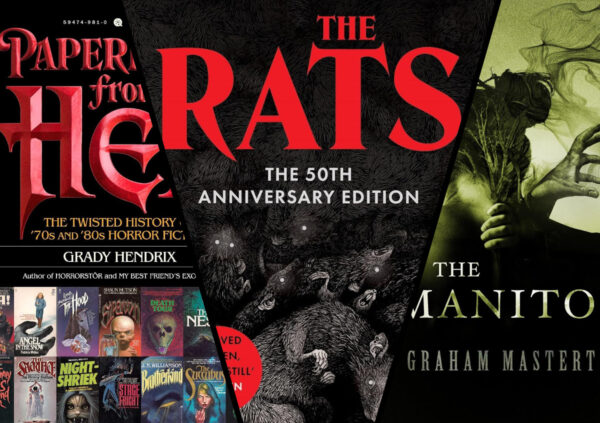
His debut is still the one people mean, and it shapes how the Graham Masterton books are remembered. The Manitou in 1975 was a huge success, was filmed with Tony Curtis, and established the formula he has used ever since: an ancient non-European spirit, usually Native American, breaks into the modern world, and a wisecracking skeptic has to deal with it.
Which brings us to the problem, and this page is not going to skirt it. The Native American material in The Manitou and its sequels is appropriated, inaccurate and frequently offensive, drawing on a hodgepodge of unrelated traditions treated as interchangeable exotica. That was the standard of the period and it is not defensible now. The books are historically significant and a reader should know what they are buying.
He is also, at his best, a genuinely inventive writer of set pieces, and the horror sequences in the good ones are as strong as anything from the boom.
I haven’t read these. What follows is the critical consensus.
Fiction by René Rehn


The Short Version
Read The Manitou for the historical importance and read the note above first.
Read Charnel House or The Devils of D-Day if you want the ones that hold up best.
And know that a catalog that size means enormous variance.
The Main Graham Masterton Books, in Order
| Year | Book | What it is |
| 1975 | The Manitou | The famous one |
| 1978 | Charnel House | The breathing house |
| 1978 | The Devils of D-Day | The best idea |
| 1988 | Mirror | The Hollywood one |
| 1989 | Walkers | The asylum one |
| 1992 | Prey | The best one |
| 1997 | The Chosen Child | The Warsaw one |
| 2013 | White Bones | Katie Maguire #1 |
| 2023 | What Hides in the Cellar | Patel & Pardoe #4 |
| 2024 | Pay Back the Devil | Katie Maguire #12 |
| 2025 | House of Flies | Patel & Pardoe #5 |
| 2026 | Suffer in Silence | Katie Maguire #13, just out |
Where to Start
Read Prey first. It’s the novel his readers rank highest, the restraint is real, and it mostly sidesteps the problem that runs through the famous ones.
Read The Devils of D-Day for the best idea he ever had.
If you want the famous one, read The Manitou, knowing what you are getting.
And approach the Graham Masterton books with the sheer volume in mind, because that many books written at that pace produce a very wide range, and the recommendations above are the ones that consistently hold.
The Life, Briefly
Edinburgh, 1946, and the pre-horror career explains everything about the prose: deputy editor of Mayfair at twenty-one, executive editor of the British Penthouse at twenty-four, and then a sideline in sex manuals, led by How To Drive Your Man Wild In Bed, that sold around two million copies and funded the fiction. A man trained to deliver exactly what the reader came for, fast, never really retrains.
The Poland story is the strangest second act in horror. In 1989 he became the first Western horror writer published in post-war Poland, an entry arranged by his wife and agent Wiescka, who died in 2011. The country adopted him outright: a quarter-million copies of the sex manual alone, repeated visits, a national short-story prize he founded for prison inmates, the Złoty Kościej award for best horror novel in 2023, and, since 2021, a bronze dwarf statue of him in Wrocław, holding an open book with a shaman rising out of it. No other writer on this site is a garden gnome anywhere.
The honors at home came late and real: an Edgar nomination for Charnel House back in 1979, France’s Prix Julia Verlanger in 1988 (its only non-French winner), and the Horror Writers Association’s Lifetime Achievement Award, presented at StokerCon 2019. He turns eighty with the production line still running: a new Katie Maguire novel arrived in October 2026.
The Essential
The Manitou (1975)

Karen Tandy has a tumor growing on the back of her neck, and it’s growing faster than a tumor should, and there’s a fetus inside it. It is the reincarnating spirit of a Native American medicine man dead for centuries, and he is coming back angry.
The premise stands among the great high-concept horror ideas, and the body horror in the first third is excellent. It sold enormously, was filmed in 1978 with Tony Curtis, Susan Strasberg and Burgess Meredith, and it made his career.
The rest of it is the problem described above. Harry Erskine, the fake fortune teller protagonist, is good company, and the resolution involves a great deal of invented spirituality that does not survive scrutiny.
The retrospective verdict hasn’t changed much since Will Errickson filed it as “tasteless and outrageous fun,” and his longer Tor retrospective called it “a gory, pulpy, funny and even ridiculous read,” which covers both the appeal and the warning.
Five sequels followed across forty years, of which Revenge of the Manitou is the best.
Also on paperbacks from hell.
Charnel House (1978)

A San Francisco sanitation official is called out by a man who says his house is breathing.
It is, and what’s inside is the demon Coyote, and the novel is about a Native American entity taking possession of a building and using it to reach the city.
The premise is the same problem as The Manitou and it is worth stating once. Masterton uses Indigenous belief systems as sources of monsters, the research is thin, and the entities are treated as generic threats rather than as parts of living traditions. It was standard in 1978 and it is not defensible now.
What the book does well is the house. The breathing, the walls, the sense of an entire structure being alive and hostile, is genuinely well handled and it is one of the better haunted buildings of the period, good enough to earn an Edgar Award nomination for best paperback original in 1979.
Kirkus, meeting the 2002 reissue, shrugged “Raises a few goose bumps, but mostly run-of-the-chill,” which is the fair modern verdict.
Read it as a period artifact.
The Devils of D-Day (1978)

An American cartographer mapping Normandy finds a sealed tank that has been sitting in a field since 1944 and that the local villagers will not go near.
Inside it is a demon. Thirteen were bound into thirteen tanks by an occult unit working with the Allies, deployed at D-Day, and this one was never released.
The premise is the best Masterton had. An Allied occult program, demons used as weapons, and the paperwork to prove it, and the novel treats the military bureaucracy of it seriously for a while.
The Nazi occult material was already a cliche by 1978 and Masterton’s inversion, in which the Allies are the ones dealing with demons, is genuinely fresh.
The last act reverts to a conventional confrontation.
The general verdict calls it his most inventive early novel, and adds that the idea deserved a better writer, which is the recurring verdict on him.
More like it on my historical horror list.
Prey (1992)

David Williams takes a job restoring Fortyfoot House on the Isle of Wight, a former Victorian orphanage, and brings his young son with him for the summer.
There are rats in the attic. There is also something that is not a rat, moving in the roof space, and a Victorian photograph of the house showing a man who should not be there.
The house exists in two times simultaneously and Williams can move between them.
It’s Masterton at his best, and the reason is restraint. The thing in the attic is glimpsed rather than described for most of the book, the Victorian sections are properly researched, and the son gives the danger real weight.
Brown Jenkin is drawn from Lovecraft’s The Dreams in the Witch House and Masterton is open about it.
By broad agreement it’s his single best novel, and it’s the one to start with.
The Rest Worth Naming
The Chosen Child (1997)

The Polish readership earned a Polish novel, and this is it: Warsaw, a creature in the sewers and the drainage system beneath the city, tied to what happened during the war and the uprising, and the historical material is the best-researched thing he has written.
The novel deals directly with the destruction of Warsaw in 1944 and with what was left underneath it, and he treats that material with considerably more care than he treats Native American belief, which is worth noting on the same page.
Walkers (1989)

An abandoned asylum being demolished, and the patients who disappeared from it decades ago are still inside the walls, literally, and they come out through them.
The image of people walking out of solid brick is the best thing in it, and it demonstrates the pattern with him: a strong premise executed at speed.
Mirror (1988)

A Hollywood story. A collector buys the mirror that hung in the dressing room of a child star who was murdered in 1939, and the mirror is a passage, and what is on the other side wants out and has been waiting fifty years.
The Golden Age Hollywood material is well done and Masterton knows the period. Fast, nasty, and better than most of what surrounds it in the catalog.
The Katie Maguire series (2013 onward)

Crime fiction set in Cork, now running to thirteen novels, and it is where the second half of his career went.
Detective Superintendent Katie Maguire runs a murder squad in an Irish city, and the novels deal with organized crime, the Church, historical institutional abuse, human trafficking and the specific way Irish institutions protected themselves.
The Magdalene laundries and the mother and baby homes appear repeatedly, and Masterton is not gentle about any of it.
The violence is the horror writer’s violence and it is considerably more extreme than the crime genre usually carries, which is either the appeal or the objection. Publishers Weekly has reviewed the series both ways, praising one entry with “Horrors abound in Masterton’s gripping fifth crime novel” and filing another under “stomach-churning violence and undistinguished prose,” and both verdicts are accurate to different volumes.
The series came out of his five years living in Cork, in the years when the abuse revelations dominated Irish public life. The first book, White Bones (2013), reworks an earlier novel, and the newest, Suffer in Silence, arrived in October 2026.
No supernatural content.
What he’s publishing now
The pace has never dropped. Alongside Katie Maguire runs the Patel and Pardoe crime series, London-set and stranger, whose recent entries are What Hides in the Cellar (2023) and House of Flies (2025), the latter built on a murdered clergyman, vanishing corpses and a figure on CCTV that moves without using its legs, which is the old horror instinct smuggled into a police procedural.
A collection of his erotic horror stories is even being reissued in 2026, and nothing about the catalog suggests a man planning to stop.
Graham Masterton: Deep Dive and FAQ
What Runs Through the Books
The set piece as the unit of composition. Masterton builds books out of individually engineered shocks, a breathing wall, a tumor with a pulse, men stepping out of brick, and the connective tissue is whatever gets you to the next one.
Speed as a style and a cost. The man who edited skin magazines at twenty-four writes to deliver, and the recurring critical verdict, that the ideas deserved more patient execution, has followed him for fifty years without ever slowing him down.
And the two readerships. In English he is a boom-era paperback name with a problem catalog and a few real keepers. In Polish he is an institution with a statue. Few careers have ever split so cleanly down a language line.
Questions About the Graham Masterton Books
Is the Manitou Worth Reading Now?
As history, yes: it’s a foundational boom-era bestseller with a genuinely great body-horror premise. As representation, it’s indefensible, and this page’s note at the top is part of the recommendation. Readers who want Masterton without that weight should start with Prey.
What’s His Newest Book?
Suffer in Silence (October 2026), the thirteenth Katie Maguire novel. On the horror-adjacent side, House of Flies (2025) is the latest Patel and Pardoe book.
Why Is He So Big in Poland?
He got there first: in 1989 he became the first Western horror writer published in post-war Poland, thanks to his wife and agent Wiescka, and he kept showing up for the readership for three decades. The statue in Wrocław and the prison writing prize are the receipts.
Did He Really Edit Penthouse?
The British edition, as executive editor at twenty-four, after Mayfair at twenty-one, and the sex manuals that followed funded the horror career. The Graham Masterton books were always written by a man who knew exactly what the reader ordered.
Where to Go Next
Everything else worth reading is on my best horror books list. He is one of the workhorses of the era on my Paperbacks from Hell page.