Graham Masterton has published something like a hundred and twenty books, was the editor of Penthouse before he wrote any of them, and is more popular in Poland than anywhere else on earth.
That is not a joke. He has a genuine cult following in Poland, has been given an honorary citizenship of Kraków, and several of his novels have been adapted there. In Britain and America he is a paperback horror name from the seventies boom who kept going long after most of his contemporaries stopped.
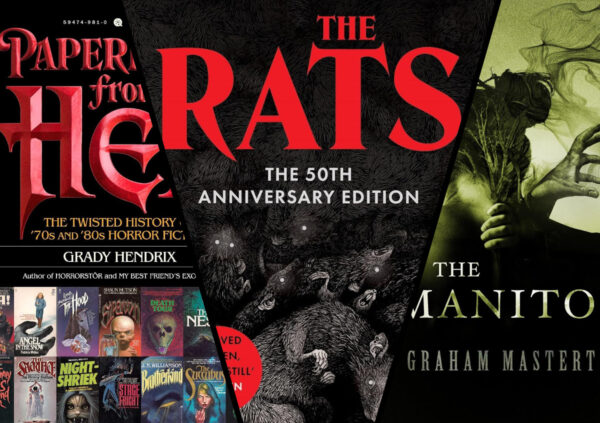
His debut is still the one people mean, and it shapes how the Graham Masterton books are remembered. The Manitou in 1975 was a huge success, was filmed with Tony Curtis, and established the formula he has used ever since: an ancient non-European spirit, usually Native American, breaks into the modern world, and a wisecracking skeptic has to deal with it.
Which brings us to the problem, and this page is not going to skirt it. The Native American material in The Manitou and its sequels is appropriated, inaccurate and frequently offensive, drawing on a hodgepodge of unrelated traditions treated as interchangeable exotica. That was the standard of the period and it is not defensible now. The books are historically significant and a reader should know what they are buying.
He is also, at his best, a genuinely inventive writer of set pieces, and the horror sequences in the good ones are as strong as anything from the boom.
I haven’t read these. What follows is the critical consensus.
Fiction by René Rehn


The Short Version
Read The Manitou for the historical importance and read the note above first.
Read Charnel House or The Devils of D-Day if you want the ones that hold up best.
And know that a hundred and twenty books means enormous variance.
The Essential
The Manitou (1975)

Karen Tandy has a tumor growing on the back of her neck, and it’s growing faster than a tumor should, and there’s a fetus inside it. It is the reincarnating spirit of a Native American medicine man dead three hundred years, and he is coming back angry.
The premise stands among the great high-concept horror ideas, and the body horror in the first third is excellent. It sold enormously, was filmed in 1978 with Tony Curtis, Susan Strasberg and Burgess Meredith, and it made his career.
The rest of it is the problem described above. Harry Erskine, the fake fortune teller protagonist, is good company, and the resolution involves a great deal of invented spirituality that does not survive scrutiny.
Four sequels followed across forty years, of which Revenge of the Manitou is the best.
Also on paperbacks from hell.
Charnel House (1978)

A San Francisco health inspector is called out by a man who says his house is breathing.
It is, and what’s inside is Coyote, out of Navajo belief, and the novel is about a Native American entity taking possession of a building and using it to reach the city.
The premise is the same problem as The Manitou and it is worth stating once. Masterton uses Indigenous belief systems as sources of monsters, the research is thin, and the entities are treated as generic threats rather than as parts of living traditions. It was standard in 1978 and it is not defensible now.
What the book does well is the house. The breathing, the walls, the sense of an entire structure being alive and hostile, is genuinely well handled and it is one of the better haunted buildings of the period.
Read it as a period artifact.
The Devils of D-Day (1978)

A journalist in Normandy investigates a sealed British tank that has been sitting in a field since 1944 and that the local villagers will not go near.
Inside it is a demon. Thirteen were bound into thirteen tanks by an occult unit working with the Allies, deployed at D-Day, and this one was never released.
The premise is the best Masterton had. An Allied occult program, demons used as weapons, and the paperwork to prove it, and the novel treats the military bureaucracy of it seriously for a while.
The Nazi occult material was already a cliche by 1978 and Masterton’s inversion, in which the Allies are the ones dealing with demons, is genuinely fresh.
The last act reverts to a conventional confrontation.
The general verdict calls it his most inventive early novel, and adds that the idea deserved a better writer, which is the recurring verdict on him.
Also on historical horror.
The Rest Worth Naming
The Chosen Child (1997) and the Polish Books

He has an unusual second readership and it is worth explaining.
Masterton is enormously popular in Poland, has lived there, was married to a Polish woman, and has been given a Polish cultural honor. Several of his novels are set there and were written partly for that audience.
The Chosen Child is set in Warsaw and concerns a creature in the sewers and the drainage system beneath the city, tied to what happened during the war and the uprising, and the historical material is the best-researched thing he has written.
The novel deals directly with the destruction of Warsaw in 1944 and with what was left underneath it.
Several later books also use Polish settings and Polish folklore, and he treats that material with considerably more care than he treats Native American belief, which is worth noting on the same page.
The Polish editions are frequently better produced than the English ones.
Prey (1992)

David Williams is an antiques restorer who takes a job renovating Fortyfoot House on the Isle of Wight, a former Victorian orphanage, and brings his young son with him for the summer.
There are rats in the attic. There is also something that is not a rat, moving in the roof space, and a Victorian photograph of the house showing a man who should not be there.
The house exists in two times simultaneously and Williams can move between them.
It’s Masterton at his best, and the reason is restraint. The thing in the attic is glimpsed rather than described for most of the book, the Victorian sections are properly researched, and the son gives the danger real weight.
Brown Jenkin is drawn from Lovecraft’s Dreams in the Witch House and Masterton is open about it.
By broad agreement it’s his single best novel, and it’s the one to start with.
Walkers (1989) and Mirror (1988)

Two from the peak of his output and both are better than most of what surrounds them.
Walkers is an abandoned Pennsylvania asylum being demolished, and the patients who disappeared from it in 1948 are still inside the walls, literally, and they come out through them.
The image of people walking out of solid brick is the best thing in it.
Mirror is a Hollywood story. A collector buys the mirror that hung in the dressing room of a child star who was murdered in 1939, and the mirror is a passage, and what is on the other side wants out and has been waiting fifty years.
The Golden Age Hollywood material is well done and Masterton knows the period.
Both are fast, both are nasty, and both demonstrate the pattern with him, which is a strong premise executed at speed.
The Katie Maguire series (2012 onwards)

Crime fiction set in Cork, running to over a dozen books since 2012, and it is where the second half of his career went.
Detective Superintendent Katie Maguire runs a murder squad in an Irish city, and the novels deal with organized crime, the Church, historical institutional abuse, human trafficking and the specific way Irish institutions protected themselves.
The Magdalene laundries and the mother and baby homes appear repeatedly, and Masterton is not gentle about any of it.
The violence is the horror writer’s violence and it is considerably more extreme than the crime genre usually carries, which is either the appeal or the objection.
They sell well in Ireland and Poland and are barely known in America.
He has said the series came out of living in Cork and out of the abuse revelations that dominated Irish public life in the 2000s.
No supernatural content.
Where to Start
Read Prey first. It’s the novel his readers rank highest, the restraint is real, and it mostly sidesteps the problem that runs through the famous ones.
Read The Devils of D-Day for the best idea he ever had.
If you want the famous one, read The Manitou, knowing what you are getting.
And approach the Graham Masterton books with the sheer volume in mind, because a hundred and twenty books written at that pace produces a very wide range, and the recommendations above are the ones that consistently hold.
Everything else worth reading is on my best horror books list. He is one of the workhorses of the era on my Paperbacks from Hell page.