Alma Katsu spent thirty-odd years as an intelligence analyst for the CIA and the NSA before she wrote horror novels, and the research discipline is the whole reason the books work.
The method across the Alma Katsu books stays consistent: take a documented historical catastrophe, reconstruct it exhaustively from the record, and then introduce one supernatural element and let it do only what the historical evidence can’t already explain. The Donner Party. The Titanic. The Japanese American internment camps.
The consequence is that the history does most of the frightening. By the time anything supernatural becomes undeniable in The Hunger, the wagon train has already demonstrated it doesn’t need a monster, and the novel knows that and uses it.
And she’s unusually good on what people do to each other under pressure, which is presumably not unrelated to the previous career.
I haven’t read these. What follows is the critical consensus.
Fiction by René Rehn


The Short Version
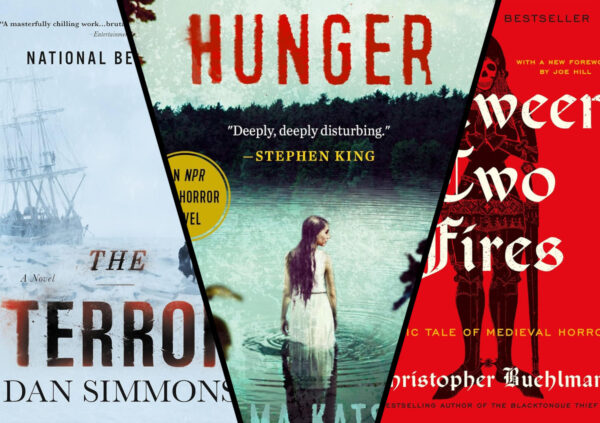
Read The Hunger. It’s the Donner Party novel, it was a Bram Stoker finalist, and Stephen King called it deeply, deeply disturbing.
Then The Fervor if you want the most serious one, or The Deep if the Titanic appeals.
The Historical Horror
The Alma Katsu books she’s known for, and the method is identical across all three: take a documented American disaster, research it exhaustively, and add one thing.
The Hunger (2018)

The Donner Party, 1846, on the trail west, with something following them.
The research is what you’ll remember. The party’s internal politics, the disastrous decision-making, the specific personalities and their grudges all come from the historical record, and the novel is very good on how a group of ordinary people talked themselves into every wrong turn.
The supernatural element stays held back a long time, and it runs deliberately ambiguous for most of the book, so that you spend a couple of hundred pages unable to separate what’s happening from what starvation and exhaustion would produce anyway.
Bram Stoker and Locus Award finalist. Also on historical horror and cannibal books.
The Deep (2020)

Two ships, forty years apart. The Titanic in 1912 and the Britannic, her sister, sunk in 1916 while serving as a hospital ship.
Annie Hebbley is a stewardess on the first and a nurse on the second, and something followed her.
The research is the reason to read it. Katsu works from the real passenger list, and Madeleine Astor, Benjamin Guggenheim, W. T. Stead and Dorothy Gibson are all characters doing things they documentably did. The spiritualist material on board comes from Stead’s actual obsession with it, and he really did die on the ship.
The horror stays deliberately ambiguous for most of its length. Annie is an unreliable narrator, she has been in an asylum, and every supernatural event comes with a psychiatric reading available.
The general verdict makes it her most atmospheric novel and her least frightening, and puts the Britannic sections above the famous ship.
The Fervor (2022)

Idaho, 1944. Meiko Briggs and her daughter Aiko are in the Minidoka internment camp, where over nine thousand Japanese Americans were held, and an illness begins spreading through the barracks that makes people violent.
The history is the substance, and Katsu is unsparing about it. The camps were real, the conditions are documented, and the novel spends as much time on the administration, the loyalty questionnaire and the recruitment of internees into the army as on the outbreak.
The folklore is jorōgumo, the spider yōkai, and Katsu ties it to Japanese American experience rather than importing it decoratively.
There’s also a balloon bomb thread, drawn from the actual Japanese fūsen bakudan campaign, which killed six people in Oregon.
Her own grandmother was in a camp.
The rough agreement runs that the historical material outweighs the horror and that the ending is rushed, and it’s her angriest book.
The Rest
The Taker trilogy (2011 to 2014)

Her first books, published from 2011, and they aren’t horror in the way the later novels are.
Lanny gets brought into a hospital in Maine having confessed to a murder, and tells the doctor she’s over two hundred years old, and the novel goes back to Maine in 1817 and to a man called Adair who made her what she is.
It’s a historical romance with immortality in it, running across two centuries and several countries, and the register sits closer to Anne Rice than to anything else Katsu has written.
The Reckoning and The Descent follow, and the third takes Lanny into a version of the underworld.
They sold well, and they’re the books her later readers are most surprised by.
Katsu has been open that she wrote them while working full time at the National Security Agency, and that the shift to historical horror came afterwards.
Read them only if the later novels have worked on you.
Red Widow (2021) and Red London (2023)

The spy novels, and they’re the books she was always going to write eventually.
Katsu spent over thirty years in intelligence, at the NSA and the CIA and later as a senior analyst at RAND, and these draw from that directly.
Red Widow follows two women in the CIA’s Russia division. Lyndsey Duncan gets brought back from suspension to find a mole after an asset is killed in Moscow, and Theresa Warner is a widow whose husband died on an operation that went wrong.
The tradecraft is the appeal, and it’s entirely unglamorous. The novel is about internal politics, career damage, security clearances and the specific way a bureaucracy protects itself.
Red London moves to the Russian money in Britain and to a wife being cultivated as a source.
No supernatural content. They read as procedurals, and the institutional detail beats almost anything in the genre.
Fiend (2025)

Her most recent novel, and it’s a Manson book.
The premise is that Charles Manson’s control over the Family wasn’t charisma and wasn’t drugs, and Katsu supplies something else, and the novel runs across the events of 1969 with that in place.
It’s her first contemporary-adjacent horror rather than a period piece from a century or more ago, and the sixties California material gets the same research discipline as the camps and the ships.
Reception so far is mixed. Readers who wanted her historical mode find the subject overexposed, and readers who wanted the horror foregrounded call it her most direct book.
What’s not in dispute is that she’s doing the thing she always does, which is to take a documented American atrocity and ask what would have to be true for a supernatural explanation to fit the record without contradicting it.
Recent enough that the reception is still forming.
Where to Start
Read The Hunger, and read the historical chapters as carefully as the supernatural ones, because that’s where the book lives.
If it works, read The Fervor, which is the better novel and the less famous one.
The Deep if maritime disaster appeals. Red Widow if you’d rather have the spy fiction.
And approach the Alma Katsu books expecting well-researched history with a supernatural element restrained enough that you’ll spend most of each novel unsure whether it’s there at all.
The whole shelf is ranked on my best horror books list. Her books all sit on my historical horror list, which has the rest of that shelf.