Thomas Tryon walked out of Hollywood at forty-three, sat down to write a horror novel because Rosemary’s Baby had annoyed him into it, and produced two of the best American horror novels of the seventies.
The acting career is why he could. He was a square-jawed leading man who never quite became one: B-pictures, television westerns, I Married a Monster from Outer Space, a role in the Marilyn Monroe film that collapsed when she was fired. Then Otto Preminger cast him in The Cardinal, which got him a Golden Globe nomination and, by Tryon’s own account, a nervous breakdown.
Preminger fired him in front of his visiting parents and rehired him afterwards, having satisfied himself that the humiliation had landed. Tryon retired from acting in 1969 and said later that writing gave him more satisfaction and considerably more money than acting ever had.
Both of the horror Thomas Tryon books are about the same thing, which is what a community will do to keep something going, and in both cases the reader works it out several chapters after they could have.
And he is genuinely well written, which is the thing that gets lost. His prose outclasses most of the paperback boom that followed, and The Other earned critical praise and bestseller numbers simultaneously, a double almost no book of the period pulled off.
He died in 1991.
Fiction by René Rehn


The Short Version
Read Harvest Home. It is the American folk horror novel and almost nobody has read it.
Then The Other, which is the better-reviewed of the two and the more conventional.
Note that availability is a genuine problem. Harvest Home has spent long stretches as an ebook only.
The Essential
Two of the Thomas Tryon books are horror and both came out in the first three years of the career, which is the shape of the whole thing.
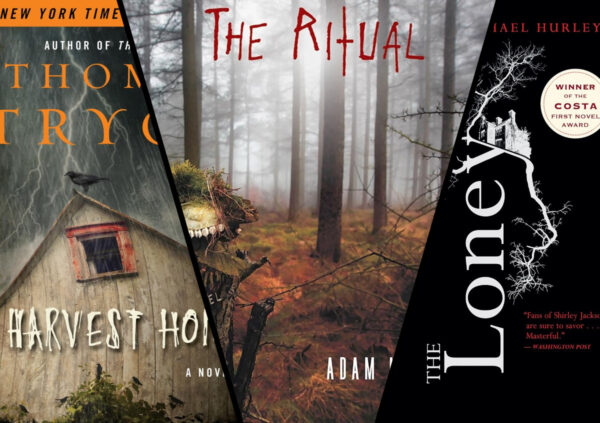
Harvest Home (1973)

Ned Constantine leaves a New York advertising job to paint full time, and buys an eighteenth-century house in Cornwall Coombe, a Connecticut village that appears to have declined to participate in the twentieth century.
No televisions. No modern farming. Corn planted and harvested by hand, on a calendar nobody explains. The villagers are warm, welcoming, and pleased to have the family, and Ned’s wife and asthmatic teenage daughter both improve almost immediately.
Patience is the whole method. For two hundred pages you read a pleasant book about house restoration and neighborly acquaintance, while wrongness gathers at a rate calibrated to leave you exactly where Ned stands: sensing the off-ness, refusing to be the one who causes a scene over it.
Underneath, the village runs as a matriarchy, the element its folk horror descendants mostly abandoned. Cornwall Coombe’s men fill the offices with titles while the Widow Fortune governs in fact, women carry the knowledge between generations, and women administer the ritual at the book’s core. Its Harvest Lord is a young man appointed to a role that ends him.
The reputation it carries, as the American folk horror novel nobody read, is earned. It predates almost everything the label now describes on the American side, it was a New York Times bestseller, and it has been out of print in physical editions more often than in.
Filmed by NBC in 1978 as The Dark Secret of Harvest Home, with Bette Davis as the Widow.
More on folk horror.
The Other (1971)

Summer 1935, Connecticut again. The Perry twins, Niles and Holland, are thirteen: Niles gentle, Holland anything but, the father dead by accident, the mother unwell upstairs, and a Russian grandmother who has taught Niles a game of projecting his mind into other beings.
Then people start dying.
The withholding makes it work and makes it nearly impossible to discuss, both at once. At one precisely chosen moment the novel’s true operation surfaces, and every prior page changes meaning behind you.
It was a genuine critical success, unusual for horror in 1971, and it sold enormously. Tryon adapted it himself for the 1972 film, which he also produced, with Uta Hagen as the grandmother.
More on psychological horror books.
The Rest
He published seven books across eighteen years and none of the later ones is horror in the way the first two are.
Lady (1974)

The third of what he thought of as a Connecticut sequence, and it is not horror at all.
Woody Sprague is a boy in a small Connecticut town in the 1930s, and Lady Harleigh lives across the road: elegant, wealthy, widowed, and the person he cares most about in the world. The novel is his memory of that friendship, told forty years later, and of the summer he found out what had happened to her husband.
The disclosure is handled with real restraint, which is the surprise given what The Other does. There is no reveal engineered for effect. There is a fact about the past that Woody was too young to understand and too fond of her to want to.
It is quiet, warm and slow, and Tryon’s admirers argue no book of his is better written.
Readers who arrive from the first two novels expecting another one are frequently disappointed, and it is not that book.
Crowned Heads (1976)

Four novellas about Hollywood, and this is where the acting career pays off.
Tryon spent fifteen years as a contract player, and the industry material here is written from inside it rather than researched.
“Fedora” is the best known. A reclusive star of the silent and early sound era has not aged, a producer goes to Corfu to find out why, and the explanation is one of the more disturbing things Tryon wrote. Billy Wilder filmed it in 1978 as his penultimate picture.
“Bobbitt” is the cruelest of the four, following a former child star into middle age.
“Willie” draws on a famous Hollywood murder, and “Lorna” is the weakest.
The connecting subject is what the studio system did to the people it manufactured, and Tryon is writing about an industry that had chewed him up and that he had walked away from.
All That Glitters (1986) and The Night of the Moonbow (1989)

The last two, and the second is the one worth finding.
All That Glitters is more Hollywood material, five actresses across several decades, and it is considerably weaker than Crowned Heads. The formula is the same and the energy is not.
The Night of the Moonbow is his final novel and a late return to horror, and there is nothing supernatural in it.
A boys’ summer camp in Connecticut in 1938. Leo Joaquim is an outsider, awkward, musical, an orphan, and he does not fit, and a group of boys decide to correct that. What follows is a slow, methodical campaign of cruelty across a summer, and Tryon writes it with the same withholding he used in The Other.
It is his most straightforwardly cruel book and it has no consolation in it anywhere.
He died of stomach cancer in 1991.
Where to Start
Read Harvest Home, and be patient with the first third, because the slowness is doing the work and the ending only lands if you have been lulled.
Then The Other, and go in knowing nothing about it at all.
Read Crowned Heads if you want to see what he did with the part of his life he actually hated.
And note that the Thomas Tryon books drift in and out of print constantly, so if you find a physical Harvest Home, take it.
The canon it belongs to is on my horror classics page. Harvest Home is one of the American cornerstones of my folk horror list.