Mary Shelley wrote the most famous horror novel in the English language when she was eighteen, and then spent thirty more years writing books almost nobody reads.
That’s the standard summary and it’s badly unfair. She wrote seven novels, and one of them invented the modern apocalyptic story. Another was suppressed by her own father and stayed unpublished for nearly a hundred and forty years. She also edited and annotated her dead husband’s poetry into the shape it still holds today, which is most of the reason Percy Shelley has the reputation he has.
But there’s no getting around the fact that most people arriving at the Mary Shelley books want Frankenstein, so this guide starts there, including the thing about Frankenstein that almost nobody knows before they buy a copy.
I haven’t read these. What follows is the critical consensus rather than my own verdict.
Fiction by René Rehn


The Short Version
Read Frankenstein, and read the 1818 text, not the 1831 revision most editions print. That’s not a pedantic distinction and I’ll explain why below.
Then read The Last Man if you want the other important book, which is a plague novel written in 1826 and the ancestor of everything from I Am Legend to Station Eleven.
Then Mathilda, which is short, was buried for over a century, and is the strangest thing she wrote.
The Mary Shelley Books in Order
| Year | Book | What it is |
| 1818 | Frankenstein | The one |
| 1823 | Valperga | The Italian political novel |
| 1826 | The Last Man | The first modern apocalypse |
| 1830 | The Fortunes of Perkin Warbeck | The long one |
| 1835 | Lodore | The domestic critique |
| 1837 | Falkner | The last novel |
| 1844 | Rambles in Germany and Italy | The travel book |
| 1959 | Mathilda | The buried one, written 1819 |
Where to Start
Frankenstein, in the 1818 text. If you’ve read it before in a school edition, it’s worth reading again in the original, because it’s a harsher and better book than the one most people were assigned.
Then The Last Man, which is the other genuinely important thing she wrote and the one most likely to surprise you.
Then Mathilda if you want to understand her, and Valperga if you want to know what she actually wanted to be writing.
Everything else among the Mary Shelley books is for completists, and there’s no shame in stopping after three.
The Life, Briefly
Born August 30, 1797, in London, to the two most notorious radicals in England. Her mother, Mary Wollstonecraft, who wrote A Vindication of the Rights of Woman, died eleven days after the birth. Her father was the philosopher William Godwin, and she grew up in his house being told who her mother had been.
At sixteen she ran away to the continent with Percy Bysshe Shelley, who was married to somebody else at the time. The summer of 1816 put her at the Villa Diodati on Lake Geneva with Percy, Byron and Polidori, where a wet season, a ghost-story challenge and a waking nightmare produced Frankenstein. She was eighteen.
The rest of the biography is loss on a scale that reads like fiction. Three of her four children died, and only Percy Florence survived to adulthood. Percy Shelley drowned in the Gulf of Spezia in July 1822, when she was twenty-four. She came home, raised her son alone on an allowance from a hostile father-in-law who forbade her from writing Percy’s biography, and supported herself by her pen for the rest of her life, which is what the novels below mostly are.
She got around the biography ban in plain sight: her editions of Percy’s poems carried notes so extensive that they amounted to the forbidden book, and they established his reputation almost single-handedly.
Mary Shelley died on February 1, 1851, at fifty-three, of what her physician suspected was a brain tumor.
Frankenstein (1818)

You know the story, or you think you do, and the odds are good that what you know came from the 1931 Boris Karloff film rather than the novel. There’s no lightning, no hunchbacked assistant, no laboratory of the kind you’re picturing. The creature is not a lumbering mute. He is articulate, self-educated, and by some distance the most persuasive speaker in the book.
The frame is a ship’s captain in the Arctic writing to his sister. He picks up a half-dead man off the ice, and that man tells him a story, and inside that story the creature tells his own. Three narrators, each nested inside the last, and the innermost one is the monster explaining precisely how he was made and then abandoned. It’s the architecture of gothic fiction at its most deliberate.
The point that gets lost. Victor’s crime is not making the creature. It’s what he does about ninety seconds afterwards, which is to look at what he’s made, recoil, and walk out of the room. Everything that follows proceeds from an act of abandonment rather than an act of creation. Written by a woman who had already lost her first baby and whose own mother died eleven days after giving birth to her.
The 1818 reviewers mostly recoiled too. John Wilson Croker, in the Quarterly Review, called the book “a tissue of horrible and disgusting absurdity” and signed off “in doubt whether the head or the heart of the author be the most diseased.” Walter Scott, reviewing it in Blackwood’s and assuming Percy had written it, broke the other way: “Upon the whole, the work impresses us with a high idea of the author’s original genius, and happy power of expression.” Mary wrote to him and corrected the authorship.
The edition question, which matters more than you’d think
There are two versions of this novel and most editions print the wrong one.
The 1818 was published anonymously, with a preface written by Percy Shelley, which led plenty of readers to assume he’d written it. The 1831 was published under Mary Shelley’s name, with a new introduction of her own that tells the famous Villa Diodati story: the wet summer, Byron’s challenge, the nightmare, and the send-off that became the most quoted sentence she ever wrote, “I bid my hideous progeny go forth and prosper.”
Between the two, she revised heavily, and she was a different person by then. Three of her children had died. Percy had drowned. She was poor, and she had spent a decade being judged.
The 1831 version lets Victor off the hook. It adds a fatalism that isn’t in the original, framing his obsession as something like destiny, a pull he couldn’t resist. In 1818, he has full autonomy and therefore full culpability. Abandoning the creature is a choice. Refusing to make him a companion is a choice. Failing to take responsibility is the entire horror of the book.
Other changes point the same way. Elizabeth stops being Victor’s cousin and becomes an adopted orphan, which removes a detail some readers had found distasteful. Justine’s speech before her execution changes from a furious attack on the injustice of retribution, exactly what you’d expect from William Godwin’s daughter, into meek submission to the will of Heaven. And the 1831 cuts two protests against injustice that the 1818 text gave Elizabeth.
Scholars overwhelmingly hold that 1818 is the book she meant, and Anne K. Mellor has laid out the textual case in detail. Buy an edition that says 1818 on the copyright page. The Norton Critical and the Oxford World’s Classics both use it. Most cheap paperbacks and most public-domain ebooks use 1831, because it’s the text that entered common circulation.
The novel has its own full page here: Frankenstein, with the 1818 and 1831 texts compared, the themes, the films, and which edition to read.
The Other Novels
She wrote six after Frankenstein and almost nobody reads any of them, which is a genuine loss in at least two cases. The Mary Shelley books below are what a professional novelist produced across thirty years while raising a son alone.
The Last Man (1826)
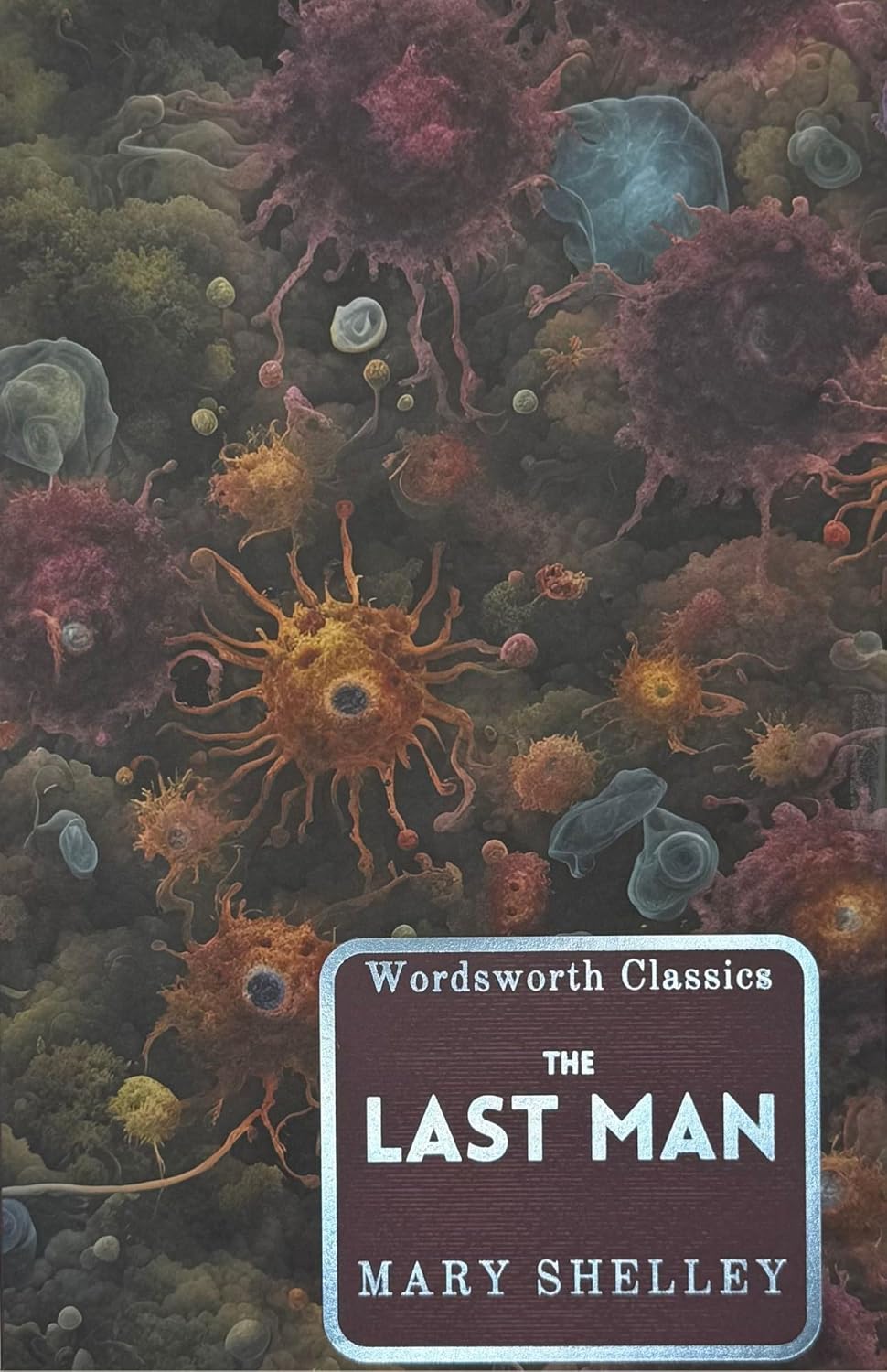
The one that should be famous, and increasingly is.
It’s set at the end of the twenty-first century, in a republican England, and it follows Lionel Verney through the arrival and spread of a plague that gradually removes the human species, with the final pages reaching the year 2100. It’s a slow apocalypse rather than a fast one: politics carrying on for a while, borders closing, institutions failing quietly, populations moving, and eventually nobody left to move.
It was savaged on publication, with reviewers calling it “sickening” and its author’s imagination “diseased,” and it went out of print for well over a century. Not until Hugh J. Luke’s 1965 University of Nebraska edition did it come back, and it has been climbing ever since, for the obvious reason that it turns out to be the first modern pandemic novel and the template for a form nobody else attempted for the better part of a century.
It’s also a roman à clef. The Byron figure and the Percy figure are both in there and both die, which makes it, among other things, a book about being the last survivor of a particular group of friends. She was.
Long, slow and worth it. The consensus warning is that the first volume is heavy going and the last is extraordinary. More of its descendants are on my dystopian books list.
Mathilda (written 1819, published 1959)

A hundred pages, and the reason it took nearly a hundred and forty years to reach print is the subject.
A dying young woman writes an account of her life for a friend. Her mother died at her birth. Her father left, returned when she was sixteen, and confessed a sexual obsession with her, after which everything falls apart.
Mary Shelley sent the manuscript to her father, William Godwin, and asked him to arrange publication. He found the theme detestable and kept it. He never returned the manuscript and never submitted it, and it stayed in his papers, and it was not published until 1959.
Reading it as autobiography is tempting and probably too simple, but it was written in the months after her son William died, and the grief in it is not fictional. It is the rawest of the Mary Shelley books and the one that changes how the others read.
Valperga (1823)

Her historical novel, set in fourteenth-century Italy, and the one that shows how much reading she had done.
Castruccio Castracani is a real figure, a Ghibelline warlord who took Lucca and made himself its ruler, and Shelley researched him properly in Italian sources while living in Italy.
The novel is about what political ambition does to him, and the two women who see it happen. Euthanasia is the Countess of Valperga, educated, republican, and in love with him, and she has to decide between the man and the free city he intends to take. Beatrice is a young prophet who believes she is divinely inspired, is destroyed by the Inquisition, and whose sections are the strangest thing Shelley wrote.
It is a political novel about tyranny written by somebody whose father was William Godwin and whose mother was Mary Wollstonecraft, and it argues that a republic is worth more than a great man.
Godwin edited it heavily before publication and cut it.
Lodore (1835)

The second-to-last novel, domestic, and considerably better than its reputation as one of the books where she gave up.
A man takes his daughter to the American wilderness after a scandal and raises her in isolation to be entirely dependent on him, and then dies, leaving her to survive in a society she has never seen. The critique of that upbringing is explicit and it is aimed at exactly the kind of Romantic idealism her circle practiced.
Falkner (1837)
Her last novel, and it is about a girl raised by a guilt-haunted man, who grows up to love the son of the woman her guardian destroyed, and has to choose between her adoptive father and the truth when it surfaces.
Like Lodore it is about fathers and daughters, about men who damage women while believing themselves principled, and Shelley had by then buried three children and a husband.
Neither of the late novels is horror and neither is a masterpiece. They are the work of a professional novelist paying the bills and settling something.
The Fortunes of Perkin Warbeck (1830)
Her other historical novel, and the premise is a good one badly served by the execution.
Perkin Warbeck was a pretender who claimed to be Richard of Shrewsbury, the younger of the Princes in the Tower, and led rebellions against Henry VII before being executed in 1499. Historians have largely settled on impostor from Tournai.
Shelley’s novel takes the position that he was telling the truth, that he was the prince, and that he survived the Tower and grew up in exile.
That is a defensible reading of a genuinely unresolved case, and she researched it thoroughly, and the result is her longest and least read book.
The problem is the shape. It is three volumes of court politics and military campaigning in a period she had not lived in and could not make vivid the way she made Italy vivid.
Read it only if the Wars of the Roses interest you independently.
Everything Else
She was a working professional writer for thirty years and the novels are a small part of it.
The short fiction runs to about two dozen stories, written mostly for annuals and gift books, and several are genuinely strange. “The Mortal Immortal,” from 1833, is a man who drank Cornelius Agrippa’s elixir as a young student and is now three hundred and twenty-three, having watched his wife age and die while he did not. “Transformation” (1831) is a body swap with a dwarf. “Roger Dodsworth” concerns a man frozen in an avalanche in 1660 and thawed out alive, written in 1826 in response to a newspaper hoax claiming exactly that, and itself unpublished until 1863.
She also edited Percy’s poetry after his death, with the extensive notes described above, which established his reputation almost single-handedly and shaped how he was read for a century.
And she wrote travel books. Rambles in Germany and Italy (1844) was the last work published in her lifetime.
The Journals of Mary Shelley and her letters are both available and are the primary sources for almost everything anybody knows about that circle.
Mary Shelley: Deep Dive and FAQ
What Runs Through the Books
Abandonment by the people who made you. Victor walks out of the room, Mathilda’s father confesses and flees, Lodore raises a daughter as a dependency and dies. Shelley kept writing creators and fathers who fail the thing they shaped, and she had reasons.
Survival as a subject. The Last Man is the whole theme at species scale, and it was personal before it was speculative: by 1826 she had outlived Percy, Byron and most of the Diodati circle, and the novel knows it.
And the editor’s hand. She curated Percy into his reputation, revised Frankenstein into respectability, and spent a career managing how the radicals she loved would be remembered. The reason to read the 1818 text is that it is the one document where nobody, including her later self, had softened anything yet.
On Screen, Forever
The film history belongs on the Frankenstein page, but the past year earned a paragraph of its own.
Guillermo del Toro’s Frankenstein premiered at Venice in August 2025 and hit Netflix that November, with Oscar Isaac as Victor and Jacob Elordi as the Creature, and it leaned hard on the novel’s actual subject, the abandonment. It took three Oscars in March 2026, for production design, costume design and makeup, out of nine nominations that included Best Picture. Maggie Gyllenhaal’s The Bride!, a Bride of Frankenstein reinvention with Christian Bale and Jessie Buckley, followed that same March and died on arrival, opening to thirteen and a half million dollars against a reported ninety-million budget.
Two centuries on, the book still generates studio-scale gambles, and the one that worked is the one that went back to the novel.
Questions About the Mary Shelley Books
Which Version of Frankenstein Should I Read?
The 1818 text. The 1831 revision adds fatalism that excuses Victor and softens the book’s moral architecture. Norton Critical and Oxford World’s Classics both print 1818, and most free ebooks print 1831, so check before you download.
How Old Was Mary Shelley When She Wrote Frankenstein?
Eighteen when she began it at the Villa Diodati in the summer of 1816, twenty when it was published anonymously in 1818. Plenty of readers assumed Percy Shelley had written it, since his name was on the preface.
Why Wasn’t Mathilda Published Until 1959?
She sent the manuscript to her father, William Godwin, to arrange publication. He found the father-daughter incest theme detestable, kept the manuscript, and never returned or submitted it. It surfaced from his papers for a scholarly edition in 1959.
Is the Last Man Worth Reading?
Yes, with patience. It is the first modern pandemic novel, written in 1826, and the last volume is extraordinary. Contemporary reviewers savaged it and it spent over a century out of print before its 1965 recovery.
What Did Mary Shelley Die Of?
She died on February 1, 1851, at fifty-three. Her physician suspected a brain tumor, which fits the headaches and paralysis of her final years.
Where to Go Next
The canon around her is on my horror classics page. The creature’s descendants are on my monster books list, and the wider shelf is on my best horror books list.