Between roughly 1974 and 1991, American publishing lost its mind about horror. The era has a name now, Paperbacks from Hell, and it fits.
The Exorcist and The Other had proved the market in 1971. Carrie and Jaws confirmed it. And then the paperback houses did what paperback houses do, which was to publish everything: five hundred horror titles a year at the peak, with foil-embossed covers, die-cut skulls, and a house style built almost entirely around children, animals and Nazis. Then in 1991 the bubble burst, the horror sections came out of the bookstores, and most of it vanished.
Grady Hendrix wrote the book about it and named the era, and this page owes him the debt directly. What his history established is that the boom was not simply a landfill. It was a landfill with about forty genuinely good novels buried in it, most of which went out of print for thirty years and are only now being recovered by Valancourt and a few others.
This is a guide to those. Some of it is out of print and hard to find, and I’ve said which.
I haven’t read most of these. What follows is the critical consensus.
Fiction by René Rehn


The Book That Started the Rediscovery
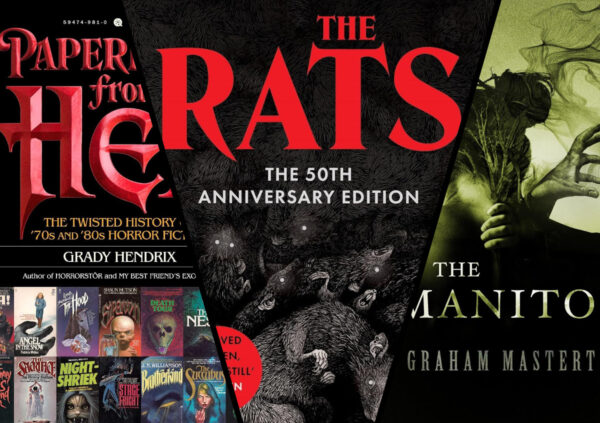
Paperbacks From Hell (2017)

The book this page is named after and the reason most of the novels below are back in print.
Hendrix’s argument is economic rather than critical, and nothing more useful has been written about the period. Paperback distribution in the seventies put spinner racks in supermarkets, drugstores, bus stations and airports. Those racks needed filling every month. Publishers therefore needed volume, and for about fifteen years an unknown writer with a lurid hook could get bought, printed and shipped nationally on no reputation at all.
Then the racks went, distribution consolidated in the early nineties, and the entire ecosystem died inside three years.
The cover reproductions are the pleasure and there are hundreds, organized by subgenre: skeletons, evil children, Nazi occultism, animals attacking, and the celebrated era of the die-cut cover with a foil skull behind it.
Won the Bram Stoker Award for non-fiction. Valancourt then reissued a line of the books he had recommended, which is how the rediscovery actually happened.
The Essential Novels
The best of the paperbacks from hell, which is a phrase that has to work harder than it should because several of these are genuinely good novels that happened to be published as disposable ones.
The Elementals (1981)

McDowell’s second novel and the one that proves the boom produced literature.
It is the outlier on this page in every way that matters. No cover skeleton, no cult, no killer, and prose good enough that Poppy Z. Brite and Stephen King both went on record about it. What it has instead is three houses on a sandbar and one of them filling with sand from the inside.
More on southern gothic.
Blackwater (1983)
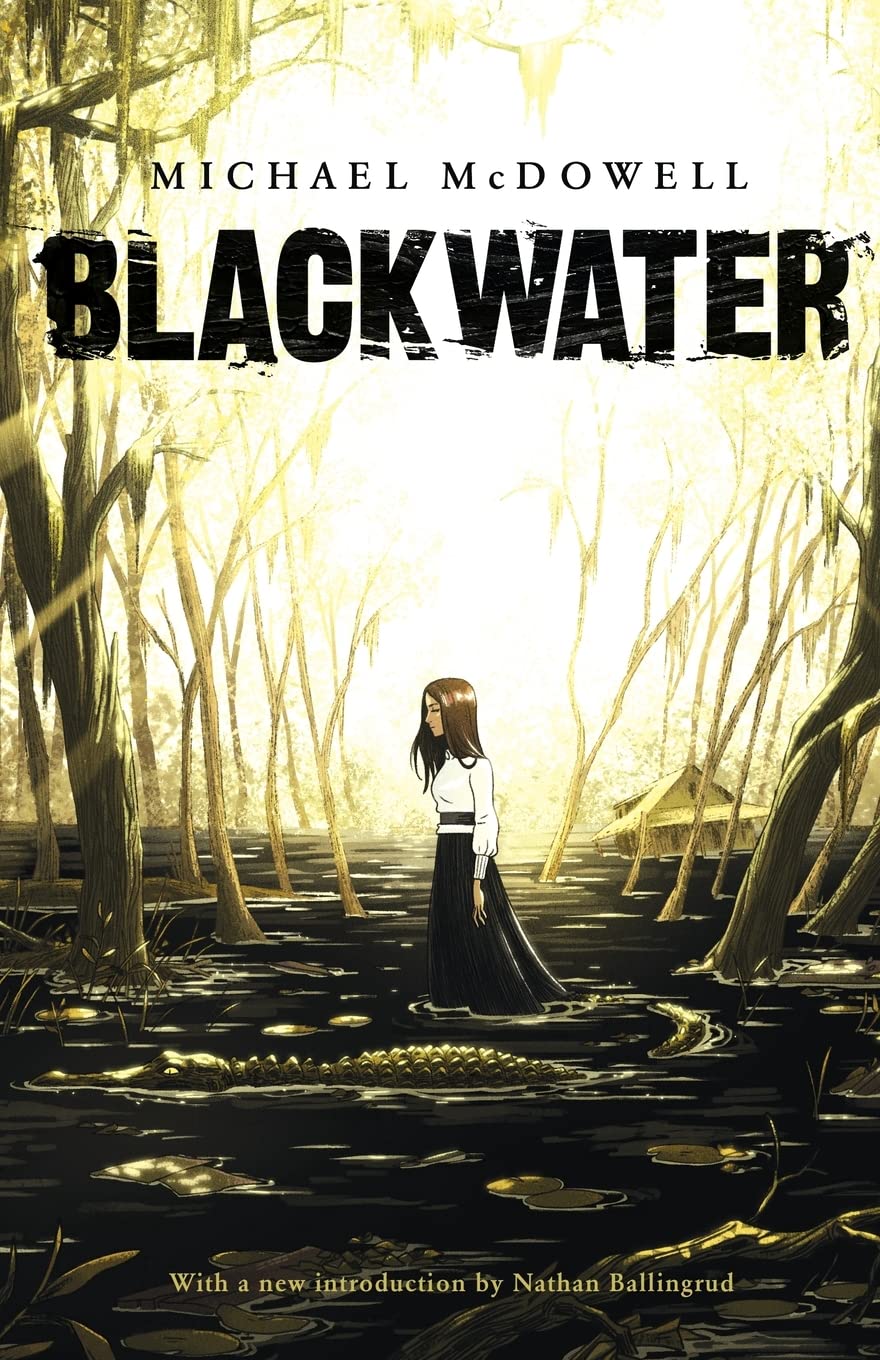
No publishing gamble of the period matched it: six slim paperbacks, one hitting the racks each month of 1983, Victorian serialization run under Reagan, and the gamble paid.
Perdido, Alabama, four generations of the Caskey family, and a woman found in a flooded hotel in 1919 who has an understanding with the river that nobody in the family raises.
The structure is why it reads the way it does: every volume ends where a monthly serial has to end.
Burnt Offerings (1973)

A summer away is beyond the Rolfes’ budget, until Marian spots a listing: a sprawling country place, the whole season for nine hundred dollars, and they drive out from Queens to look.
The house is enormous, decaying and beautiful. The owners state their single term: upstairs, behind a locked door, lives their mother, who is never seen, and three trays a day must be set outside her suite. She is no trouble. Marian accepts before her husband has finished thinking.
Then the estate starts mending on its own. Broken glass grows whole, the pool water turns clear, fresh paint creeps back. And each repair is paid for, and the family are the only currency available.
Marasco knows precisely how a worn-out woman gives herself to a house that requires her, and how long her husband can mistake the surrender for peace.
The pool scene is the one that stays. Marasco taught Latin at a Jesuit school, had a Broadway play produced, wrote two novels and stopped. King has named this book, with Hill House, as The Shining‘s parentage.
More on haunted house books.
The House Next Door (1978)

The last vacant lot on a moneyed Atlanta street gets a house, the work of a gifted young architect, genuinely beautiful, and one after another it destroys three sets of owners.
Nothing ever stood on that ground before. That is the entire radical move, and it is why this belongs near the top of a page about a decade that mostly recycled old machinery. Every other haunted house runs on history, and Siddons removes it and the book works anyway.
Its method is exposure: the residents’ worst private truths get produced in company, staged for maximum humiliation, and in that Atlanta street in 1978, disgrace outperforms any apparition.
Colquitt Kennedy tells it, and underneath, the book weighs one woman’s standing against what she knows to be true.
Siddons left horror after this one; the rest of the career was mainstream Southern fiction, in very large numbers. King gave it admiring pages in Danse Macabre.
Full entry on haunted house books.
The Other (1971)

Connecticut, summer 1935. Niles and Holland Perry are thirteen-year-old twins living on a family farm with their mother, who has not come downstairs since their father died in an accident in the apple cellar.
From their Russian grandmother Ada, Niles has learned what she names the great game, projection of his mind into other living creatures, at which his talent is considerable.
Then people start dying.
Total withholding makes the book work and makes discussing it nearly hopeless, both at once. Tryon picks his moment of clarity exactly, and from that moment every earlier page means something else.
He had been an actor for fifteen years, was humiliated by Preminger on The Cardinal, quit in 1969 and wrote this because Rosemary’s Baby annoyed him.
It was a critical success as well as a bestseller, which almost nothing in the period managed, and it and The Exorcist between them made the boom commercially possible. He adapted it himself for the 1972 film.
Harvest Home (1973)

Tryon again, and the one that sold enormously and then vanished.
It is the best-selling folk horror novel of the era and almost nobody has read it since. A New York family buys into a Connecticut village that farms by hand, keeps its own calendar, and is extremely welcoming right up until the husband starts asking questions about the last Harvest Home.
NBC filmed it in 1978, Bette Davis starring, and the book has spent more years out of print than in.
Also on folk horror.
Ghost Story (1979)

Milburn, New York, keeps a small club of old men, the Chowder Society, who convene to frighten each other with stories. Their number just dropped from five to four. The one story none of them will touch concerns Eva Galli, and their own young selves, half a century gone.
The opening act is the book’s best: a snowed-in New York town, four men who have run out of ways to avoid one subject, and tales traded as a substitute for confession.
The long middle is the toll. It accumulates viewpoints, takes a substantial detour, and some readers park there while others call it essential.
Alma Mobley remains one of the era’s great entities precisely because she never resolves. The three women she has been decline to rank themselves.
It settled the argument about whether horror could carry literary weight and keep its pulse, and King has spent decades saying so.
The Search for Joseph Tully (1974)

A demolition site in Brooklyn where an entire block has been cleared except for one brownstone, which is still occupied and which the wrecking crews are working toward.
Four tenants remain. One of them is Peter Richardson, who has been having dreams he cannot explain, and elsewhere in the country a man named Matthew Willow is systematically tracing the descendants of an eighteenth-century Englishman called Joseph Tully.
The two threads run in parallel for the length of the book and Hallahan withholds the connection until the last few pages, and the reveal is the reason people still talk about it.
What makes it work is the setting. The building is cold, the heating has been turned off, the neighbors are gone, and the demolition is coming closer every day, so the isolation is entirely mundane and increases on a schedule.
It was reissued by Valancourt and is one of the genuine finds of the rediscovery. The last line is the whole book.
The Nightwalker (1979)

A werewolf novel that treats lycanthropy as a sleep disorder, which is a considerably better idea than it sounds.
David Kesler is a Vietnam veteran being treated for insomnia and blackouts. His psychiatrist thinks he is dissociating. The killings around the city are being investigated by a detective who has no supernatural theory at all, and Tessier keeps the reader unsure for a long stretch about which explanation the novel intends to endorse.
The transformation, when it finally arrives, is one of the better ones in the subgenre, and Tessier writes the aftermath rather than the act.
What lifts it above the pack is the Vietnam material. Kesler’s condition is presented as continuous with what he did in the war, and the novel is genuinely interested in a man who suspects he was already this before anything happened to him.
Tessier wrote several of these in the eighties and Finishing Touches is the nastier one. This is the best.
The Ceremonies (1984)

The most literate novel the boom produced and its biggest outlier.
Jeremy Freirs takes a summer sublet, a converted outbuilding on a New Jersey farm, planning to work through the gothic canon before he teaches it in the fall. His landlords, the Poroths, are pious, newly married, and short of cash. Meanwhile, back in New York, an old man going by Rosebottom is steering a young woman named Carol toward Jeremy, since a sequence exists, and its steps come in order.
What lifts it is the reading list as machinery. Machen, Le Fanu, Radcliffe, Maturin, Jackson, one after another through the hot months, and Jeremy’s marginal notes bleed steadily into the events around him on the farm. The pattern he spots in the books is the one closing around him, and he never makes the connection.
Five hundred and fifty pages of patient literary horror in a decade selling foil skeletons, and it won the British Fantasy Award anyway.
Klein published almost nothing else.
The Auctioneer (1975)

A stranger arrives in a small New Hampshire town and asks the residents to donate items they no longer need for a charity auction, to raise money for the new deputies.
Everybody agrees, because it seems reasonable and because refusing would look mean.
Then he comes back and asks for more. The requests escalate over months, and each is small enough on its own that refusing would seem unreasonable, and the deputies who now exist are enforcing it, and by the time the Moores understand what is happening they have given away their furniture, their livestock, their land and are being asked for something else.
There is nothing supernatural in it anywhere. The horror is entirely social and the mechanism is that a community will not act collectively until it is too late for any individual to act at all.
Samson published two novels and disappeared. Grady Hendrix has called it one of the great American horror novels and the Valancourt reissue is its first proper availability in decades.
The Gloriously Stupid
The other half of what the paperback boom produced, and these are recommended without irony as artifacts of a distribution system that no longer exists.
Not everything in the boom was quietly excellent, and pretending otherwise would misrepresent the period.
The Rats (1974)

The best-selling horror novel in Britain in 1974 and the book that opened the floodgates for the whole boom.
Giant black rats appear in the East End of London and start eating people. That is the entire premise and Herbert does not complicate it.
What made it a phenomenon was the class content, which nobody expected. Herbert was from Bethnal Green and the novel is set in the parts of London that had been bombed, cleared and left derelict, and the rats come out of the neglect. The victims are dockers, tramps, schoolchildren and old people in condemned housing, and Herbert’s fury about all of that is entirely genuine and sits oddly alongside the pulp.
The technique is the vignette. Every few chapters he introduces somebody with a name and a history and two pages of life, and then kills them, which was new and has been copied endlessly.
It is crude, fast, and much better than its reputation. Lair and Domain followed and Domain is the strongest of the three.
Night of the Crabs (1976)
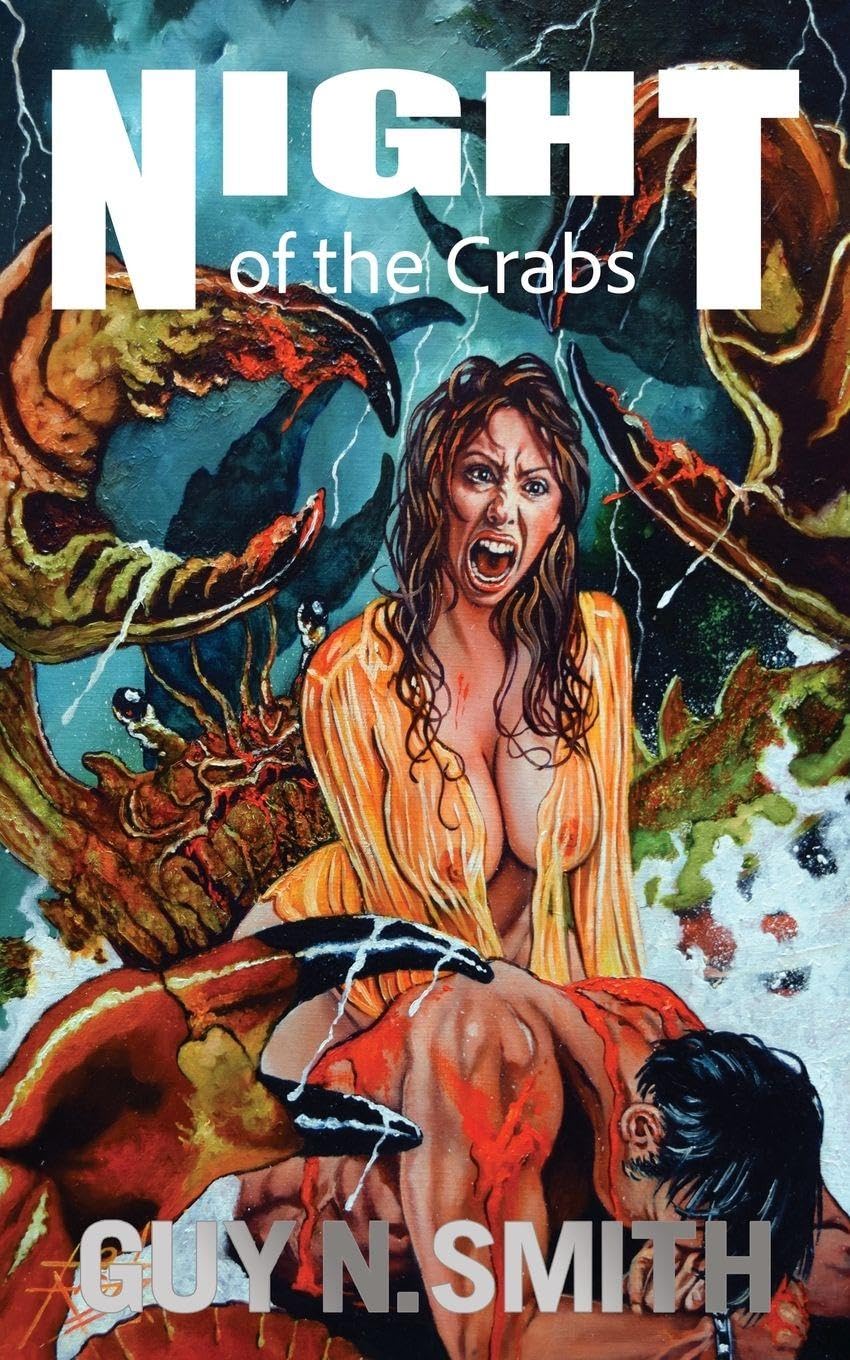
The single most beloved bad book of the entire boom, and I am recommending it without irony.
Giant crabs come ashore in North Wales and eat holidaymakers. A marine biologist investigates. The army is deployed. There are further crabs.
Smith wrote it in a fortnight, sold it immediately, and it sold well over a hundred thousand copies, which funded a career of over a hundred novels about various British wildlife becoming enormous and hostile.
The prose is functional at best and the plotting is nonexistent. What it has instead is total commitment. Nobody in the book finds giant crabs implausible. The army response is described with the seriousness of a military thriller. The crabs have a queen and a strategy.
It is the purest example of the disposable paperback that the boom existed to produce, and reading it now is a genuinely instructive experience about what these books were for.
It has been reissued by Valancourt.
The Manitou (1975)

A woman develops a rapidly growing tumor on the back of her neck, and the scan shows it contains a foetus, and the foetus is developing much faster than it should.
What is being born is Misquamacus, a Native American medicine man who has been reincarnating for three hundred years in order to complete an act of revenge against the settlers.
Masterton wrote it in 1975, it made his career, and it stands as the clearest example of a problem this whole section has. The Native American material is invented, the practices are a jumble, and the premise depends on treating an entire culture as a source of monsters. It was standard for the period and it is not defensible now.
The tumor material is genuinely effective and the hospital sequences are the best in the book.
Filmed in 1978 with Tony Curtis, and Masterton wrote several sequels. Read it as a period document rather than as a recommendation.
Where to Start
Read Paperbacks From Hell first. It’s the map, and half the pleasure of this era is the covers.
Then read The Elementals, which is the best novel here, or Burnt Offerings if you want the one that shaped everything after it.
If you want the two nobody has heard of, they’re The Auctioneer and The Search for Joseph Tully.
And if you want to understand what the boom was actually like on the shelf rather than at its best, read Night of the Crabs and enjoy yourself.
The whole shelf is ranked on my best horror books list. A surprising amount of it was regional, which my southern gothic list covers.