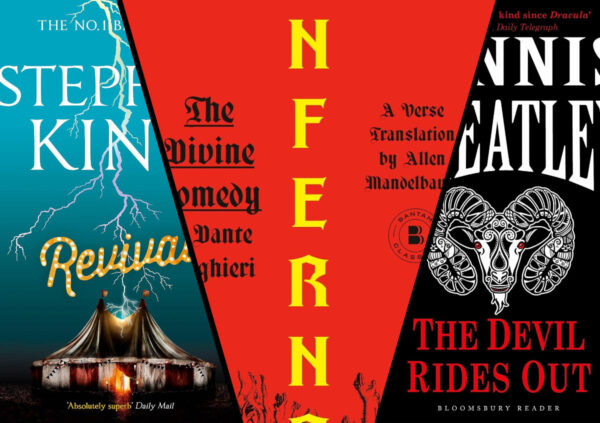
Dennis Wheatley sold something like fifty million books, invented the modern occult thriller, and is now almost entirely unread, and all three facts are connected.
He was a wine merchant who lost the business, turned to writing in 1933, and became one of the best-selling authors in Britain for four decades. During the Second World War he was recruited to the London Controlling Section, the deception planning staff, on the strength of his ability to think up implausible scenarios, which is a genuinely extraordinary biographical detail.
His contribution to horror is The Devil Rides Out in 1934 and the black magic novels that followed. Before him, occult fiction in English was largely Machen and Blackwood doing something literary. Wheatley made it a thriller: pentagrams, black masses, sinister foreigners, chases across Europe, and a small group of well-connected friends saving England from Satanists.
He also researched it properly, which is why the ritual detail still works. He knew Aleister Crowley, corresponded with Montague Summers, and the accuracy of the magical apparatus is the reason the books frighten anyone at all.
And the Dennis Wheatley books are very difficult to read now. The politics are reactionary, the antisemitism is present rather than merely implied in several books, the treatment of anyone not English and upper-middle-class is what you would expect, and the prose is stiff. This page does not pretend otherwise, and a reader should know before buying.
I haven’t read these. What follows is the critical consensus.
Fiction by René Rehn


The Short Version
Read The Devil Rides Out. It’s the one that mattered, the Hammer film with Christopher Lee is genuinely good, and it’s the least encumbered of the occult novels.
Then To the Devil a Daughter or The Haunting of Toby Jugg if you want more, and stop there.
The Black Magic Novels in Order
| Year | Book | Series |
| 1934 | The Devil Rides Out | Duke de Richleau |
| 1941 | Strange Conflict | Duke de Richleau |
| 1948 | The Haunting of Toby Jugg | Standalone |
| 1953 | To the Devil a Daughter | Standalone |
| 1956 | The Ka of Gifford Hillary | Standalone |
| 1960 | The Satanist | Standalone |
| 1964 | They Used Dark Forces | Gregory Sallust |
| 1967 | Unholy Crusade | Standalone |
| 1968 | The White Witch of the South Seas | Gregory Sallust |
| 1970 | Gateway to Hell | Duke de Richleau |
| 1973 | The Irish Witch | Roger Brook |
That is the occult core of a catalog that runs past seventy books, most of them spy thrillers and historical adventures with no supernatural content.
Where to Start
Read The Devil Rides Out, and watch the Hammer film afterwards, because it is the rare case where the adaptation improves on the source.
If you want the best-written one, read The Haunting of Toby Jugg.
And approach the Dennis Wheatley books as historical objects rather than as living fiction, because that is what they are, and because the politics in them are not incidental and will land badly if you are not expecting them.
The Life, Briefly
Born in London in 1897 into the family wine business, which he ran through the twenties and lost in the slump. He turned to fiction at thirty-six, and his first novel, The Forbidden Territory in 1933, was reprinted seven times in seven weeks and made him famous at once.
The war is the strangest chapter. He wrote speculative invasion-defense papers as a civilian, was commissioned into the RAF Volunteer Reserve, and ended up on the Joint Planning Staff and the London Controlling Section, the small cell that coordinated Allied deception. The man who invented the fictional occult conspiracy spent the war inventing real false realities for the enemy.
Afterwards he settled into a production rhythm of multiple books a year across his series, sold in the tens of millions, and kept at it until shortly before his death in 1977. For about three decades he was close to a fixture of the British bestseller lists, the kind of author whose new book was an event in houses that owned few books, which is precisely the audience the occult novels scandalized and delighted. Phil Baker’s 2009 biography, The Devil Is a Gentleman, is the full account and is a better read than most of the novels.
The Black Magic Novels
The Dennis Wheatley books that matter here, and the first is the one everybody else has copied.
The Devil Rides Out (1934)

When the Duke de Richleau works out what kind of company his young friend Simon Aron has been keeping in London, satanists, organized and serious, he sets out to pull him free.
The set pieces are the reason it survives. A pentacle drawn on a library floor and a night spent inside it while things arrive. A black mass on Salisbury Plain with a goat. A chase across France. Wheatley constructs a magical system with rules, and then puts his characters inside those rules and makes them stick to them, which is the technique every occult thriller since has borrowed.
Mocata is a genuinely good villain, based partly on Crowley, and the sequence in the pentacle is the most effective thing Wheatley wrote. One contemporary review hailed it as “the best thing of its kind since Dracula,” and the publisher never let anybody forget it. Some of it reads very differently now: the pentacle’s defenses deploy a swastika as a protective symbol, which no 1934 reader blinked at and every modern one does.
The template he built here never went away. The expert who knows the rules, the skeptic who learns them the hard way, the ritual countered by ritual, the race against an astrological deadline: half the occult thrillers and exorcism films of the next ninety years run on machinery this book assembled. That, more than the prose, is the claim it has on a modern reader.
The 1968 Hammer adaptation, scripted by Richard Matheson, with Christopher Lee as de Richleau and Charles Gray as Mocata, is better than the book and is one of the best British horror films.
Also on religious horror and possession books.
To the Devil a Daughter (1953)

Molly Fountain, a thriller writer living in the south of France, becomes concerned about a young Englishwoman staying nearby who is frightened of something and will not say what.
Christina was promised to a satanist called Canon Copely-Syle before she was born, and she turns twenty-one shortly, at which point the arrangement comes due.
The best material is the homunculus. Copely-Syle, usually read as a portrait of Montague Summers, the occult scholar Wheatley corresponded with, is growing something in a jar in his laboratory and requires a soul to complete it, and Wheatley describes the process with the same procedural seriousness he gives the pentacle in The Devil Rides Out. The London Review of Books put the faint praise exactly: the toads and homunculi show he could at a pinch manage the uncanny, though he “couldn’t do scary.”
The novel is slower than the earlier book and the middle is a chase around the Riviera.
It was filmed by Hammer in 1976 with Christopher Lee and Richard Widmark, and it was Hammer’s last horror film for over thirty years. Wheatley hated it and refused to allow further adaptations.
The Haunting of Toby Jugg (1948)

Toby Jugg is twenty, paralyzed from the waist down after being shot down over Germany, and confined to a Welsh country house in the care of a doctor and a nurse while he recovers.
Something comes to his window at night, and he can see its shadow on the curtain, and it is enormous and it is not an animal.
He keeps a journal, which is the novel, and the reader has to decide whether he is having a breakdown, whether he is being drugged, or whether the thing is real.
It’s Wheatley’s best-constructed book and his most restrained. The paralysis is the whole engine. Toby cannot leave the room, cannot investigate, and cannot make anybody believe him, and the people caring for him have reasons for wanting him declared unfit.
There is also a communist conspiracy, which is where the politics arrives and where a modern reader will wince.
The shadow on the curtain is a genuinely great image, and the book has the strongest modern defenders of anything he wrote. Den of Geek’s Wheatley retrospective calls it “a masterpiece” and “the scariest book I’ve ever read,” and even the London Review of Books, no friend of his prose, credits it with “flights of imagination some way outside his usual range.” The BBC filmed it in 2006 as The Haunted Airman.
The Satanist (1960)

The other famous one, and the closest he came to repeating The Devil Rides Out.
Mary Morden goes undercover to find the satanist circle that destroyed her husband, an agent who died investigating it, and Barney Sullivan is the colleague working the same case from another angle. The lodge they penetrate is run as a front: black magic upstairs, Cold War sabotage underneath, which is the most Wheatley sentence imaginable.
The ritual scenes are among his most sustained, the lodge’s master is a worthy successor to Mocata, and the Cold War machinery dates it precisely to 1960, down to its horror of liberated youth. The commercial scale is worth recording: one 1966 paperback printing sold over a hundred thousand copies in ten days. Readers who want a second full-dress occult thriller after the first novel usually land here, and the ending goes further than Hammer could ever have filmed.
The Ka of Gifford Hillary (1956)

An industrialist is pronounced dead, while his consciousness remains active and aware, and he watches his own funeral arrangements and the collapse of his affairs while unable to communicate.
The Egyptian ka is the mechanism, there is a murder trial underneath it, and the premise is better than Wheatley’s execution of it. The opening third, with Hillary out of his body and screaming at people who cannot hear him, is the strongest sustained stretch.
One for the second round, after the four above, and the right pick if the premise of being present at your own inquest appeals more than another black mass does.
Strange Conflict (1941)

A wartime Duke de Richleau novel in which the Nazis are using occult means to locate Allied convoys, and de Richleau travels astrally to counter them, via Haiti and a voodoo practitioner.
The astral-plane duels are inventive in a way nothing else in the series is, the SF Encyclopedia rates its occult material the “most vividly evocative” of his wartime volumes, and the book was written in the middle of the war it describes, which gives it a strange documentary charge.
It is also where Wheatley’s beliefs and his intelligence work overlap most visibly, and the racial content in the Haitian sections runs bad even by the standards of 1941. Read Toby Jugg ahead of it, and go in briefed.
They Used Dark Forces (1964)

The Gregory Sallust one, late in that spy series, and the strangest premise on this page: Sallust, operating inside wartime Germany, allies himself with a satanist and uses black magic against the Third Reich, with the occult treated as one more instrument of war.
It runs long and the espionage machinery dominates, but the sections where the series’ cold professional spy has to take the rituals seriously are genuinely effective, and the book’s view of Hitler runs the occult rumor mill of the era at face value. For readers who want the formula with a body count and a war around it.
Gateway to Hell (1970)

The last proper de Richleau occult adventure: the friends chase a vanished associate to South America and walk into a satanist operation with revolution politics bolted on.
By 1970 the formula is running on fumes, the politics have curdled further, and the ritual finale is the one stretch with the old charge. Completists and de Richleau loyalists only. Everyone else should close the series with Strange Conflict.
Everything Else
He wrote over seventy books and sold around fifty million copies, and the black magic novels are a small fraction of it.
The bulk is historical adventure and espionage. The Duke de Richleau series runs to eleven books, most of them without any occult content. The Gregory Sallust novels are wartime spy thrillers, and Sallust has been proposed as an influence on Fleming, who knew Wheatley. The remaining occult entries, Unholy Crusade, The White Witch of the South Seas and The Irish Witch, run the formula down through the late sixties and seventies and are for completists.
He also produced the Crime Dossiers in the thirties, which were murder mysteries packaged as case files with physical evidence enclosed: telegrams, photographs, hair, a bloodstained curtain fragment, and a sealed envelope with the solution.
And he wrote The Devil and All His Works, a non-fiction survey of the occult in which he states his own beliefs, and it is credulous throughout.
Dennis Wheatley: Deep Dive and FAQ
Which Editions to Buy
For decades the Wheatley shelf meant secondhand: the Hutchinson hardcovers, the Arrow paperbacks with the lurid covers, the Heron faux-leather sets that turn up in every British charity shop. Then Bloomsbury brought the catalog back in 2013 and 2014, as ebooks and print-on-demand paperbacks, which is why the books are suddenly easy to buy again after years out of print.
The Bloomsbury editions are plain but complete, and they are the practical answer for everything on this page. Collectors chase the Arrow covers, which remain the best thing about several of the lesser books.
On Screen
Hammer did him twice: The Devil Rides Out in 1968, which is the classic, and To the Devil a Daughter in 1976, which ended both the partnership and, for decades, Hammer horror itself. The Lost Continent, also 1968, is loosely taken from his Sargasso Sea novel Uncharted Seas and is a genuine oddity.
Before all that, his debut The Forbidden Territory was filmed in 1934, within a year of publication, which tells you how big he was from the start.
The Lee film of The Devil Rides Out is the reason the book still circulates, and it is the right order: film first works fine here.
Questions About the Dennis Wheatley Books
Are the Dennis Wheatley Books Still Worth Reading?
Two or three of them, with eyes open. The Devil Rides Out for the machinery every occult thriller borrowed, The Haunting of Toby Jugg for the construction, The Satanist if you want more. The critics have always split the difference the same way: the prose gets called awful, and then the SF Encyclopedia still ends up describing the catalog as “a remarkable set of exercises in the power of story.” The politics are period-ugly throughout, and this page means that as a warning, not a disclaimer.
What Order Do the Occult de Richleau Books Go?
The Devil Rides Out, then Strange Conflict, then Gateway to Hell. They stand alone comfortably, and nobody reads the full eleven-book series for the occult material.
Did Wheatley Actually Believe In Black Magic?
He claimed to take it seriously enough never to attend a ritual, and The Devil and All His Works presents the occult credulously. How much was conviction and how much was brand maintenance is argued about to this day.
Is the Devil Rides Out Scary by Modern Standards?
The pentacle night still works, because it runs on rules and patience rather than shock, and the black mass retains a genuine charge of the forbidden. Between the set pieces sits a 1930s thriller with 1930s pacing and 1930s attitudes, which is the part a modern reader has to budget for.
Do I Need to Read the de Richleau Series Before the Devil Rides Out?
No. It was written early in the series and explains everything it needs. The band of friends carries over from The Forbidden Territory, and Wheatley recaps what matters in a paragraph.
Why Is Nobody Reading Him Anymore?
The prose dated, the politics curdled, and the thriller moved on. What survives is the machinery: the books taught popular fiction how to stage the occult, and the occult fiction that followed made its teacher redundant.
Where to Go Next
The whole shelf is ranked on my best horror books list. The occult thrillers are the commercial peak of my religious horror list, and the pentacle-and-ritual machinery runs on through my possession books list.