Poe thought of himself as a poet first, and the poems came first.
That’s easy to forget, because the stories are what survived into popular culture. But his first published book was poetry, he wrote verse from his late teens until the month he died, and even his prose reads like someone who couldn’t quite switch the meter off. Anyone who’s read “The Masque of the Red Death” out loud knows what I mean.
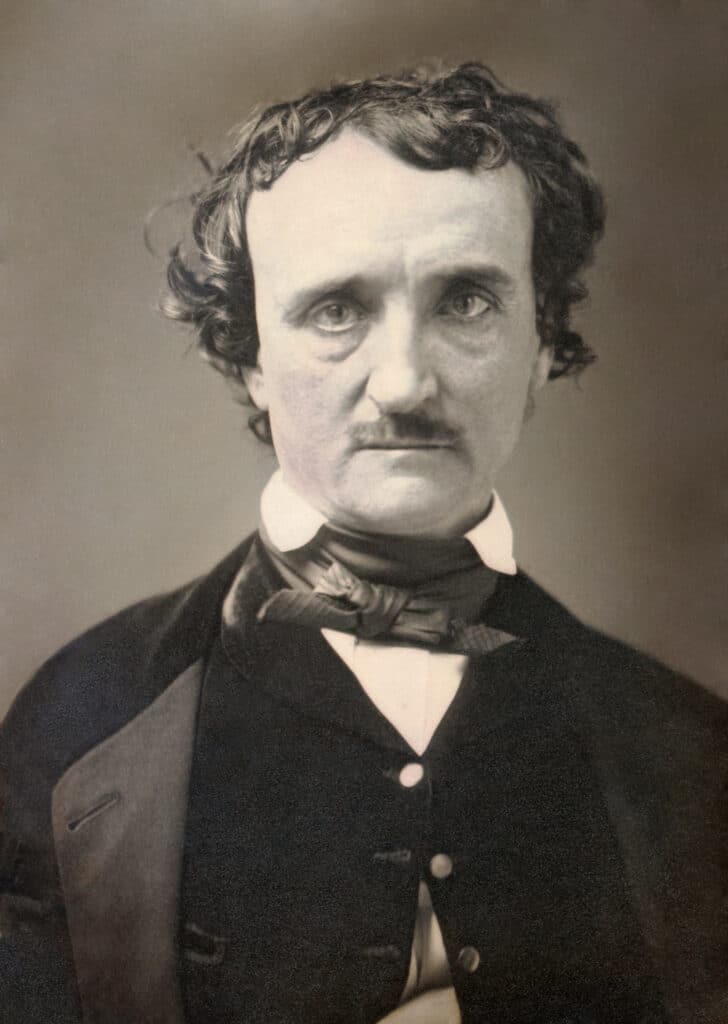
The odd thing is that the Edgar Allan Poe poems are a much smaller and much more uneven body of work than the tales. He wrote maybe fifty of them worth reading. A fair few are apprentice pieces, some are occasional verse written to flatter women he was courting, and two or three are among the most famous things ever written in English.
This is a ranked guide to the sixteen worth your time. I’ve linked each one to a free text, since all of it is public domain, and I’ve tried to say something about why each poem works rather than just summarising it. Poe would have wanted that. He was, after all, the man who wrote an essay explaining exactly how he built his most famous poem, line by line, like a piece of furniture.
Fiction by René Rehn


On Reading Poe’s Verse
A practical note before the list.
Read them out loud. This is not optional advice with Poe. The rhythms are the point, and a lot of what feels overwrought on the page becomes hypnotic when spoken. He wrote for the ear, sometimes explicitly, and Ulalume was composed as an elocution piece.
Expect the same obsession over and over. In The Philosophy of Composition he stated flatly that the death of a beautiful woman is the most poetical topic in the world, and then spent his career proving he meant it. Lenore, Ulalume, Annabel Lee, The Sleeper, The Raven. Same wound, opened repeatedly.
Some of it is genuinely bad. The early work in particular is imitation Byron and Coleridge with the volume turned up. I’ve included two of those anyway, because you can see him finding the voice in real time, and that’s interesting even where the poem isn’t.
16. Tamerlane
His first published work, in 1827, in a pamphlet of forty pages printed at his own expense with the author given as A Bostonian.
It sold perhaps fifty copies. Twelve are known to survive and one sold at auction in 2009 for six hundred and sixty-two thousand dollars, which makes it the most valuable book in American literature per page.
The poem itself is not good. It is four hundred lines of a dying Turkic conqueror confessing to a priest that he chose empire over a woman named Ada and that the ambition was worthless, and it is entirely Byron with the serial numbers filed off.
Poe was eighteen, had just left the University of Virginia over gambling debts, had enlisted in the army under a false name and a false age, and was writing about a man who had thrown away love for glory.
Read it as biography rather than as poetry, and read it last.
15. Israfel
The angel Israfel is the one in Islamic tradition who will blow the trumpet at the resurrection, and in the Quran he has the sweetest voice of all God’s creatures.
Poe’s poem is a complaint about that.
The angel sings in heaven, unrivaled, and the stars stop to listen, and Poe’s argument across seven stanzas is that this is easy. Israfel is in heaven where love is a grown-up god and the flowers are perfect, so of course he sings well. There is nothing to overcome.
Then the last stanza makes the trade. If Poe were where Israfel is and Israfel were here, the angel could not manage a melody so wild, and Poe would sing better than the angel does.
That is a genuinely unusual position: that the mortal poet has the harder job and the better material because his world is broken.
It is the least gloomy thing he wrote and the most competitive.
14. To Helen
Fifteen lines, three stanzas, and the one poem of his that critics who dislike him tend to concede.
It is a compliment. A woman’s beauty is compared to the ships of antiquity that carried a weary traveler home, and then to the glory that was Greece and the grandeur that was Rome, which is the line everybody knows and which is quoted constantly by people who have never read the rest.
Then the last stanza puts her in a niche, holding an agate lamp, and calls her Psyche from the regions which are Holy Land.
The Helen was Jane Stanard, the mother of a schoolfriend, who was kind to Poe when he was fourteen and died the following year at thirty-one. He visited her grave.
That is the pattern for everything he wrote afterwards, and it started here with a poem written by a boy about a woman who had been kind to him once.
13. Spirits of the Dead
Twenty-nine lines, published when he was twenty and originally titled “Visits of the Dead”, and the earliest poem on this list.
The instruction is to stand alone among the tombstones of a churchyard at night and not look at any of the stones, because the loneliness there is not solitude.
The dead who stood in life around you are there again in death, and their will overshadows you, and the poem’s word for it is that you shall be still.
Then the night’s tone changes. The breeze is described as the breath of God, the mist on the hill is shadowy and unbroken, and the poem’s last image is that it is a symbol and a token of something hanging on the trees, which it declines to name.
It feels unfinished, and nothing else in his verse comes closer to a genuine ghost story.
Nothing in it is explained and the effect depends on that.
12. The Sleeper
Poe said this was better than The Raven and almost nobody agrees with him.
It is midnight in June under a mystic moon. An opiate vapor drips from the moon’s rim onto a valley, the rosemary nods on the grave, the lily leans on the wave, and the ruin molders into rest.
Then Irene is at her open window, asleep, and the narrator is outside looking in, and he asks whether she is not afraid, and remarks that the lady sleeps.
Except she is dead. The poem discloses that gradually and then commits to it: the last stanza is about the vault she will be sealed in, and the narrator’s wish that her sleep be as deep as it is sound.
The unsettling part is the position of the speaker. He is at a woman’s bedroom window at midnight, describing her body, and she cannot object.
Poe revised it repeatedly across twenty years, which suggests he knew it was not finished.
11. Dream-Land
A traveler returns from a place he reaches by a route he describes as an obscure and lonely road haunted by ill angels, out of space and out of time.
What is there is a catalog: bottomless vales, boundless floods, chasms and caves and Titan woods, seas that restlessly aspire toward skies of fire, lakes that lie forever still, and snows of lily that droop into them.
And ghouls, and the shrouded forms of friends who have been given over to the earth.
The poem’s argument is that the region is where the bereaved go to see the dead again, that it is available only to those who have lost somebody, and that the traveler cannot look at it directly because the eye must be shut with fringed lid.
It is the most explicit statement anywhere in Poe of what his landscapes are for.
The refrain about Eidolon, named Night, ruling upright with a scepter, is the best line in his shorter verse.
10. The Conqueror Worm
Another poem inside a story. Ligeia recites it in the tale of the same name, having written it herself, shortly before dying.
The conceit is a theater. Angels sit weeping in the audience, watching a play in which mimes chase a phantom around and around and never catch it, driven by formless things that shift the scenery.
Then a crawling shape comes out of the wings, red as blood, and eats the mimes while the angels sob at its fangs.
The curtain comes down and the angels rise, pale, and say that the play is the tragedy Man and the hero is the Conqueror Worm.
It is a bleak little machine and it is doing something specific in the story, which is telling you that Ligeia understood exactly what she was facing and refused it anyway.
The worm is decay rather than a monster, and the poem is about the fact that nothing in the play was ever going anywhere.
9. The City in the Sea
No people in it, no dead woman, no narrator with a grief, and the closest Poe came to pure cosmic horror in verse.
A city stands in the west where Death has raised a throne. The towers, the shrines, the palaces and the walls are all there, complete, and the sea does not move around them. There is no wave, no ripple, no wind, and no tide.
Poe spends the whole poem establishing that stillness and then removes it. The waters glow redder, the hours breathe faintly, the towers begin to settle, and the city sinks, and Hell rises from a thousand thrones to do it reverence.
There is no explanation of what the city was or who built it or why it is being taken.
That refusal is why Lovecraft admired the poem and why R’lyeh is recognizably descended from it.
It was published in 1831 when Poe was twenty-two.
8. Lenore
The dead woman who is named in The Raven gets her own poem, written years earlier, and the two are not the same piece of work.
The situation is a funeral. A young woman is on her bier, wealthy, and the poem is an argument at the graveside between Guy de Vere and the mourners about whether anybody present is entitled to grieve.
De Vere’s position is that they killed her. They loved her wealth and hated her, they wished her dead, and now they are performing a dirge, and he refuses to weep in front of them.
So he sings a paean instead, celebrating that she has escaped them, and tells them not to ring the bell.
It is the angriest thing Poe wrote, the one poem where the grief has a target rather than being weather.
It went through several versions across fifteen years and started as a longer piece called “A Paean”.
7. Eldorado
Twenty-four lines, written in 1849 during the California gold rush, and the only cheerful thing on this list until you look at it twice.
A gallant knight rides in sunshine and in shadow, singing, looking for Eldorado. He grows old. He meets a pilgrim shadow and asks where the land is.
The answer is that he must ride over the Mountains of the Moon, down the Valley of the Shadow, and ride boldly if he seeks for Eldorado.
Which is to say: it is not in this world and you get there by dying.
Poe wrote it the year he died, during a national mania in which thousands of men were abandoning everything to go west, and the poem is either an encouragement or an obituary depending on how you read the pilgrim shadow.
It is the least ornamented and most quotable of the short ones, and the meter is a riding rhythm that does not let up.
6. The Haunted Palace
A poem inside a story, which is unusual and is why it is here rather than lower.
Roderick Usher performs it on the guitar in The Fall of the House of Usher, improvising, and the narrator records the words. So it functions twice: as a standalone lyric and as a symptom of the man singing it.
The palace is beautiful. It stands in a green valley, it has banners on the roof and windows through which spirits move to music, and a door of pearl and ruby through which echoes come.
Then the last two stanzas. Evil things in robes of sorrow assail the palace, the windows are now red-litten, and what moves through them is a hideous throng that laughs and does not smile.
The building is a head and Poe means it entirely literally. The windows are eyes, the door is a mouth, the banners are hair, and the throng is a mind coming apart.
Usher knows what he is describing. That is the horror in the story.
5. Ulalume
The strangest thing he wrote and the one that divides readers most sharply.
A man walks with his soul, which he calls Psyche, through a landscape of cypress and volcanic ash on a night in October, in a place he names Weir, by a lake he names Auber. Psyche is frightened and tries to turn him back. He insists on following a star. They arrive at a tomb.
Whose tomb it is he does not remember until he reads the name, and then the poem stops.
The invented geography is the trick. Nothing in it exists, the names are made up, and Poe is producing an interior landscape rather than describing anything, and the repetition of the false place names is what makes it work.
It is also the most sonically extreme thing he did. Almost every line ends on the same handful of sounds and the effect is closer to a chant than to speech.
He wrote it in 1847, the year after Virginia died. Aldous Huxley thought it was vulgar. Read it aloud.
4. The Bells
Four sections and four kinds of bell, and it is a technical exercise about what a sound can be made to do.
Silver sleigh bells in the first, and the meter is fast and light. Golden wedding bells in the second, slower and fuller. Brazen alarm bells in the third, jangling and irregular and genuinely frantic on the page. And iron funeral bells in the fourth, which slows almost to a stop and stays there for the last twenty lines.
The onomatopoeia is relentless and completely deliberate. The word bells appears about sixty times, tinkle and clang and moan and knell are doing structural rather than decorative work, and the whole poem is engineered so the reading speed changes without the reader deciding to change it.
It is a party piece and it is a genuine achievement.
Rachmaninoff set it as a choral symphony in 1913 and considered it his finest work.
It was published after Poe’s death.
3. A Dream Within a Dream
Twenty-four lines and the least ornamented thing he wrote.
A man says goodbye to somebody and admits that everything he has believed has been a mistake, and then he is on a shore, holding grains of sand, and they are falling through his fingers no matter how tightly he closes his hand, and he is weeping about it.
The question the poem ends on is whether anything he has experienced was real, and it is asked twice, and not answered.
What separates it from the rest of the verse is the restraint. There is no invented geography, no dead woman with a name, no bells and no bird. There is a beach, a hand, and sand.
That makes it the Poe poem most people can read without any tolerance for nineteenth-century ornament, and the one most often quoted by people who dislike his poetry.
It was assembled from an earlier fragment and published in 1849, the year he died.
2. Annabel Lee
The last poem he completed and it was published two days after he was buried.
A man loved a girl in a kingdom by the sea when they were both children, and she died, and the angels took her out of envy because their love was greater than anything in heaven. He sleeps beside her tomb by the sea every night.
The mechanism is simple and it works. Poe repeats the phrase kingdom by the sea six times, and Annabel Lee’s name seven, and the ballad meter is nursery-simple, so the poem lodges the way a song does rather than the way a poem does.
Then the last stanza tells you where he is sleeping.
Who Annabel Lee was is disputed. Virginia is the usual candidate, since she died two years earlier at twenty-four and Poe never recovered. Several other women have been proposed and there is no evidence for any of them.
It is the most anthologized poem in American literature.
1. The Raven
The most famous poem written in America, and it made him nationally known and earned him about nine dollars.
A man is reading at midnight in December, trying not to think about a dead woman named Lenore. Something taps. He opens the window and a raven comes in and sits on the bust of Pallas above his door, and it says one word.
The construction is the reason it lasts. Poe wrote an essay afterwards, The Philosophy of Composition, claiming he built the whole thing backwards from the sound of the refrain, chose nevermore because the long o and the r were the most sonorous available, chose a raven because he needed a creature capable of speech without reason, and calculated the length at about a hundred lines because that is what a reader can hold in one sitting.
Whether that account is honest is argued about. It is certainly a poem that behaves as though it were engineered.
The horror is that the narrator works out the bird can only say one word and keeps asking questions anyway.
Which Edition to Buy

All of it is public domain and every poem above is linked to a free text, so buying is optional.
If you want a physical copy, the Dover Thrift edition of The Raven and Other Favorite Poems collects forty-one poems for almost nothing and covers everything on this list.

For everything in one volume, The Complete Tales and Poems of Edgar Allan Poe is the standard doorstop and gives you the prose as well.
Where to Start
Read “The Raven” first, out loud, all of it. If it does nothing for you, the rest won’t either.
Then “Annabel Lee” for the same wound handled quietly, and “A Dream Within a Dream” for Poe without any of the gothic furniture.
If you want the weird rather than the grief, go to “Dream-Land” and “The City in the Sea”, which are the two Edgar Allan Poe poems that point straight at the century of cosmic horror that followed him.
And if you’ve read the tales, read “The Haunted Palace” next. It’s the key to “The Fall of the House of Usher” hiding in plain sight inside the story itself.
Everything else worth reading is on my best horror books list. The prose that made him is on my best Poe tales page.