Wrath James White is the writer who makes the case that extreme horror can be about something, and he is also the writer most likely to make you put a book down.
He was a world-class heavyweight kickboxer before he was a novelist, he trains fighters, and he has spent twenty years writing the most physically extreme fiction in the field. He co-founded the Splatterpunk Awards with Brian Keene in 2017, is a J. F. Gonzalez Lifetime Achievement recipient, and has been nominated for the Bram Stoker.
He is also, and this matters, one of very few Black writers working at the extreme end of a subgenre that is overwhelmingly white, and race is a subject in his work rather than a fact about his biography. That gives several of his books an argument that the scene around him mostly doesn’t have.
The standard I apply to extreme horror everywhere on this site is whether there’s something under the disgust. White is the reason that standard exists rather than being a blanket exclusion. He passes it more often than almost anyone at his level of intensity, and there are still Wrath James White books I wouldn’t recommend to anyone.
I’ve read one of these. I’ve said which.
Fiction by René Rehn


The One I’ve Read
The Bug Collector (2011)

Jesus Christ. What did I just read.
It is the wildest, grossest, most disturbing thing I have ever read, and I’m not being funny about that. I’d come to it from The Troop, having decided to see what the extreme end of the genre actually had in it, and this is what was there.
It opens with a list of content warnings so long you find yourself checking whether anything has been left off. That is not a marketing device. It’s accurate.
The premise is a man who collects sexually transmitted diseases, and White describes everything. Every page of it is disgusting. There is a great deal of torture and violence and it does not let up.
And it isn’t a bad book. That’s the part I didn’t expect. What it’s actually doing is following how this man became what he is, how the fetish assembled itself out of his history, and that development is genuinely interesting to read. There’s a serious exploration of trauma, abuse and distorted sexuality underneath the surface, and the surface is doing work rather than being the whole thing.
Would I recommend it? To almost nobody. If you’re already deep into extreme horror and you want to know where the ceiling is, this is the ceiling, and it may still be too much. If you’re not, this is not the book to find out with.
For what it’s worth, it wasn’t the worst thing I’ve read. That’s a lower bar than it sounds and it’s an honest one.
The Essential Others
I haven’t read these. What follows is the critical consensus.
The Resurrectionist (2009)

Dale Mc Carthy can bring the dead back and restore them completely, and he uses it so that he can kill his neighbors and their children repeatedly without consequence.
They wake each morning intact with no memory of what happened, in a house that has been put back exactly as it was.
The premise is the whole novel and it is one of the best in extreme horror, because it removes the two things that usually limit this material: there is no investigation possible and there is no permanent damage, so the only thing at stake is what Dale is doing to himself.
Sarah, the neighbor, is the reason it works. She knows something is wrong, has no evidence and no memory, and the novel follows her assembling a case out of small physical inconsistencies.
It is deeply unpleasant and it is constructed rather than merely escalating.
His readers reliably rank it his best-plotted book, and the one to read after The Bug Collector.
Yaccub’s Curse (2015)

The most ambitious thing he has written and the one where the argument is entirely explicit.
The framework is the Nation of Islam’s Yakub myth, in which a Black scientist created the white race through selective breeding six thousand years ago as an act of vengeance. White takes that as his premise and builds a novel around it, running from that origin through slavery to a contemporary Philadelphia housing project.
The present-day sections are the strongest. A young man in North Philadelphia, the drug economy, the specific mechanics of poverty, and a community that has been failed so consistently that a mythology explaining it as deliberate makes more sense than the alternative.
That is the actual subject. The novel is about why a theory of engineered malice is comforting when the real explanation is indifference.
It is extremely violent and the violence is contextual rather than decorative.
Among his readers it counts as his most serious book. It is also the least read.
Unfortunately, the book is currently out of print.
Succulent Prey (2008)

His breakout, and the one that established the register.
A man whose childhood involved a serial killer is now grown, and is trying very hard not to become one. The novel treats compulsion as a medical condition with an etiology rather than as evil, which is the recurring interest across his work.
It has a sequel, Prey Drive, and it is where most of his readers started.
Population Zero (2010)

A novella about an environmental extremist who has concluded that the humane solution to overpopulation is compulsory sterilization, and who has stopped waiting for legislation.
Short, focused and considerably more argued than the premise suggests. Several reviewers name it as the best thing to hand somebody who wants to try him without committing.
The Collaborations
He works with other writers frequently and the results are mixed in a way worth knowing about.
Poisoning Eros and its sequel, with Monica J. O’Rourke, are the most extreme things he has been involved in and are not recommended here.
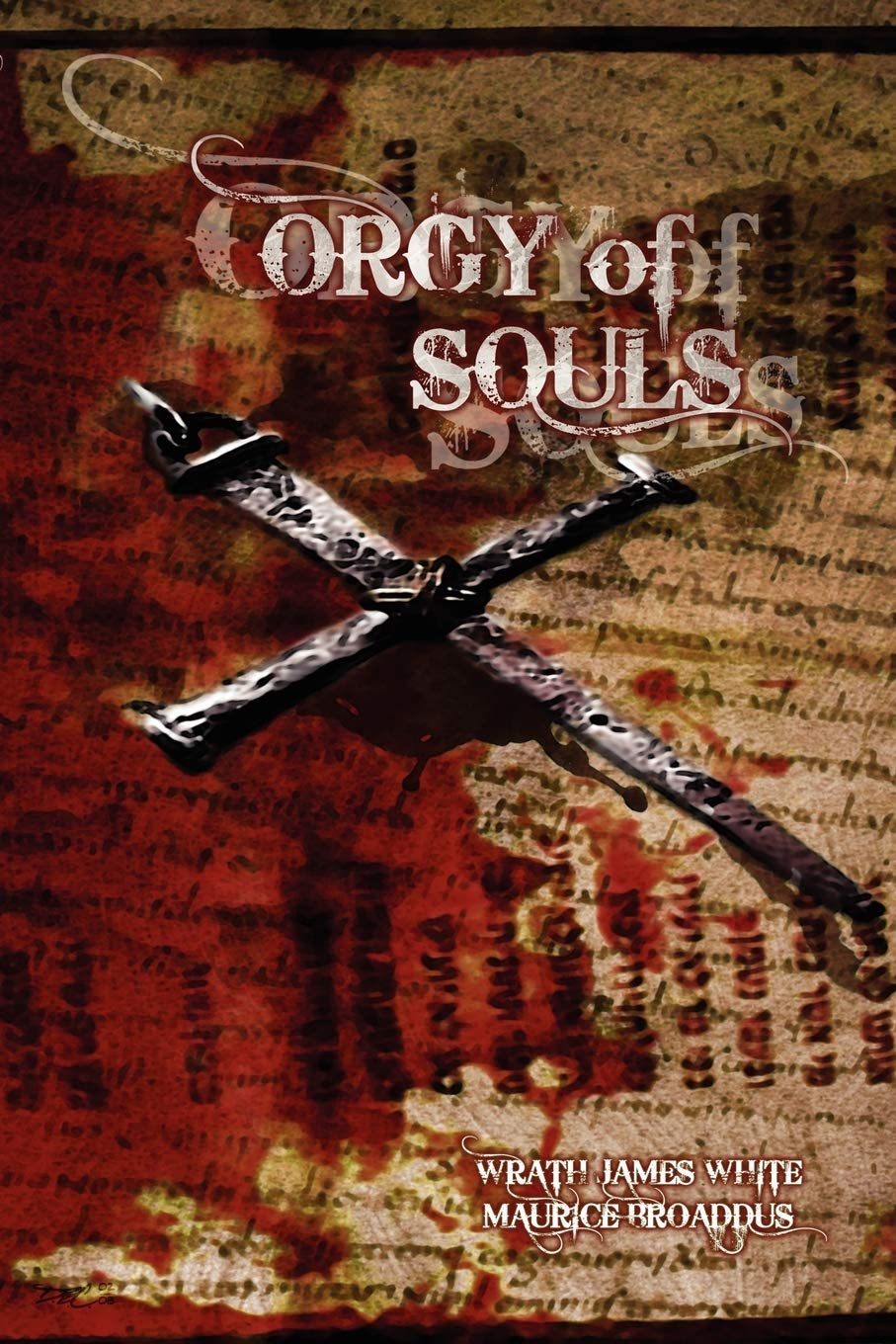
Orgy of Souls, with Maurice Broaddus, is the exception and it is genuinely good. Two brothers, one a minister dying of AIDS and one a musician who is not, and a bargain, and the theological argument between them is the book. Broaddus is a Christian writer and White is not, and the disagreement is real rather than staged.
Hero is with J. F. Gonzalez, and The Killings is with Keene.
The pattern is that collaboration usually pulls him toward the extremity and away from the argument, and Orgy of Souls is the one where it went the other way.
Read that one, once it’s available again.
Where the Line Falls
Some of the Wrath James White books are where I stop recommending, and I’d rather say so than let a reader find out by accident.
Poisoning Eros, The Book of a Thousand Sins and 400 Days of Oppression are the titles to look at descriptions for yourself before buying. The first two are collections and novels built primarily around sexual extremity, and the third is a deliberately provocative novel about race and consent that has been argued about since publication.
I’m not going to characterize books I haven’t read, and I’m also not going to list them without a note, because a reader arriving here from The Resurrectionist deserves to know that the catalog is not uniform.
The test stays the same. When the extremity is doing work, White is one of the best writers in the field. When it isn’t, it’s the thing this site doesn’t recommend, and only you can decide which side a given book falls on once you’ve read what it’s actually about.
Where to Start
Read The Resurrectionist. It’s the best-made thing he’s done, it has a real idea at the center, and it is a fraction as extreme as his reputation.
Then Yaccub’s Curse if you want to see the ambition, or Population Zero if you want something short.
The Bug Collector is the ceiling, not the entry point. Go there last, if at all, and take the warnings at the front of it seriously, because they are not decorative.
And if you want the wider scene this sits in, both extreme horror and splatterpunk have their own guides, and White co-founded the awards that hold the modern scene together.
Everything else worth reading is on my best horror books list. He is the hardest end of my extreme horror list.