Christopher Buehlman is the best horror novelist most horror readers have never heard of, and the reason is that he keeps changing period.
A Depression-era hobo novel. A Southern gothic. A vampire book set in seventies New York. A medieval plague epic. A comic fantasy about a thief. There is no series to follow, no recurring detective, and no reliable shelf, which is excellent for readers and terrible for a career.
What is consistent across the Christopher Buehlman books is the prose. He was a poet first, he won the Bridport Prize, and he writes sentences that are noticeably better than the genre requires without ever slowing the book down. He also worked for years as an insult comic at Renaissance faires, which shows up in the dialog.
And he narrates his own audiobooks, unusually well. Several of his readers came to him that way and will tell you the audio is the better format.
I haven’t read these. What follows is the critical consensus.
Fiction by René Rehn


The Short Version
Read Between Two Fires. It won nothing on release, built a reputation entirely by word of mouth, and is now regularly named one of the best horror novels of the century.
Then The Lesser Dead if you want the vampires, or Those Across the River if you want the Southern one.
The Essential
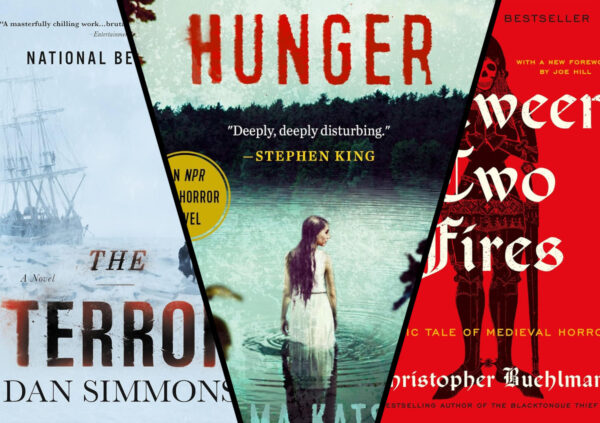
Between Two Fires (2012)

France, 1348. A disgraced knight, a starving orphan girl who says she speaks with angels, and a road north through a country that the Black Death has already emptied.
The war in heaven is happening and the right side is losing. The demons are literal, numerous, embodied and specific, and they are winning, and the novel takes the theology entirely seriously rather than using it as scaffolding.
The medieval detail is what makes it unbearable. The smell, the roads, the abandoned villages, the arithmetic of a plague that has already killed half of everyone, the specific cruelty of soldiers with nothing to do. The middle section in Paris is the part everyone talks about.
It sold modestly on release and its reputation has grown steadily ever since, largely through readers pressing it on each other. That is usually a sign of something.
Also on religious horror and historical horror.
The Lesser Dead (2014)

New York, 1978. Joey Peacock is a vampire who looks fourteen, lives in the subway tunnels with a small group of others, and is having a marvelous time.
The voice is the whole book. Joey narrates directly to the reader, charmingly, and he is a liar, and working out what he is lying about is the actual plot. Then the novel finds something worse than vampires in the tunnels.
It won the American Library Association’s Alex Award, and it’s the most purely entertaining thing he has written. The seventies New York material is excellent.
Also on vampire books.
Those Across the River (2011)

Whitbrow, Georgia, 1935. Frank Nichols, a disgraced history professor, and his wife Eudora arrive to take up a house Frank has inherited, and he intends to write a book about his great-grandfather’s plantation, which stood across the river.
The town has a custom. Twice a year they drive two pigs across the bridge into the woods and leave them, and they have been doing it since before anybody living can remember, and the Depression means they can no longer afford the pigs.
The novel is patient for a long time. Frank’s marriage, the Depression, the research, the town’s manners, and the specific way a Southern community declines to explain itself to an outsider.
What is over the river is connected to what the plantation was, and Buehlman does not soften the history.
It was his first novel, published when he was in his forties, and it was nominated for the World Fantasy Award.
Also on southern gothic and folk horror.
The Rest
The Necromancer’s House (2013)

Andrew Blankenship is a recovering alcoholic and a competent wizard living in a house on a lake in upstate New York, full of things he has collected and bindings he has made, and he attends AA meetings and works on his sobriety.
Then somebody in Russia notices that a particular object in his possession is missing from where it should be, and Baba Yaga comes for it.
The magic is the best thing in it. Buehlman treats it as a craft with materials, costs and a supply chain, and Andrew is good at it in the way a competent tradesman is good at something, and the descriptions of what he keeps in the house are the pleasure of the book.
The AA material is serious and drawn from something.
Baba Yaga is genuinely frightening, treated as folklore rather than as fantasy, and the sections in Russia are the strongest.
It is his funniest and most inventive novel.
The Blacktongue Books

He also writes fantasy and it is not a sideline.
The Blacktongue Thief (2021) is narrated by Kinch Na Shannack, a thief in enormous debt to the Takers Guild, who is assigned to accompany a knight on a journey across a continent where two wars against goblins have killed most of the men and most of the horses.
The world-building is what fantasy readers cite first. The goblin wars leave consequences running through everything: the demographics, the economy, the fact that women hold the military, the absence of horses. Buehlman worked it out properly rather than gesturing at it.
Kinch’s voice is the other half and it is very funny.
The Daughters’ War (2024) is the prequel, following Galva during the second goblin war, and it is considerably grimmer and several readers prefer it.
A third is coming. The fantasy is where his career is now.
The Suicide Motor Club (2016)

A black Ford Falcon runs cars off the highway at night in the American Southwest in the sixties, and the people in it feed on the wreckage.
Jude Lanchester’s husband and son are killed when they are forced off the road, and she survives, and she does not remember what she saw because the vampires can take memories.
Then she starts remembering.
The premise is the whole appeal. Buehlman’s vampires are a road gang rather than aristocrats, they are stupid and cruel and enjoying themselves, and the period detail on American car culture and highway motels is exact.
Jude’s route into fighting them runs through a convent, which is a genuinely strange choice and works.
Most who’ve read the full catalog rank it his weakest horror novel, a premise that deserved a better book, and the last act reverts to a conventional chase.
Read it after the other three.
Where to Start
Read Between Two Fires, and give it the first hundred pages, because the road takes a while to become the book.
If the medieval material puts you off, read The Lesser Dead instead, which is fast, funny and vicious.
Those Across the River is the most conventional entry point and the safest recommendation.
And if you finish those and want more of the writing rather than the horror, the Blacktongue books are where the rest of the Christopher Buehlman books have gone.
For the wider canon, see my horror classics page. The faith running under the medieval novels is on my religious horror list.