There’s a decent argument that Stephen King is a better novella writer than he is a novelist. The novellas are the evidence.
Look at what’s been adapted. The Shawshank Redemption, Stand By Me, The Mist, Apt Pupil, The Life of Chuck, 1922, Secret Window. Every one of those came from a novella, and several sit well above the film versions of the big novels. The reason isn’t mysterious. King’s great weakness as a novelist is that he doesn’t always know when to stop, and the novella takes that decision away from him. A hundred pages of King with the padding removed is a formidable thing.
The problem is that the Stephen King novellas are scattered. Four are in dedicated collections, a good number are buried inside the short story collections where nobody thinks to look for them, and a few were published as standalone books. This is a guide to all of it.
I should say up front which parts of this I’ve read. I’ve read all six of the short story collections, which means I’ve read the novellas hiding inside them, and those get my own verdicts below. The four novella collections I haven’t got to yet, so that section is the critical consensus rather than my opinion.
Fiction by René Rehn


The Short Version
Start with Different Seasons. It’s the best of the four collections, it contains Shawshank and The Body, and only one of the four pieces in it is horror at all.
Then Full Dark, No Stars if you want the mean one, or If It Bleeds for late King.
And if you’ve already done those, the real find is N., which is buried in a short story collection and is one of the best things he’s written.
The Four Novella Collections
I haven’t read these. What follows is the critical consensus.
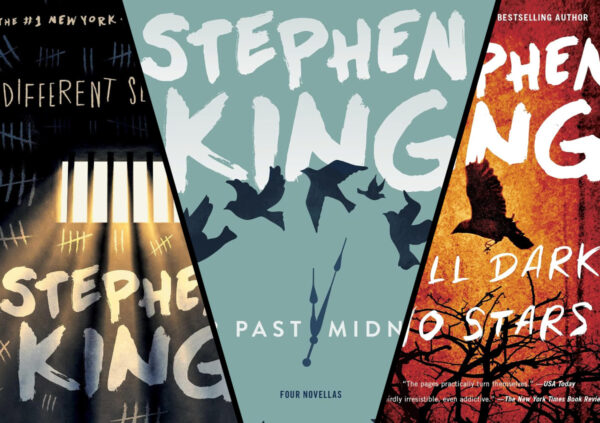
Different Seasons (1982)

Four novellas, three of them not horror, and the book that proved King could do something other than scare people.
Rita Hayworth and the Shawshank Redemption became the film, and the novella is generally held to be just as good, with the same patient accumulation of small prison details. Apt Pupil is the horror one in everything but the supernatural: a teenage boy discovers a Nazi war criminal living quietly in his suburb and blackmails him into telling stories, and the two of them corrupt each other. It’s the most disturbing thing in the book by a distance. The Body became Stand By Me and is the one people cry about. The Breathing Method is the actual ghost story and the slightest of the four.
Consensus puts this at the top, and the usual line is that it’s the best entry point to King for someone who doesn’t like horror.
Four Past Midnight (1990)

King’s own introduction says this one is straight horror, unlike its predecessor. It won the Bram Stoker Award for Best Collection.
The Langoliers is the famous one, a red-eye flight where most of the passengers vanish mid-air and the survivors land in a world that’s subtly wrong. Secret Window, Secret Garden is a writer accused of plagiarism by a stranger who won’t go away, filmed with Johnny Depp. The Library Policeman has the reputation for the single most upsetting scene, and The Sun Dog is a Castle Rock story about a Polaroid camera that photographs something that isn’t there.
Reception is a step below Different Seasons, with reviewers generally saying the pieces run long even by novella standards.
Full Dark, No Stars (2010)

Four novellas about retribution, and by consensus the nastiest book King has written. It won both the Bram Stoker and the British Fantasy Award for Best Collection.
1922 is a farmer’s confession to murdering his wife, and the rats that follow. Big Driver follows a writer after a roadside assault and is brutal enough that plenty of readers warn about it. Fair Extension is a deal with the devil played almost as comedy, and the meanest thing in the book. A Good Marriage asks what a woman does after twenty-five years of marriage when she finds out what her husband has been doing.
The recurring note in reviews is the total absence of comfort, which is both the design and the warning.
If It Bleeds (2020)

The most recent of the four, and the one that shows late King in a gentler register.
Mr. Harrigan’s Phone is a boy and an old man and a smartphone left in a coffin. The Life of Chuck is told in three acts running backwards and has been widely called one of the best things he’s written in decades. Rat is a writer at a cabin making a bad bargain. If It Bleeds is a Holly Gibney story, and how much you enjoy it depends on how you feel about Holly.
Consensus rates The Life of Chuck as the standout and the collection overall as solid rather than essential.
The Stephen King Novellas Hiding in the Short Story Collections
This is the part most guides miss. Several of his best long pieces were never given their own book, and sit halfway through a collection of short stories where nobody looks for them.
I’ve read all six of those collections, so these are my own verdicts. There’s more detail on the books they come from in my ranking of the Stephen King short story collections.
The Mist (Skeleton Crew)

The best thing in the shorter work and it appeared first in the Dark Forces anthology in 1980 before Skeleton Crew collected it.
A storm comes through a Maine lakeside town and afterwards a mist rolls in off the water. David Drayton is in the supermarket with his five-year-old son buying supplies when it arrives, and the doors close, and about eighty people are inside.
What is in the mist is genuinely well done and King keeps it mostly unseen, but the creatures are not the subject.
Mrs. Carmody is. She is a local woman nobody liked, she starts preaching in the aisle by the second day, and by the third she has a congregation, and by the fourth she is nominating people for sacrifice. King is exact about the sequence and about how normal each step looks from inside.
The ending is deliberately unresolved. Darabont’s 2007 film supplies one, King has said publicly he wishes he had thought of it, and it is considerably crueler.
N. (Just After Sunset)

Fifty pages in Just After Sunset, and no cosmic horror King has written beats it.
A psychiatrist takes on a patient with obsessive compulsive disorder, identified only as N., who counts things and arranges objects and has to touch things a set number of times. The compulsion started after he visited a field in rural Maine called Ackerman’s Field, which has eight standing stones in it, except that sometimes there are seven.
The rituals are holding something shut. When N. stops performing them, the gap opens.
The structure is what makes it. The story is told through the psychiatrist’s case notes, then his own journal, then his sister’s letters, and the compulsion transmits itself to each person who reads the previous document, including at least implicitly the reader.
King has said it is a deliberate response to Machen’s “The Great God Pan,” which is the same source he went to for Revival.
The counting is the reason people find it hard to shake.
Ur and Morality (The Bazaar of Bad Dreams)

Two very different pieces from the same collection.
Ur was commissioned by Amazon as a Kindle exclusive in 2009 and it is about a Kindle. A college lecturer buys a pink one after an argument with his girlfriend about paper books, and it arrives with menus that should not exist: an archive of novels by authors from other realities, including Hemingway books that were never written, and a newspaper function that reports events that have not happened yet.
It is a commissioned piece about the device it was sold on, and King makes it work by taking the paradox seriously.
Morality has nothing supernatural in it at all. A retired minister with a stroke offers a young couple who are broke a large sum of money if the wife will commit one act of deliberate cruelty against a stranger and film it.
She does. The novella is about what it costs afterwards, and it is one of the nastiest things he has written.
Everything’s Eventual and Riding the Bullet (Everything’s Eventual)

The title story is one of his best and almost nobody names it.
Dinky Earnshaw is nineteen, works at a pizza place, and discovers he can draw a specific arrangement of symbols that kills anybody who looks at it. A company finds him, pays him well, gives him an apartment, and sends him names.
The horror is the employment. Dinky is not troubled by the work, he is troubled by the possibility of losing the job, and King is exact about how quickly a young man with no prospects will accept an arrangement that is obviously wrong.
Riding the Bullet was published in 2000 as the first mass-market ebook, sold four hundred thousand downloads in a day, and crashed the servers. It is a hitchhiking story: a student going to see his mother in hospital gets picked up by a driver who is dead, and is offered a choice.
The technological footnote has outlived the story, which is a shame, because it is very good.
Dolan’s Cadillac (Nightmares and Dreamscapes)

A schoolteacher’s wife witnesses something and is killed by a car bomb, and the man responsible is untouchable, and the teacher spends seven years planning.
There is nothing supernatural in it. What there is instead is a procedural revenge story in which almost all the tension comes from logistics: how to get a highway crew’s schedule, how to hire the equipment, how much a man can dig in the desert in a night, and the precise dimensions required.
King spends pages on the arithmetic of the hole, and the arithmetic is the story.
It is Poe transposed, openly. The Cask of Amontillado is the model and King does not hide it, and Dolan’s fate is Fortunato’s with a Cadillac Sedan DeVille instead of a wine cellar.
The narrator hears his dead wife’s voice throughout, which is either grief or something else, and King leaves it alone.
Filmed in 2009 with Christian Slater.
The Gingerbread Girl (Just After Sunset)
A woman loses an infant daughter to sudden infant death syndrome, cannot function, and starts running.
That’s the first third, and the novella works because of it. Emily runs because it is the only thing that stops her thinking, she runs further and further, her marriage ends because of it, and she ends up alone in her father’s beach house on a Florida key running the length of the island twice a day.
Then she looks into a car in a neighbor’s driveway.
The second half is a straightforward captivity thriller and it is extremely tense, and the reason it lands is that King spent the first half establishing that this woman can run further than anybody expects and has nothing left to lose.
It is in Just After Sunset alongside N., which makes that collection the strongest of the later ones.
Roughly ninety pages, and one of the few King pieces with a female protagonist carrying the whole thing.
The Ballad of the Flexible Bullet (Skeleton Crew)
An editor at a dinner party tells a story about a writer he once worked with, and nothing in Skeleton Crew is stranger.
Reg Thorpe was a brilliant young novelist who became convinced that a creature called a Fornit lived in his typewriter and supplied the good sentences, and that the electricity company was trying to kill it. The Fornit’s name was Rackne.
The editor, who is drinking heavily and coming apart himself, decides to humor him in letters, and then starts to believe it, and the story is about a folie à deux conducted by correspondence between two men who are both losing.
King wrote it while deep in his own addiction and it reads like it. The passages about the editor’s drinking and about what he is prepared to accept in order to keep a talented writer working are uncomfortably specific.
The title comes from a line about the mind being a flexible bullet, and it is one of his best pieces of writing at any length.
The Standalone Novellas
A handful were published on their own.
Elevation (2018) is a short, warm, strange book about a man in Castle Rock who is losing weight without getting smaller. Barely horror, filed by most reviewers as minor but likable.
Gwendy’s Button Box (2017), written with Richard Chizmar, is a Castle Rock story about a girl given a box with buttons that do things. It spawned two sequels.
Cycle of the Werewolf (1983) is a novella in twelve parts, one per month, illustrated by Bernie Wrightson, and the source of the film Silver Bullet.
Where to Start
If you want the reputation, read Different Seasons. It’s the collection everything else is measured against and two of the four became films you’ve probably seen.
If you want to be frightened, read Full Dark, No Stars, and take the warnings about Big Driver seriously.
And if you already know the famous ones, go and find N. It’s the best of the buried Stephen King novellas and almost nobody points you to it, which is the main reason this page exists.
My best horror books list ranks the rest of the genre. The short fiction is on my Stephen King short stories page.