Before anything else, a warning about Japanese mystery novels that will save you money. The author index lives on my Japanese authors hub.
Japanese mystery novels arrive in English out of order and incomplete, and nobody tells you. Yukito Ayatsuji’s house series runs to ten books. Four are translated, and the English editions go one, two, three, five, because nobody has done the fourth. Keigo Higashino’s Malice is the fourth Kaga novel, and the third and fifth do not exist in English, so you meet the detective a third of the way into his own career. Futaro Yamada’s The Meiji Guillotine Murders is one book pulled from a whole cycle of Meiji-era mysteries, and the only one you can read. Uketsu’s English debut is his second Japanese book, and the third English release is a sequel to the second.
Four authors, four different failures, one list of Japanese mystery novels. It is a condition of the category rather than an accident, and every entry below says where you are standing.
The second thing worth knowing is that Japanese detective fiction has three names for itself and English-language coverage only ever uses one.
Honkaku is the fair-play puzzle: every clue on the page, the reader invited to solve it, an unbreakable contract between writer and reader. Everybody explains this one. Shakai-ha, the social school, is what displaced it. Seicho Matsumoto won a prize in 1957 for a short story and effectively ended honkaku’s dominance for thirty years by arguing that motive matters more than mechanism and that crimes come out of societies rather than out of clever floor plans. Iyamisu, roughly “eww mystery”, is the contemporary strain: grisly, mean, interested in the worst of people. The critic Aoi Shimotsuki coined it in 2006.
The history of Japanese detective fiction is an argument between those three, and it is still going.
The third thing is a piece of publishing history that explains what you can and cannot buy. Almost none of this existed in English fifteen years ago. Locked Room International, a tiny specialist press, published Ayatsuji in 2015 and proved there was a market. Pushkin Vertigo scaled it, and now carries Yokomizo, Shimada, Ashibe and Yamada. Soho Crime ran the noir side in parallel. Then Uketsu got big enough that HarperCollins arrived. If you found this genre through one of those imprints, there is a decent chance you have never encountered the half of it published by the others.
They sit inside the wider tradition mapped on my list of the best Japanese novels. Below: nineteen Japanese mystery novels, grouped by which side of the argument they are on. Every entry says which edition to buy and where in the sequence you are landing.
The Founders
Beast in the Shadows
Edogawa Ranpo · 1928 · translated by Ian Hughes

Everybody calls Ranpo the father of Japanese mystery novels, and it is nearly true. The genre starts in 1889 with a journalist named Ruiko Kuroiwa, who spent two years adapting French crime novels into Japanese, moving the settings to Japan and renaming every character, and then wrote Muzan, generally recognized as Japan’s first detective story. He was not trying to join a Western tradition. He was using its machinery to attack the Meiji justice system and argue against the death penalty. Ranpo grew up reading him.
What Ranpo did was make Japanese detective fiction native. He took the pen name because it sounds like Edgar Allan Poe said quickly in Japanese, founded the Mystery Writers of Japan, and left a prize that still carries his name.
Beast in the Shadows is the one to read if you want the detective side rather than the horror side. A mystery novelist is approached by a woman being stalked by a man who claims to have loved her years ago and now writes her letters describing her private life in detail. The novelist investigates. The man he is hunting is a rival mystery novelist, or may not exist, and the deeper the narrator goes the harder it becomes to trust the person telling you about it.
It is detective fiction about detective fiction, written in 1928 by the man who had just invented the Japanese version, and it is already suspicious of the form. Everything on this page after him is arguing with something he set up.
The Honjin Murders
Seishi Yokomizo · 1946 · translated by Louise Heal Kawai · English 2019

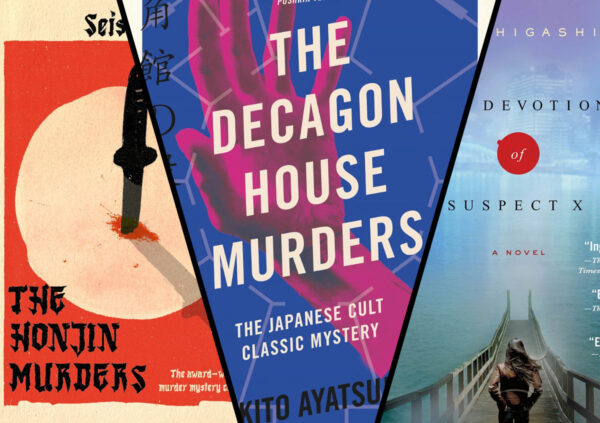
The purest locked room in Japanese mystery novels, and the book that proved the form could survive being transplanted.
Consider only the mechanism. Among Japanese mystery novels nothing is built tighter. A newly married couple die inside a sealed annex. The snow around the building is unmarked. A koto sounds in the night. A blood-stained sword stands upright in the garden, driven into the ground. A three-fingered man has been seen in the village. Every one of those elements is a clue rather than atmosphere, and every one of them is on the page before the solution.
Yokomizo’s real position in this history is as the bridge. He was writing in 1946, twenty years after Ranpo established the genre and forty years before shin honkaku revived it, and he is the reason there was anything to revive. When Ayatsuji and Shimada rebuilt the fair-play novel in the eighties they were rebuilding what Yokomizo had done.
It took the Mystery Writers of Japan Award in 1948, and the organization still lists it first among its own prizewinners that an English reader can buy.
On the series. Kindaichi appears in seventy-seven books, more than any other detective in Japanese mystery novels. Pushkin Vertigo has translated a handful, including The Village of Eight Graves and The Devil’s Flute Murders. This one is first chronologically and the right place to start, but be clear that you are sampling rather than reading a series.
Shakai-ha: The Social School
In 1957 Seicho Matsumoto won the Mystery Writers of Japan Award for a short story called The Face, and Japanese crime fiction changed direction for thirty years. His argument was that the puzzle had become a parlor game, that motive mattered more than method, and that a murder is produced by a society rather than by a floor plan.
And the strangest part is who helped him. Ranpo, who had built the tradition Matsumoto was dismantling, publicly praised his work. When the magazine serializing one of Matsumoto’s novels folded, the serial moved to Hoseki, where Ranpo was editor-in-chief. The founder of Japanese detective fiction personally published the man who ended his era.
Matsumoto never accepted the label. He insisted his books were not detective fiction but deduction fiction.
Tokyo Express
Seicho Matsumoto · 1958 · translated by Jesse Kirkwood · English 2022

Two bodies on a beach in Kyushu, a man and a woman, apparently a double suicide. A local detective is not satisfied, and neither is a Tokyo investigator, and what follows is two hundred pages of train timetables.
That sounds like a joke and it is the entire method, and no other entry in these Japanese mystery novels is quite so literal about it. The alibi in this book is built out of the Japanese rail network, and demolishing it requires understanding exactly which trains ran, when, and who could have been visible on which platform for how many minutes. Of all the Japanese detective novels here it is the most local: the murder is solved by timetable, and the murderer is protected by a bureaucracy that would prefer the case closed.
A buying warning, because this book has two lives in English. It was first translated as Points and Lines, by Makiko Yamamoto and Paul C. Blum. Penguin Classics reissued it in 2022 as Tokyo Express in a new translation by Jesse Kirkwood. Same novel, two titles, two translations, two publishers, and a reader who knows one will not find the other. Get the Kirkwood.
Matsumoto published more than four hundred and fifty books, a career with no equal in Japanese mystery novels, and was the highest-earning writer in Japan through the 1960s. Almost none of it is in English.
All She Was Worth
Miyuki Miyabe · 1992 · translated by Alfred Birnbaum

A policeman on leave with a broken leg is asked by a relative to find his missing fiancée. She has vanished, and as he works backwards through her life it stops being a missing person case and becomes an investigation into consumer credit, personal bankruptcy and what a person’s identity is worth on the open market in bubble-era Japan.
This is shakai-ha in its purest available form, and the most sociological of the Japanese mystery novels here. The crime exists because of the economy. Nobody in it is evil. A woman is destroyed by credit card debt and the system that issued it, and the novel is more interested in the mechanics of Japanese bankruptcy law than in the killer.
The literary scholar Amanda Seaman called it a watershed in the history of women’s detective fiction and credited it with opening the way for a generation of women crime writers who followed. Read it next to Out, further down this page, and you have two novels eleven years apart about women crushed by money, by the two writers who made that a subject.
Start here rather than elsewhere. Miyabe has been enormously prolific and the English selection is scattered. The Sleeping Dragon won the Mystery Writers of Japan Award and is worth having, but it assumes you already know her. Her acknowledged masterpiece, Puppet Master, is available in English only as a Japan-only ebook in five volumes, which is a shame worth knowing about.
The Thief
Fuminori Nakamura · 2009 · translated by Satoko Izumo and Stephen Coates · English 2012

A pickpocket works Tokyo with unusual skill and no name. He lifts wallets from men who will not miss them, returns some of the contents, and lives in a deliberate absence of connection to anyone. Then a man from his past finds him and gives him three jobs, and the third one is not survivable.
Nakamura is where Japanese mystery novels meet existentialism without embarrassment. The plot is thin on purpose. What the novel is about is a man who has arranged his life so that nothing can reach him, discovering that someone has been arranging him in turn, and the tower that keeps appearing at the edge of his vision is not explained and does not need to be.
The credentials are extraordinary for a book this short. It won the Kenzaburo Oe Prize in 2010, which is judged by Oe alone, so Japan’s second Nobel laureate personally selected it. Nakamura also holds the Akutagawa Prize. In America it was a finalist for the Los Angeles Times Book Prize and received the David L. Goodis Award for Noir Fiction, which is an American noir prize going to a Japanese novelist and about as clean a confirmation as this section could ask for.
Natsuo Kirino, who is two entries below, said she wanted to write something like it herself.
Six Four
Hideo Yokoyama · 2012 · translated by Jonathan Lloyd-Davies · English 2017

Six hundred pages about a police press officer.
Mikami used to be a detective and is now the man who manages journalists on behalf of a prefectural force, which everyone including him regards as a demotion. His daughter has run away. And the fourteen-year-old kidnapping case that defined the department, known internally as Six Four, is about to have its anniversary, with a commissioner’s visit attached and something buried in the file that nobody wants found.
Almost nothing happens for a very long time and it is one of the great Japanese detective novels. Its subject is institutional in a way few Japanese mystery novels attempt: territorial warfare between departments, the press club system, information withheld as currency, a man who has lost his standing and is trying to work out whether he still believes in the organization that took it.
Yokoyama was a police reporter in Gunma for twelve years before he wrote fiction, which is why the newsroom scenes are as convincing as the police ones. He spent ten years writing this and had a heart attack partway through and carried on. Lloyd-Davies then spent over a year translating it, working alone, reading Japanese police records to get the ranks and procedures right. A novel about bureaucratic exhaustion, produced through a decade of it.
Shin Honkaku: The Revival
In 1987 a Kyoto University student published a locked-room mystery that ignored thirty years of social realism entirely, and the puzzle came back. Shin honkaku, the new orthodox school, is what most English-language readers now think Japanese mystery novels are, largely because it is what got translated first.
The Tokyo Zodiac Murders
Soji Shimada · 1981 · translated by Ross and Shika Mackenzie

An artist is found murdered in his locked studio, having left a manuscript explaining his plan to kill six young women in his family and assemble their body parts into a perfect being called Azoth. He is dead. The murders happen anyway. Forty years later, two amateurs sit down to solve it.
The book stops partway through and tells you that you now have every piece of information the detectives have, and challenges you directly to name the solution. That device is old, and the reason it works here is that the solution is available and almost impossible to see, and when it arrives it reorganizes everything you have read.
Shimada is the godfather of shin honkaku and of most of the Japanese mystery novels written since. He wrote this in 1981, six years before Ayatsuji, and spent the following decades championing younger writers, including writing the introduction to Imamura’s debut further down this page.
Not for everyone. The Azoth plan is gruesome, the prose is functional, and the cast exists to serve the mechanism. If you want characters, start elsewhere on this page.
The Decagon House Murders
Yukito Ayatsuji · 1987 · translated by Ho-Ling Wong · English 2015

Seven university mystery club members spend a week on an island that saw four killings half a year before they arrive. They have nicknamed themselves after Western detective writers: Ellery, Carr, Poe, Van Dine, Agatha, Leroux, Orczy. The house at the center has ten sides. On the first morning there are seven plates on the table, each marked with a role, and one of them says victim.
This is the book that restarted the tradition and the book that started the translation wave that brought Japanese mystery novels into English at all. It borrows its structure openly from And Then There Were None, and the characters discuss Christie by name while it happens to them, and none of that is a joke at the reader’s expense. Ayatsuji is arguing that the fair-play mystery was never exhausted, only abandoned, and the final revelation is one line long and lands like a dropped weight.
He founded the Honkaku Mystery Writers Club of Japan and came out of the Kyoto University Mystery Club, which has produced a startling proportion of the country’s crime writers. So did his translator. Ho-Ling Wong belongs to both organizations, which makes him something rarer than a translator: a member of the tradition he is carrying across.
On the series, and read this before you buy. The Bizarre House novels run to ten in Japanese. Four are in English, all from Pushkin and all translated by Wong: this, The Mill House Murders, The Labyrinth House Murders and The Clock House Murders. That is books one, two, three and five. The Doll House Murders has never been translated, so the English sequence has a hole in it that nobody mentions. Every book features the same detective and a house designed by the same fictional architect.
Death Among the Undead
Masahiro Imamura · 2017 · translated by Ho-Ling Wong · English 2021

A university film club rents a mountain lodge. A bioterrorism incident nearby surrounds the building with the reanimated dead. And then, inside the lodge, someone starts committing locked-room murders.
The premise sounds like a gimmick and the execution is the opposite of one, which is true of more Japanese mystery novels than the covers suggest. The rules governing the zombies are stated precisely and then obeyed without exception, and those rules generate the boundaries of the puzzle. The siege supplies the closed circle. The behavior of the dead is fair-play evidence. It is a Golden Age country house mystery in which the house is under siege and the detection still obeys every rule Knox laid down, and it is the strangest thing in Japanese detective fiction.
It swept the major annual Japanese mystery rankings in a single year, which nobody had managed before, and became a film and a manga. Soji Shimada wrote the introduction, calling it a work of great importance, which is the elder statesman of shin honkaku blessing the debut that revived it thirty years on.
One honest note. Not everyone is convinced. At least one well-regarded locked-room specialist has written that the praise is overdone and that the setup promises more than the solution delivers. And the combination was not new: Masaya Yamaguchi’s Death of the Living Dead did it in 1989. This is the book that broke through, not the one that invented the idea.
Murder in the House of Omari
Taku Ashibe · 2021 · translated by Bryan Karetnyk · English 2025

An Osaka merchant family collapsing across forty years. In 1906 the heir climbs a tower and does not come down. In 1914 two figures fight on a bridge and one falls. By 1943 the family is finished, both remaining heirs have been conscripted, and the house begins producing corpses.
It is orthodox in the most literal sense: a diagram of the building at the front, a long cast list, and every crime constructed to be solved rather than experienced. It won both the 2022 Mystery Writers of Japan Award and the Honkaku Mystery Award for Best Fiction, which very few books manage.
Ashibe was a journalist at the Yomiuri Shimbun’s Osaka office, won the inaugural Ayukawa Prize in 1990, and has been publishing crime fiction for thirty-five years across more than two dozen novels with titles like The Puzzle Box of 300 Years. In English there is this and one other book. An award-winning novelist of three and a half decades, represented by two volumes.
One honest note. Publishers Weekly called it a bumpy ride, and readers consistently report the pacing sags where the historical background takes over. If you want momentum, this is not the entry point.
The Meiji Guillotine Murders
Futaro Yamada · 1979 · translated by Bryan Karetnyk · English 2023

Tokyo, 1869. The shogunate is gone, the civil war has just ended, and a brand-new police force is trying to impose order on a city full of unemployed samurai and imported ideas. Two chief inspectors, Kazuki and Kawaji, work a series of impossible murders with the help of a shrine maiden who channels the dead.
The pleasure here is historical rather than mechanical, which sets it apart from the Japanese mystery novels around it. The Meiji settlement is being improvised in real time, nobody knows which side will win, and the crimes are entangled with a political order inventing itself week by week. Yamada wrote it in 1979, and it reads as a book about how a country decides what to become.
Two things to know before buying. This is one novel pulled from Yamada’s long cycle of Meiji-era mysteries and the only one in English, so you are joining a long-running project at the point a publisher chose. And Yamada is not primarily a crime writer in Japan at all. He is best loved there for his ninja novels, which have been adapted into films, television, manga and anime for decades. What English readers have been handed is one strand of a hundred-book career.
One honest note. Reviewers agree it is slow and confusing to start and heavier on history than the cover suggests, and the structure becomes predictable once you realize who will be explaining each solution.
Iyamisu: The Unpleasant School
The contemporary strain of Japanese mystery novels, named in 2006 and built on the worst of people. Not puzzles, not procedure. Motive taken past the point of comfort.
Out
Natsuo Kirino · 1997 · translated by Stephen Snyder · English 2003

As a crime novel specifically, the interesting thing about Out is that the investigation almost does not matter.
You know who killed the husband from the start. What follows is a study of what four women with no money and no options do about a body, and then what happens when the solution to that problem turns out to be a marketable skill. The plot machinery is loan sharks, a casino owner, a bodyguard with his own history, and a slow drift from cover-up into enterprise.
Kirino was writing before iyamisu had a name and the book is its founding text. The cruelty is not decorative and the women are not redeemed. The book’s argument is that the night shift at a boxed-lunch factory has already prepared these women for anything, and that the thing standing between an ordinary person and something much worse is opportunity rather than character.
The Mystery Writers of Japan Award at home, and in 2004 an Edgar nomination for Best Novel, which no Japanese novel had previously reached.
Confessions
Kanae Minato · 2008 · translated by Stephen Snyder · English 2014

A middle school teacher stands in front of her class on the last day of term and tells them her four-year-old daughter did not drown accidentally. Two of the children in this room killed her. She knows which two. She has already taken her revenge, and she explains what she has done, and then term ends.
That is the first chapter. The rest is other voices going back over the same events, and each one makes the situation worse.
This is the iyamisu novel. Minato is called the queen of the form in Japan and she earned it here, in a debut that sold over three million copies. It is not a whodunnit and barely a thriller, and it has almost nothing in common with the Japanese detective fiction above it. It is a machine for demonstrating that everybody involved is worse than they appeared one chapter ago, including the woman you started out agreeing with.
Minato was a home economics teacher who spent two years volunteering in Tonga, then a housewife who began writing in her thirties. She grew up reading Ranpo, Christie, Higashino, Miyabe and Ayatsuji, four of whom are on this page. Only two of her novels exist in English.
Won the Japanese Booksellers Award, took an Alex Award in the United States, and was nominated for the Shirley Jackson Award.
The Aosawa Murders
Riku Onda · 2005 · translated by Alison Watts · English 2020

Seventeen people die of poisoning at a family celebration in a coastal town in 1973. The only member of the household to survive is the blind daughter, Hisako. Someone is convicted. The case is closed. And the novel is a collection of testimony, interviews, fragments and a book-within-the-book, assembled decades later by people who cannot agree on what happened.
There is no detective and there may be no solution, which makes it the least orthodox of these Japanese mystery novels and the most argued about. Onda gives you the material and declines to arrange it, and the reader ends up doing the work a detective would normally do, with the strong suspicion that it cannot be finished. It is the furthest thing on this page from fair play and it is deliberately in dialogue with it.
It won the Mystery Writers of Japan Award for Best Novel in 2006. The 1973 poisoning is a clear echo of the real Teigin Incident of 1948, one of Japan’s most contested criminal cases, where the convicted man spent decades on death row insisting on his innocence. A novel about a crime nobody can settle, built on a real crime nobody has settled.
Published in Japan as Eugenia, which is not a translation of the English title or the other way round.
Sisters in Yellow
Kiiroi Ie · 2023 · translated by Laurel Taylor and Hitomi Yoshio · English 2026

The newest of these Japanese mystery novels and the only one by a writer who had never touched crime before.
The frame is 2020: Hana, forty, catches a name in an online court report and drops back twenty-five years. At fifteen she shared a cramped flat with a hostess-bar mother, no money anywhere and no plan either. Kimiko arrived. The two of them opened a bar called Lemon in Sangenjaya, and the bar became a refuge, then a front, then something neither of them could get out of.
Kawakami called it a Breaking Bad story without the macho drama. Fair, and it undersells the real engine: what two women will do for each other when the alternative is going back. The yellow of the title is feng shui: the color that draws money.
Two things separate it from the other Japanese mystery novels above. It was serialized in the Yomiuri Shimbun before book publication, and it then took the 2024 Yomiuri Prize for Literature, which puts it in the company of Snow Country and The Woman in the Dunes.
One honest note. The length shows. Four hundred and forty-eight pages, and the weekly installments have left their joints in it. When The Times crowned her the most exciting Japanese novelist at work, the citation fit this book’s reach better than its wiring. The rest of her catalog is on my Mieko Kawakami books page.
Check your edition. Knopf in the US, Picador in the UK, both March 2026.
The Crossovers
Two writers who broke out of Japanese detective fiction entirely, forty years apart.
The Devotion of Suspect X
Keigo Higashino · 2005 · translated by Alexander O. Smith · English 2011

The killing is over by page thirty and you watched it. What the book is about is the man in the next flat, a mathematics teacher who heard it through the wall, worked out what had happened, and knocked to offer his help.
From there it is not a whodunnit but a duel, and it is the best known of all Japanese mystery novels in English for that reason. Ishigami against the police, and behind them against Manabu Yukawa, a physicist who knew him at university and is the one man breathing who can keep pace with how Ishigami thinks. You watched the killing. The question is not who but how far the man next door has gone, and the answer arrives in the last two pages and reorganizes the entire book.
The 134th Naoki Prize, the Honkaku Mystery Award, and second on the Japanese bestseller list for the year across every category of book. It arrived twenty years into a career of more than eighty novels and it is the one that carried his name out of the country.
It is the first Detective Galileo novel, so this one you can start at the beginning.
Malice
Keigo Higashino · 1996 · translated by Alexander O. Smith · English 2014

Read this second among these Japanese mystery novels, and read it because it is the exact inverse of the book above.
A novelist is murdered in his locked study. His best friend, also a writer, discovers the body. Detective Kaga makes an arrest quickly, obtains a confession quickly, and then hits the wall: the killer will not say why. Not evasion. Refusal. And the novel spends its length excavating a motive that turns out to be older, smaller and considerably worse than anything the investigation expected.
In Devotion you know who and the question is how far. In Malice you know who and how, and the only thing left is why. Higashino built a whodunnit with nothing in it but motive, which is the one thing Matsumoto said the puzzle school always neglected. The two books together are an argument about what Japanese mystery novels are for, conducted by one writer with himself.
A sequence warning. This is the fourth Detective Kaga novel. The third and fifth have not been translated. You are entering a series a third of the way in.
Strange Pictures
Uketsu · 2022 · translated by Jim Rion · English 2025

A masked man in a black bodysuit with an altered voice, over 1.7 million subscribers, no name and no face. He appears at press conferences in costume. Nobody knows who he is.
And the books are better than the gimmick deserves, which is not what anyone expected from the most-hyped Japanese detective fiction of the decade. Strange Pictures runs on drawings, a crayon house, a diagram from a blog, a notepad scribble, printed in full, with the prose circling each one until the wrongness comes forward. The answers connect across four apparently unrelated stories, and the final connection is difficult to see coming.
It sold in the hundreds of thousands in Japan, topped the German crime list, was a book of the month in France, and was nominated for a British Book Award. In Japan he is called the Edogawa Ranpo of the internet, which is a comparison this page can evaluate, since Ranpo opens it. His full catalog, manga included, is on my Uketsu books page.
Sequence warning, and this one is tangled. In Japanese, Strange Houses came first. In English, this did. The third English book, Strange Buildings, is a sequel to Strange Houses rather than a standalone. Also check your territory: HarperVia publishes him in the US and Pushkin Vertigo in the UK, so the two editions are not the same object.
Strange Houses
Uketsu · translated by Jim Rion · English 2025

His actual debut, arriving second in English.
A writer’s friend is house-hunting and forwards the floor plan for a second opinion. The house is ordinary except for a room with no windows and no obvious purpose, reached through a corridor that does not need to exist. The plan sits on the page in front of you, and the book’s whole engine is one refusal: it will not stop asking what kind of household ends up needing a space built to that shape.
It reads buildings the way other books read witnesses, which no other entry in these Japanese mystery novels attempts, and it is the purest thing he has done: no detective, no crime scene, just a diagram and the mounting sense that it records something terrible in right angles.
Read this before Strange Buildings, which continues it, whatever the English release order suggests.
What’s Coming
The pipeline for Japanese mystery novels in English is unusually visible right now, which is worth knowing if you are about to spend money.
Pushkin Vertigo’s 2026 Japanese slate is already landing. Uketsu’s Strange Buildings arrived in February, with Haruo Yuki’s The Ark, Alice Arisugawa’s Ghost Detective and Akane Araki’s Murder at the End of the World following it, more Yokomizo and Ayatsuji expected behind them, and Locked Room International still working the shin honkaku backlist.
Any list of Japanese mystery novels will need updating within a year. That is a good problem and a fairly new one.
What You Still Can’t Read
The untranslated half of Japanese detective fiction, and it is bigger than the part you can buy.
Six of Ayatsuji’s ten Bizarre House novels, including the fourth, which sits in the middle of a sequence English readers can otherwise follow. Almost all of Taku Ashibe, thirty-five years and two dozen novels reduced to two books. Most of Miyuki Miyabe, including Puppet Master, her masterpiece by her own translator’s account, marooned as a five-part ebook sold only inside Japan. Most of Kanae Minato, two novels out of a substantial career. And most of Seicho Matsumoto, who published over four hundred and fifty books.
The people fixing this are Pushkin Vertigo, Locked Room International and Soho Crime, and the fixing is recent and fragile. Kurodahan Press, who did comparable work on Japanese horror and weird fiction, shut down in March 2025 and took every title on their list out of print in one stroke. A press that size leaves no estate. The books just stop existing in English.
Buy the translations while they are in print. That is not a sales pitch, it is how this works.
Five of these have their own pages: The Honjin Murders · The Tokyo Zodiac Murders · The Decagon House Murders · The Devotion of Suspect X · Out. For the writers behind them, see the guides to Seishi Yokomizo, Yukito Ayatsuji, Seicho Matsumoto, Natsuo Kirino.