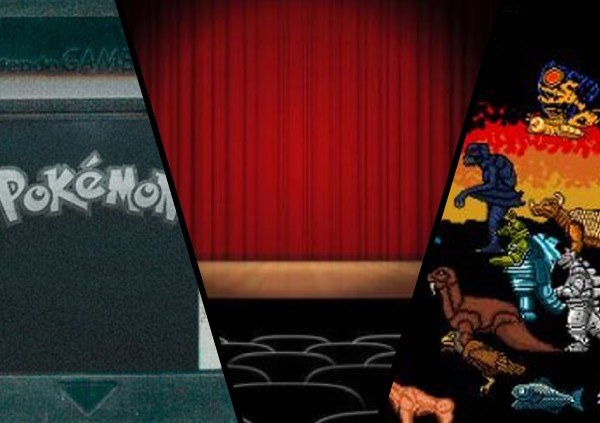
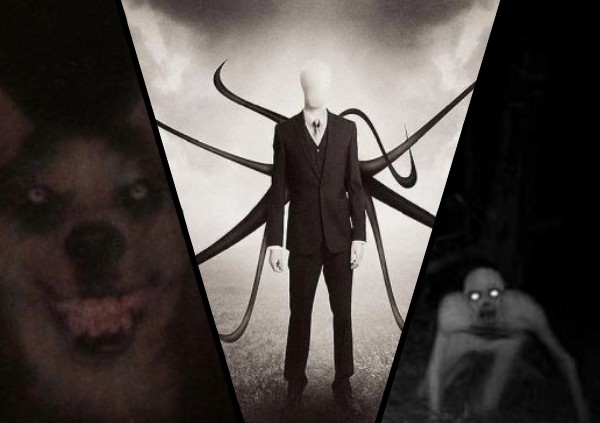
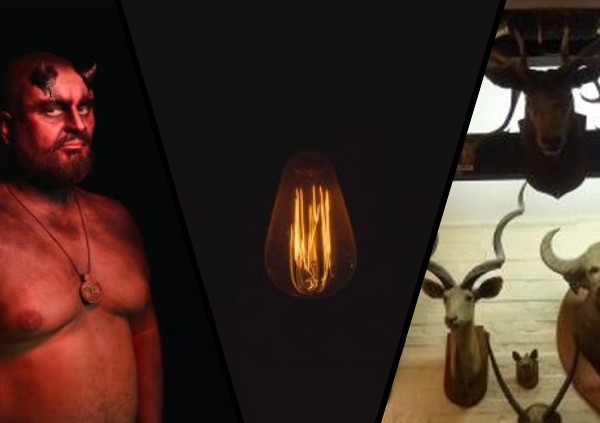
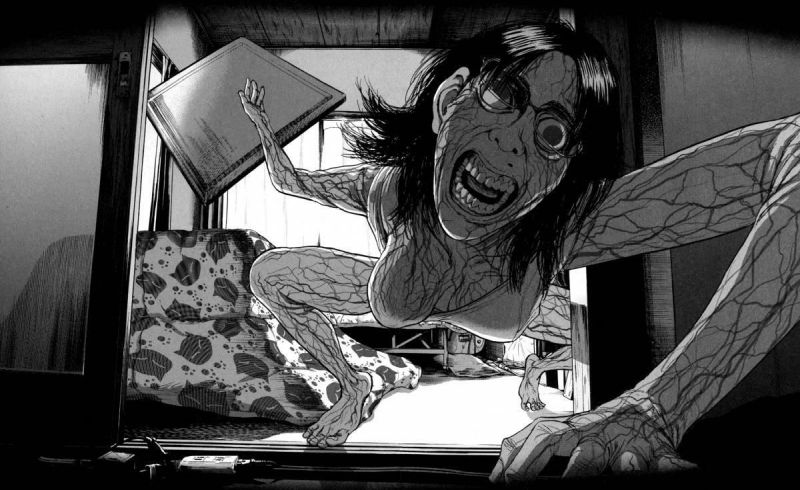
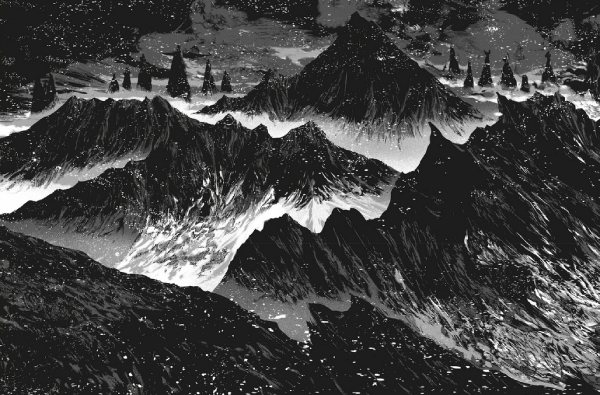
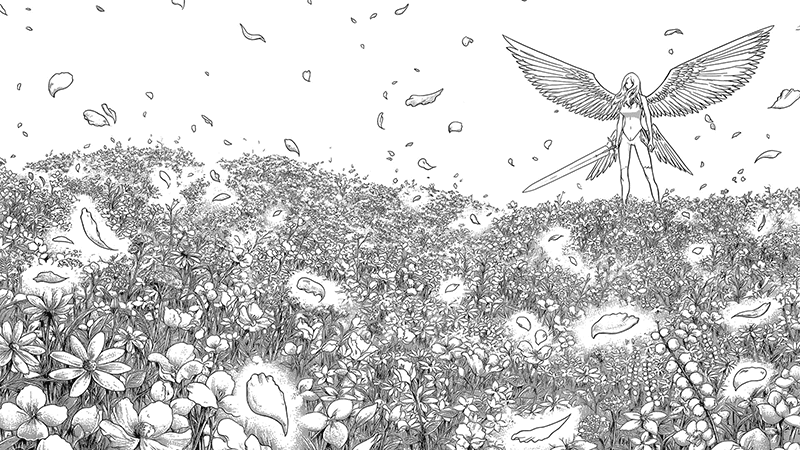
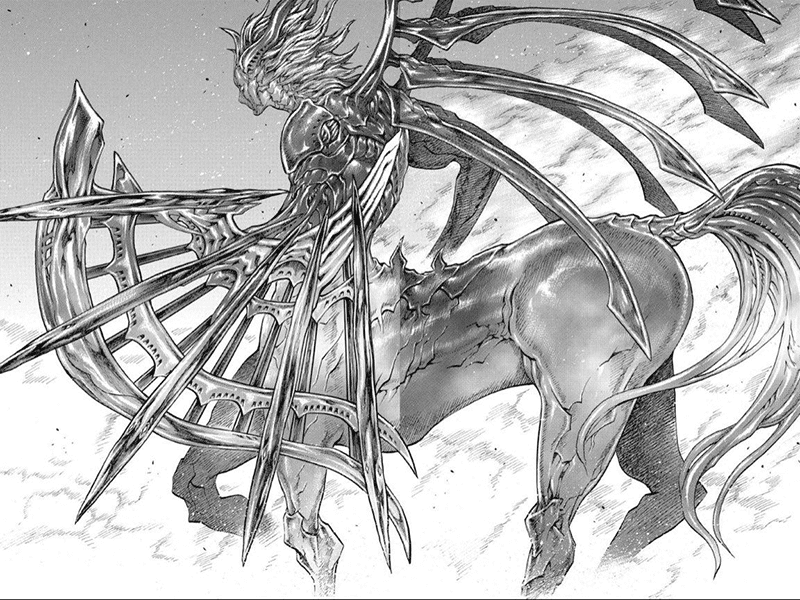
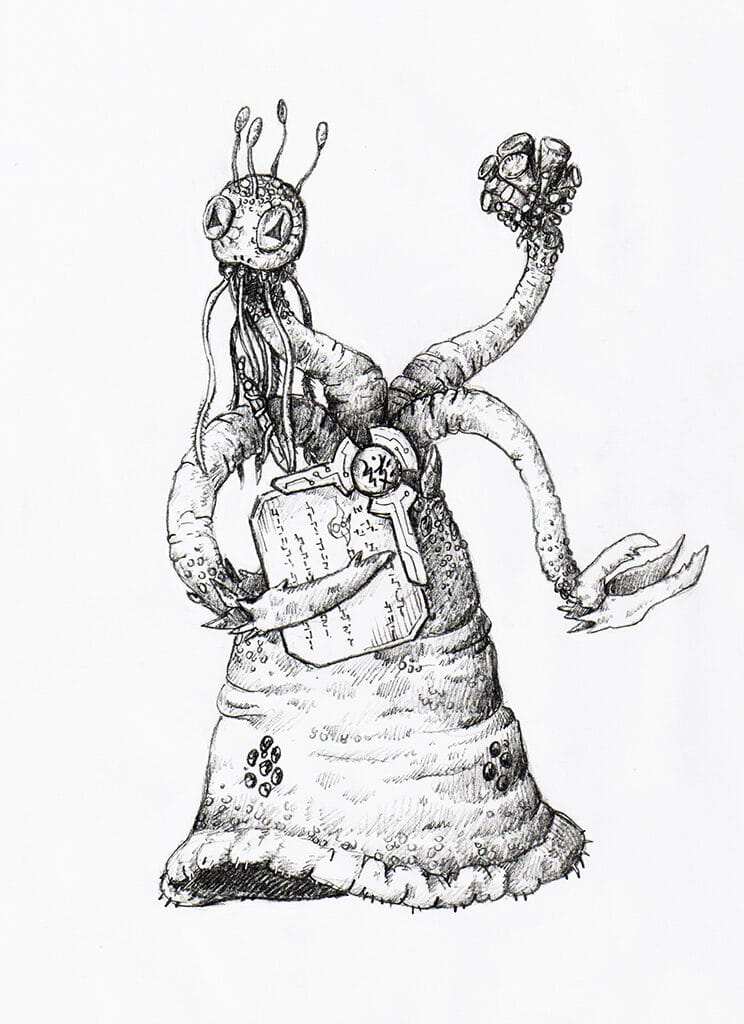
Creepypasta are internet horror stories usually meant to scare you, but sometimes you find stories that are less frightening than they are weird.
That’s what this list focuses on. These are weird creepypasta stories that stand out because of their concepts, premises, imagery, or even writing style.
Weird Creepypasta Stories: The Dream of Every Dentist, The Egg, String Theory
Some are still scary, disturbing, or unsettling, but what makes them so memorable is their strangeness. They push beyond standard internet horror and turn into something more surreal, bizarre, or hard to categorize.
This list collects the weirdest creepypasta I’ve read over the years, focusing on stories that are not just strange, but actually worth reading.
Think Not of the Morrow is not weird in the flashy, surreal sense, but it earns its place through concept and perspective. The story is told by an old headmaster remembering a boy named Christopher, who once came into his office in a panic, insisting that things weren’t supposed to happen this way.
Christopher’s explanation involves a familiar time-loop idea, but the story becomes stranger because we’re not trapped with him. Instead, we experience it through someone who dismissed him, lived an entire life, and only later realizes the boy may have been telling the truth.
The ending is what makes the story work as a weird creepypasta. It turns a familiar premise into something quietly existential: if the loop resets, what happens to everyone else?
Cervin Birth is less a traditional story and more an anecdote about a strange lost video. It centers on an alleged art film showing an albino deer, a mirror behaving impossibly, and a grotesque birth viewers claim once appeared online before vanishing.
What makes it weird isn’t some final twist, but the imagery itself. The video sounds surreal, dreamlike, and deeply unnatural, full of scenes that feel symbolic without ever becoming clear.
The story becomes stranger once it describes the creator’s later work and disappearance. There’s no monster, no clear plot, and no answers waiting at the end. Cervin Birth stands out because it feels like forbidden media.
The Woman in the Oven is one of the shortest weird creepypasta stories on this list. It’s framed less like a normal narrative and more like a brief report about an unexplained case.
Police discover a woman’s charred body inside a kitchen stove, and at first, it appears to be a bizarre suicide. Then a VHS tape is found, and instead of explaining the event, it only makes everything stranger.
That’s what makes the story weird. Nothing adds up, and there’s no clear answer at the end. It’s simple, mysterious, and strange enough to linger despite its length.
The Magician’s Game is a weird creepypasta built around a familiar idea, but told in an unusual way. It follows Tom, a magician who receives a mysterious invitation after a failed performance and is drawn into a strange game of chess.
A supernatural chess match for someone’s fate is not exactly new, but the story makes it work through presentation. The shifting settings, theatrical dialogue, and dreamlike imagery give the whole thing a peculiar quality.
What makes it weird is how much of the horror comes from performance, ego and psychological collapse rather than a simple monster or threat. It feels like a stage play slowly turning into a breakdown.
Burgrr Entries is one of the weirdest creepypasta stories I’ve ever read. It’s technically an apocalypse story, but the end doesn’t come from zombies, aliens, or disaster. It comes from fast food.
Strange takeout windows begin appearing around town, including one on the side of the narrator’s house, despite there being no room for it inside. The food is disgusting, but everyone else treats it as normal and becomes increasingly obsessed with it.
From there, the story grows more grotesque as the food changes people in grotesque bodily ways. The first half is especially strong, full of surreal imagery and genuinely original ideas. The later stretch turns into a drawn-out fight-and-escape scenario, which is much less interesting, but the core concept is so strange that Burgrr Entries still earns its place here.
The Algorithm is a weird creepypasta because it traps you entirely inside the narrator’s broken logic. He believes his life is being controlled by an unseen power that predicts his choices, sabotages his routines, and poisons every piece of food he tries to eat.
That first-person perspective makes the story far stranger. You’re stuck in his head as his paranoia reaches its peak. It feels insane, but also internally coherent.
What makes it stand out is how far it commits to that voice. By the time the narrator believes he’s found a way to trick the algorithm, the story has escalated into something much darker and stranger than expected.
The Theater is a weird video game creepypasta that stands out partly because it avoids almost everything video game creepypasta stories usually rely on. There’s no evil entity, no cursed cartridge, and no supernatural force trapping the player.
Instead, the story centers on a strange, glitchy game with no clear purpose. The narrator simply plays, observes, and tries to understand what the game even is.
That mystery is what makes it weird. Nothing is explained, and the odd visuals, repeated actions, and broken systems make it feel like some forgotten experimental project rather than a normal horror story. It’s not especially scary, but it’s strange in a way that sticks.
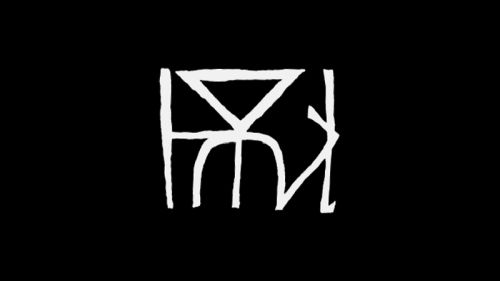
The Memetic Symbol was one of the first truly weird creepypasta stories I read, and it holds up because of the strength of its idea. It follows a man interested in memetics who discovers a strange symbol on an IRC channel, only to realize it shouldn’t exist.
From there, the symbol begins spreading beyond the screen and into the real world. That’s what makes the story so strange. This is not a monster story, a serial-killer story, or a simple glitch-in-the-matrix tale. It’s about an abstract image infecting and rewriting reality itself.
It’s not subtle, and it moves quickly, but the concept is so bizarre and ambitious that it remains one of the strongest weird creepypasta stories.
The Backrooms is probably the most popular weird creepypasta of all time. It began with almost nothing: a short post, an unsettling image, and the idea that if you ‘noclip’ out of reality, you end up in an endless maze of empty yellow rooms.
What makes it so weird is how casually it can happen. There’s no monster chasing you, no curse, no ritual. You might simply walk to work, open a door, or use the bathroom, then suddenly fall out of reality.
That idea instantly clicked with people because it feels both absurd and strangely plausible in dream logic. The original concept remains the strongest version: short, eerie, deeply uncanny.
House of Rules is a weird creepypasta story I first read years ago, and it still stands out as an early example of rule-based horror. The narrator lives in a house that enforces strict rules on anyone inside it, and breaking them leads to punishment.
What makes the concept so strange is how ordinary the rules are. This isn’t a story about monsters or obvious supernatural evil. It’s about your own home becoming an authority you cannot question.
That idea felt fresh when I first read it, and it still works. The house isn’t haunted. It has rules, expectations, and consequences, which makes it far weirder than many later rule-based stories.
String Theory is one of the best examples of a creepypasta that becomes unsettling without needing monsters or killers. Its horror comes from questioning how reality itself works.
The story follows a boy who wakes up and finds strings in his room, mapping out his usual morning routine. Once he goes outside, he sees more of them, connecting people, places, and actions in ways that shouldn’t be visible.
That image is what makes it so weird. The strings imply that life may not be as free or random as it seems, and that something else may be guiding it. That pushes String Theory into philosophical horror territory, which makes it stand out.
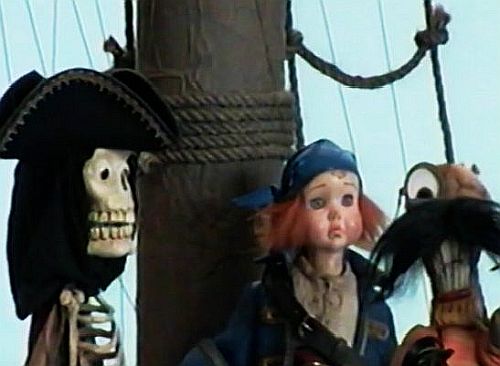
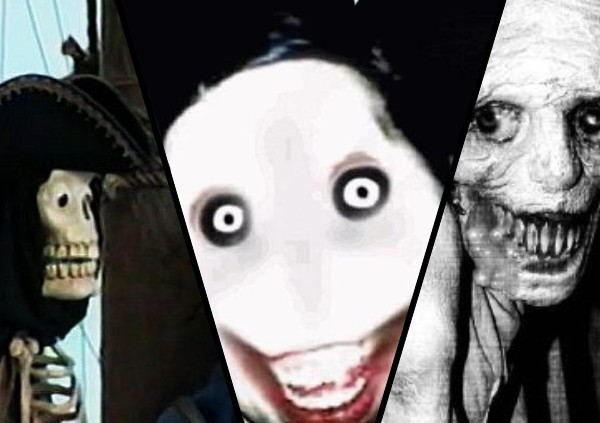
Candle Cove is one of the most famous weird creepypasta stories ever written. It unfolds as a nostalgic forum thread where users remember a strange children’s show they watched when they were young.
That format already makes it special, but the memories soon become stranger and darker. The cheap puppets, old pirate characters, and half-remembered episodes begin to feel less like forgotten children’s television and more like something deeply wrong.
The final reveal makes the whole story even weirder. It doesn’t explain what Candle Cove was, but it forces you to question what these people actually experienced and why they all remember watching the same impossible show.
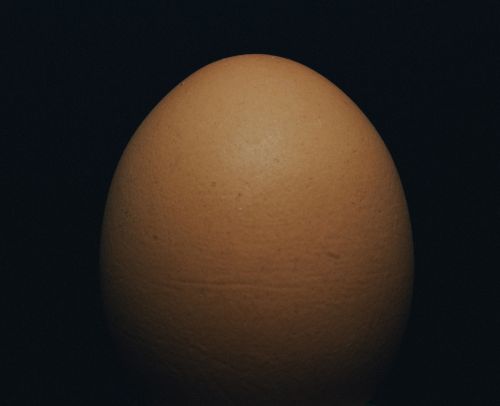
The Egg begins with a familiar premise: someone dies and has a conversation with what appears to be Death. From there, however, the story becomes much stranger and more existential.
There’s no monster, no chase, and no obvious horror set piece. Instead, The Egg builds itself around an enormous idea about identity, reincarnation, morality, and human existence.
That concept is what makes it such a weird creepypasta. It’s not frightening in the usual sense, but it’s profound, humbling, and quietly haunting. Few internet horror stories manage to feel this simple while suggesting something so vast.
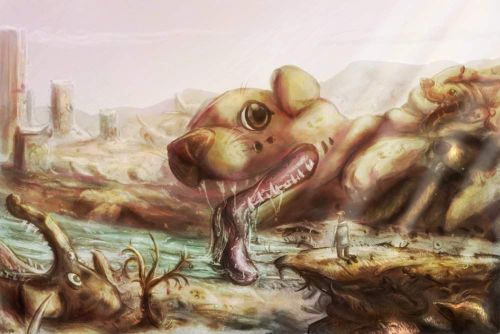
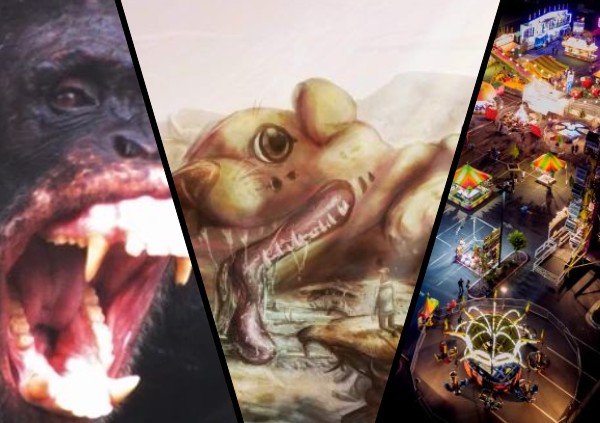
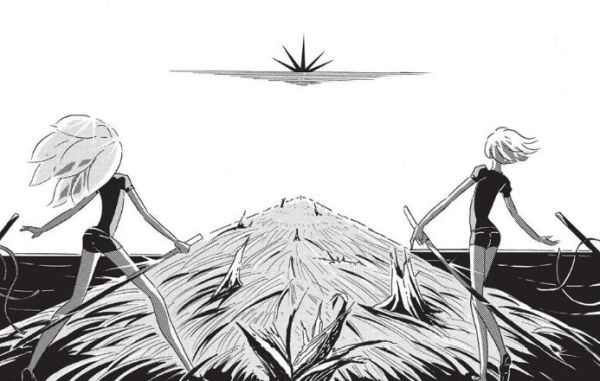
No list of weird creepypasta would feel complete without Dogscape. It’s not one single story but a series of tales set in a world that has become all dog.
That setting is what makes it so bizarre. The ground is dog flesh and fur, dog heads sprout from the terrain, and the entire world feels like a living biological nightmare. Even rivers, mountains, and trees have all become part of this grotesque canine landscape.
The individual stories vary in quality, but the concept is unforgettable. People survive in tribes, worship the Dogscape, are consumed by it, or slowly become part of it. It’s surreal, disgusting, and one of the strangest creepypasta stories ever produced.
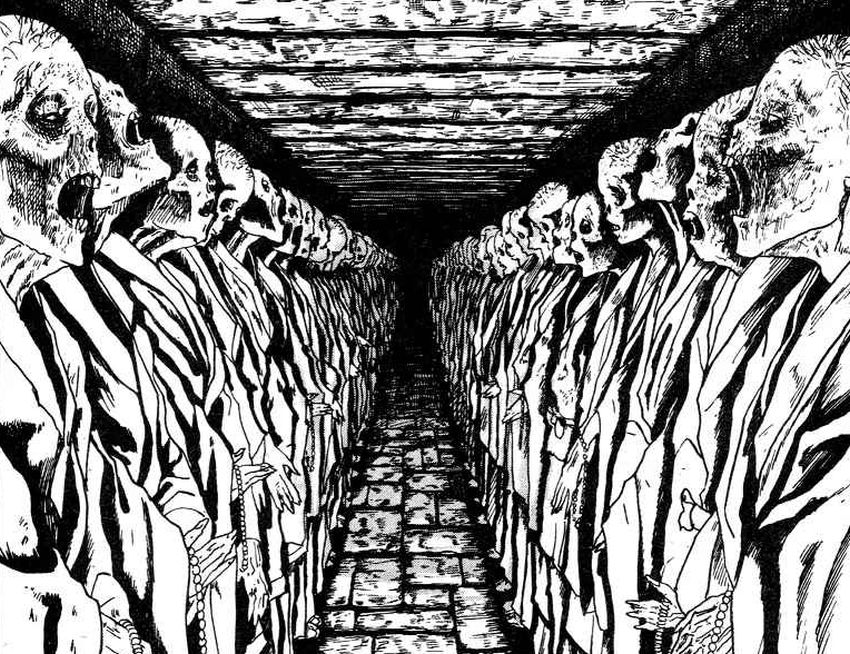
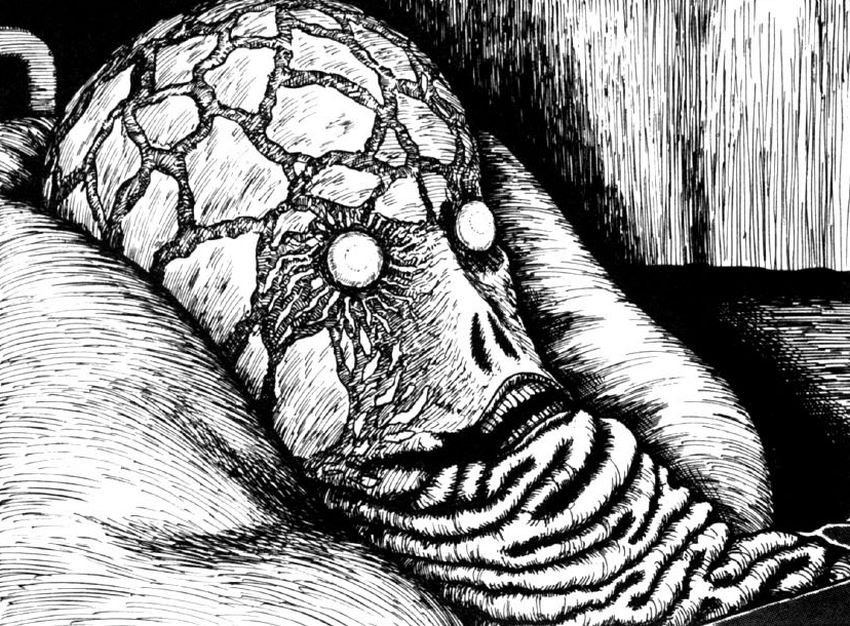
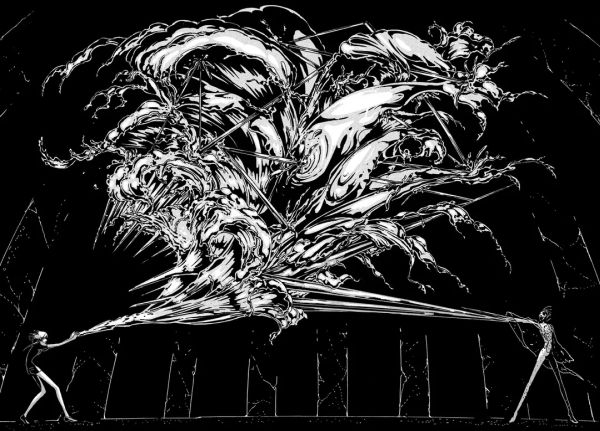
The Dream of Every Dentist is not just a weird creepypasta. It’s one of the most bizarre creepypasta stories ever written.
The story centers on a group of dentists who reveal a shared nightmare to a man, but that basic setup barely explains how strange the piece becomes. It’s grotesque, irrational, and almost impossible to summarize without making it sound ridiculous.
What makes it work is how seriously everything is delivered. There’s no explanation, no normal logic, and no clear answers, but the nightmare follows its own strange internal rules. It feels like dream logic turned into horror, leaving you wondering what the hell you just read.
Creepypasta began as short internet campfire tales. They were made to spread quickly, deliver a memorable scare, and be read in a single sitting. Many early creepypasta stories only needed a few paragraphs, a strong image, or one clever idea to leave a lasting impression.
As the genre grew, writers became more ambitious. Stories expanded beyond quick scares into longer narratives with deeper mysteries, stronger worldbuilding, and slower psychological dread. Some proved that creepypasta could sustain real tension over time rather than rely on a final twist.
Best Long Creepypasta Stories: The Dioanea House, Ted The Caver, Humper-Monkey’s Ghost Story
Of course, length alone doesn’t guarantee quality. Internet horror has always been wildly inconsistent, and plenty of long creepypasta stories outstay their welcome through padding, repetition, or weak endings.
That’s why I created this list. These are my favorite long creepypasta stories, chosen not simply because they are lengthy, but because they justify the time investment.
Humper-Monkey’s Ghost Story is the longest creepypasta on this list, and with its follow-up tales, it stretches into near-novel territory. Originally posted on the Something Awful forums, it later gained wider attention as one of the internet’s standout long-form horror stories.
It follows Monkey, a U.S. Army serviceman stationed in an isolated three-story building in the German mountains during the late 1980s. On paper, it’s a ghost tale, but the length allows it to become more than that. It builds through blizzards, isolation, personal anecdotes, military routine, and the slow feeling that something is deeply wrong with the place.
What makes it work is the voice. It feels casual and conversational, like someone sitting down to tell you a strange story from their past. It’s a serious commitment, but if the style clicks early, this long creepypasta is absolutely worth the time.
The House That Death Forgot is a long creepypasta that earns its length through sustained atmosphere and disturbing horror. It starts with a familiar setup: a woman trying to meet her estranged father gets lost on a lonely road and stops at an isolated roadhouse in the middle of nowhere.
From there, the story turns into a slow-burn exercise in dread. The roadhouse feels old and disconnected. The other guests are strange, the rules are unclear, and the details keep piling up until the narrator realizes she’s entered a place far worse than a creepy roadside inn.
What makes it work is the pacing. The story doesn’t rush its reveal. It lets the unease gather through small details before delivering a grim, painful payoff. If you enjoy long creepypasta stories that build their horror slowly, this one’s worth the commitment.
Midnight Train is a long creepypasta that uses its length to build the shape of a life. Instead of focusing on one isolated supernatural event, it follows Daniel from childhood into old age, tracing the moments when the Midnight Train appeared around trauma, grief, and farewell.
That structure is why the story earns its slower pace. The train itself is a strong horror image, but it becomes more powerful because each appearance is tied to something Daniel carries within him. Childhood abuse, lost love, family, war, and regret all gather around the same haunting symbol.
The result feels more like a melancholic horror story than a simple internet scare. It’s not the tightest entry on this list, but the longer form gives it emotional weight. By the end, the Midnight Train feels less like a monster and more like a shadow following Daniel throughout his life.
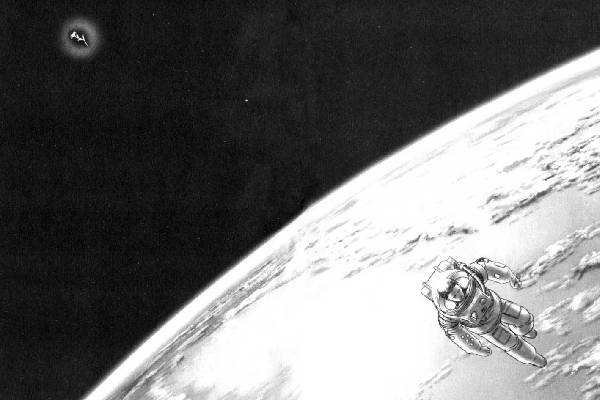
The Devil’s Cosmonaut stands out because it’s a long creepypasta set entirely in space. Instead of a haunted house or cursed road, it traps Boris alone aboard a failing space station, cut off from ground control while strange details begin piling up around him.
Its length works because the story depends on isolation. The small routines, radio conversations, technical problems, temperature changes, pills, noises, and tiny mechanical details all make the station feel real before the horror fully takes over. You’re stuck there with Boris as he tries to decide whether he is losing his mind or whether something impossible is really inside the station with him.
It’s deliberately slow, but the pacing suits the premise. Space horror needs pressure, silence, and uncertainty, and The Devil’s Cosmonaut uses all three well. The ending is also strong, giving the whole story a strong final punch.
1999 is a long creepypasta worth including more for legacy than consistency. It centers on a boy who discovers a hidden local TV channel airing strange children’s programs, most notably Mr. Bear’s Cellar. Years later, he realizes how disturbing those memories were and begins investigating the channel, the tapes, and the man behind the bear costume.
The strongest parts are the early sections. The idea of a half-forgotten childhood broadcast, watched on an old bedroom TV, taps into nostalgia while twisting it into something deeply wrong. That combination is exactly why the story became so memorable.
As a long piece, 1999 is more uneven. The later blog updates can become repetitive, often following the same pattern of finding or watching another tape. The ending is also more suggestive than fully satisfying. Still, its atmosphere, investigation format, and influence make it one of the major long creepypasta classics.
NoEnd House is one of the most famous long creepypasta stories, and its premise is instantly readable: make it through nine rooms in a haunted house attraction and win $500. The narrator enters expecting cheap scares, only to discover that each room is stranger and more dangerous than the last.
What makes the length work is the structure. The room-by-room format gives the story natural momentum, and each stage pushes the horror a little further. It starts almost laughably simple, then becomes more surreal, personal, and psychologically cruel.
It’s not flawless. Some later rooms grow so bizarre that they can feel random rather than frightening. Still, the escalation is strong, the final reveal lands, and the story’s reputation is deserved. It also became famous enough to inspire the second season of Channel Zero, which shows how deeply it became part of creepypasta culture.
Stevie is a long creepypasta that needs its length to work properly. The story is built around a psychotherapist speaking with Michael, a young man in custody, as he slowly explains the childhood events that led to his supposed crime.
What makes the long structure effective is the accumulation of detail. Stevie spends a lot of time on neighborhood friendships, school bullying, guilt, loyalty, and Michael’s uneasy relationship with Andrew. That buildup can feel slow, but it gives the later horror much more impact.
This is not a quick-scare story. It’s methodical, emotional, and memory-driven. The length may be intimidating, but it allows the story to become more than a simple ghost tale. It becomes a tragedy about childhood cruelty turning into something monstrous.
The Dionaea House is a long creepypasta that justifies its length through format and mystery. Instead of telling everything in a straight narrative, it unfolds through emails, blog updates, text messages, and fragments of correspondence. That gives the story room to expand naturally without feeling like one massive block of exposition.
The investigation begins with Andrew’s murder-suicide, but each new message points toward something larger: a strange house that seems to feed on more than just curiosity. The longer the story goes on, the more people are drawn into its orbit, and the more the mystery feels like something spreading through documentation itself.
What makes the slow burn work is restraint. The Dionaea House never gives you a neat explanation, but it offers enough connections, disappearances, and implications to keep the tension alive. It’s lengthy, but that length works in its favor.
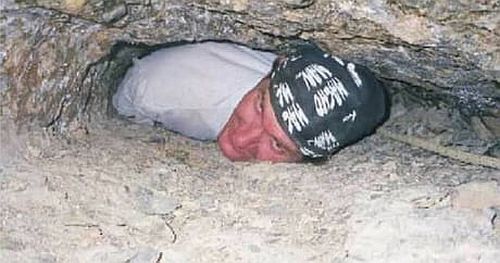
Ted the Caver is one of the foundational long creepypasta stories, and its length is central to why it still works. Rather than rushing into horror, it begins as a believable online journal about a caving enthusiast trying to widen a narrow passage into an unexplored section of the cave.
The extended buildup matters. Ted describes equipment, cave routes, physical strain, and the miserable reality of squeezing through tight stone corridors. Those details create immersion and make the setting feel real. By the time the dread begins to surface, the reader already feels trapped inside that underground world.
What follows is less about jump scares than gradual psychological corrosion. The cave becomes uncanny, almost hostile, and impossible to shake from Ted’s mind. Because the story moves so patiently, the later horror moments feel earned rather than sudden.
Some readers may find the early caving detail slow, but that realism is exactly what gives Ted the Caver its power. It remains one of internet horror’s best examples of how length, atmosphere, and escalation can work together.
Psychosis is one of the strongest long creepypasta stories because its length is psychological rather than physical. It follows John, a programmer living in isolation, who begins noticing small inconsistencies in the world around him: strange phone calls, missing communication, odd behavior, and the growing sense that reality itself may be staged.
The longer format allows those doubts to build gradually. Instead of leaping into madness, the story lets each suspicion connect to the next until John’s paranoia feels logical from his perspective. You are trapped inside his reasoning, watching ordinary details become terrifying.
That slow spiral is what makes Psychosis so effective. For most of the story, it’s never fully clear whether John is mentally collapsing or uncovering something genuine. The uncertainty carries the tension all the way through.
The ending explains a little more than some readers may prefer, but the buildup is exceptional. As a sustained descent into paranoia and fractured reality, Psychosis remains one of the genre’s best long-form stories.
The Strangers is, in my view, the greatest long creepypasta ever ever written. It follows Andrew Erics, a man who passes time by studying fellow commuters on the New York subway, until he notices certain passengers who seem subtly wrong: silent, plain, emotionless, and impossible to place.
The story’s length is one of its greatest strengths. It spends real time on Andrew’s routine, boredom, and growing fixation, allowing the subway world to feel authentic before anything overtly supernatural happens. That realism makes the early unease much stronger.
As Andrew follows one of them beyond the familiar city, the story expands into something far stranger and more ambitious. What began as commuter paranoia becomes a descent into something much, much worse. The patient buildup is what gives the later imagery real weight.
The Strangers uses length exactly as it should: first to immerse, then to escalate, then to transform. It remains one of creepypasta’s most original and fully realized narratives.
Creepypasta stories are internet horror stories, and while most of them aim to be scary, not many actually succeed. Even fewer manage to become genuinely disturbing.
That’s what this list focuses on. These are disturbing creepypasta stories that stand out because of their subject matter, imagery, concepts, or the events they depict.
Most Disturbing Creepypasta Stories: Normal Porn for Normal People, Dogscape, and Case Report 7591
Some are disturbing because of explicit content. Others are more psychological, surreal, or existential. A few are simply built around ideas that are harder to shake once you’ve read them.
Here are the most disturbing creepypasta I’ve read over the years, focusing on stories that leave behind more than a quick scare.
The Woman in the Oven is a short, disturbing creepypasta built less on graphic imagery than on mystery. It begins with a woman’s charred body being discovered inside a farmhouse oven, followed by a VHS tape that seems like it should explain what happened.
Instead, the tape only makes everything stranger. The idea of someone climbing into an oven and filming it is disturbing enough on its own, but the real unease comes from the lack of explanation.
Nothing quite makes sense, and the story refuses to clarify what actually happened. That unanswered mystery makes it linger.
Cervin Birth is a disturbing creepypasta built around the idea of a strange video that may or may not still exist online. It describes an unnerving piece of video art involving an albino deer, a mirror, and a grotesque birth.
The image is disturbing enough, but the story grows worse once it mentions the creator’s other works. The added details make the entire thing feel less like fiction and more like some lost corner of underground internet media.
There’s no monster, no explanation, and barely even a traditional plot. That lack of context makes it work. Anyone who’s spent enough time online knows something like this could actually exist out there.
The House That Death Forgot is one of the longest, most disturbing creepypasta stories on this list, but it earns the length. It begins with a familiar setup: a woman gets stranded and spends the night at an isolated roadhouse.
At first, the horror builds slowly. The roadhouse feels wrong, the guests seem off, and strange details start to accumulate. Then the final act reveals what the place really is, what happened to the other tenants, and what awaits the narrator.
That ending makes the story so disturbing. It pays off the slow-burn narrative with grotesque imagery, a bleak concept, and a fate that feels worse the longer you think about it.
The Algorithm is one of the strongest disturbing creepypasta stories built around paranoia and mental collapse. It follows a man who becomes convinced that an unseen system is controlling his life and poisoning his food.
What makes it disturbing is not only the premise but its first-person perspective. You’re trapped inside the narrator’s thoughts, fears, and obsessive logic as he spirals further into collapse. His inability to trust basic necessities like food gives the story a grim, claustrophobic tension.
The ending pushes that horror even further once the narrator believes he’s found a way to escape the system controlling him. That final turn makes the story far more unsettling than what came before.
My Older Sister might seem like a surprising pick for a disturbing creepypasta list. It starts with something familiar and grounded: sibling jealousy, comparison, and an older sister who seems better at everything.
Then tragedy strikes, and the story appears to center on grief and memory rather than outright horror. For much of its length, it feels restrained, almost understated.
What makes it disturbing is the ending. The final reveal reframes everything before and leaves the story on an idea that’s deeply cruel, intimate, and hard to shake. It’s not disturbing because of gore or shock value, but because of what it suggests comes next.
The Hidden Things is one of the best-written disturbing creepypasta stories on this list. It begins with a dead body in a hotel room and strange writing left behind on the walls.
What makes it disturbing is not just what happened in that room, but how the final account describes it. The hidden things themselves are grotesque, taunting, childish, and malicious, turning every dark corner of the room into a hiding place.
The whole story has a grim, claustrophobic atmosphere, as if there’s no real escape once you know they exist. That sense of hopelessness makes it hit so hard.
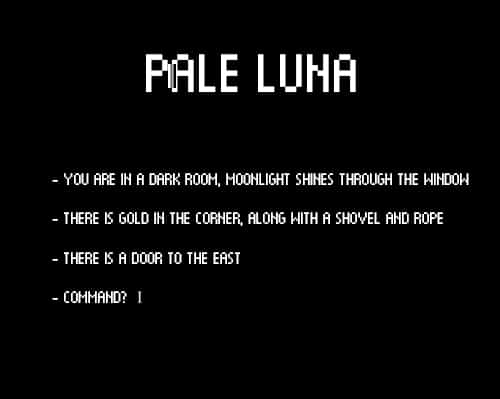
Pale Luna might seem like an odd choice for a disturbing creepypasta list, since it’s also a video game creepypasta. Yet it works because the game is only a framework for something much worse.
The story centers on an obscure, broken text adventure that most players abandon because it barely functions. One determined player pushes through and eventually receives a set of coordinates.
The final discovery is what makes Pale Luna so disturbing. Combined with the game’s cryptic descriptions and old-software atmosphere, it turns a simple gaming mystery into something grim, grounded, and deeply unsettling.
12 Minutes is one of the more overtly disturbing creepypasta stories on this list. It centers on a religious TV program called Words of Light with Rev. Marly Sachs, which begins causing strange reactions in women around the twelve-minute mark.
After the show is canceled, a miscarriage epidemic hits the area, but the true horror only becomes clear when an intern reviews the old tapes and discovers what’s hidden in the footage.
The imagery is graphic, but not in a cheap way. It feels ominous, invasive, and deeply wrong, which makes the story’s final turn even more disturbing.
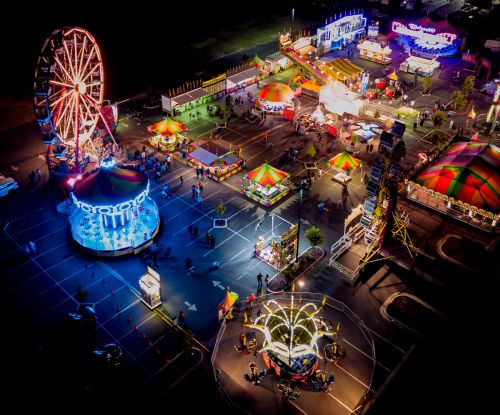
Case Report 7591 is disturbing less because of graphic imagery and more because of its central idea. It focuses on an amusement park built by Travis Leroy, especially an enchanted forest ride filled with fairies, woodland figures, and preserved displays.
At first, the attraction seems harmless, but then children begin disappearing, and investigators eventually turn their attention to the park.
What they find inside the ride is what makes the story so haunting. It’s not loud or cheap horror, but a slow, awful realization built around exploitation, concealment, and one especially disturbing discovery.
Gateway of the Mind is a short, disturbing creepypasta built around one horrific experiment. A man is stripped of every sense so researchers can see whether complete isolation from the physical world will let him contact God.
That premise makes the story so disturbing. No sight, no sound, no touch, no taste, and no real way to measure time. He’s left trapped inside his own head, cut off from everything that makes reality feel real.
The ending moves into familiar creepypasta territory, but the experiment itself is strong enough to carry the story. Sometimes one cruel idea is enough.
Dogscape is the most bizarre disturbing creepypasta on this list. Its premise alone is enough: Earth has become an endless landscape of dog flesh, fur, teeth, rabid heads, and impossible canine growths.
That imagery works as surreal body horror immediately. The world itself feels alive, biological, and hostile, as if reality has been replaced by a giant, diseased organism.
The content is often disturbing in a more direct way, though. Some entries lean heavily on gore, cruelty, and sexual violence. The quality also varies because Dogscape is a shared project, with stories ranging from cheap exploitation to genuine horror. Still, for sheer originality and grotesque nightmare logic, few creepypasta stories are as disturbing.
Normal Porn for Normal People is probably the first story many readers think of when they hear disturbing creepypasta. It centers on a strange website, an imageboard investigation, and a series of videos that grow increasingly worse the deeper people dig.
The clips begin as bizarre and uncomfortable, then shift into something more fetishized, exploitative, and finally much darker. Yet the most disturbing part is not just the content, but the idea behind it.
We have all heard stories about hidden websites, disturbing online communities, and awful things buried in the wrong corner of the internet. Normal Porn for Normal People works because it feels just plausible enough, and that makes it deeply unpleasant.
Creepypasta originally thrived as short internet campfire tales. They were built to spread quickly, deliver a sharp scare, and linger on your mind after only a few paragraphs. Because of that, many early stories relied more on twists, shocking images, or clever hooks than polished prose.
Over time, the genre matured. Longer and more ambitious stories became common, and some writers began treating creepypasta less like disposable scares and more like real horror fiction. Not every story benefited from the added length, but the best ones proved that internet horror could deliver atmosphere, structure, voice, and genuine craft.
Most Well-Written Creepypasta Stories: Midnight Train, The Song and Dance Man, The Strangers
That’s what this list focuses on. These are the most well-written creepypasta stories I’ve read, chosen for storytelling quality as much as their ability to unsettle. Some are elegant psychological horror pieces, others use inventive formats or unforgettable narrators, but all of them rise far above the average quick scare.
While some readers may expect NoSleep stories here, this page focuses on classic creepypasta and early internet-era horror. If you’re looking for Reddit-era fiction, I cover that separately on my list of the best NoSleep stories.
The Algorithm is one of the sharper psychological horror entries in creepypasta. It follows a man who becomes convinced that an unseen force is poisoning everything he eats and predicting the patterns of his life through a vast, inescapable system he calls the Algorithm. What begins as paranoia over contamination gradually mutates into total collapse.
What makes the story so effective is its voice. The narrator sounds articulate, intelligent, and completely sincere, which makes his delusions more disturbing than if he were written as obviously unstable. The reader understands something is wrong, yet the story never steps outside his perspective to confirm it outright. Instead, you’re trapped inside reasoning that feels coherent to him at every moment.
That commitment to viewpoint gives the story real power. It captures the frightening self-consistency of delusion, where every setback becomes proof of the larger conspiracy. By the time the narrator believes he has finally freed himself, the horror is complete. If you enjoy character-driven psychological horror, this is a well-written creepypasta worth reading.
Satan’s Fall is one of the more vivid long-form creepypasta stories, and it opens with a fantastic image: a strange neighborhood man who dresses as the devil every Halloween, paints himself red, sits on a throne between flaming cauldrons, and terrifies the local children. That setup alone feels like suburban folklore remembered years later.
What makes the story stand out is its voice. The narrator captures childhood fear, curiosity, and bravado without sounding forced. The dialogue between the kids is especially strong, full of little details that make the setting feel alive rather than staged. It has that nostalgic 1970s suburban texture, but there’s something wrong beneath it.
From there, Satan’s Fall grows stranger than expected. What begins as Halloween legend turns into a mix of UFO rumors, rural myths, religious dread, and cosmic weirdness. It probably runs longer than necessary, but its strongest sections are genuinely well-written. Messy in places, yes, but memorable and atmospheric.
The Art of Jacob Emory feels closer to a polished short story than a standard internet scare. It opens with a small-town storyteller’s voice, the kind of narrator who sounds like he’s passing along a secret he was never meant to share. That framing immediately gives the story personality.
The premise is excellent. Jacob Emory returns to town carrying a strange black piece of chalk that can bring his drawings to life. At first, the concept feels almost whimsical as he creates moving sketches and becomes a local sensation. Then something terrible happens during one of his shows.
What makes The Art of Jacob Emory memorable is the contrast between a familiar rural setting and its impossible central idea. The story builds from curiosity to spectacle to horror without losing its voice. It remains one of the most well-written creepypasta stories built around a supernatural gimmick.
The Hidden Things is one of the most obscure entries here, but also one of the strongest from a pure writing standpoint. It begins with a hotel manager discovering a dead tenant in room 304, the body twisted beyond explanation and the walls marked with strange writing. That alone would support a decent premise, but the story goes much further.
When the narrator returns with a black light, he uncovers hidden messages left behind by the dead man and slowly reconstructs what happened to him. Much of the tale then shifts into that recovered account, where unseen creatures whisper from drawers, drains, walls, and every dark corner of the room.
What makes The Hidden Things stand out is the prose. The creatures speak in playful, mocking voices that become genuinely disturbing, while the idea of light as the only refuge creates constant pressure. It feels less like standard creepypasta and more like a compact weird horror story.
The Dionaea House is one of the smartest long-form creepypasta stories because it understands its format. It’s told through emails, blog posts, messages, and scattered fragments of correspondence, yet none of it feels gimmicky. The writing feels casual, messy, worried, and convincingly human.
The story follows Mark as he contacts his old friend Eric about Andrew, a former acquaintance who murdered two strangers before killing himself. Mark investigates Andrew’s final days, and every trail seems to lead back to a mysterious building known as the Dionaea House.
What makes this well-written creepypasta work is restraint. It never explains too much, never turns the house into a simple monster, and never abandons realism. Each message feels like another fragment of something much larger.
Case Report 7591 is one of the best-constructed stories on this list. The story begins with local history, economic decline, and Travis Leroy’s decision to build an amusement park on his farmland.
It’s a simple setup, but the pacing is excellent. The narrative slowly introduces the park, Leroy’s attachment to one attraction, and the first child disapperances nearby. Only gradually does suspicion turn toward the indoor enchanted forest ride itself.
What makes Case Report 7591 stand out is its control. It doesn’t rely on elaborate mythology or a wildly complex premise. Instead, it builds dread through procedural detail before delivering one of the more grotesque reveals in classic creepypasta.
Stevie is the longest story on this list, but the length is part of why it succeeds. Told through therapy sessions with a young asylum patient named Michael, it gradually unpacks a childhood shaped by guilt, cruelty, friendship, and the strange legacy of a boy named Stevie.
What makes Stevie stand out is patience. The story takes time with neighborhood dynamics, school hierarchies, childhood shame, and the bond between Michael and Andrew. Even Stevie the unsettling taxidermy-obsessed outcast, becomes more disturbing because he’s first grounded in recognizable pain.
The horror arrives slowly. This is not a story rushing toward monsters or violence, but one that lets memory, guilt, and dread overlap until they become inseparable. It could be shorter, but its emotional weight depends on the long buildup. Few creepypasta stories are this ambitious and well-written.
Midnight Train is one of the most literary entries here. It’s framed as an old man reflecting on his life and recounting the moments when he encountered a strange black train that appears around death, trauma, and loss.
The story follows Daniel from childhood onward, beginning with a brutal act of abuse that marks him permanently. From there, the Midnight Train returns at key moments tied to grief, violence, and farewell. What could’ve been a simple supernatural image instead gains real emotional weight.
What makes Midnight Train stand out is the voice. The prose is vivid, rough-edged, and atmospheric, capturing an old man sorting through pain, regret, and memory. It’s not the tightest story on this list, but it’s the one that lingers the most.
The Gift of Mercy is one of the rare science-fiction creepypasta stories, and that alone makes it distinctive. There’s no haunted house, masked killer, cursed image, or local legend. Instead, the tale is presented as a transmission from an alien civilization reflecting on the greatest mistake it ever made.
The premise is simple yet powerful. After observing humanity from afar, the alien narrators become terrified by our violence, expansion, and technological growth. In fear, they launch a weapon toward Earth, only to realize far too late that humanity has changed.
What makes The Gift of Mercy such a well-written creepypasta is its sense of scale and voice. The narrator sounds alien, ceremonial, remorseful, and slightly pompous. It transforms cosmic horror into a story about guilt and irreversible consequences.
The Song and Dance Man is one of the most literary creepypasta stories, and it earns that reputation through voice and atmosphere. It’s told by an old man recalling a long-ago event in Belle Carne, when a strange performer arrived, raised a tent near the bandstand, and invited the townspeople inside for a free night of music and dancing.
What makes it stand out is how real the narrative voice feels. The narrator gives you the town, the people, the gossip, and the rhythm of rural life before the horror begins. That groundedness gives the supernatural element real weight.
Once the music starts, the story becomes a nightmare of momentum. The prose captures exhaustion, pain, and bodily ruin without losing its old storyteller cadence. It feels like a local tragedy remembered by the few who survived.
Psychosis by Matt Dymerski is one of the finest psychological creepypasta stories ever written. It follows John, a programmer living in a basement apartment, who begins suspecting that something about the world around him is wrong. At first, the details are small: unanswered messages, strange calls, odd conversations, and the feeling that every connection to the outside world may be false.
What makes Psychosis so effective is its first-person voice. John’s thoughts spiral with terrifying logic, and the story traps you inside that momentum. You can see how irrational his conclusions might be, but you can also understand why he reaches them.
That uncertainty is the story’s greatest strength. For most of its length, you’re never entirely sure whether John is losing his mind or seeing through reality itself. My only criticism is that the ending explains too much. Even so, the buildup is excellent, making this one of the most well-written creepypasta classics ever posted online.
The Strangers is my favorite creepypasta of all time, and one of the clearest examples of the genre reaching beyond a simple internet scare. It begins with Andrew Erics, a man from New York who develops a habit of watching commuters on the subway. At first, it’s harmless people-watching, but then he notices certain passengers who feel wrong: plain, silent, expressionless, and almost too normal.
That opening stretch is one of the story’s greatest strengths. It takes time to develop Andrew’s boredom, curiosity, and growing obsession. The subway setting feels authentic, and the commuter details ground the story before it moves into stranger territory.
Once Andrew follows one of the Strangers to the end of the line, the story opens into something far larger and more imaginative. The imagery is unforgettable, the creature design is bizarre without becoming silly, and the central concept is one of the most original in creepypasta. Yet what truly makes it work is the writing. The pacing is deliberate, the atmosphere is superb, and Andrew’s voice carries everything from urban realism into cosmic nightmare.
For me, The Stranger remains the best example of a well-written creepypasta because it combines craft, originality, and lasting impact. It’s eerie, ambitious, and beautifully constructed, with an ending that transforms the entire story into both warning and myth.
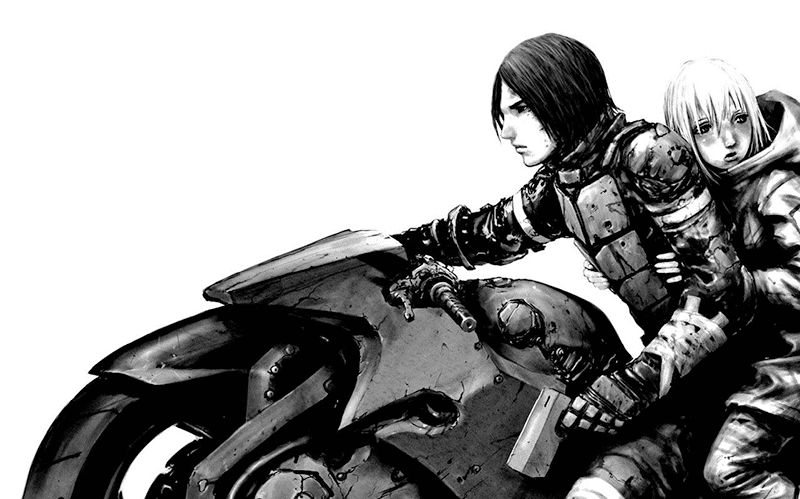
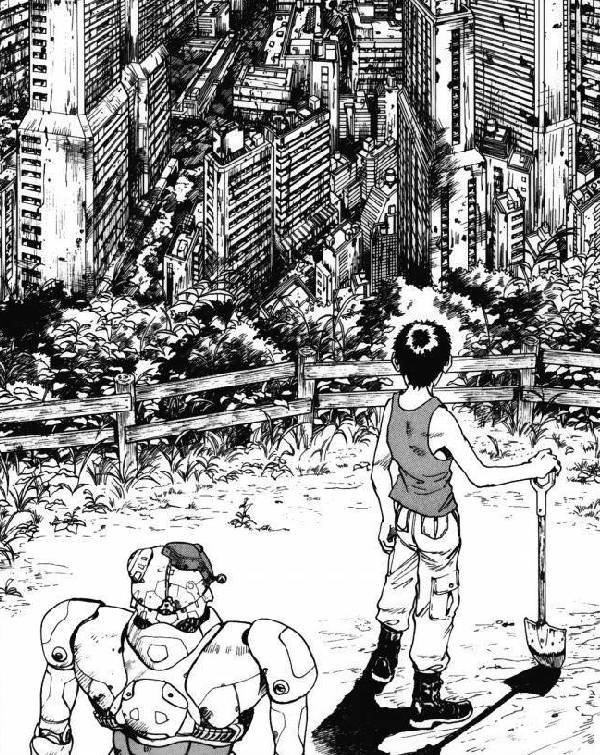
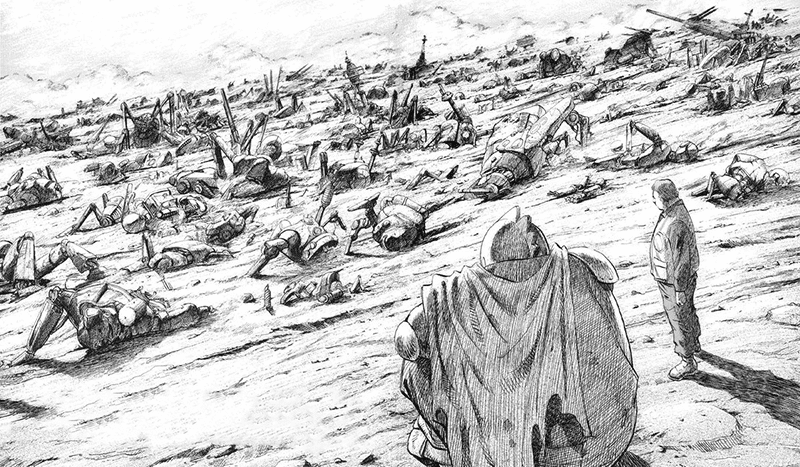
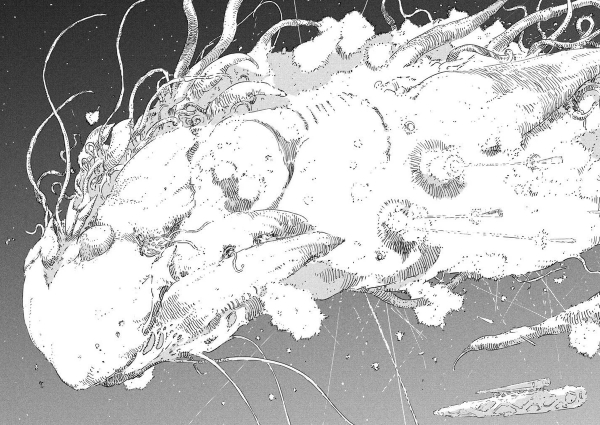
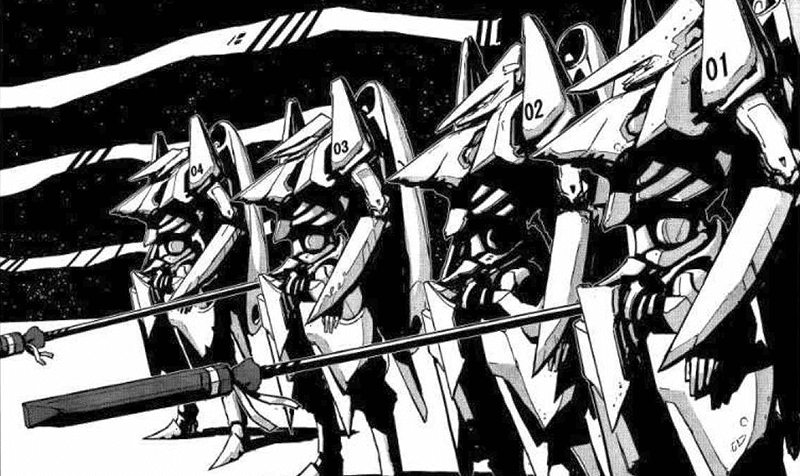
Blame! is the debut series of Tsutomu Nihei, a science-fiction cyberpunk manga artist. He’s among the best and most talented manga artists out there and his art can compare to the best in the entire medium.
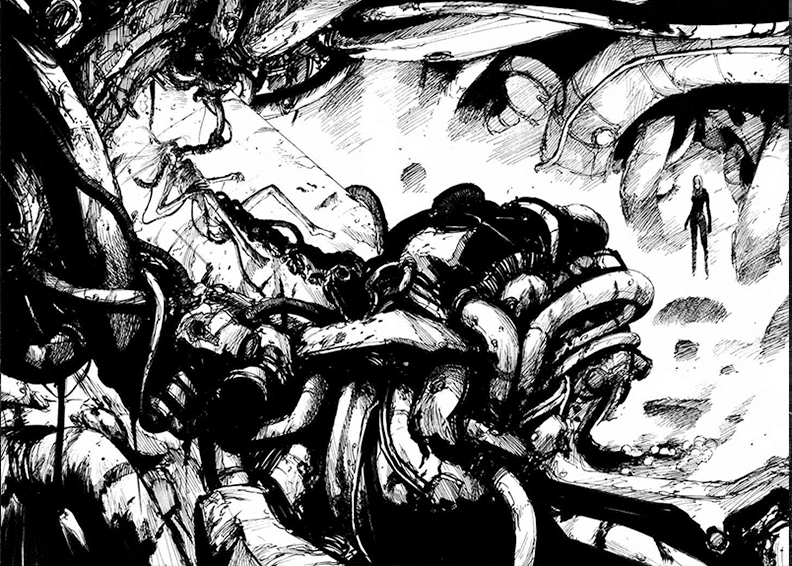
Blame! is one of my favorite manga of all time. It’s unique, beautiful, awe-inspiring and at times brutal. The manga stands out for its amazing setting, the stunning action scenes, but also the many gorgeous and disturbing cybernetic horrors that populate it.
It tells a dark, futuristic story that depicts a world in which technology is running amok and has created one of the most unique settings ever created.
The world of Blame! is a typical cyberpunk setting, depicting a world of fascinating high-tech but at the same low-life for all its inhabitants. Many other cyberpunk tropes fit Blame! as well, but the manga also features many instances of biomechanics and bio-punk.
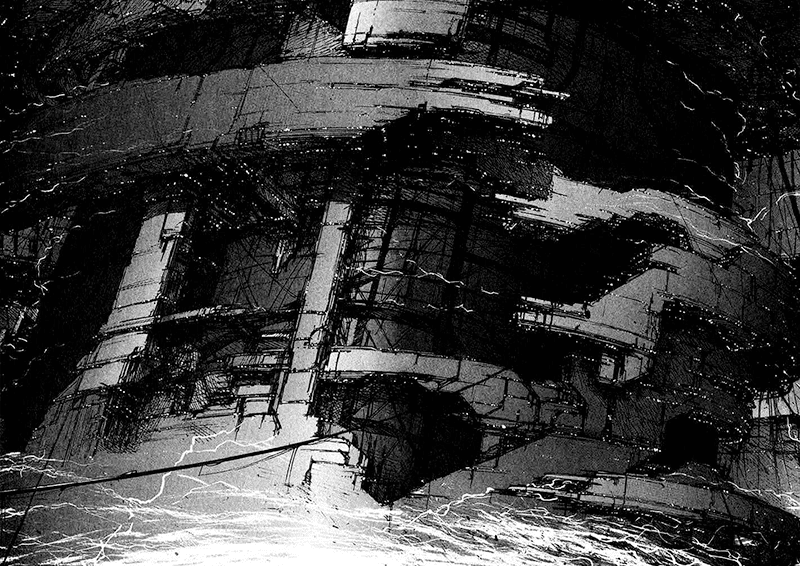
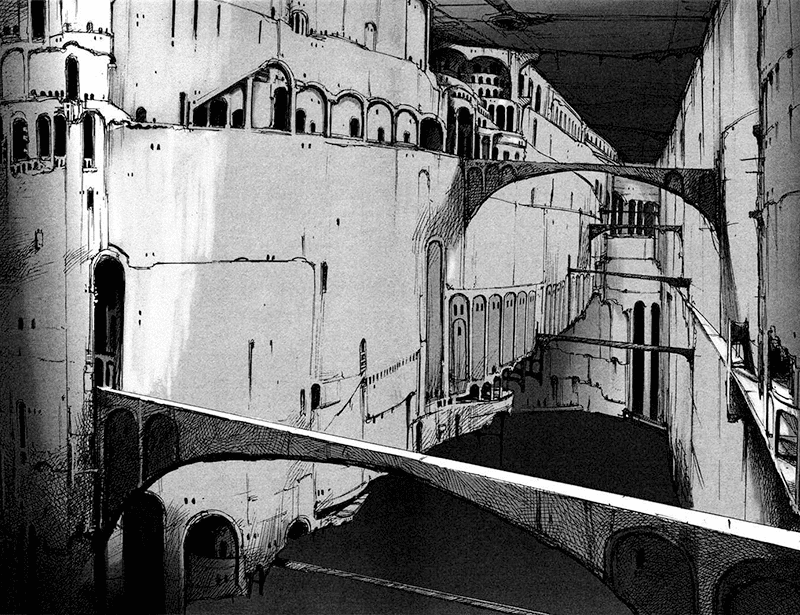
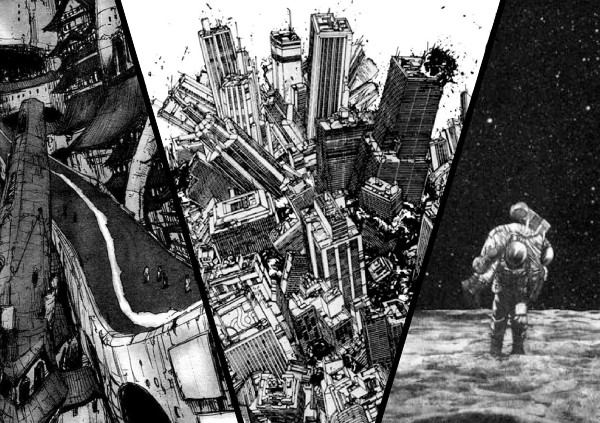
Tsutomu Nihei was an architecture student before he became a manga artist. This knowledge of architecture is one reason Blame! is so unique and impressive. We constantly see grand, awe-inspiring buildings and massive architectural wonders. Blame!’s world isn’t just huge, it’s immeasurable and mind-boggling gigantic.
The plot of Blame! is relatively simple. Killy, our main character, wanders the world of Blame! only known as the City in search of a human with Net Terminal Genes. A person like this could access the Netsphere, stop the chaotic growth of the City and stop the Safeguard from destroying what remains of humanity.
Over the course of the manga, we follow Killy on his journey through the world of Blame! and witness his interaction with the many other inhabitants of the City.
Blame’s world is dark and beautiful, chaotic and depressing and dangerous and brutal. It’s a wondrous, technological wasteland.
Blame! is a cyberpunk manga set in the far-future, but it’s also set in a post-apocalyptic dystopia.
The apocalyptic event was the loss of control over the City and thus over the builders and the Safeguard. There’s also the infection and devolution of humans and at the time of the story, no one with Net Terminal Genes remains.
The dystopian elements are clear at first sight. The surviving humans don’t amount to much when compared to the other cybernetic horrors inhabiting the City. They huddle together in small pockets of society and constantly have to fend for survival. Another aspect is the Netsphere, an advanced virtual reality which allows people to upload their consciousness. People with the Net Terminal Gene already did so, leaving the real world or base reality, as it’s called in Blame! behind.
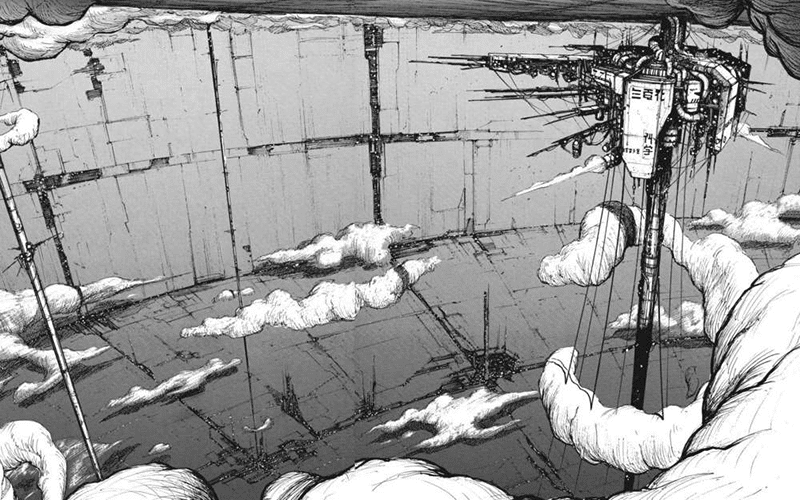
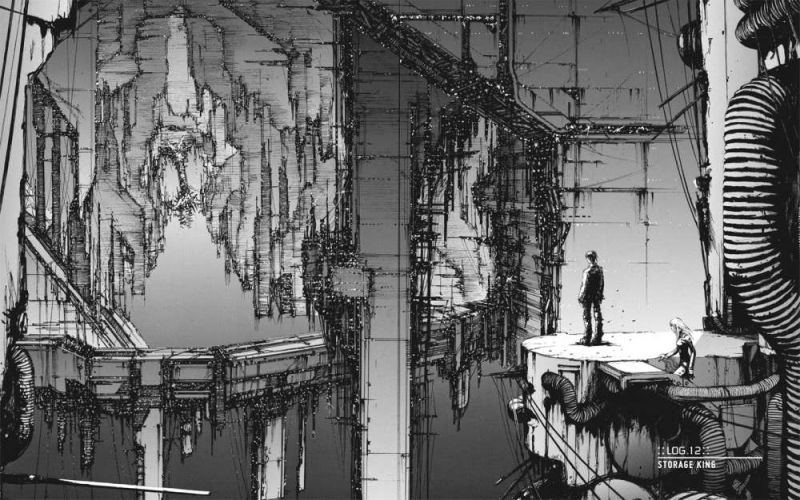
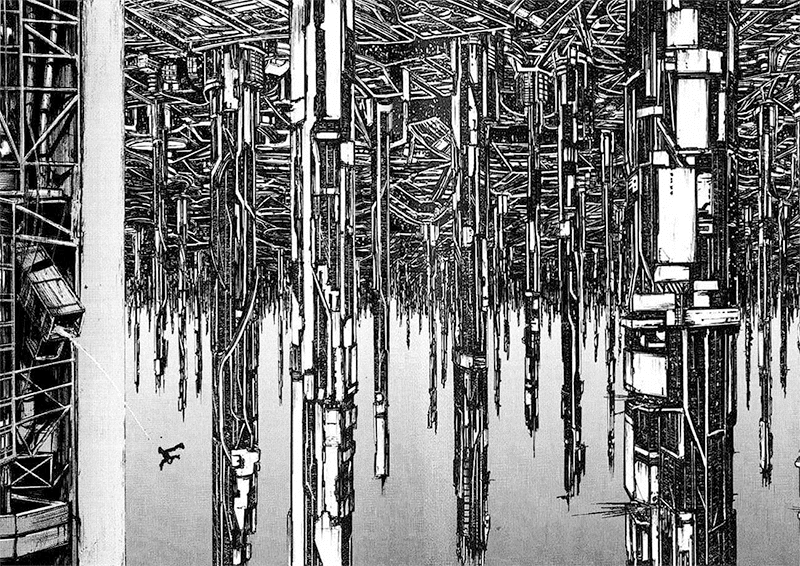
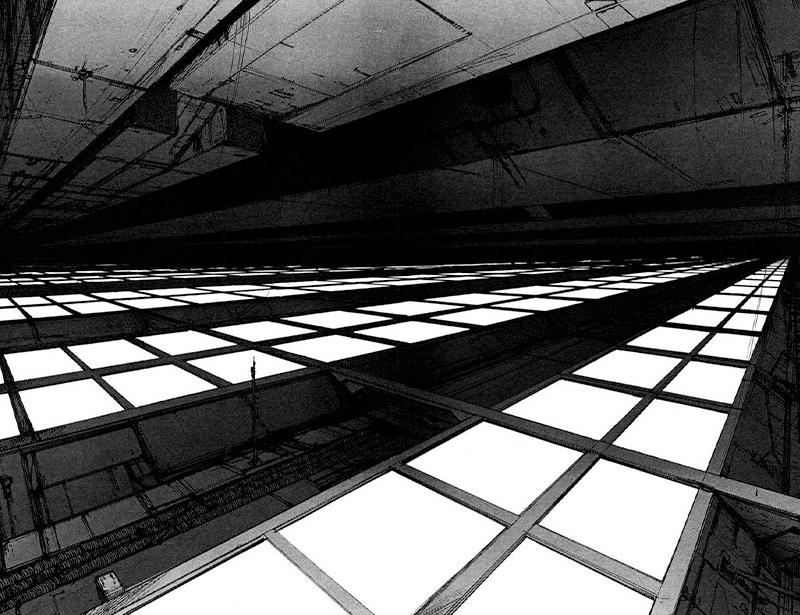
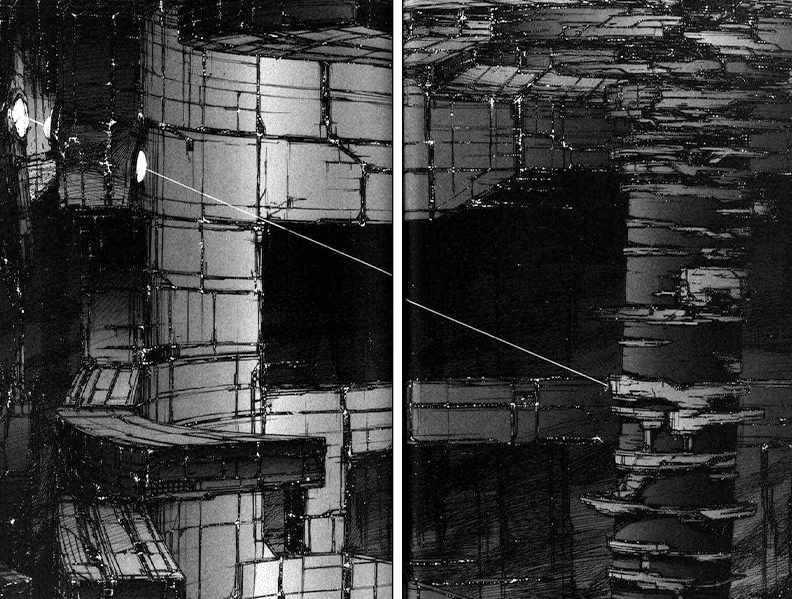
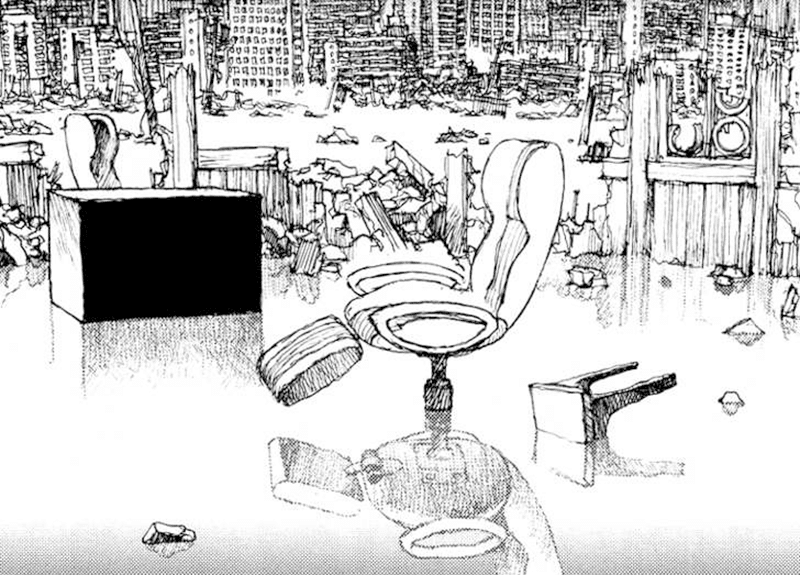
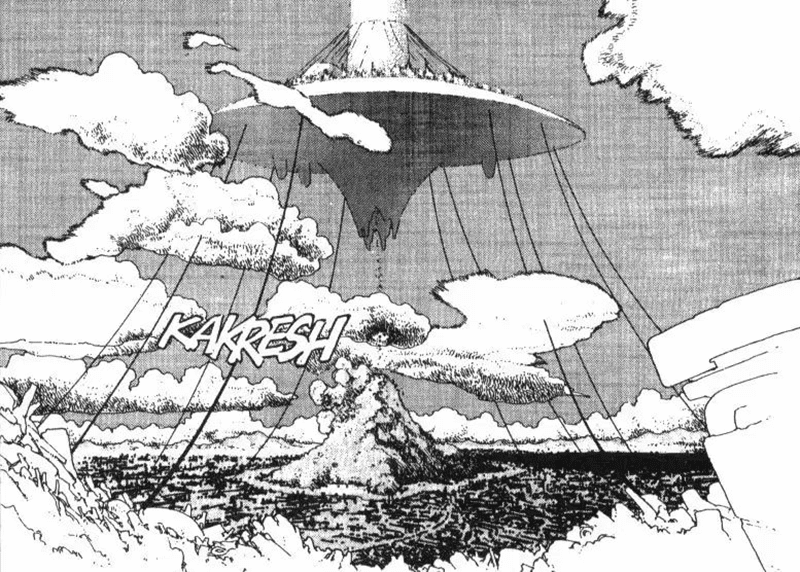
Blame!’s setting is entirely unique. It’s a world devoid of any natural elements. There are no forests, no normal ground and no mountains within the megastructures. Instead, everything we see in Blame! are buildings and constructions, many of which are of mind-boggling size. The City is a chaotic amalgamation of titanic architecture whose dimensions are entirely unknown to any of its dwellers. It’s essentially labyrinthine, futuristic dungeon.
Over the course of the manga, we learn more about the insane size of the City. At one point, Killy stumbles upon a single room the size of Jupiter inside the City. In the prequel NOiSE, we learn the Moon was the first celestial body incorporated into the City. It’s stated by the writer Tsutomu Nihei that the City is the size of a Dyson Sphere, meaning it stretches as far as the orbit of Jupiter.
Even now, however, the City continues to grow and is endlessly constructed by so called builders, autonomous robots. Since no human is possible to access the Netsphere, no one can communicate with the builders and so they just keep on increasing the size of the City.
There are, however, some interesting details and concerns about the City. It’s so massive that its sheer size defies the law of physics. A construction the size of a Dyson Sphere would inevitably collapse into itself. Yet, this seems to be solved by certain gravitational controllers inside the megastructure which manipulate gravity itself and keep the City from destruction.
Another interesting tidbit is the sheer amount of materials. We learn, over the course of the story, that many celestial bodies have been harvested as raw materials. Even then, there wouldn’t be enough raw materials for a construction the size of the City. It’s implied, however, that builders can convert energy into matter, are using some sort of antimatter or can simply conjure matter into existence.
The City is one of the most unique and interesting settings I’ve ever come upon in manga.
As mentioned before, humans don’t have it easy in the City. Many of them have to fight for survival and do so in various outposts and pockets of civilization. Some are smaller, others, however, like the Capitol, are bigger.
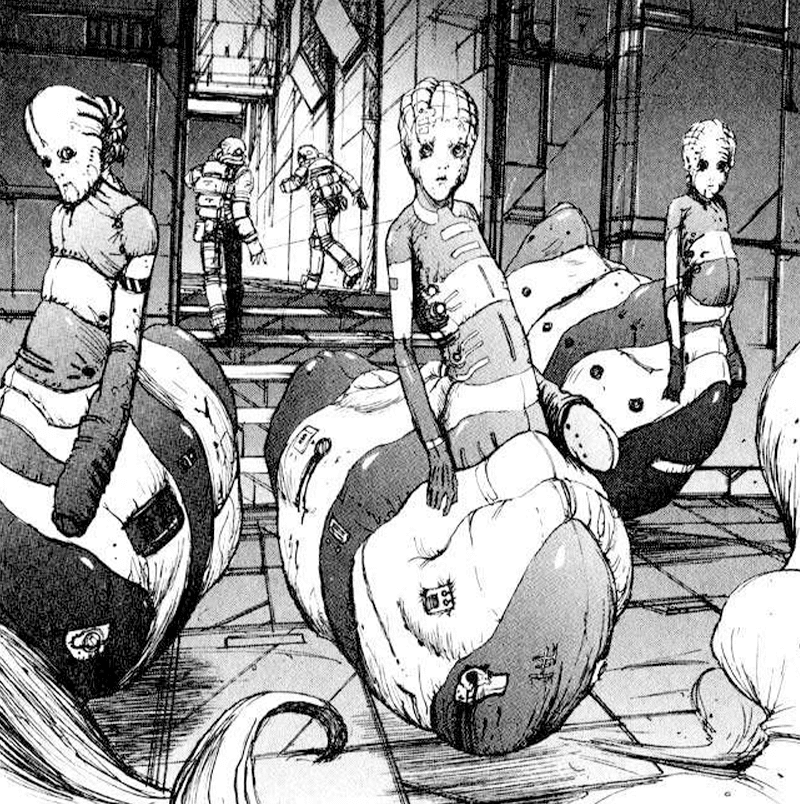
Many of the humans our main characters encounter look different from one another. Some are taller, others are smaller. The reason for this is most likely because of the often mentioned infection, devolution, and mutation. What they all have in common, however, is that they look pale, emaciated, even sick. These changes are also the reason that people aren’t carrying the Net Terminal Genes anymore.
The Safeguard was originally a security system to protect the Netsphere from unauthorized access and protect humans with the Net Terminal Gene. The Safeguard still follows these instructions, but by now hunts down and kills anyone without Net Terminal Genes.
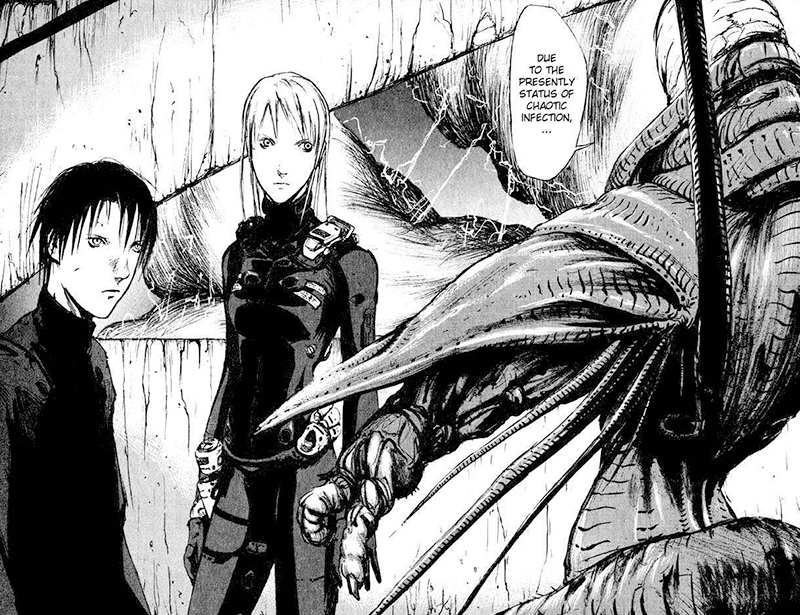
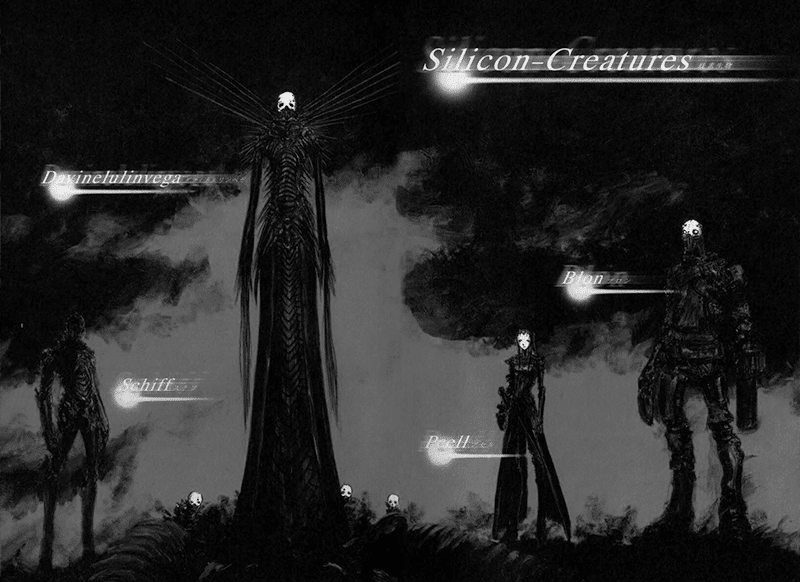
Other dwellers of the City are the Silicon Life, cyborgs who have their own goals, are independent from the Netsphere and want to keep the chaotic growth of the City going. If humanity would regain control over the City, and thus the Safeguard, they’d most likely use them to destroy the Silicon Life. And thus they want to keep the current status quo intact.
The last important fiction is the Governing Agency, which is basically the AI administration in charge of protecting the Netsphere. They are the ones who task Killy with finding a human with Terminal Net Genes to stop the chaotic growth of the City.
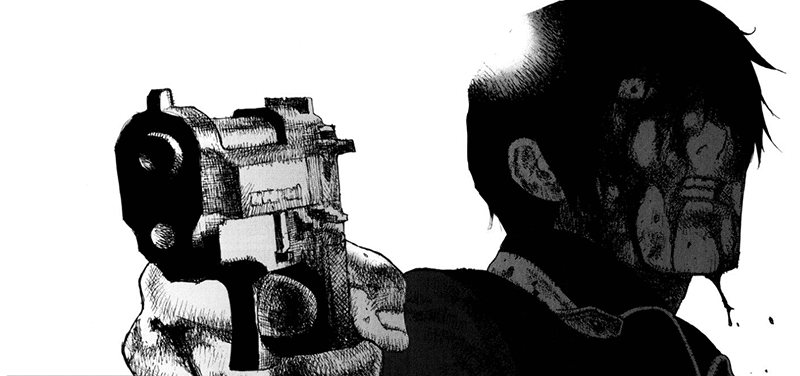
Blame! is a highly stylistic and unique manga, but that also means it’s not for everyone. The manga is mostly told via visuals and has very little dialogue.
With Blame! Nihei pushes the entire manga towards the visual side and his story is told not by dialogues or conventional narration, but almost entirely by visuals.
Blame! is a grand example of virtual story-telling and of a work in which a setting drives the narrative. In Blame!, the narration is told via the setting and not the other way around.
It’s this reason that makes Blame! so special and unique because it succeeds at telling a story primarily through the art.
Many parts of Blame! comprise nothing but silence. We watch as Killy travels on through futuristic wastelands, desolation and massive derelict buildings.
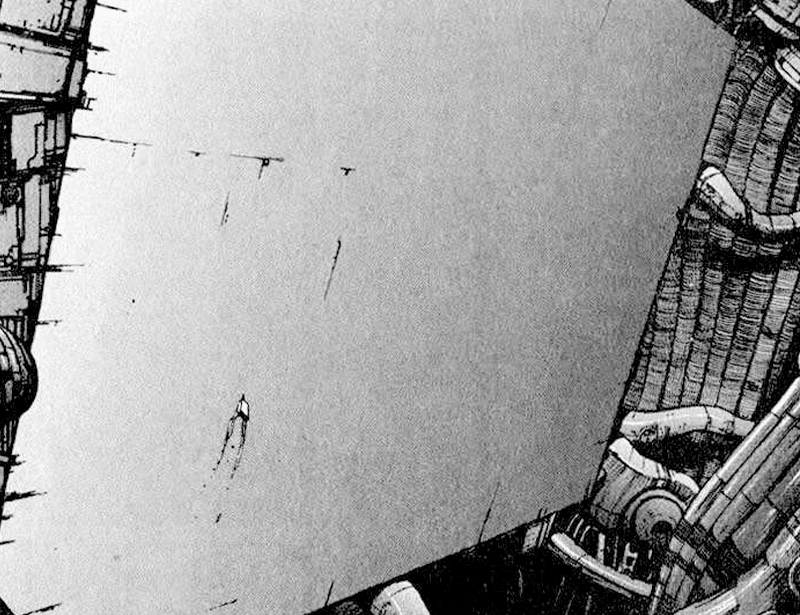
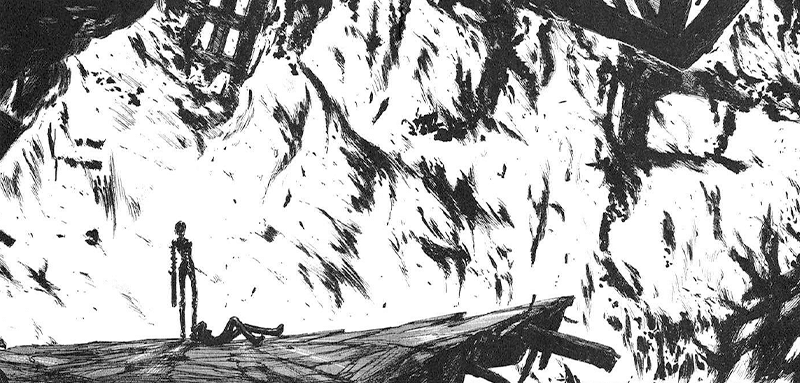
There’s scarcely any dialogue in Blame! but often it’s unnecessary. A great example is Killy’s gun, the Gravitational Beam Emitter. Instead of telling us how it works and how powerful it is, Nihei shows us multiple panels of how destructive a single shot is. Another one is the City itself. We know it’s chaotically and continuously growing, but we’re never told how huge it is. Instead, Nihei conveys this entirely through the visuals. There are countless panels in which we’re shown a bird’s-eye view of Killy as he wanders through buildings and past constructions of mind-boggling proportions.
Another great way about Blame!’s specific way of story-telling is that the manga’s never bogged down by needless explanations. We don’t get long-winded explanations about how the world of Blame! works. Instead, we merely witness the stunning, bizarre and nightmarish effects of the technological wonders Nihei conjures. Blame! is all visual.
This visual story-telling also influences the pacing of the manga, which lends itself especially well to the many action-sequences of the manga.
Nihei’s fantastic at world-building and Blame!’s a masterclass in world-building.
We know right from the very first chapter that Blame!’s a world that’s unfamiliar, dangerous and even alien when compared to our own. As we watch Killy’s travels, we soon realize that the City is entirely different from our world and it gives us a feeling of alienation.
All this is only possible by the insane, futuristic technology that exists within the City. This technology, however, is never explained, we just see it. Blame! happens so far in the future and everything can be explained by technology, but technology that not even the cast of characters truly understands anymore.
A lot of the technology we witness is the stuff of dreams or nightmares. This is most prevalent in the arc about Toha Heavy Industries. It’s here we learn that teleportation, time travel and even traveling to parallel realities is possible. All that, however, is hinted at to be caused by yet another of Nihei’s strange, futuristic technologies going haywire.
What’s true about technology is also true about the many factions and the mythology of the world. We only learn more about the City and its inhabitants in bits and pieces and have to put together the entire story on our own. All of it is vague, however, at times confusing, but it adds so much more to the mystery of the story and the atmosphere.
The main characters in Blame! are stoic, quiet badasses that almost never twitch when they get hurt.
This is truer for Killy than for everyone else. As he wanders the City he barely ever utters a word. That changes when he meets up and continues to travel with Cibo, but there’s still very little dialogue compared to other works.
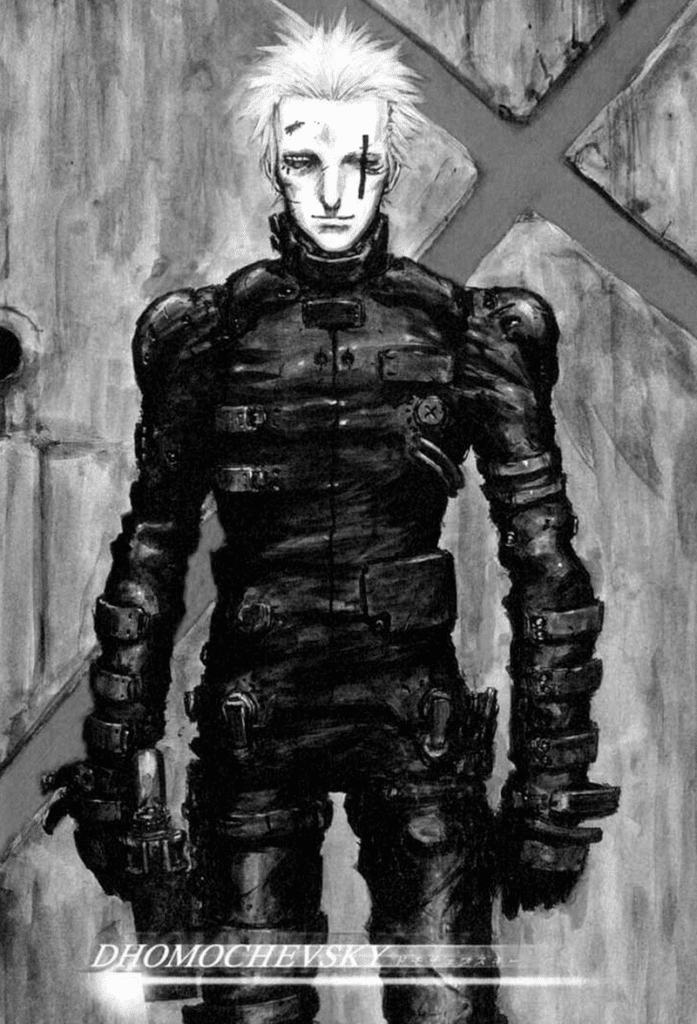
When reading Blame! one soon learns that Killy isn’t a normal human being, and it’s later revealed or at least hinted at that Killy, similar to Dhomochevsky and Iko, is a provisional Safeguard. Even then, his past is hazy and we never learn much about him apart from what we witness of his mission.
Many of the human characters we encounter are badasses in their own right, and one can clearly see the toll survival has taken on them. We never encounter someone who’s truly happy or truly beautiful. No, this is a dark, depressing and dangerous world and it shows as much in its setting as in its characters.
While the manga comprises various arcs within their own specific parts of the megastructure, Killy’s overall quest ties it all together.
Because of the special way Blame! is told, the manga can be confusing. There’s little dialogue and no exposition.
This is especially the case at the beginning of the manga when we don’t know what’s going on. We merely follow Killy as he wanders the City through several almost unconnected chapters.
The story only gets more engaging when Killy reaches the Capitol and meets up with Cibo.
Even then, the reader has to always put things together on their own as information is revealed slowly and only bit by bit over the course of the manga. Once one gets used to Nihei’s style of story-telling, however, the story is almost straight-forward.
And yet, Blame! might still be a manga you have to read twice. When I read Blame! for the first time years ago, I was entirely lost when I reached the ending. On my second reread, however, all was much clearer and the plot now made sense.
The passage of time is something that matters little in the world of Blame! We don’t know how much time passes as Killy travels from location to location.
It’s only occasionally that we get a measure of time for an elevator ride or the time it takes for Killy to fully repair and those numbers, similar to the size of the City, are mind boggling.
An elevator ride through a megastructure takes about a month, his reconstruction after being heavily damaged takes years. The same is true for other characters and other parts of the story. Dhomochevsky, for example, has been fighting the Silicon Life under Davinelulinvega for approximately three-hundred years before Killy and Cibo arrive at the unofficial megastructure.
This treatment of time only helps to add to the mystery of the world and makes the City seem even more unfathomable and immeasurable.
The sheer size of the City makes the passing of time almost irrelevant, especially since Killy’s is almost always seen to be traveling on foot. We don’t know how long he’s been wandering the City, but estimations point not just at centuries or millennia, but at dozens of millennia.
What’s interesting about Blame! is also the question of who the antagonists are. The more we learn about the world of Blame!, however, the more we discover that there are merely different factions opposing one another.
At first the Safeguard is the primary antagonist. We discover, however, that the Safeguard is merely a security network out of control which was originally responsible for protecting the Netsphere from unauthorized access.
The Silicon Life fits the term antagonists the closest, but even they are merely fending for survival in the City. It’s their goal to keep the current status quo, afraid that should humanity regain control over the City and the Safeguard, they’d be wiped out.
It’s even revealed in Blame² a sequel that the Silicon Life as Killy as ‘the calamity,’ the one responsible for their race almost going extinct.
The Governing Agency wants to find a Net Terminal Gen simply to stop the growth of the City and to regain control of it.
While we watch the story from the eyes of Killy, it appears, of course, that the Safeguard and the Silicon Life are the prime antagonists of the story. If we take a step back, however, we learn that all that’s happening is caused by mismanagement and the chaotic stage of the ever-expanding City.
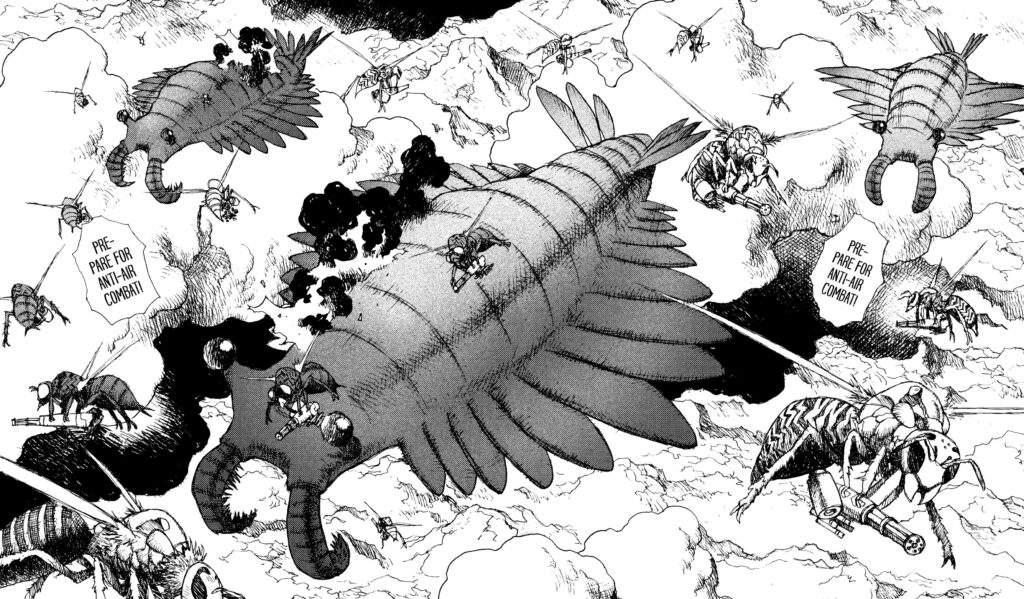
Blame! is one of the greatest manga’s I’ve ever read in terms of visuals. As mentioned before, I believe that Tsutomu Nihei is an artist who can rival the best in the genre. Be it his world or his various cybernetic horrors, Blame! is a marvel to look at.
The moment you start reading Blame! you realize that this manga’s different from others. Even in chapter 1, we already get to see the grand architecture of mind-boggling proportions so common to Blame!
You can clearly see that Tsutomu Nihei studied architecture and that he knows about the construction of buildings. It’s this knowledge that sets Blame! aside from other works.
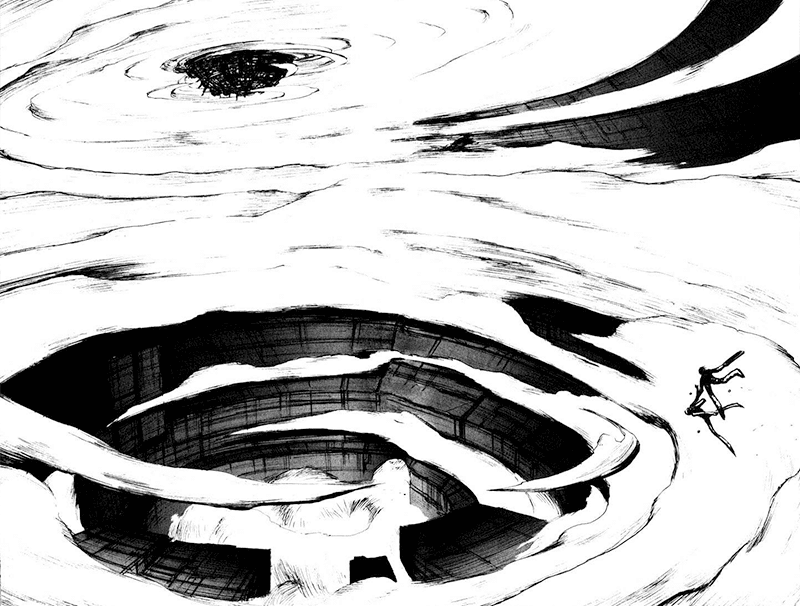
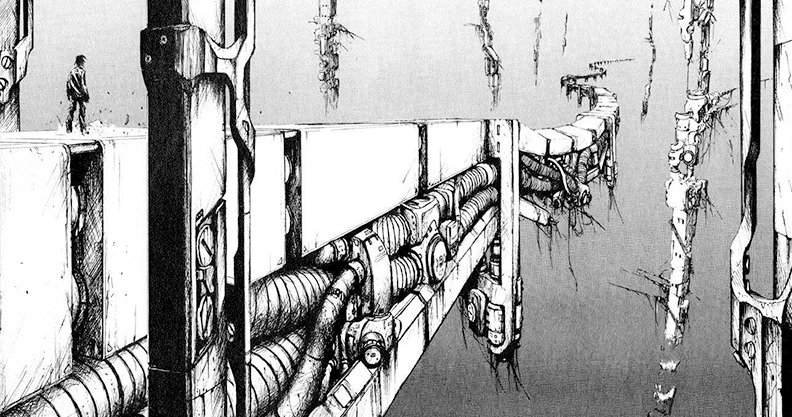
There’s a sense of scale in many of Tsutomu Nihei’s panels that really showcases the insane proportions of the immeasurable City. Yet, all those constructions are as bleak as they are vast. Many times we can’t even make out the end of these constructions, as they seem to go on forever.
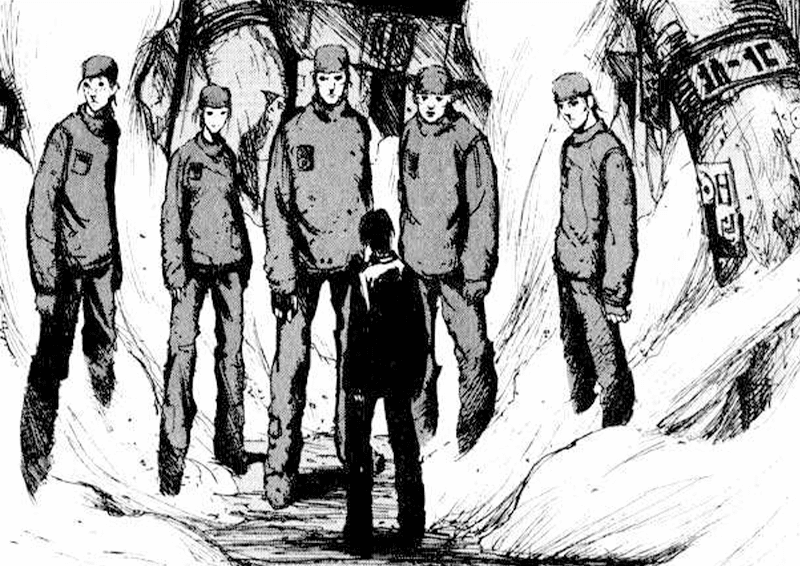
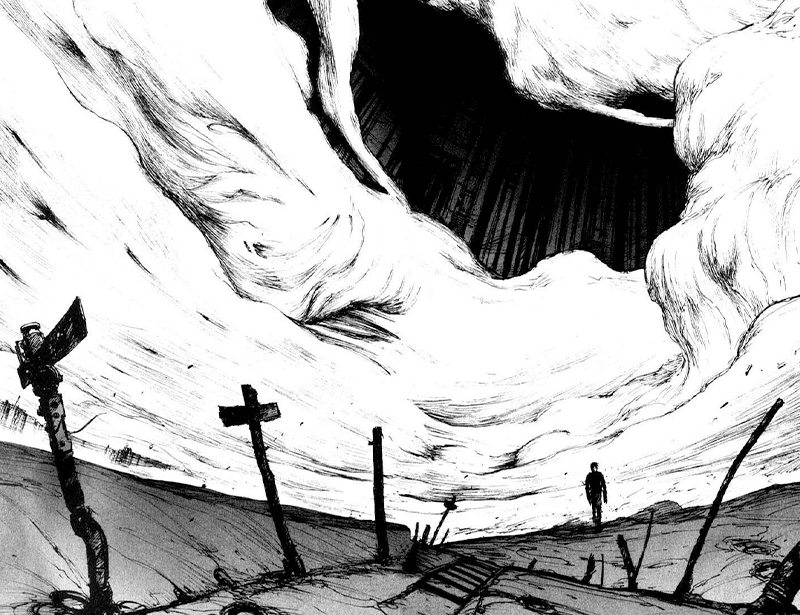
Many times, we see Killy in front of a backdrop of immeasurable proportions or we see him only as a small unimpressive dot as he walks vast metal plans, climbs giant buildings, or wanders a bridge that continues further than the eye can see.
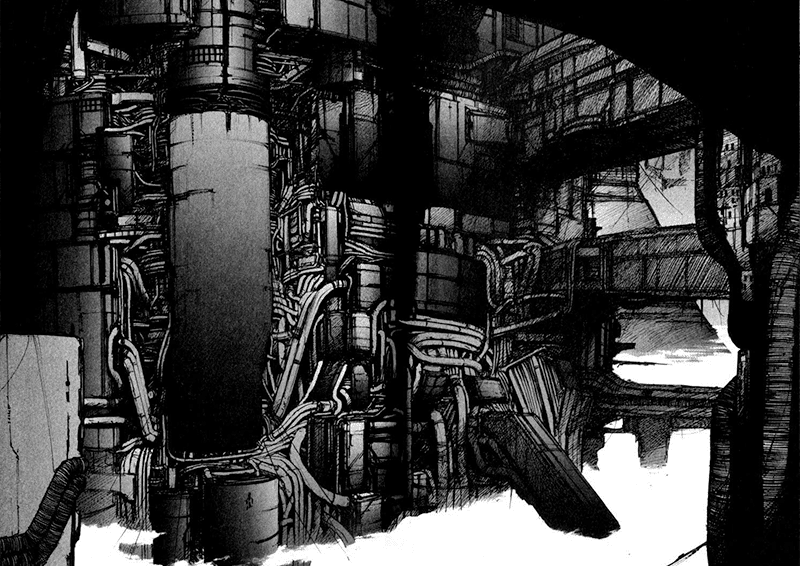
And yet, as gigantic as Tsutomu Nihei’s creations are, they are still insanely detailed. This attention to detail is especially prevalent when we get a closer look at the locations Killy travels. Technological gadgets, machines and many other elements of the City are rendered in stunningly beautiful detail.
It’s this mixture of mind-boggling proportions and attention to detail that truly brings forth Nihei’s world and truly immerses you in the story.
An interesting detail to note is that Blame!’s world isn’t a unified one. In one chapter, we see Killy traversing an amalgamation of high-tech constructions or a futuristic cityscape. In others, he’s ascending winding corridors, unending staircases or what looks like gothic castles. At times, these constructions look almost organic, almost like something that grew instead of being built.
Tsutomu Nihei’s style is rough, almost dirty, especially in earlier chapters. His imagery comprises a lot of line work which lends itself fantastically to the more derelict and ruined areas of the City.
The many different details of the City are brought forth by a heavy reliance on shadows and shading.
Blame!’s entire visual style is one of the stark contrast between light and dark. Empty spaces are generally held in lighter colors while interiors, especially tunnels, caves and staircases, are conveyed via deep blacks.
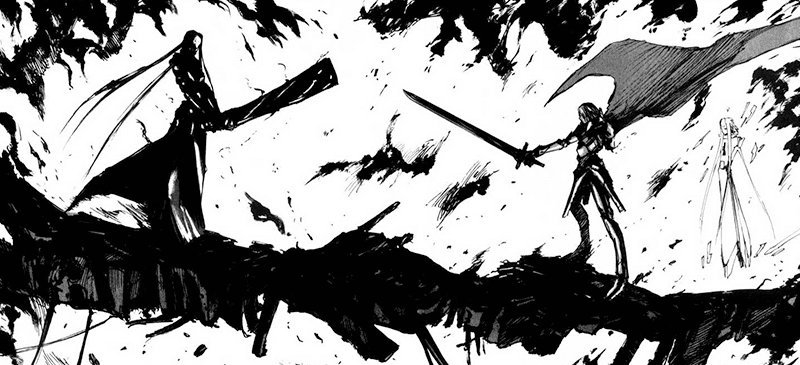
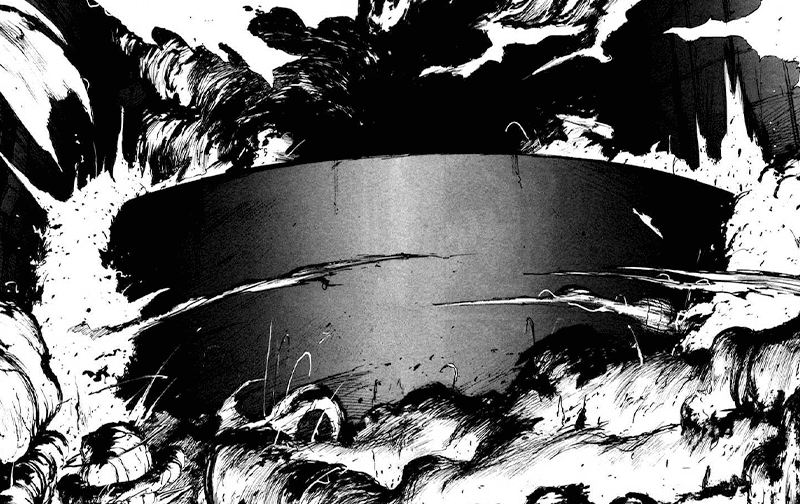
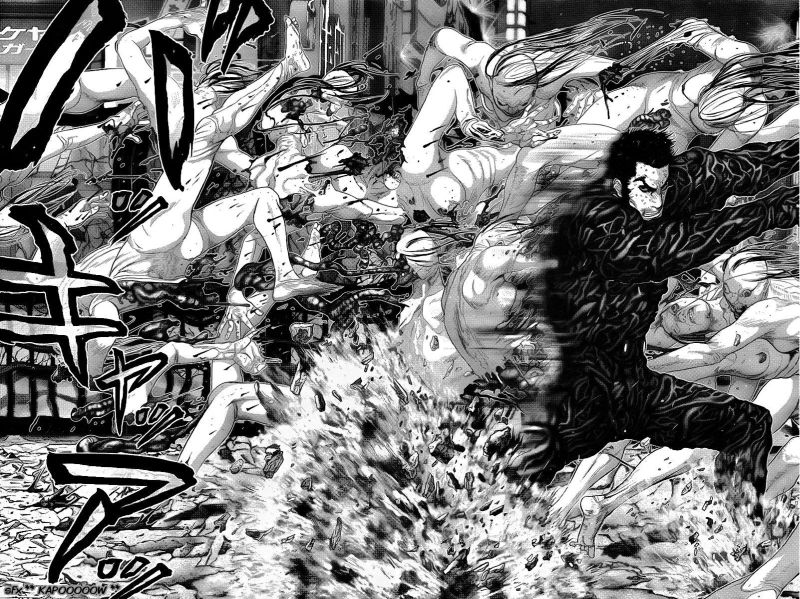
What’s special about Tsutomu Nihei’s style is his usage of negative spaces to convey light or huge explosions during action sequences. This makes them a marvel to look at and helps to bring forth what’s happening.
Killy’s design is an interesting choice. He’s wearing all back, no special armor and seems to be almost understated in a world as strange as Blame!’s. The same can be said about the rest of the cast, however. Cibo, Sanakan and also Dhomochevsky are all dressed similarly.
This is a stark contrast from the other inhabitants of the City who all have a distinctly different look from one another. The Electrofisher’s armor, the Silicon Life in general, but also the exterminators of the Safeguard.
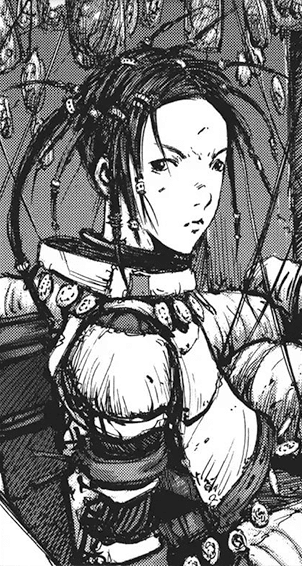
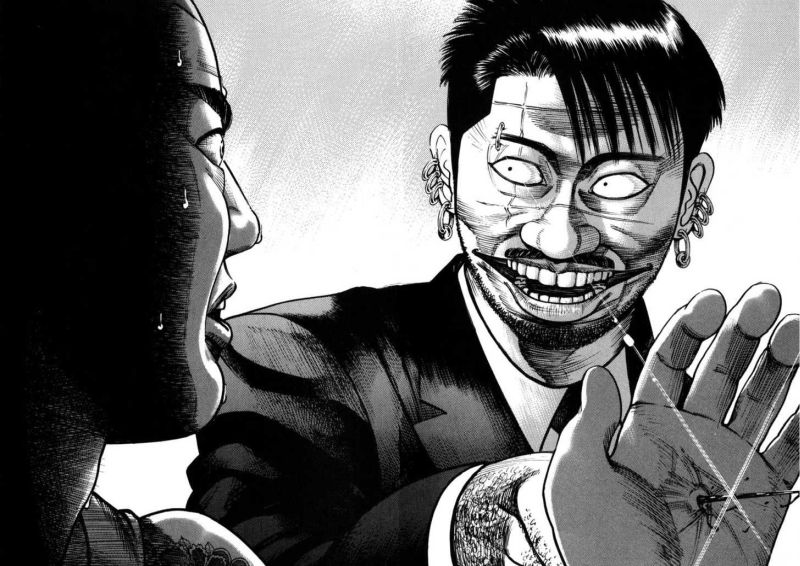
Blame’s world is a harsh and dangerous one and as mentioned before, you can truly see it in the design of the many humans. Almost all of them look pale, sick, malnourished and depressed. They look hardened, emotionless and you can see just how much they went through.
What’s interesting to note is the aforementioned contrast of light and dark also applies to many of the character designs. The interior structure of the exterminators seems to be black, while their faces and outer parts are white. The same is true for the many Silicon Life, who generally have white, human faces, but distorted, black, metallic bodies.
One could even say that the color palette of a character shows their alignment. The most dangerous beings, like Schiff, or the armored Silicon Knights, are held entirely in black. Mensab and Sue, two arguably lawful individuals are held in almost pure white.
Our main characters, especially Killy, are almost all morally gray and thus are a mixture of black and white.
While Blame!’s world is one of futuristic high-tech, many of its elements look strangely biological.
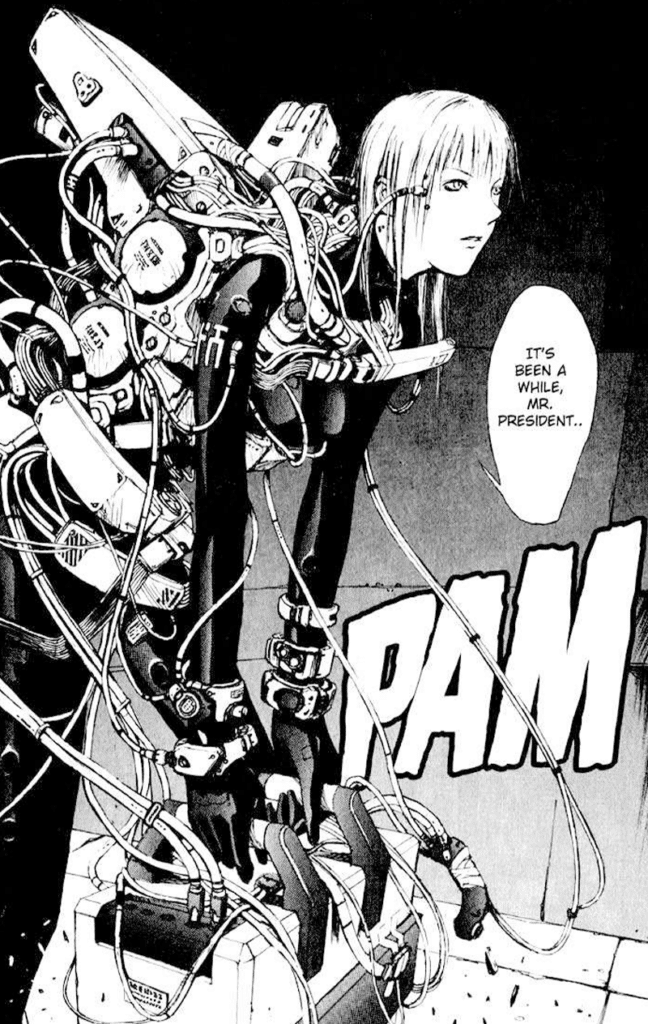
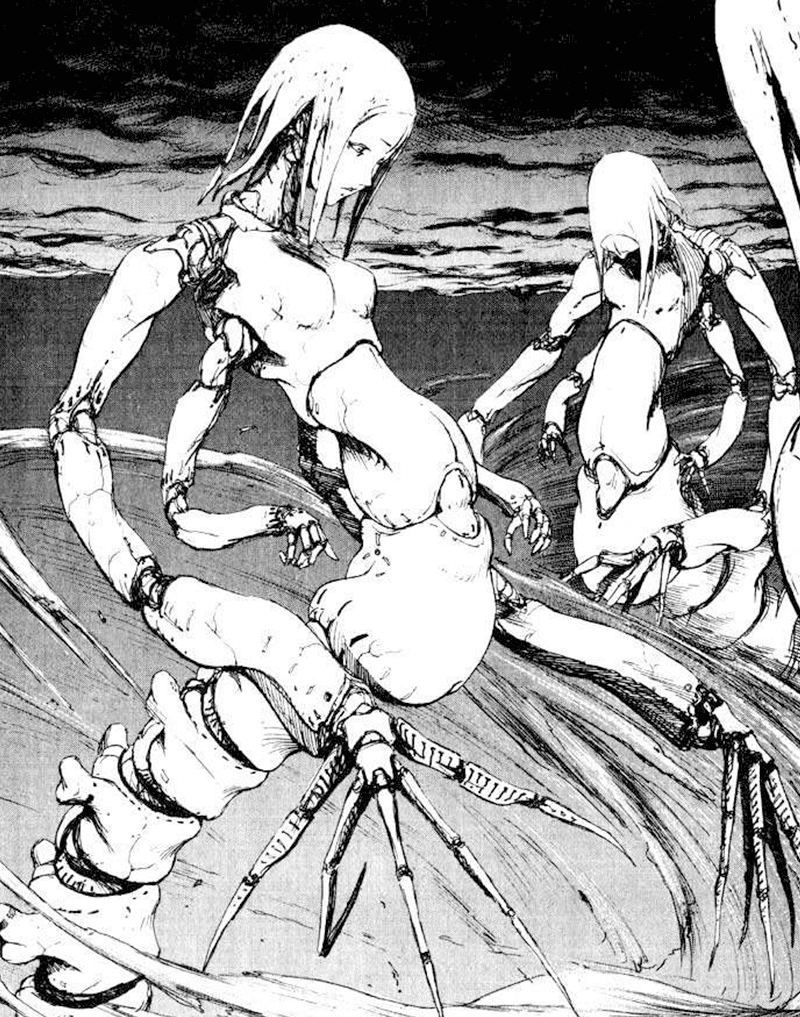
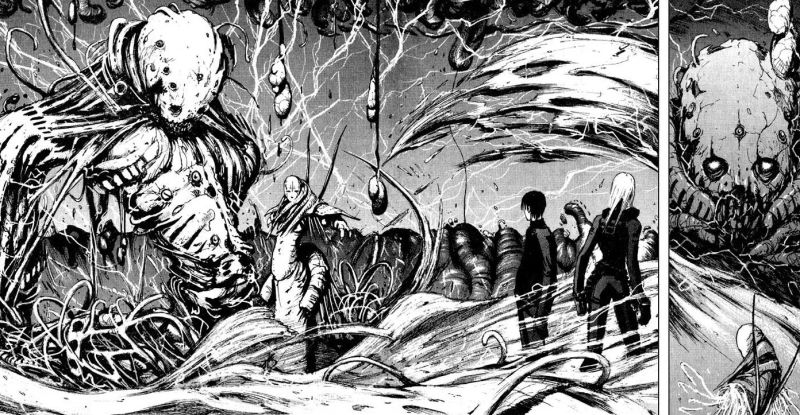
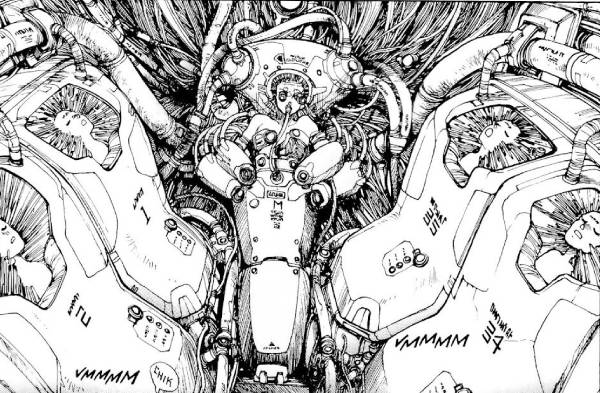
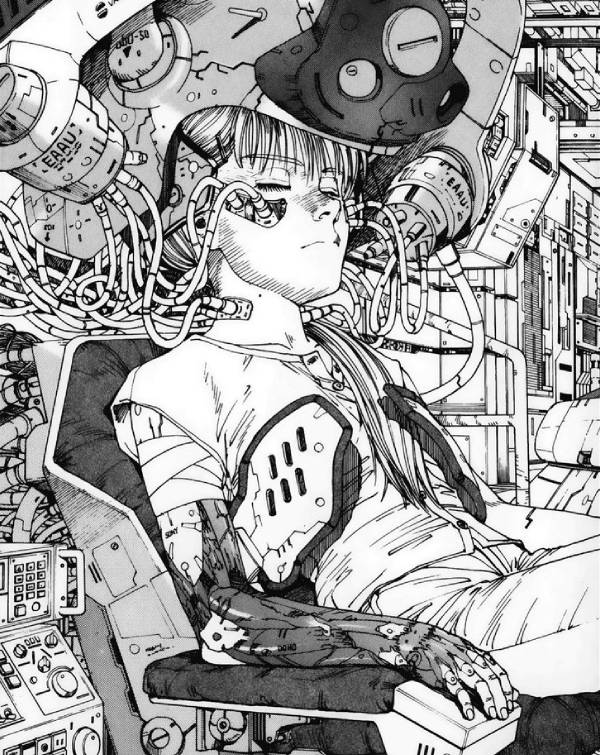
This is especially true for the many cybernetic monstrosities Killy encounters, the exterminators of the Safeguard and the Silicon Life. They clearly look mechanical or robotic, but at the same time, they all have a distinctly organic look to them. This is especially true when new Safeguard units are synthesized. The entire process has a sort of biological look and feel to it.
The many cybernetic horrors that populate the City are all fantastic, disturbing and outlandish to look at.
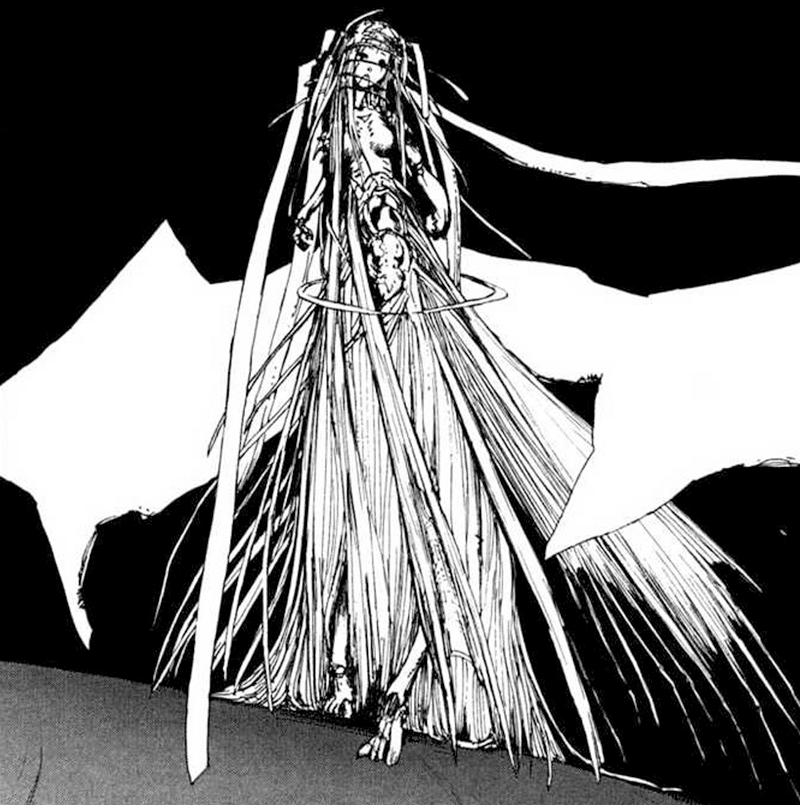
While the normal, level 1 exterminators look terrifying, they all look identical to one another and appear more like drones than anything else. Higher-level exterminators, however, look amazing. There’s the ‘siren’ Safeguard Killy encounters when climbing the tower, the high-level exterminator at the end of the story, but also Cibo after fusing with the level 9 Safeguard. They all have a distinct, almost angelic look to them with rings, haloes, and even wings. It’s an interesting design choice that only serves to make them creepier.
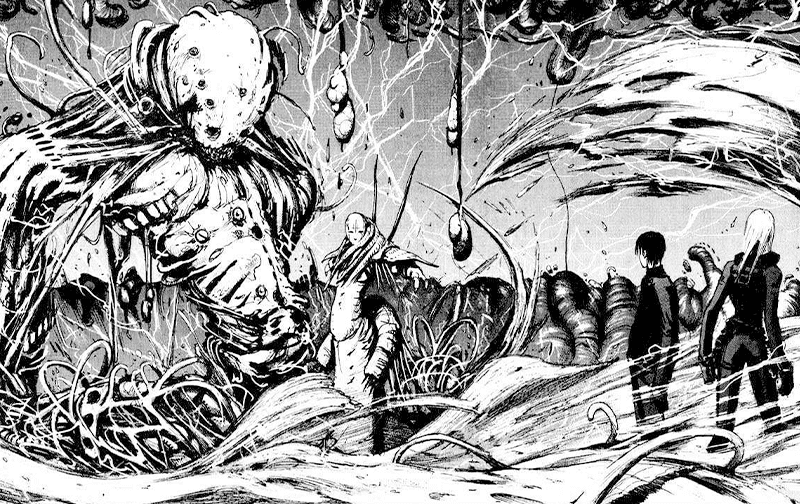
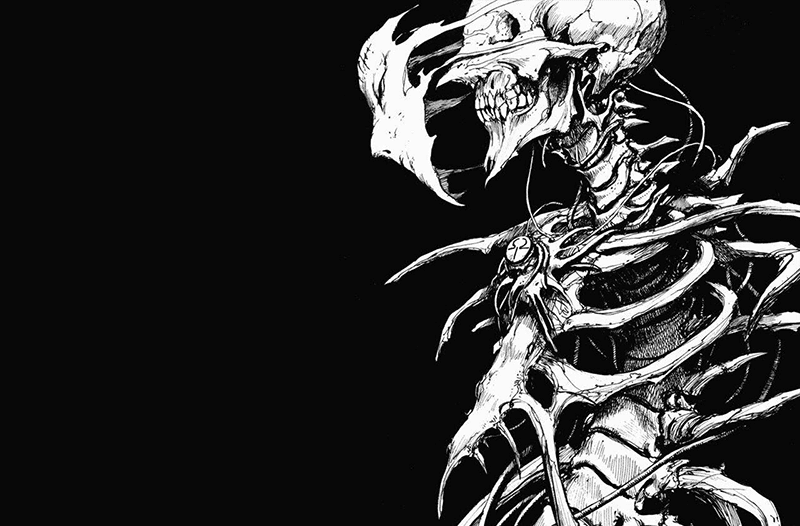
The Silicon Life has some of the most fantastic design I’ve ever seen in a science-fiction magna. They come in a variety of forms and design, employ a variety of weapons and wear a variety of armor. Some are even heavily distorted, sprouting additional limbs or parts.
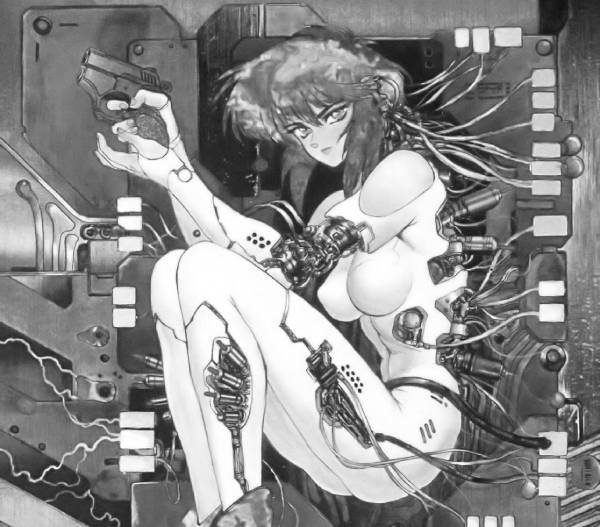
Their design is throughout the book terrifying and disturbing, but they are a marvel to look at and are rendered in beautiful detail. Their design is reminiscent of the strange organic-inorganic art of H. R. Giger.
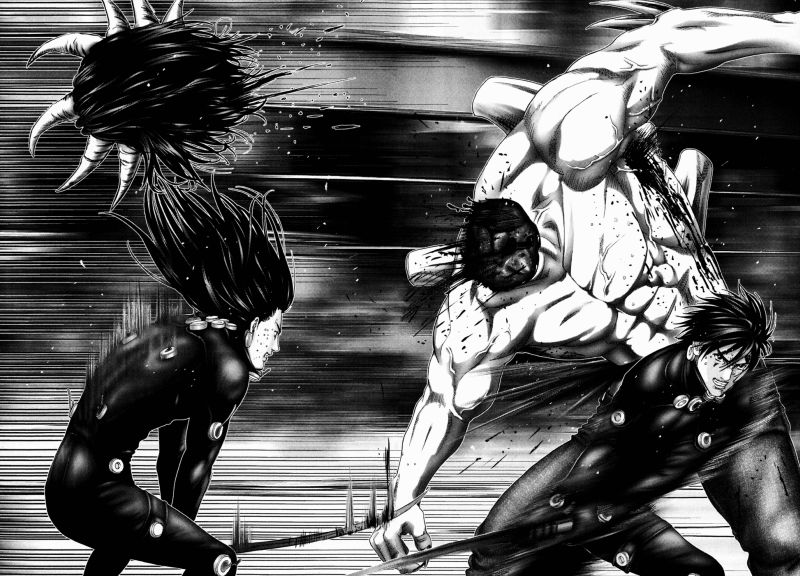
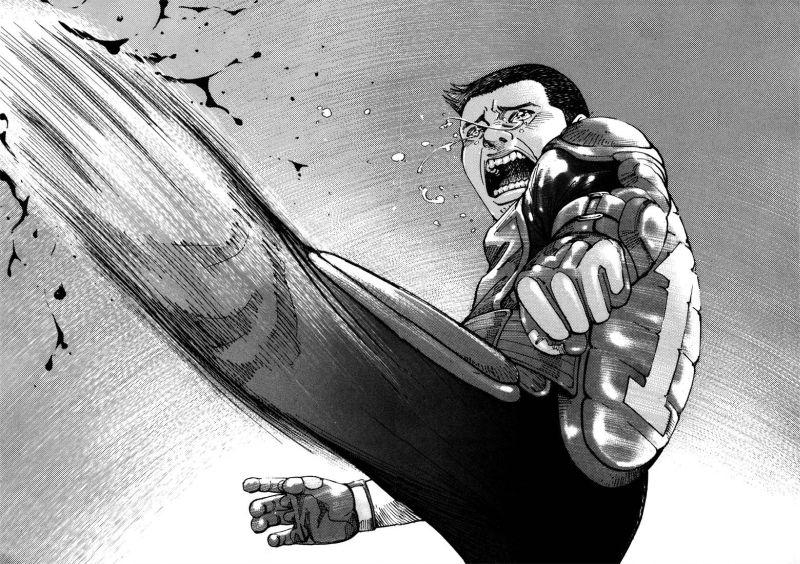
Blame! is full of frantic action which is always shown in stunning detail. Each of panel of it is fantastic to look at.
Many of the action sequences in Blame! are devastating, insane in scale and bright forth mass destruction. At other moments, however, they are more intimate and showcase fantastic close-range encounters.
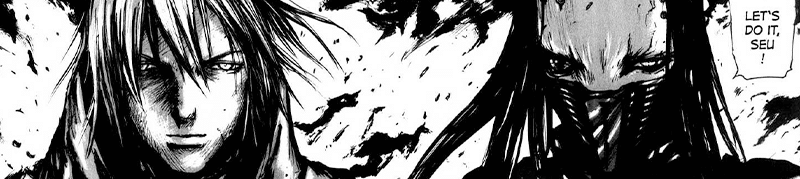
There are also action scenes in Blame! that are clearly created for style alone. This is most prevalent in the Toha Heavy Industry arc, which features Seu, the protector of Mensab who appears as a knight in shining white armor wielding a sword. When he fights Ivy and when he fights the guards of the Central AI, it gives the action the air of a fantasy manga and not that of a science-fiction one. One thing has to be said, however, those fights look absolutely amazing!
I always loved science-fiction, but especially the more futuristic and outlandish scenarios. Blame! was everything I was looking for.
It combines fantastic and unique world building with breathtakingly beautiful visuals. The art is incredible and shines because of its technical drawings and Tsutomu Nihei’s knowledge of architecture.
While Blame!’s setting is a post-apocalyptic dystopia, it’s one so strange and fresh it’s unique. It’s a tale of technology run amok which manifests in the ever-growing, chaotic City and the out-of-control Safeguard. Things go even so far as to include time travel, mass-scale teleportation and even parallel realities.
What I came to love the most, however, were the many creatures, especially the higher-level exterminators and the Silicon Life, who spice the manga up with a fair bit of horror because of their design and simply look gorgeous.
An interesting little detail is that Blame! never becomes preachy, never a discussion of the topics it showcases. Instead, it simply conjures up a nightmarish vision of our future, one unlike any ever seen before.
While most of Blame! is full of weird imagery, crazy action, and Killy’s stoic demeanor, there are some human and tender scenes. At one point, Killy and Cibo discover a cloning machine which is forever creating clones and which Killy promptly destroys. At another point, Killy saves a Dry Man child and later destroys the cooperation’s docks after he realizes that the transporter he was on was transporting Dry Man ready for organ harvesting.
Those minor events never detract from the atmosphere, but are instead merely there, but they help to flesh out Killy a bit and give him at least some semblance of emotion.
There are, however some problems with Blame! While I love the action scenes in the manga, some of them can be hard to follow because of the abundance of gigantic explosions caused by Killy’s Gravitational Beam Emitter.
Another problem can be the style of story-telling and the story overall. It makes for a somewhat different, confusing reading and can be hard on first-time readers of the manga, making it almost necessary to read the manga more than once.
While I enjoyed the weird and outlandish technologies at play, I think Tsutomu Nihei went a bit too far during the Toha Heavy Industry arc and makes it one of the most confusing ones to follow and understand.
And yet, even with this criticism, I still think Blame! is an absolute visual masterpiece. It’s not something to be simply read, but it’s something to marvel at and to be immersed in.
Blame! is a manga with an intensely dark and brooding atmosphere, a unique setting which is portrayed by vast, colossal structures and frantic action sequences.
I’d recommend Blame! to anyone interested in visual story-telling, people who are fans of science-fiction and anyone who loves cyberpunk.
If you want to read Blame!, I recommend buying the complete set of the Master Edition released by Vertical Comics:
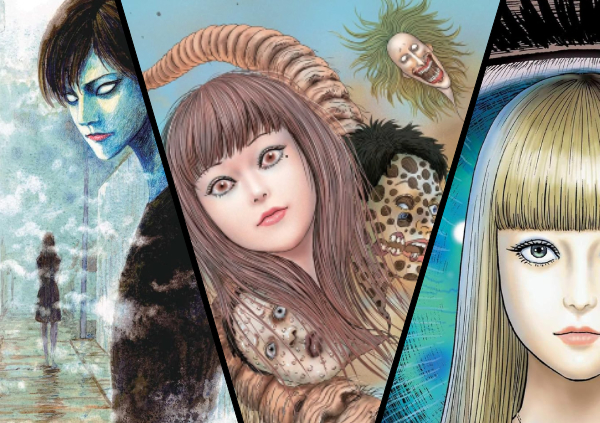
There’s no one as famous in the world of horror manga today as Junji Ito. He has rightfully amassed a global cult following.
Yet Ito is not merely a horror mangaka. He’s one of the greatest horror artists alive today. If you’re a fan of horror, especially horror manga, you’ve likely encountered his work.
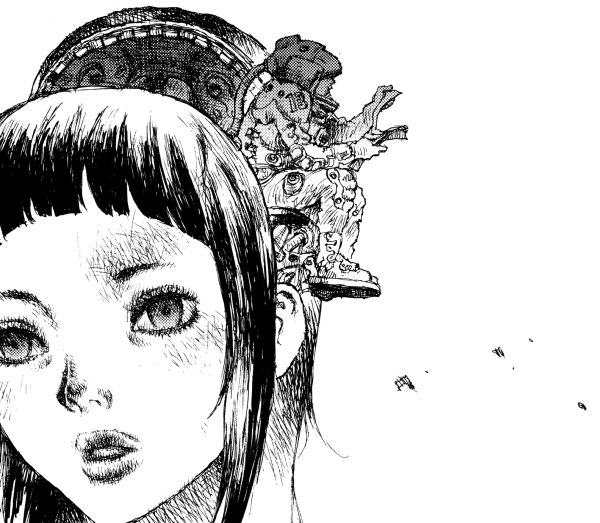
Ito’s body of work is as strange as it is distinctive, and reading his manga feels like falling down a very particular rabbit hole.
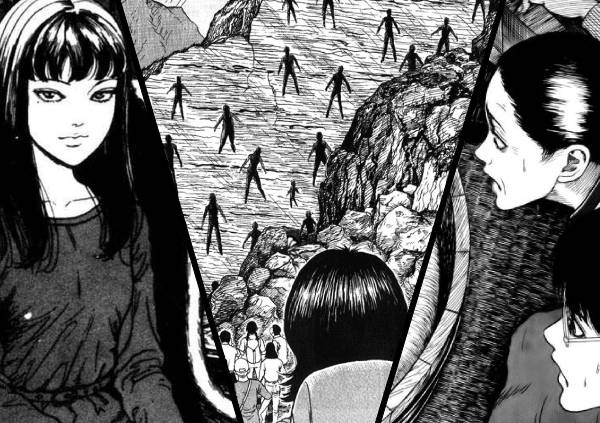
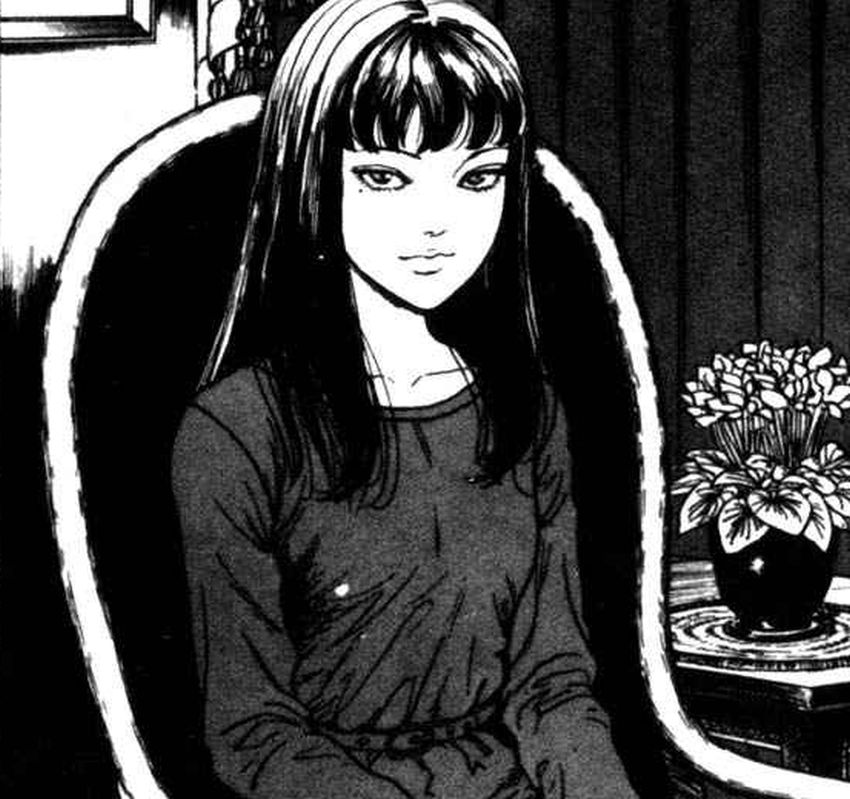
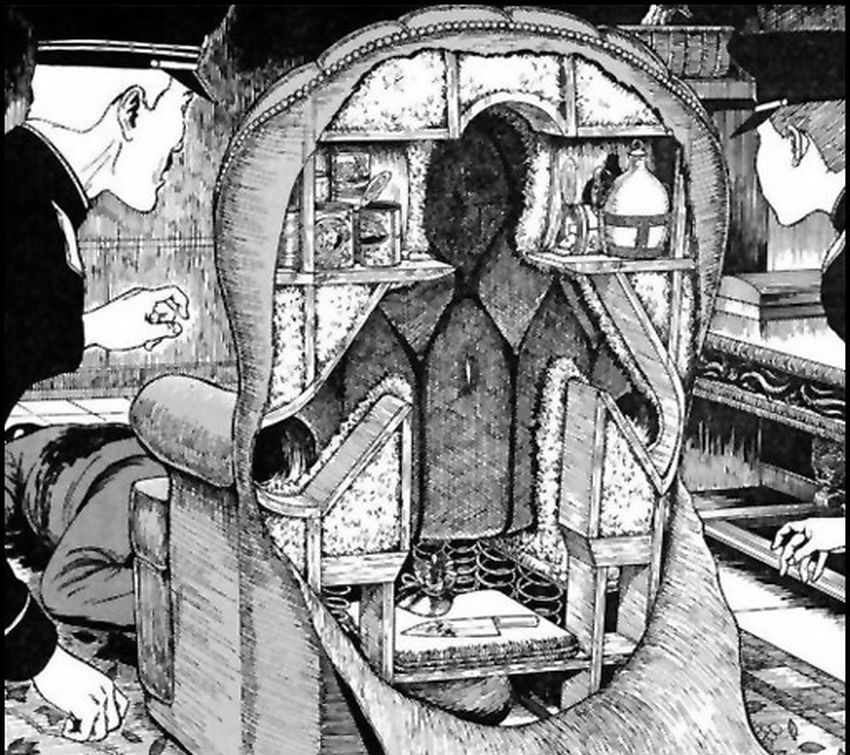
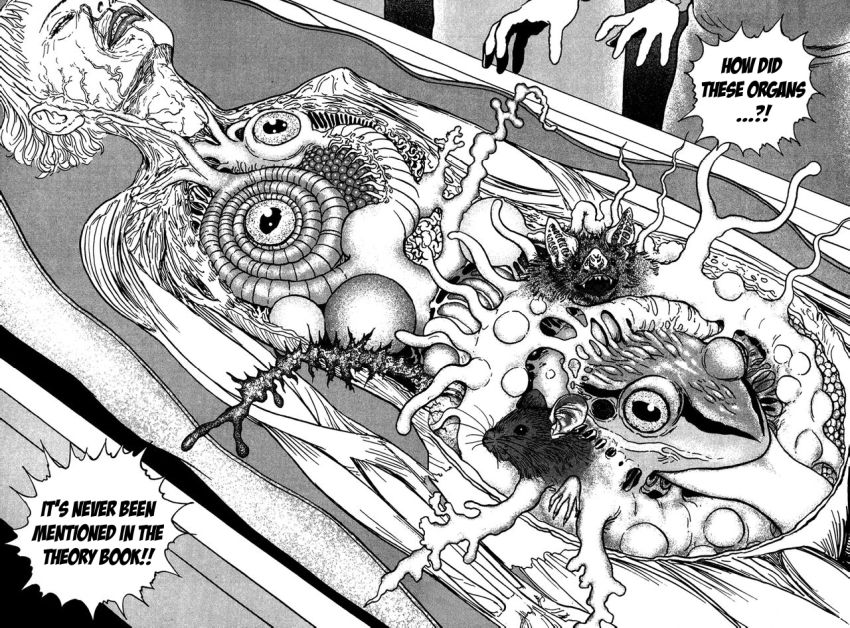
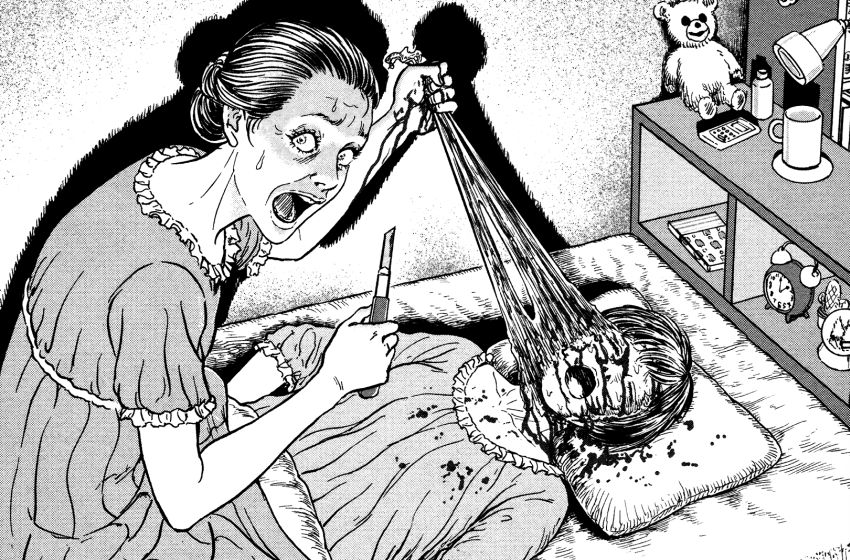
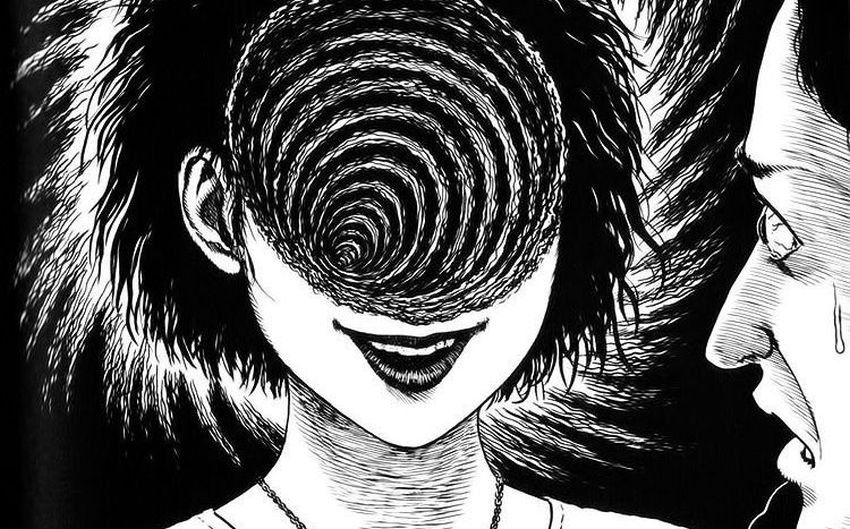
@ Junji Ito – Tomie, Enigma of Amigara Fault, Uzumaki
His catalogue spans hundreds of short stories collected in English anthologies, as well as several longer works that showcase his skill at building uniquely unsettling worlds. Whether you start with a one-shot or a full volume, the same obsessions return: bodily transformations, cosmic horror, psychological collapse, and the corruption of the mundane.
In the sections below, I explore these elements, the signature techniques of his visual style, and his recurring narrative themes.
I first learned about Junji Ito a decade and a half ago when I was searching online for new horror manga to read. At the time, I was still new to the genre, but the prospect of a manga that was supposed to “give me nightmares” sounded interesting enough. That manga was Tomie, and when I finally read it, it was everything I desired in a work of horror and much more. It was full of outlandish ideas and terrifying imagery.
The next manga by Junji Ito I read was Gyo, which was as nightmarish as Tomie but much more surreal, weird, and absurd. His style was as fantastically disturbing and nightmarish as in Tomie.
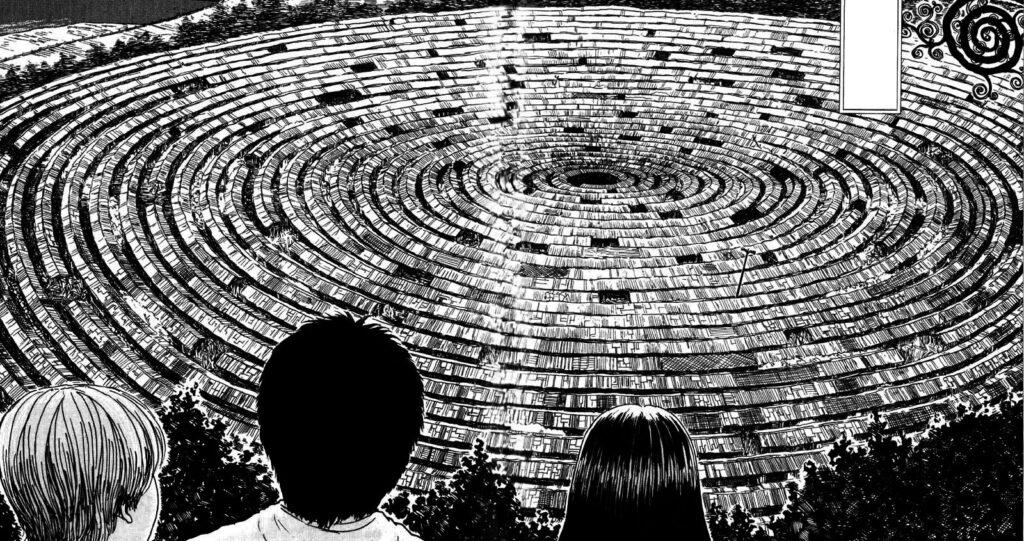
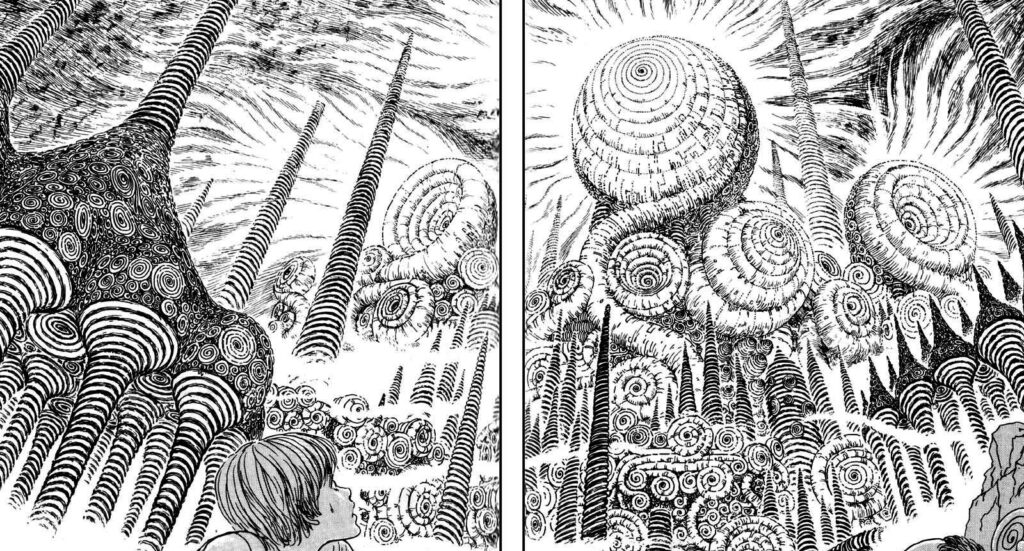
What finally sold me and made me a lifelong fan of his work was Junji Ito’s masterpiece, Uzumaki. It’s the story of the small coastal town of Kurouzu-cho, which is haunted by spirals. The story was outlandish, the imagery disturbing. It felt completely unique and was unlike any other horror manga I’d read until then. For readers curious about Uzumaki, I also put together a short article about my favorite Uzumaki chapters.
Over the years, I’ve read countless horror manga, both by well-known and lesser-known writers, as you can see in the list of my favorite horror manga. Still, Junji Ito’s works hold a special place in my heart and are, in my opinion, among the best horror manga of all time. His works are so strange, so unique, and so outlandish that I find myself going back to them time and again.
What makes Junji Ito’s works so fantastic is his blend of outlandish, sometimes supernatural horror with the mundane. Junji Ito’s work truly shines because it’s a very specific kind of horror. His stories seldom feature killers or monsters. Instead, his horror is often unexplained, comes from powers outside our influence, or arises from our own faults, fears, obsessions, and phobias.
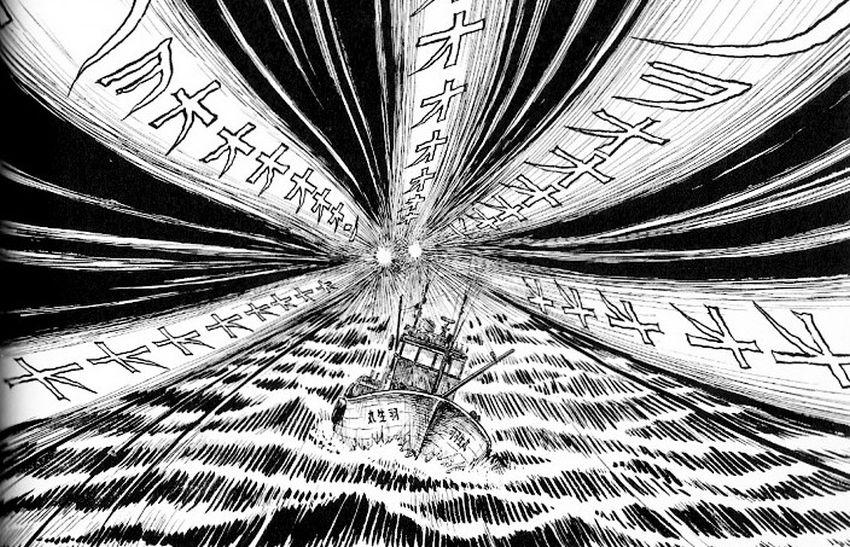
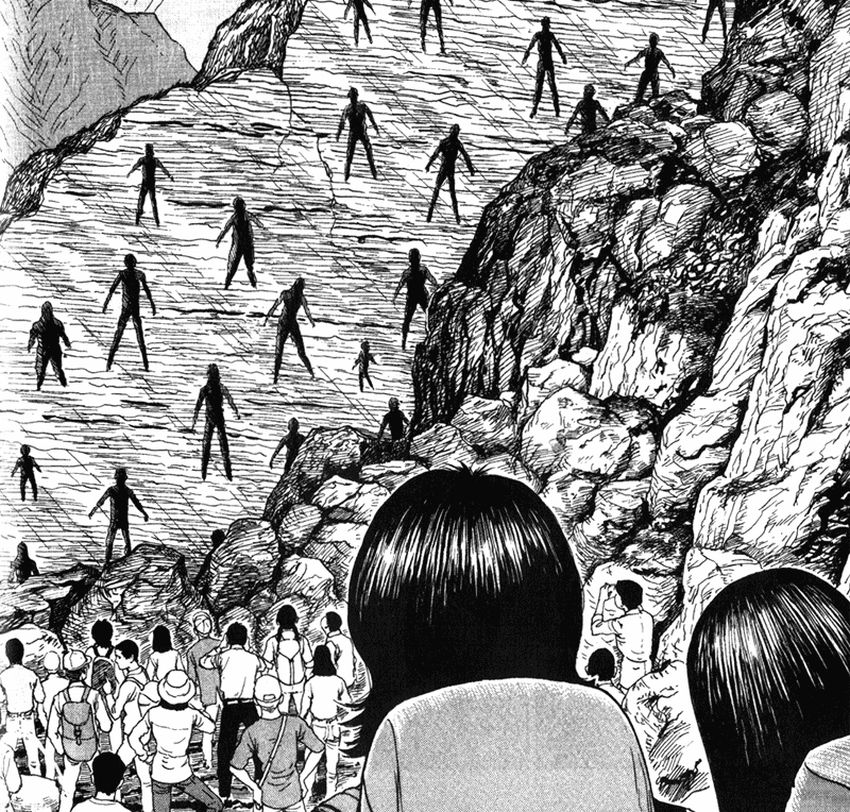
Sometimes his premises are strange, even ridiculous, but Junji Ito makes them work. The idea of a town haunted by spirals becomes one of the most disturbing and unique horror works of all time. Balloons that take on people’s faces and hunt them down become a nightmarish apocalypse. Even a story about human-shaped holes revealed after an earthquake becomes a setting for outlandish existential horror and deadly curiosity.
Junji Ito’s works stand out for their blend of masterful imagery and the narrative themes they explore. It’s worth noting that his nightmarish imagery and disturbing ideas often conceal deeper themes and ideas to ponder.
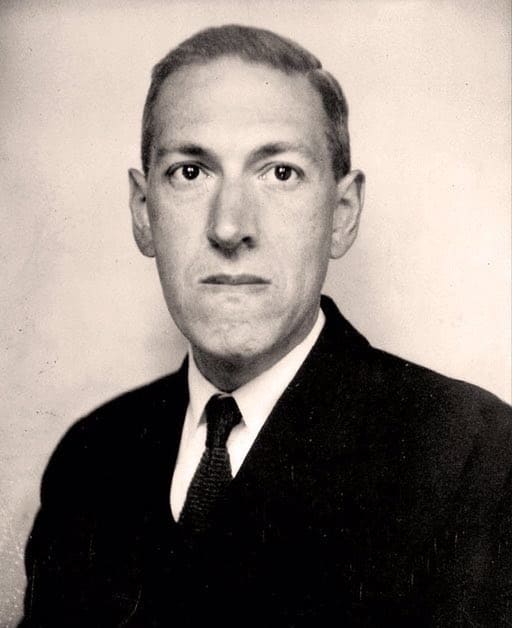
One can’t talk about Junji Ito without first discussing cosmic horror. The genre was shaped by American horror writer H. P. Lovecraft. It centers on the idea that the most horrible realization is that humanity is ultimately meaningless in the greater scope of the universe. Worse, there are powers and beings far older and more powerful than we can imagine. They existed long before humans emerged and will remain long after we are gone. Our lives, our dreams, our problems are all meaningless in the vastness of the cosmos.
While Junji Ito is influenced by Lovecraft, he has created his own blend of cosmic horror, often stranger and more surreal than Lovecraft’s. Humans are powerless in Ito’s worlds; while some works, like Uzumaki, feature unknown forces or entities, much of his horror focuses on the intimate and mundane.
Another similarity is that cosmic horror and Ito’s work seldom feature central villains or antagonists. We don’t encounter evil in the traditional sense. Instead, the terror arises from our own realizations or from inexplicable forces at the edges of comprehension.
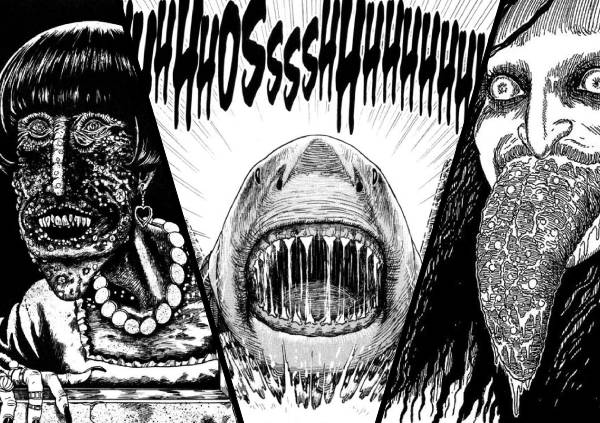
Junji Ito’s works are well known for his distinctive personal style. He brings his horrors to life through masterful ink and line work.
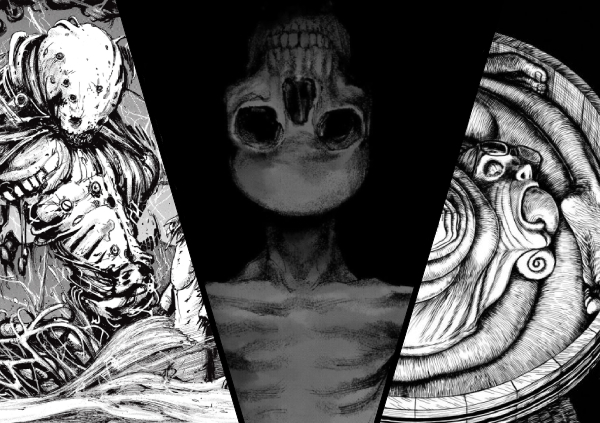
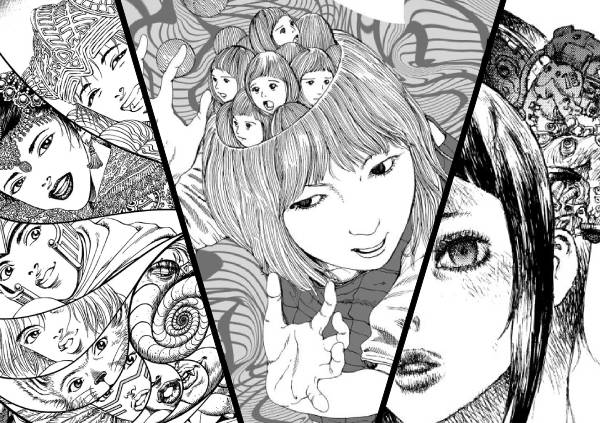
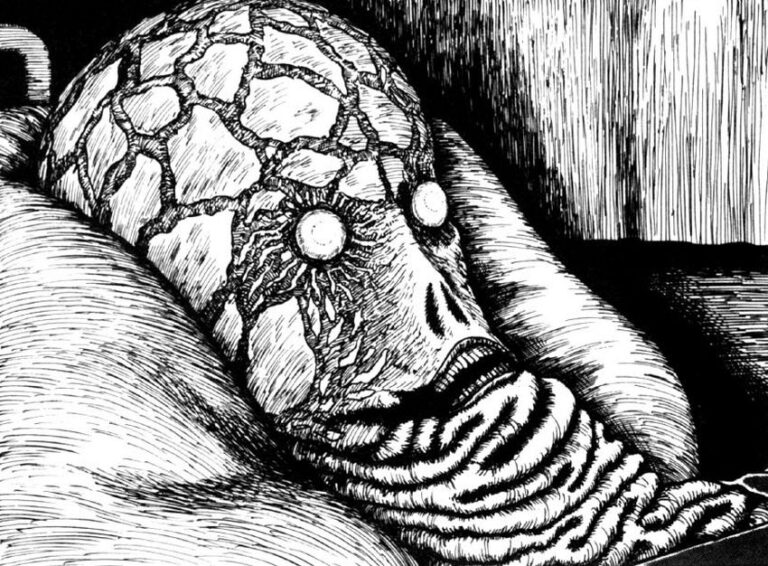
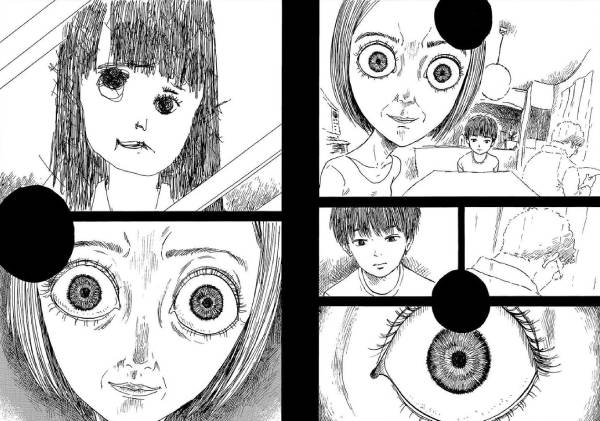
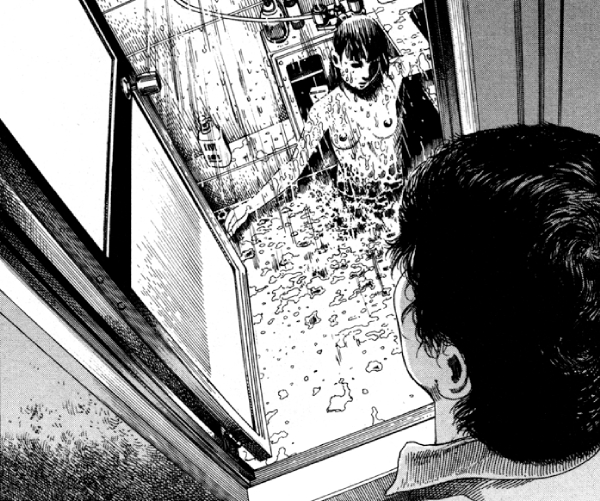
Ito uses detailed line work and bold, almost unsettling blacks to present grotesque, shocking imagery. While he uses shading, his pages mostly rely on lines to convey texture. Even gore and other unsettling elements, like blood, wet and squishy surfaces, are rendered almost entirely with lines. This gives them a unique look, adds detail, and lends a more visceral, nauseating quality.
He also leans on stark contrast, both in environments and in characters.
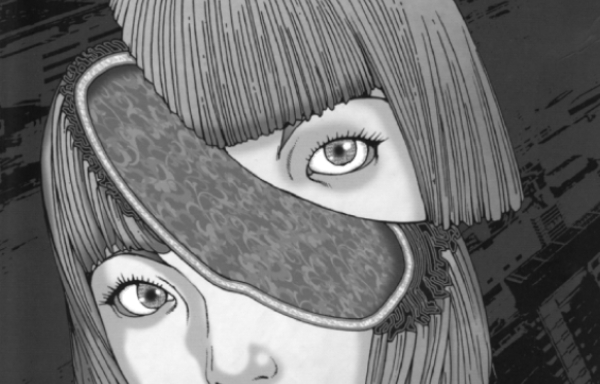
Ito’s style is most recognizable in his characters. They never blush and seldom show ordinary happiness. Instead, they are often emotionally muted, and when emotion appears it arrives as exaggeration.
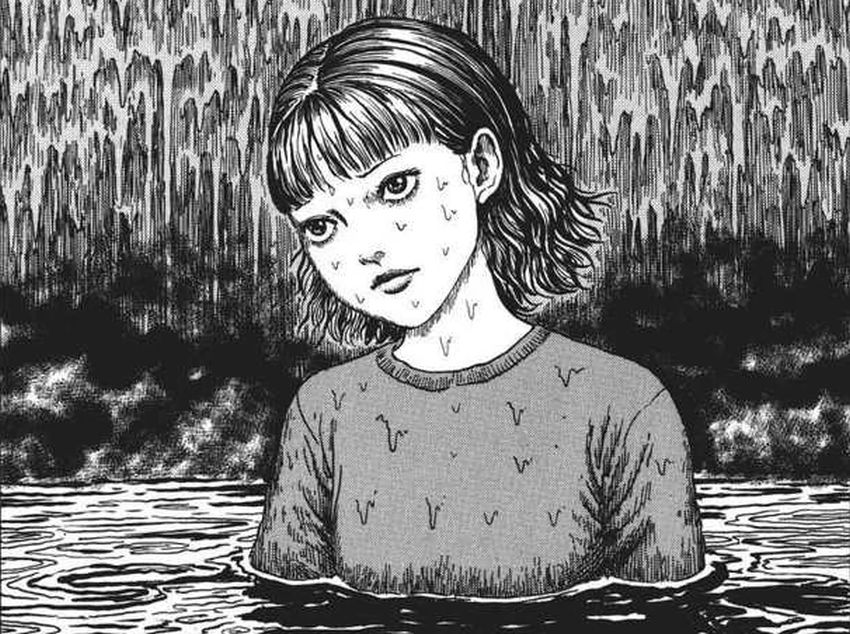
His characters frequently look empty and lifeless even before the horror begins, especially in stories focused on personal horror or mental illness. You can see how badly they feel and how close they already are to the abyss that will swallow them. Their faces are marked by sunken cheeks, and their bodies are often sickly thin, almost skeletal. Dark circles around the eyes and unnatural irises signal heavy emotions such as depression and gloom.
He achieves this with minimal shading and heavy contrast across the face. Ito often focuses on the eyes and the mouth, using them to convey unnatural emotional reactions.
His characters often wear unsettling expressions. Whether smiles or sorrow, the features are grotesquely accentuated, giving them a surreal quality.
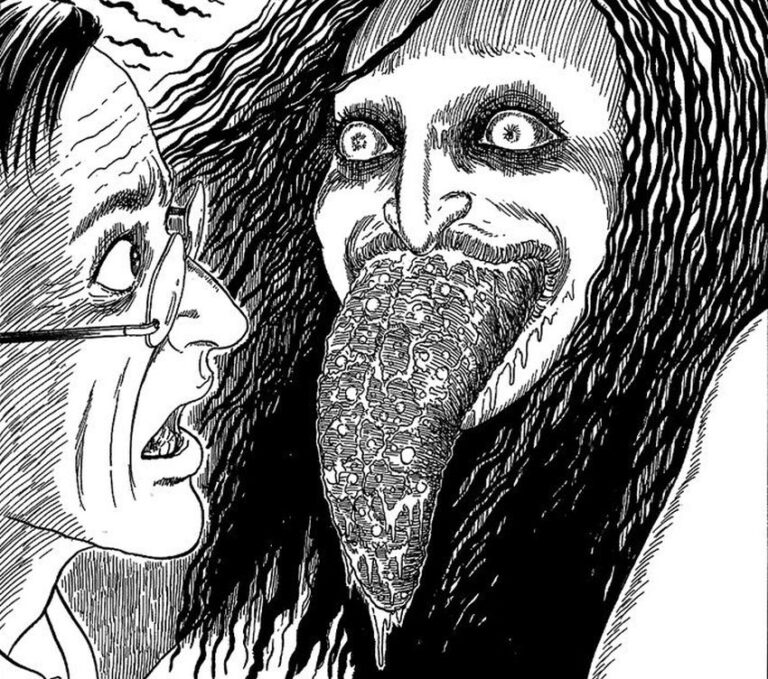
When the true horror arrives, Ito goes all out in depicting a person’s emotional response. Terrified expressions are so exaggerated they make us uncomfortable. Mouths gape, faces distort and elongate mid-scream, and eyes open wide.
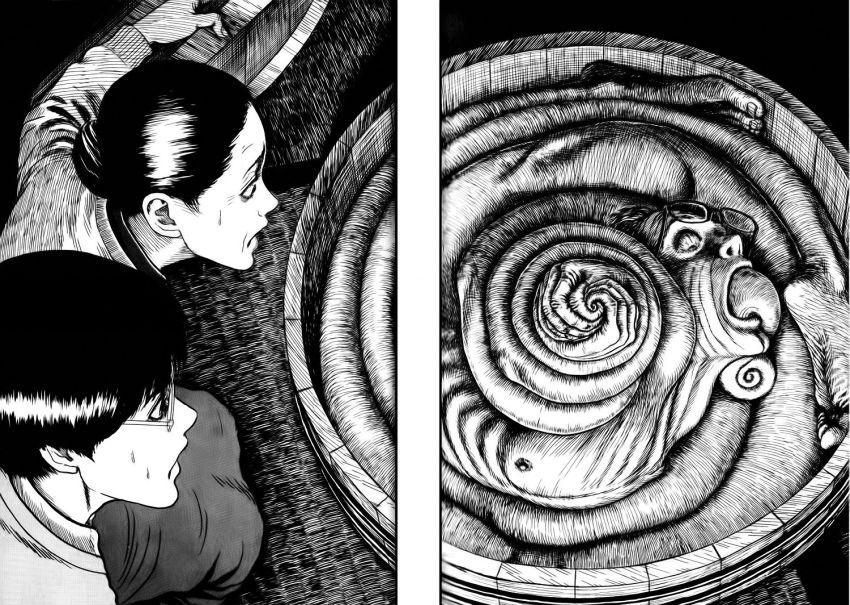
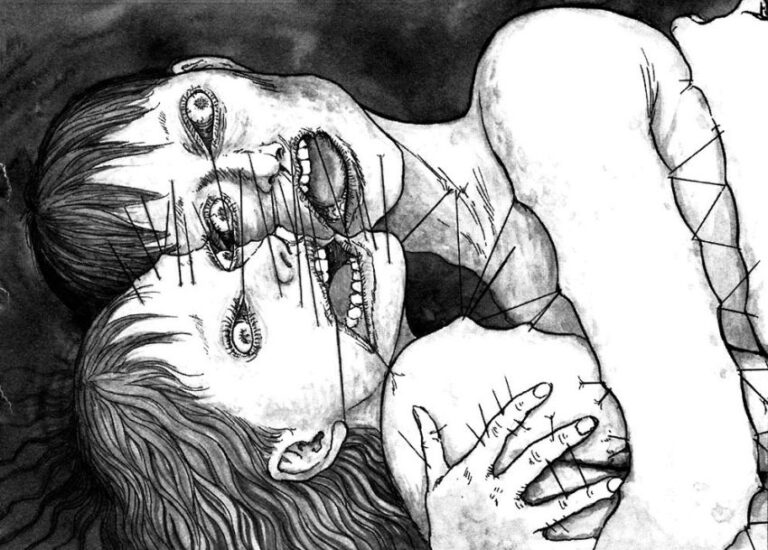
Another signature element is his reliance on body horror and the distortion of the human form. He often avoids traditional monsters; instead, the terror comes from our own bodies. People are twisted, warped, and turned into shapes that barely resemble human beings. We see bodies curling into spirals, rotting into abominations, or stretching into elongated versions of themselves.
This reliance on body horror makes Ito’s work so terrifying. Often the horror does not come from outside, but from within our own bodies. It is both strangely fascinating and deeply disturbing.
Junji Ito’s Narrative Themes
As a writer, I’m often fascinated by Junji Ito’s work not only for its visual power but also for the recurring elements that shape his stories. While his work can be graphic, Ito employs a wide range of narrative themes to craft his unique blend of horror. His concepts are bizarre, sometimes even absurd, but incredibly creative. By contrast, his characters and settings are often as mundane as can be, at times even boring, which grounds the strangeness.
Many of his tales revolve around fears, obsessions, and phobias, showing what happens when people give in to them. Yet they also carry deeper meanings that may not be visible at first glance. Below, I discuss those elements in more detail.
Junji Ito’s work doesn’t follow traditional storytelling conventions.
Most of his characters are minimally characterized, and there is little overt character development. Instead, characters are often blank slates or exist to embody a specific fear or obsession.
The same applies to plot. Ito’s stories seldom rely on intricate plotting. More often he gives us a glimpse into someone’s life and lets us witness the horrible things that befall them. Above all, his work is about atmosphere, dread, and the gruesome demise of his characters.
Although Ito writes horror stories, there is seldom a clear, traditional antagonist. People are haunted by faceless entities, curses, higher powers, or their own psychological problems.
One of the biggest pitfalls in horror is the urge to explain what should remain inexplicable, or to add too many details. Ito seldom does this. Instead, he leaves us with the mystery, leaving us guessing and fearing the unknown. A prime example is Hanging Balloons. We never get an explanation of what the balloons are, where they came from, or why they exist. He simply shows what happens after they appear, lets us watch events through his characters’ eyes, and ends the story when their time on the page is over. The mystery remains intact and, with it, the horror.
Gyo is an example where Ito breaks this convention. Near the end, he offers a scientific explanation for the apocalyptic horror that unfolds, and it didn’t work for me. It feels almost comically absurd and undercuts the menace.
Junji Ito’s stories often begin in normalcy. They don’t open with a dramatic backstory or by introducing an antagonist. Instead, they start in the most mundane places. We watch characters go to school, fall in love, or visit the hospital. It is in these ordinary settings that Ito slowly introduces the horror.
The same is true of the horror itself. In many stories, the threat emerges from mundane places or is triggered by everyday objects: records, laughter, hair, and even concepts such as spirals.
Many of his stories center on ordinary fears: the unknown depths of the ocean, claustrophobia, being watched, a sweaty, dirty mattress, or holes in a wall. Ito takes these anxieties up a notch. He twists them into something irrational and surreal, magnifies them, and turns them into phobias. At their core, though, they are fears many of us share.
Ito then bends these mundane settings and puts his ordinary characters under pressure until the world turns into horror. What begins as an everyday scenario becomes uncomfortable to watch; it is warped, and the surreal takes over.
This contrast between the mundane and the horrors he conjures is what makes his work feel so distinctive. We see it most in his characters. Their almost expressionless faces are twisted into masks of terror, with exaggerated features that barely resemble themselves. It is as if not only the story but also the characters are warped into something entirely different, something horrifying.
There are also stories grounded in reality. A great example is The Bully, one of his most realistic and most terrifying works.
It’s not only Junji Ito’s stories that are mundane; his characters are, too. They are nobodies, often blank slates who become entangled in Ito’s horrors.
They are frequently students or everyday people living ordinary lives. His characters are rarely the heroes of their stories; they are seldom smart or resourceful protagonists. Instead, they often serve as vessels through which Ito gives us a glimpse into his world of horrors.
Worse, they are sometimes foolish, driven by curiosity or desire. And when his characters do show strong emotion, it is almost always a single one. A fear, phobia, or desire becomes the defining trait, is often the only one they display, and it ultimately leads to their demise.
Junji Ito is a fantastic writer and artist, but he is not a character writer. His characters are merely there to be tested, and many feel like lambs led to the slaughter.
We all know irrational or childish fears. When we were young, we were afraid of the monsters under the bed, the doctor, strange neighbors, or even shadows.
As adults, we understand those are nothing more than irrational fears. There is no boogeyman, and there are no monsters out to get us.
Ito’s work, however, often features exactly these fears. That recognition gives his stories an uncanny feeling, because we have seen these scenarios before. We too were afraid to visit the doctor, and we too were afraid of the monsters under the bed, and even now we carry our own eccentricities and phobias. Ito explores and exploits them. He takes the most irrational, even silly fears, gives them life, and as a result his stories become much more terrifying.
Junji Ito is a master of body horror. He isn’t satisfied with people simply dying. Instead, he often distorts, warps, and twists them. This is visible not only in their ultimate demise, but also in how people change over the course of his stories. Characters who start out looking normal, even beautiful, become haunting, sick versions of themselves, or go insane as their sanity shatters.
Two of the strongest examples are Dissection Girl and Uzumaki. The first features a disturbed woman who wishes to be dissected. Her wish is ultimately granted at the end of the story, culminating in one of Junji Ito’s most fantastically disturbing panels. It is revealed that not only her mind but also her body is heavily distorted. Uzumaki, on the other hand, is a three-volume masterpiece about a small town haunted by spirals. Over the course of the story, many inhabitants become obsessed with spirals and are warped and twisted until their bodies reflect the spiral in various horrible ways.
Junji Ito’s brand of body horror is always a disturbing delight to look at, and it often renders his characters almost unrecognizable.
One of Junji Ito’s most common tropes is mental illness. Depression, fears, phobias, and obsessions are often the focus of his stories. Yet Ito isn’t satisfied with merely exploring them. Often, an irrational fear or phobia is only the starting point, and over the course of the story he amplifies and distorts it until it ends in utter madness.
His characters’ minds get distorted and change much like their bodies. As eyes bulge and mouths hang open in terrible screams, their minds, too, are inevitably broken.
Powerful emotions and erratic, irrational behavior are common in his work and almost commonplace among his characters. They are eccentric weirdos, people whose entire being revolves around a single trait, often a personal blend of mental illness, fear, or phobia.
Obsession is the leitmotif in Junji Ito’s Tomie, which features a woman so beautiful that any man who sees her becomes obsessed. Many other stories also center on obsession. It can be caused by love, animosity, jealousy, or even the urge to possess a particular object. Each of these stories ends with people giving in to their obsession, being changed by it, and ultimately facing dire consequences.
Love, too, is something Ito often exploits and distorts. What begins as a harmless crush soon becomes a dangerous obsession that drives people mad. Strong examples include Tomie, Lovesick Dead, and the chapter Jack-in-the-Box in Uzumaki.
As mentioned before, Junji Ito often pushes his characters’ fears and phobias to their limits, driving them into despair and insanity.
The reason is simple: his characters are often inevitably doomed. Similar to figures in the works of Franz Kafka or H. P. Lovecraft, they have little power over their world.
We see it clearly in Uzumaki, where an entire town becomes an inescapable hell and characters realize there is no hope, no way out. In a similar way, The Enigma of Amigara Fault toys with curiosity and with inevitable fate. People flock to the human-shaped holes that mirror them and, compelled by a primal urge, enter despite themselves.
Existential dread sits at the core of our being. As humans, we are the only creatures on this planet who know that we will die one day, and there is nothing we can do about it.
Ito’s stories are full of this dread, and his worlds are harsher than our own, stranger, more dangerous, and indifferent to the people within them. The horror often arises from the most mundane places, showing that nothing is safe in Junji Ito’s world. There are no safe spaces, and even the most ordinary thing can lead to a terrible, irreversible event.
Town Without Streets is a prime example. It examines privacy and pushes it to its extremes. What would you do if privacy no longer existed? Would you reject such a world and fight against it, or accept it and discard the idea of privacy altogether? It is a topic that feels even more relevant today.
Another strong example is Long Dream. It asks whether endless dreaming could be a way to defeat death. Is it better to be trapped in a dream forever than to die? Is even a never-ending nightmare preferable to ceasing to exist?
Isolation is another dominant theme in Ito’s work. As mentioned before, many of his characters struggle with problems and isolate themselves from society.
Ito presents a different view of isolation in Army of One. Safety in numbers is usually the rule in horror. In Army of One, however, he twists that idea, and those who stay alone, who truly isolate themselves, are the ones who remain safe. It is a strange story, but one ripe with meaning. It seems to point to our urbanized society and the forced social interactions common in it, especially in Japan. Is it ultimately better to remain on your own than to join an often forced social life?
Lingering Farewell is a study of holding on and refusing to accept the death of loved ones, and it is also one of Junji Ito’s best stories.
Black Paradox is one of Ito’s weirdest works, but in its later parts it raises an interesting question. In the story’s context, humanity uses its own souls as a new source of energy. The broader idea is clear: we may bring about our own end through greed and the hunger for power.
Hanging Balloons may seem nonsensical at first glance, but there is more here than meets the eye. The first person to die is Terumi, an idol. If you are familiar with Japanese pop culture and the idol industry, you know suicides are an unfortunate reality. Yet the story is not simply a critique of the idol system.
Similar to The Enigma of Amigara Fault, the story engages with Sigmund Freud’s death drive, our fascination with self-destruction and the compulsion to move toward it. Most of us suppress those thoughts, but some do not.
While The Enigma of Amigara Fault shows characters driven by a strange, almost supernatural obsession to find their holes, Hanging Balloons takes a different route. The balloons are a personification of the death drive, and the story functions as an allegory of that impulse catching up with and preying upon people.
Examples like these show that while Junji Ito is predominantly an artist who creates visual nightmares, his work often carries deeper meaning.
It always strikes me that works as bloody, surreal, and twisted as Ito’s can also convey layered themes. That added depth gives readers something to ponder when they want more than blood and gore alone.
Stephen King is a master of horror and one of the most popular and most successful horror writers of all time. Over the course of his long career, he’s written over sixty novels and two hundred short stories.
I’ve been a fan of Stephen King ever since I was a teenager and read the first four entries of his Dark Tower series. Yet, over the years, I never fully explored his work and only read some of his more popular novels, like the Dark Half or The Stand.
Stephen King
Since I’m a horror writer myself, I recently decided to read more horror literature myself. After I devoured the works of H. P. Lovecraft and Edgar Allan Poe, Stephen King seemed like a logical next step.
Over the past months, I read every single Stephen short story collection. While I enjoyed most of his short stories and each one of his collections, I found some of them more impressive and worthwhile than others.
That’s the reason I created this short list. It’s not only to rank but to also share my thoughts on each Stephen King short story collection out there.
If you are, however, more interested in a more detailed list of short stories, I urge you to check out the list of my favorite Stephen King short stories. It’s a list of the stories I consider best as well as my individual thoughts on them.
Just After Sunset is not a bad collection, but it’s the weakest one of the six Stephen King short story collections out there.
It differed from what I was looking for. I was looking for horror and Just After Sunset, felt different and more literary. I recognize that it’s a more ambitious collection and I appreciate Stephen King’s efforts. It’s just that I didn’t care too much for most of the stores in Just After Sunset.
It starts off great with Willa, a beautiful, melancholic little tale about love and life’s fragility, followed by the suspense-filled novella Gingerbread Girl.
There are other stories that I enjoyed, especially Stationary Bike and N., one of Stephen King’s greatest novella of all time. I absolutely loved this one and the eerie, uneasy and Lovecraftian atmosphere so prevalent in the work.
It also brings us one of the weirdest stories Stephen King ever wrote with The Cat from Hell. Even now, I’m still divided on what to think about it. I’m not sure if I love it or hate it, but I guess that says something about the story.
Overall, Just After Sunset is not a bad collection of short stories. Apart from N. and Willa, however, nothing truly stood out to me.
After reading all six Stephen King short story collections, I encountered many memorable short stories. The ones in Just After Sunset, however, aren’t part of it and are, for the most part, forgettable.
The Bazaar of Bad Dreams, published in 2015, is the most recent Stephen King short story collection on this list.
While I enjoyed this collection, many of the short stories suffer from similar problems the ones in Just After Sunset do.
Stephen King’s writing is stronger and much more mature in this collection. Yet, I have to admit that I miss the pulpy horror and the weirdness of his earlier collections.
While some stories, such as The Dune, Obits and Drunken Firework stand out, many others didn’t.
I felt the strongest entries in this collection were the two novellas, Ur and Morality. Especially Morality was an incredibly powerful piece with its nuanced discussion of morality, guilt and sin.
As for short stories, The Dune was a delightfully short tale, while Obits was a lengthier tale about deadly obituaries. I was most surprised by the humorous Drunken Fireworks, which featured a firework arms race on the Fourth of July.
The Bazaar of Broken Dreams isn’t as horror centric as his earlier collections, but features a wider variet of stories. It’s a collection about life, death, morality, guilt and regret.
The Bazaar of Bad Dreams is not a bad collection, and it might be his most polished one, but it’s also not the best collection for those readers who are looking for a true bone-chilling experience.
To Reads: The Dune, Morality, Ur, Obits, Drunken Fireworks
I enjoyed Everything’s Eventual a great deal, but it’s still a middle-of-the-road Stephen King short story collection.
Some entries in this collection are fantastic, yet there’s also a fair share of stories I didn’t care too greatly about or that didn’t stand out to me.
There are some truly terrifying and suspenseful stories in Everything’s Eventual. The fantastic Autopsy Room Four and the terrifying 1408 come to mind. Yet, it felt lacking when compared to other Stephen King short story collections.
Once more I most appreciated the two novellas in this collection, the titular Everything’s Eventual and Riding the Bullet. They are both fantastical, but once more, they differ from what I expected from Stephen King.
Overall, I really enjoyed Everything’s Eventual, but it felt lighter and less scary than the other Stephen King short story collections.
Don’t get me wrong, Everything’s Eventual is a good collection, just not as good as the following three.
To Reads: Autopsy Room Four, Everything’s Eventual, That Feeling You Can Only Say What It Is In French, 1408, Riding the Bullet
Nightmares and Dreamscapes is an odd collection and probably the oddest amongst all Stephen King short story collections.
I don’t think all the stories in Nightmares and Dreamscapes are great. Yet, it features some of my favorite stories of his.
It starts of fantastic with another one of Stephen King’s novellas, Dolan’s Cadillac. It’s the story about a man taking revenge on a crime boss, but also serves as an homage to Edgar Allan Poe.
Stories such as Sneakers and Dedication don’t seem to get a lot of love. Yet I came to enjoy those two a lot, and I’d wholeheartedly recommend them.
Other great stories include Suffer the Little Children, My Pretty Pony and The Ten O’clock People. My favorites, however, were the Lovecraft inspired Crouch End and The Moving Finger.
One thing I was surprised about was Stephen King’s decision to include Head Down. It’s a nonfictional essay about the Bangor West Little League baseball team. I’m not one for baseball and neither know a lot about the game or the rules, yet Stephen King’s writing made it a very enjoyable experience.
Overall, Nightmares and Dreamscapes was odd. It had its share of silly stories such as Chattery Teeth, but all in all it was a great read and none of the stories were terrible or forgettable.
Another thing I came to enjoy a lot was the switch of format and tone. Nightmares and Dreamscapes is truly the broadest of all the Stephen King short story collections, including a variety of genres, formats and narrative choices.
To Reads: Dolan’s Cadillac, Suffer the Little Children, The Moving Finger, My Pretty Pony, The Ten O’clock People, Crouch End
Night Shift is Stephen King’s very first collection of short stories. It was exactly what I was looking for when I think of a Stephen King short story collection.
It’s a fantastic collection of all out and pulpy horror.
Sure, Night Shift might not be as refined and lack the finesse of his later work, but I still loved many of the stories in this collection.
However, it features not only horror stories. There are the deeply emotional stories The Last Rung on the Ladder and The Woman in the Room.
Yet, it’s also full of goofy and weird stories that I really didn’t care for. Trucks, Battleground or The Mangler are examples of those.
Night shift has also one of the strongest starts with the great Jerusalem’s Lot and Graveyard Shift, two of the best stories in the entire collection.
What follows, however, are the weaker entries of the collection, the stories who are sillier and almost nonsensical.
Overall, The Ledge, Quitters Inc. or Children of the Corn more than make up for the weaker entries. They elevate Night Shift to one of the best Stephen King short story collections out there.
The main reason I didn’t rank Night Shift as number one is first the sillier stories in this collection, and second, that Skeleton Crew is a stronger collection overall.
To Reads: Jerusalem’s Lot, Graveyard Shift, I Am the Doorway, Gray Matter, Strawberry Spring, The Ledge, Quitters Inc., Children of the Corn, The Last Rung on the Ladder, The Woman in the Room
Skeleton Crew was the very first Stephen King short story collection I read, but one that should prove my favorite.
This one really has it all. It includes a plethora of true horror stories, but also several more interesting and fantastical entries.
We are already off for a fantastic start, with Stephen King’s the Mist. It’s one of his most popular and famous novellas, about a town engulfed by an otherworldly mist and the creatures that come with it.
The stories that stood out to me the most were Mrs. Todd’s Shortcut and The Jaunt, incidentally two of the more fantastical entries in this collection.
However, many of the true horror stories were also fantastic. The Monkey, The Raft, The Reaper’s Image and the suspenseful Gramma are all great reads.
Yet Skeleton Crew also has its share of weirder stories. Survivor Type is one of Stephen King’s most disturbing stories, and his story Nona is nothing short of a trip down into insanity.
The one story that surprised me the most, however, was The Reach. It’s the most heartfelt and beautiful of all of Stephen King’s short stories.
There might be one or two stories I didn’t care too much about, but those are easily brushed aside by the many strong entries. Skeleton Crew, like Night Shift, is not as refined or well-written as some later Stephen King short story collections. The stories felt stronger, more rough and creepy, and made me far more uneasy than some of his more recent ones.
Skeleton Crew is as full of horror as Night Shift. Yet, it doesn’t shy away from experimenting and including different stories like Everything’s Eventual and Nightmares and Dreamscapes. It never feels too broad though, and is mostly a pure horror collection. One with no silly, over-the-top stories like the ones we found in Night Shift.
Skeleton Crew was the very first and, in my opinion, also the best of the six Stephen King short story collections out there. I think it’s one of the greatest entry points into the world of Stephen King.
To Reads: The Mist, Cain Rose Up, Mrs. Todd’s Shortcut, The Jaunt, The Raft, The Reaper’s Image, Nona, Survivor Type, Gramma, The Ballad of the Flexible Bullet, The Reach
Stephen King is one of the most successful fiction writers of all time. Over the course of his career, he’s written over sixty novels and over two hundred short stories. While he’s most famous for his novels, many Stephen King short stories are also fantastic works of fiction.
Stephen King
Stephen King was a name I’d heard long before I ever read any of his works. Even in the 90s in Germany, his popularity was enormous, even among those who’d read none of his books. I guess this was because of the many movie adaptions of his works.
The very first book I ever read by Stephen King was The Gunslinger. I still remember how impressed and fascinated I was by it. It differed from anything I’d read before. I was a young teenager, and until then most of what I’d read comprised folktales, fables, fairy tales or books I had to read for school.
Stephen King’s The Gunslinger was full of bloody action, cursing and set in a world so strange and vast it blew my mind. After The Gunslinger, I devoured the rest of his Dark Tower series, comprising four books at the time. I loved it.
Over the years, though, I only read a few more of Stephen King’s novels. I read his entire The Dark Tower series, The Stand, The Dark Half and the Bachman novels Thinner and The Long Walk.
As a horror writer, I recently decided to read more horror literature. Last year, I read all the works of H. P. Lovecraft and Edgar Allan Poe. After that, I checked out the works of Stephen King.
Since I’m mostly a writer of short stories, I started off with his short story collections. Over the last couple of months, I read all six of them and it was a very enjoyable experience. There’s a reason Stephen King is as popular and as well-liked as he is.
After I finished his most recent collection, The Bazaar of Bad Dreams, I put together a list of my favorite Stephen King short stories.
Something worth noting, though, is that Stephen King is a much more prolific writer than I’d thought. I’d expected his collections to comprise horror and suspense literature, but found quite a few stories that were different. While I enjoyed almost all of his stories, what I was looking for was tales of horror and suspense. Yet, some Stephen King short stories differ from what I’d expected, and I felt somewhat disenchanted with them.
This list won’t include any of Stephen King’s novellas though, for those I created yet another list which you can find here.
Cain Rose up is a story that you’d probably not see published in this day and age because of its controversial subject. It’s one of shorter Stephen King short stories on this list about a university student Curt Garrish.
We follow Curt as he walks back to his room, interacts with some of his fellow students before he shoots people with a sniper rifle from his dormitory room.
It’s a story that’s unsettling and disturbing. The most disturbing aspect of the story was how normal Curt’s interaction with other people was, and that none of them suspected a thing.
Sure, Curt’s mind was disturbed as we saw from his thoughts, but he could put on a facade, pretending to be just another student. I’m not sure if King had this specific idea in mind, but I felt the story showed strongly how normal psychopaths like Curt Garrish can act in public.
Another interesting part of the story were the things the narrator sees and his images and that he thought it didn’t matter if he killed people. It was truly chilling.
Cain Rose Up might be an earlier effort of Stephen King’s but it’s still a disturbing story, more so because of how believable it is.
Stephen King wrote he likes his stories to be grisly, but this one might have gone a bit too far, even for him.
I have to agree with him, but that’s also a reason Survivor Type stands out so much. It’s more gruesome and absurd than almost any of the other Stephen King short stories I’ve read.
The story is written as the diary of a surgeon, Richard Pinzetti. He was aboard a cruise ship, attempting to smuggle a sizeable amount of heroin when the ship sunk. He escaped via lifeboat and finds himself on a tiny island with limited supplies and no food.
The diary reveals Pinzetti thinks of himself as a survivor. Determined to hold out until rescue arrives, he goes to horrifying lengths to survive. Desperate for food, he eats insects, kelp and seagulls. After breaking his ankle and a subsequent infection, he self-amputates it. Yet, he doesn’t waste it. This, however, is barely the beginning.
What made this story so much more interesting was the detailed backstory Stephen King created for his protagonist. It’s for this reason everything else works out so well and makes sense, at least in a way.
The diary format, too, works incredibly well as it showcases the narrator’s descent into madness brought forth by drug abuse, blood loss and starvation.
Truly one of the most disturbing Stephen King short stories out there, one that made me quite uncomfortable. Yet, it’s interesting, if only to show how far King can go.
King suggests that hell is not “other people”, as French philosopher Jean-Paul Sartre wrote, but repetition and enduring the same pain repeatedly without end.
That’s what this story is about. A woman named Carol is on her second honeymoon, yet as she and her husband drive along the road, she gets this strange feeling. It’s a feeling, she knows, that you can only say what it is in French. She knows the place they’ll pass by, the things she sees, and eventually, it all ends with the same outcome.
It’s never explicitly stated what happened to Carol and her husband, but we get enough information to figure it out.
What I enjoyed the most about this tale was the brief hints and the strange feeling you get throughout the story. We all know the feeling of a déjà vu and how unsettling it can be. The idea of not having it once, though, but constantly, is really unsettling to me.
It’s downright creepy and I have to agree with Stephen King. His version of hell is one that’s truly terrifying. Yet, this is a different type of horror, one that we’re not used to from usual Stephen King short stories. It’s one that’s entirely existential.
Willa is an odd little tale, but one that I enjoyed a lot. It’s different from the truly terrifying and gut-wrenching Stephen King short stories I became so used to. Instead, Willa is a nice, almost cozy little tale.
It’s about a man who finds himself at a train station with a few other passengers. He’s unable to find his fiancée Willa and sets out to find her at a nearby town. The others warn him that the train will arrive any minute and it takes a three-mile hike to get to the town. Even worse, it’s through deserted terrain inhabited by wolfs. He ignores their advice and heads out anyway, having a close encounter with a wolf.
Eventually, he finds Willa at a club, sitting alone in a corner booth. He tries to convince her to come back with him, but as the two of them talk, he realizes something he’s known all along.
Willa is a nice little tale, one that’s almost a romance story if not for the haunting ending. I don’t know what made me feel so strong for this tale. Maybe it’s because it’s not just a tale about love, but one about life’s fragility.
As I said, this tale differs from the usual Stephen King short stories, but it’s a good one and well worth the read.
The Reaper’s Image is a story about an antique collector, Jonson Spangler. He visits a museum to buy a legendary Delver’s Mirror. The museum’s curator, Mr. Carlin, recounts the mirror’s infamous history and that anyone who looked into it mysteriously disappeared.
Supposedly the Grim Reaper appears in the mirror, standing close to those who look into it. Spangler, of course, doesn’t believe any of the rumors and looks into the mirror himself.
The Reaper’s Image is as typical as Stephen King short stories can be, but it’s by no means a bad one. It has all the hallmarks of a great horror story. What I liked the most, however, was the history of the mirror and how it sets the mood for the rest of the story and hints at what’s coming.
While it’s not the most original or groundbreaking one among the many Stephen King short stories, it’s well worth the read for how unsettling it is.
What I really enjoy about most Stephen King short stories is that they are not happening in a vacuum. Stephen King always puts together a nice, alive setting before he slowly introduces the horror.
Sneakers is the story of a recording studio executive named John Tell. One day, he notices a pair of dirty old sneakers in a stall in a restroom at work. At first he assumes the shoes belong to an employee or a delivery person. However, when he visits the bathroom again, the sneakers are always there, haven’t moved and are surrounded by dead flies and other bugs. It dawns on him that there might be a body in the restroom, or something even worse.
What made this story so great wasn’t just the unsettling imagery of the sneakers surrounded by dead flies and bugs. It was the framework narrative at the recording study. The minor details and intricacies about recording and editing Stephen King mentions made the story just a tad it more interesting.
Stephen King once mentioned that people are naturally interested in the work and the jobs of others, and I have to agree that it’s true. While the mystery of the sneakers lured me in, the events at the recording studio also fascinated me.
The Dune is an interesting and gripping little tale. Stephen King mentioned The Dune features one of the favorite endings he ever wrote, and I have to agree. What makes this tale so good and the reason it stands out so much is the ending.
The Dune is the story of a retired Judge named Harvey Beecher, who has a lifelong obsession with a mysterious dune on a small Florida island. As a child he ventured there for the first time, looking for buried treasure, only to find the name of a person he knows written in the sand. Before long, he discovers that any person who’s name he discovers written in the dune’s sand will die within a month.
He confides this story in his lawyer Anthony Wayland, who he visits to help him with his last will.
The Dune was one of the shorter Stephen King short stories I read, but it was one I enjoyed immensely. I have to agree with King though, what makes this story is clearly the ending.
Stephen King once planned to write a Richard Bachman novel about a group of hitmen. Eventually he grew disenchanted with the project and scrapped it. Yet, one part survived, a flashback in which the protagonist, as a child, talks to his grandfather.
In this story an elderly man, whose death is approaching, gives his grandson a pocket watch. After he gives it to him, he talks to him about time.
He tells him that when you grow up, time moves faster and faster, slipping away if you don’t hold on to it tightly. He ends by telling him that time is a pretty pony with a wicket heart.
My Pretty Pony is a fantastic one among the many Stephen King short stories. Both characters, the old man and his grandson, feel alive and realistic. Yet, what makes this story so great is the topic matter. It’s something that many of us realize. As we grow older, time moves faster.
It’s a melancholic topic, one to muse on and one that hits a little too close to home.
Strawberry Spring is one of the most visual unsettling Stephen King short stories out there.
The unnamed narrator reads the words ‘Springheel Jack’ in the newspaper and recounts his memories from eight years back.
At the time he attended New Sharon College. On the 16 of March 1968, the strawberry spring arrived. It brought thick fog covering the campus at night and also Springheel Jack, a serial killer.
The narrator describes the dark mood it cast over town, the various victims of the killer, the rumors spread about them, and the toll it took on the entire community. Even worse, he states, no suspect was ever found, and the case remains unsolved.
Now, eight years later, a new strawberry spring arrives and so does Springheel Jack. Another victim was just discovered at New Sharon College.
It’s a very creepy and visual unsettling story. As the thick fog envelops the small town, fear and trauma envelope its inhabitants. It’s one of the darker and more melancholic Stephen King short stories, but it still packs a punch. It’s well worth the read, not only for its eerie and somber atmosphere but also for its great ending.
Dedication differs from other, more typical Stephen King short stories. It’s less a horror story, but a weird genre mix.
Now, full disclosure here, this story gets mentioned quite a lot because of a certain… deed, the protagonist commits. It’s frankly said, disgusting.
While this scene made me shudder, the rest of the story was incredibly well written and deeply interesting to me. Who knows, maybe it’s because I’m a writer myself, so stories about writers are inherently interesting to me.
Dedication is the story of a black maid named Martha Rosewell. One day she arrives at work, showing her friend and colleague Darcy Sagamore that her son’s first novel has arrived.
At the end of their shift, the two woman meet up to have a few drinks and Martha reveals the truth about the dedication in her son’s novel.
While Dedication is not a horror story, it’s still one of the darker Stephen King short stories. It involves a violent husband, a gifted, yet hateful and racist write, and black magic. Yet, Stephen King molded all of those elements together into an interesting mixture and a great story, apart from one little detail.
What’s interesting to note is that Stephen King wrote this story to explore the idea gifted and famous people can be utterly horrible in real life.
Dedication is honestly one of the weirder Stephen King short stories, yet somehow I came to enjoy it and hold it dear.
The Raft is one of the more simple and straightforward Stephen King short stories. Yet, I enjoyed it quite a lot.
A group of college students go to a lake and swim towards a wooden raft. One of them, Randy, notices a mysterious black substance floating on the lake’s surface and that it chases the last of them as she makes her way to the raft.
Soon after, one of them, Rachel, states that the strange substance’s surface sparkles in various beautiful colors and leans forward to touch it. When she does, she’s pulled into the water and torn apart by the substance.
From here on out, the story continues as the remaining three deliberate what to do and how to escape from the raft and the mysterious creature.
As I said, it’s a rather typical monster story, but Stephen King can still make it more interesting in various ways. There’s the setting, the titular raft. There’s something about confined spaces that makes things so much more interesting.
Even though this is one of Stephen King’s earlier works, he’s still able to populate it with interesting characters and make us feel for them. During the first half, we learn much about their relationship and its superficial nature. This makes the dynamic between the characters much more interesting and makes us feel for them once the horror hits.
While The Raft is a simple story, I all around enjoyed it. Stephen King’s at its best in this. It’s gory, it’s violent, and it’s scary.
Autopsy Room Four is one of the most suspenseful Stephen King short stories of all time. The premise is downright terrifying, and it makes for some delightfully unsettling reading.
It’s about a man who wakes up in an autopsy room and is paralyzed after an incident during a golf game. While he’s conscious, his body appears to be entirely lifeless.
Soon enough, the medical person present prepares for an autopsy to learn what caused his supposed death. All the while, the narrator tries to get their attention via the smallest minute signals.
What makes this story is the palatable tension, the idea of just lying there while people talk about which part of yours to cut open first. And Stephen King renders it in acute and minute detail.
Autopsy Room Four was one of the tensest readings I ever had, and the sheer idea of being in this situation made me shudder. My only problem with the story was the rather humorous ending, but I guess there are different ways to relief tension. And I might say it was rather unexpected.
Stephen King has written his share of science-fiction short stories. While I enjoyed him switching to different genres and topical matters, I wasn’t too big a fan of most of them.
I Am the Doorway stood out to me though.
It’s the story of a crippled former astronaut, Arthur. After being exposed to some sort of extraterrestrial mutagen during a space mission to Venus, he notices strange changes to his body.
It’s tiny eyeballs push from his fingertips, allowing an alien species to see into our world. Yet, as the story continues, we learn that it’s not all they can do.
I Am the Doorway is one of the stranger and more surreal Stephen King short stories. I’m a big fan of body horror, and the idea of alien eyeballs sprouting from your own body is utterly unsettling and revolting to me. And as so often, Stephen King describes them in intricate detail, making things so much worse.
Overall, I Am the Doorway is one of Stephen King’s stranger stories, but one that lured me in with a scenario both fascinating and terrifying.
Good old Quitters, Inc. a story I first got to know from the anthology movie Cat’s Eye.
Quitters, Inc. is the story of Richard Morrison. One day he meets an old friend at the airport. His friend used to be a heavy smoker, but has now given up on the habit and enjoys a better life. Before he leaves, though, he hands Richard a business card for Quitters, Inc. a company who helps people to give up smoking for good.
Unhappy with his life, he eventually pays them a visit and learns of the unorthodox methods the company carries out to get its clients to stop smoking.
Quitters, Inc. brings forth one of the most interesting and bizarre concepts. Of course such a company would never work in real life, but the story itself works damn well. It’s such a strange concept, one that grows more terrifying as the story continues.
The story resonates with me especially. As a former smoker, I know how hard it is to give up the habit and how easy it is to slip back into it.
Quitters, Inc. is one of my favorite Stephen King short stories and one that I enjoyed immensely.
1408 is one of the most popular Stephen King short stories of all time and for a good reason.
The story begins with Mike Enslin’s arrival at the Dolphin Hotel in New York City. He’s a writer of books about haunted places. His books are very successful, but Enslin himself is not a believer in the paranormal. For his newest book, he plans to spend a night in the hotel’s most infamous rooms, 1408.
As he learns from the hotel’s manager, Olin, there have been 42 deaths and 12 suicides in the room over the last 68 years.
Olin tries his best to convince Enslin to give up on his idea, but he eventually agrees to lead him to the room.
From here on out, the story takes up steam, as Enslin himself comes to experience the horror of 1408.
What made this story so great, as the slow build-up and Olin’s tale of the incidents related to the room. It not only unnerves Enslin, but us readers as well and prepares us for what to come.
What happens in the room itself is pure nightmare fuel and Stephen King describes it in great detail, using stunning imagery. The horror that happens in 1408 is utterly surreal.
I think it’s one of Stephen King’s best pure horror short stories. The only problem I have is that the time Enslin spends in the room is rather short, barely taken up half the story.
What an interesting and strange story The 10 O’clock People is.
Our protagonist, Pearson, is an office worker in Boston who tried to give up smoking before and cut down on his habit.
During his 10 o’clock smoke break, he witnesses a strange bat-like creature on his way into the office building. A young black man, Duke, keeps him from screaming and calms him down. He explains that if he doesn’t want to die, he’s got to act normal and go about his day as usual.
The two of them meet up after work and Duke explains to him it’s the unique chemical imbalance caused by nicotine withdrawals that allows them to perceive the creatures as what they really are.
Duke is quick to invite Pearson to a meeting of his group and Pearson gets along, to learn more about the strange bat-creatures.
I really enjoyed this story of monsters lurking amongst us and disguising themselves amid society. It’s a premise that’s always interesting and The O’clock People delivers.
Children of the Corn is another one of the most popular Stephen King short stories. It’s another story I knew about because of its movie adaption. While I enjoyed the movie for what it was, I was impressed by how good the original story was.
The story follows a couple, Burt and Vicky, as they are on their way to California for a vacation hoping to save their failing marriage.
While driving through rural Nebraska, they accidentally run over a young boy. They soon discover that the boy’s throat was slit and he must’ve tumbled into the road as he was dying. They decide to report the incident to the police and make their way to the nearest town, a small, isolated community called Gatlin.
When they arrive, they find the town deserted. The only building that’s still maintained is the church. While Vicky stays in the car, Burt explores it and finds hints of a strange cult. Soon after, the two of them encounter the titular children.
What made this story so interesting was in large parts because of the characters. Stephen King is always great when writing realistic characters and his portrayal of Burt and Vicky’s failing marriage, and the tension between the two is incredibly well done.
Yet, it’s the rich setting that makes the story. Stephen King provides us with beautiful descriptions of an abandoned town, religious subtext, crazy pagan children, endless cornfields and the terror lurking within.
Children of the Corn is without a doubt one of the best Stephen King short stories out there.
Gray Matter is another one of the earlier Stephen King short stories.
The story is told from the perspective of an older man who sits together with his friends at a convenience store during a heavy snowstorm.
Soon a young boy, the son of a local man named Richie Grenadine, arrives. They all know the boy because his father sent him to the store frequently to buy his beer.
Henry, the store owner, takes the terrified boy aside and speaks to him privately. Eventually, Henry, the narrator and a few of the other man, decide to bring the beer to Richie themselves. On the way, Henry tells them the terrifying story the boy told him.
Gray Matter is typical among the many Stephen King short stories out there and does exactly what it’s supposed to do, terrify us and gross us out.
What made this story so great was the creeping horror, the disgusting imagery and the body horror. It’s a fantastic, unique story that I truly enjoyed.
Here we have another different one among the many Stephen King short stories. The Woman in the Room is less a horror story and more a heart-wrenching tragedy.
It’s the story of a man who’s burdened by deep remorse and pain because of his suffering and terminally ill mother. The story details the last time he visits her at the hospital.
The Woman in the Room might not be a horror story, but seeing our loved ones wither away and die is horrible. It’s a poignant read, a tale rooted in the real world and horribly realistic and relatable. While it’s essentially a simple story, the intimate way it’s told, the details and the description make it so good.
What truly stuck to me was the description of the narrator getting drunk throughout the day before he made his way to the hospital. It’s a fantastically sad tale with one of Stephen King’s strongest finals.
We all have to say goodbye to our loved one’s one day, and this story tackles it in the most heart wrenching of ways.
Another one dark and tragic one among the many Stephen King short stories, but one that’s fantastically told.
The story regards a man named Larry, who discovers that his sister has committed suicide. He recounts how the two of them often played in the family barn when they were children. They’d climb on top of a very tall ladder and leap into a huge haystack. However, the ladder was old and unsafe. Finally, on the last turn, the ladder breaks and his sister is left clinging to the last rung.
This intense scene, though, is only part of the story and Stephen King ties it together with the rest of the story, showing the impact the incident had on both Larry and his sister.
The Last Rung on the Ladder is a deeply and stunningly emotional tale. What made it so great was the tie-in between past and present. everything about this raw and emotional tale is great, but the final is truly devastating.
The Ledge is another early Stephen King short story. Similarly to Quitters, Inc. I first came to know it from the anthology movie Cat’s Eye.
Our protagonist is a man named Stan Norris, who’s currently held at the penthouse of Cressner, a wealthy crime boss. Cressner intends to get revenge on Norris because he had an affair with Cressner’s wife.
Instead of killing him, though, Cressner proposes a wager. If Norris can circumnavigate the small ledge surrounding the building in which the penthouse is located, he can have both Cressner’s wife and $20,000.
Should Norris refuse, he’ll be framed with heroin possession and never see his lover again. With no other option, Norris accepts the wager and makes his way outside.
As someone who’s afraid of heights myself, The Ledge disturbed me immensely. I was anxious throughout the entire story, and it didn’t help that Stephen King painted such an impressive picture of the small ledge and the view down onto the street. It was an incredible, never-wrecking read, but one that came to a very satisfying conclusion.
The Ledge is one of the best Stephen King short stories in his collection Night Shift and stands out because the horror is entirely realistic.
Graveyard Shift is one of my favorite Stephen King short stories. It’s such a dark, visual tale of horror it’s amazing.
It’s the story of a young man named Hall who’s been working at a textile mill in Main. Warwick, his foreman, recruits him and others to clean the basement of the mill. It’s been abandoned for decades, and over the years it’s gotten infested by rats.
As the men make their descent, they notice how severe the rat infestation is. Eventually they discover its source, a sub-basement which Hall and Warwick descend to investigate.
There’s something about cleaning an old, abandoned basement in the middle of the night. Adding in a rodent infestation only serves to make things worse.
Yet, King isn’t satisfied with just this and he makes the story much worse and much more nightmarish.
I truly loved this story. Once more, Stephen King, as so often, makes his characters realistic and interesting.
The best part about this story, however, is the visuals. The dark decrepit tunnels and rooms of the mill’s basement and later the sub-basement are rendered in intricate detail, as are the rodents who infest it.
Graveyard shift is a true treat for any horror fan out there.
There are horror stories that only allow us a glimpse at the true horror or only a small part of it. The Moving Finger is one such story.
It’s the story of a man named Howard Milta. One day when he goes to the bathroom, he finds a human finger poking out from the bathroom sink.
At first he denies the finger’s existence, but when he returns to the bathroom, the finger’s still there. Eventually more and more of it pushes from the sink and even attacks him.
Finding a finger pushing out from the drain in the sink is already creepy and surreal enough, but the image of the finger growing and extending makes it so much worse. Yet, as I mentioned above, there’s a deeper horror about this story, a finger can’t exist on itself and is always part of something…
It’s one of the more outlandish Stephen King short stories out there, but a great one.
Crouch End is one of the Stephen King short stories inspired by the works of H. P. Lovecraft. As a Lovecraft fan, I absolutely loved this story.
The story starts off with two police constables in London, Ted Vetter and Robert Farnhame who work at a small station in the London suburb of Crouch End.
The two of them discuss the case of Doris Freeman, an American woman who reported the disappearance of her husband and spoke of monsters and other supernatural occurrences.
Doris relates how she and her husband got lost in Crouch End while searching for the home of a potential employer. As they wandered the neighborhood, it becomes strangely deserted and alien, and things get weirder and weirder.
I really love the idea of places in which the dark of the universe can slip through easier than in others, and where the influence of otherworldly entities is stronger.
What made this story was the warping of Crouch End and the descriptions of the outlandish place it became, as well as the strange things going on there.
Crouch End is a fantastically creepy story that works so well because it’s not only about being lost at an unknown place, but a place that’s truly alien and surreal.
There’s a fair share of wholesome or sad Stephen King short stories, and The Reach might very well be the best among them.
It’s the story of Stella Flanders, one of the oldest residents of Goat Island. She’s never crossed the reach, the water separating the island from the mainland. She states she never had a reason to go.
Stella has visions of the dead people of the island and realizes her time to go is approaching. Dressed in her warmest clothes, she finally makes her way across the frozen reach towards the mainland.
The Reach is a story that’s both sad and beautiful. It’s a tale rip with emotions and one that made me tear up at the end.
I highly recommend people to read The Reach. While it might differ from Stephen King’s usual work, it’s fantastic.
As I mentioned before, I’m a big fan of H. P. Lovecraft, and Jerusalem’s Lot is the closest Stephen King ever came to writing a true Lovecraft story.
It’s an epistolary short story written as a series of letters and diary entries by a man known as Charles Boone and his man servant Calvin McCann.
The story details what happens after Charles and his manservant arrive at Chapelwaite, the ancestral home of Charle’s dead cousin. Many of the people in the nearby town consider them mad for taking residence in the mansion because it has a history of strange events, disappearances and mysterious noises.
Eventually they discover an old map of a deserted village called Jerusalem’s Lot. Thus starts their exploration of the decrepit village, and the two soon discover how the Boon family line is related to it.
While the format and style of the story might not be for everyone, I enjoyed it. The plot of this story was close to what one’s used to from Lovecraft’s works. It’s a slow, deliberate uncovering of an old family mystery and its relation to otherworldly, lovecraftian powers.
As a Lovecraft fan, I absolutely loved this story. The writing, the atmosphere and the archaic vocabulary make it feel more akin to Lovecraft’s work than the other Stephen King short stories.
One of the best, if not the best story from Stephen King’s collection Night Shift, albeit I’m biased here.
Gramma might be the most suspenseful short story Stephen King has ever written. While there are other Stephen King short stories ripe with tension, there’s something about Gramma, about the intimacy and the narrative voice that made it stand out to me.
The story details what happens one day when an eleven-year-old-boy named George Bruckner has to watch over his grandmother. His mother has to leave because George’s thirteen-year-old brother has broken his leg playing baseball and she has to drive to the city that’s an hour away.
The rest of the story details not only what happens that day but also events George witnessed earlier in his life regarding his grandmother.
Before long, George hears strange noises from his grandmother’s room and eventually realizes that she’s died, but this is only the beginning.
What made this story so enjoyable was the narrative voice. The entire story is told from the perspective of a young boy who’s clearly freaked out about what’s going on. Stephen King nailed the voice and the thoughts of a young boy perfectly. It makes you wonder if Stephen King ever was in a similar situation, left alone with an invalid relative as a young boy.
The story is also fantastically well written. It’s told in a way that never releases the tension, and instead, the suspense just keeps growing and growing.
Gramma is definitely one of my favorite and one of the best Stephen King short stories of all time. I absolutely loved it.
I stated before that many of the Stephen King short stories in the genre of science-fiction were hit or miss for me. The Jaunt was definitely a hit. I think it’s one of the absolute greatest short stories he’s ever written.
The story is set in the future in which a form of instantaneous teleportation called ‘The Jaunt’ was developed, allowing humanity to colonize the solar system.
The story begins with Mark Oates and his family at one of the jaunt terminals in New York City. While the family waits for their turn to be jaunted, Mark relates them the history of how Victor Carune, an eccentric scientist, discovered the Jaunt.
What I really enjoyed about this story was the pseudo-history about the Jaunt and its creator, Victor Carune. I don’t know why, but I really enjoy these pieces of pseudo-history in fiction and Stephen King tells it masterfully. Yet, there’s more to this tale. The Jaunt is not merely a fictional history lesson, as we soon learn when Mark reveals the biggest problem about the Jaunt.
It’s an absolutely fantastic story, masterfully told and containing a concept that’s both fascinating and utterly terrifying.
I can’t recommend The Jaunt highly enough. It’s clearly one of the best Stephen King short stories of all time.
Mrs. Todd’s shortcut is my favorite Stephen King short story of all time.
The narrator, David, meets his elderly friend Homer. The two of them talk about Mr. Todd’s new wife and how she differs from his former wife, who vanished years ago.
Homer relates his experiences with the former Mrs. Todd and her habit of finding shortcuts. At first things are normal enough, as she explains her different routs, their length and the time she saves following them. Soon enough, though, the tale gets stranger as Homer realizes her shortcuts shouldn’t be possible.
The entire concept of the story is incredibly unique and told in such an interesting way, I couldn’t stop reading.
I think anyone who’s used to driving certain distances frequently has tried to find a shortcut before. Mrs. Todd’s habit, however, borders on an obsession, but it’s what makes the story so interesting. The meticulous way she explains things to Homer, the minute detail Stephen King goes to in describing her routes. It’s simply fascinating. Even before any of the weird elements were introduced, I was drawn in by this story and wanted to learn more about Mrs. Todd’s various shortcuts.
I don’t know what it was, but I was absolutely blown away by this story and the idea behind it. There’s something about this among the many other Stephen King short stories that made it stand out to me so much.
Even though it was one of the first of Stephen King’s short stories I read, I think back to how good it was constantly. That’s the reason I think that Mrs. Todd’s shortcut is the best of the over two-hundred Stephen King short stories out there.
Manga was once seen as a primarily Japanese medium, but over the past few decades it has grown into a true global powerhouse. Today, hundreds, if not thousands, of new series are released every year. With so much choice, finding the best manga to read can feel overwhelming, time-consuming, and sometimes even frustrating.
That’s why I put together this definitive list of the best manga of all time. This is a curated selection of titles that, in my opinion, stand above the rest or, at the very least, are worth your attention. I also wanted this list to offer variety, so it covers a wide range of genres.
You’ll find essential seinen and shonen masterpieces, terrifying horror manga, emotional character studies, hidden gems, and bold experimental works that push the medium to its limits.
Every manga included here is worth reading, depending on what you’re in the mood for at the time.
Mild spoiler warning: while I focus on why each series matters, occasionally plot details might be necessary to explain their inclusion.
Some manga stand so far above the rest that they have become true masterpieces and defining works of the medium itself. The titles in this section have shaped entire genres, influenced generations of creators, and demonstrated their lasting value. Each is a must-read and represents the highest level of what manga can achieve, not only in terms of craft but also in cultural impact.
One cannot talk about manga without talking about Berserk, often cited as the definitive best manga ever created. Kentaro Miura’s dark fantasy epic about Guts, Griffith, and a world swallowed by war and demonic creatures is frequently cited as one of the best manga of all time, and its reputation is more than deserved. Few titles demonstrate the full potential of the medium with this level of ambition, artistry, and emotional power as clearly as Berserk does.
At its core, Berserk follows Guts, a lone mercenary whose life becomes intertwined with Griffith, the brilliant and charismatic leader of the Band of the Hawk. Their rise, fall, and ultimate annihilation form the emotional core of the story. What begins as a tale of revenge and survival gradually expands into a sweeping dark fantasy about trauma, ambition, and the human will to endure. The Golden Age arc, in particular, remains one of the most celebrated storylines in manga history and continues to attract new readers even decades after its initial release.
Miura’s worldbuilding is equally striking. Medieval warfare, kingdoms, cults, and monstrous apostles all shape a setting that feels bleak yet strangely beautiful and alive. The contrast between Guts clad in black, embodying rage and resilience, and Griffith in white, symbolizing ambition taken to the extreme gives the series a mythic and philosophical weight few works ever achieve.
Then there’s the art. Berserk is renowned for its staggering level of detail, from sweeping battlefields to grotesque creatures pulled straight from nightmares. Miura’s ability to merge brutality with beauty helped define the visual identity of modern dark fantasy. Entire genres, including the Soulsborne games, openly draw inspiration from the series’ imagery and tone.
Miura’s passing in 2021 was a tremendous loss, but the continuation under Kouji Mori and Miura’s trusted assistants aims to honor the direction he intended. Even unfinished, Berserk stands as one of the best manga ever written, a landmark title that reshaped what readers expect from fantasy, character writing, and sheer visual mastery.
Genres: Horror, Dark Fantasy, Action, Tragedy, Psychological
Status: Ongoing (Seinen; continued by Kouji Mori after Kentaro Miura’s death)
Takehiko Inoue’s Vagabond stands not only at the top of the samurai manga genre but is also rightfully regarded as one of the best manga of all time. It adapts Eiji Yoshikawa’s classic novel Musashi and reimagines the life of Musashi Miyamoto with breathtaking artistry, grounded realism, and a sense of philosophical weight rarely matched in the medium. Even among the best manga, Vagabond remains a singular achievement.
The story follows Shinmen Takezo, a violent and reckless young man whose sole goal is to become the strongest warrior in Japan. After barely surviving the chaos of war, he returns home as a wanted criminal. A chance encounter with the monk Takuan offers him a new name, Musashi Miyamoto, along with the opportunity to rebuild his life. From this point onward, Vagabond traces Musashi’s long journey toward mastery, self-discipline, and a deeper understanding of what true strength means.
What immediately sets the series apart is its artwork. Inoue’s detailed brushwork brings feudal Japan to life with cinematic beauty. Mountain paths, small villages, dueling grounds, and quiet forests are all rendered with the kind of precision that makes every page a visual experience. The sword fights are especially striking. They feel tense and grounded, defined by small shifts in stance and psychology rather than pure spectacle.
Yet Vagabond is more than just a martial arts epic. It’s a story about people struggling to find meaning in a violent world. Musashi evolves from a wild brute into a thoughtful seeker, while characters like Sasaki Kojirō, Matahachi, and many others receive rich arcs of their own. Each figure is flawed, vulnerable, and shaped by personal trauma and ambition, which gives the narrative emotional depth.
Although Vagabond remains unfinished and later parts slow down, its strongest moments still place it firmly among the best manga ever created. For readers interested in powerful character studies, stunning artwork, and philosophical storytelling, Vagabond is a must-read.
Rightfully mentioned alongside Berserk and Vagabond, Makoto Yukimura’s Vinland Saga is often regarded as a modern masterpiece and one of the best manga of all time. Blending brutal Viking warfare with quiet philosophical reflection, it delivers a historical epic that stands at the very top of the seinen genre.
The story follows Thorfinn Karlsefni, the son of the legendary warrior Thors. After witnessing his father’s death, Thorfinn grows up within the mercenary band led by Askeladd, the very man responsible for that loss. Thorfinn’s fixation on revenge gives the early chapters an intense emotional charge and immediately sets the series apart from more straightforward action narratives. What begins as a simple quest for vengeance soon expands into a multilayered tale about power, identity, and the cost of violence.
Set in 11th-century Europe, Vinland Saga brings the world of Vikings to life with remarkable detail. Raids, political schemes, and the harsh realities of survival are depicted with gritty authenticity. You can almost feel the cold Atlantic winds and the weight of wooden shields. Yukimura’s art is exceptional and becomes even more impressive as the series develops. Landscapes, ships, and battlefields are illustrated with care, while the quieter Farmland arc shows how strikingly atmospheric even a snow-covered farmstead can be.
Despite its violent setting, the manga’s emotional core lies in Thorfinn’s evolution. He begins as a traumatized child soldier, yet his later attempts to overcome guilt and find a peaceful path give Vinland Saga surprising emotional depth. The supporting cast is equally strong. Canute’s transformation into a calculating ruler is captivating, while figures like Einar and Hild add humanity and different perspectives. Askeladd remains the standout, a brilliant tactician who shifts effortlessly between mentor, antagonist, and tragic figure.
What makes Vinland Saga one of the best manga ever created is its balance between large-scale conflict and deeply personal storytelling. It’s a gripping saga about war, but even more so a moving exploration of redemption and the struggle to choose a life without violence.
Few titles are as synonymous with manga and anime as Katsuhiro Otomo’s Akira. Often cited as one of the best manga of all time, it helped define Japanese cyberpunk, shaped the global perception of anime, and influenced everything from Hollywood blockbusters to modern dystopian fiction. The famous anime adaptation is widely considered one of the greatest animated movies ever created, yet even it could not capture the full scope of Otomo’s original masterpiece.
Set in the neon-drenched chaos of Neo-Tokyo, Akira follows two delinquent teenagers, Kaneda and Tetsuo, as they navigate a society on the verge of collapse. After a mysterious accident, Tetsuo awakens with overwhelming psychic powers, drawing the attention of the military and accelerating the inevitable awakening of Akira, a force responsible for the city’s destruction three decades ago. What begins as a street-level biker story quickly spirals into political conspiracy, urban warfare, and full-scale apocalyptic devastation.
The worldbuilding is breathtaking. Every street, skyscraper, alleyway, and ruined district is illustrated with obsessive detail. Otomo brings Neo-Tokyo to life with a cinematic flow that still feels modern decades later. Whether depicting underground laboratories, riot-torn city blocks, or massive psychic disasters, the artwork remains among the best visuals ever produced. The scale is enormous, and the destruction sequences remain unmatched.
Character depth varies, but the central dynamic between Kaneda and Tetsuo carries the narrative. Kaneda’s swaggering bravado clashes with Tetsuo’s unstable rise to godlike power, creating a tragic portrait of friendship fracturing under pressure. The supporting cast adds political and emotional weight, but it is the atmosphere of escalation that makes Akira so memorable.
Some aspects might feel dated, and the plot occasionally prioritizes spectacle over clarity, yet none of this diminishes its legacy. Akira remains a foundational work of science-fiction and one of the most influential manga ever created. Anyone interested in cyberpunk or in understanding the evolution of the medium owes it to themselves to read this landmark classic.
Anyone who has heard of anime or manga knows the name Dragon Ball. Akira Toriyama’s magnum opus is arguably the most influential battle shonen ever created and remains a foundational work that shaped how the medium evolved. While it may not be the most technically complex series on this list, its cultural impact and legacy make it impossible to ignore when discussing the best manga or even the best manga of all time.
The story follows Son Goku, an innocent but impossibly strong boy who embarks on a journey to find the seven Dragon Balls. These mystical orbs can summon the dragon Shenron and grant any wish. What begins as a comedic road trip with Bulma gradually expands into a worldwide martial arts adventure, introducing iconic characters such as Krillin, Yamcha, Master Roshi, Piccolo, and later Vegeta. Dragon Ball popularized many elements that would define modern shonen storytelling, including rivalries, intense training arcs, escalating power levels, and of course the now-legendary tournament format.
Readers familiar with Dragon Ball Z are often surprised when reading the original manga. The early chapters are filled with humor, oddball creatures, and pulp-inspired fantasy. Toriyama’s gag-manga roots shine brightly here, and the shift toward serious fighting is gradual. The World Martial Arts Tournaments remain some of the tightest and most exciting hand-to-hand battles ever drawn, displaying Toriyama’s gift for clear choreography and dynamic action.
As the manga grows, so do the stakes. The tone becomes more dramatic, the fights more explosive, and the cast larger. While the later arcs sometimes sideline supporting characters or rely heavily on power escalation, the energy and creativity never fade. Toriyama’s clean linework and iconic designs have aged incredibly well, which is why Dragon Ball still feels fun, fast, and adventurous decades after its release.
Dragon Ball is not perfect, but it is essential. It influenced nearly every shonen manga that came after it and remains a landmark of the medium. Anyone interested in the history of manga should definitely give this classic a try.
Naoki Urasawa’s Monster is widely regarded as one of the greatest thriller manga ever created, and a title that routinely appears on lists of the best manga of all time. It’s a slow-burn, intricately crafted suspense epic that shows just how far the medium can go when it blends grounded realism with impeccable storytelling. For many readers, it stands as Urasawa’s definitive work and the series that cemented him as one of manga’s most accomplished storytellers.
Set in post-Cold War Germany, Monster follows Dr. Kenzo Tenma, a talented neurosurgeon who makes a single choice that changes everything. When two patients arrive at the hospital in critical condition, Tenma decides to save a young boy named Johan Liebert instead of a high-ranking politician. This decision costs him his career, but the true price becomes clear years later, when Johan resurfaces as a calculating killer tied to a network of disappearances, conspiracies, and broken lives. Tenma sets out across Europe to right the mistake, beginning one of the most gripping manhunts in manga.
What makes Monster so essential is its extraordinary command of tension. Urasawa treats suspense almost like a science. Chapters build slowly, each conversation is layered with unease, and each reveal pulls the reader deeper into a web of political corruption, forgotten experiments, and personal tragedies. Every character feels alive, from detectives and ex-soldiers to ordinary citizens swept up in Johan’s schemes. The stakes grow not through spectacle but through moral weight, giving the story a gravitas few works achieve.
Monster also stands out for its realism. The European setting is meticulously researched, and Urasawa’s grounded art style enhances the sense of authenticity. Characters age, environments feel tangible, and the world moves with a quiet menace that mirrors classic noir.
Even decades after its release, Monster remains unmistakably influential. It helped redefine adult manga and continues to serve as a benchmark for long-form thriller storytelling. For readers exploring the best manga or seeking a masterclass in suspense, Monster is essential.
Widely regarded as the darkest psychological manga ever created, Inio Asano’s Oyasumi Punpun stands as one of the most daring and uncompromising works in the medium. It’s a bleak coming-of-age epic that explores adolescence, trauma, and the slow unraveling of identity with a level of honesty rarely seen in manga. For many readers and critics, it’s not only a modern classic but also a legitimate contender for one of the best manga of all time.
The story begins with Punpun Onodera, an awkward child whose life initially seems ordinary. He falls in love, goes to school, and watches his family crumble in ways he does not yet fully understand. What starts as a gentle slice-of-life narrative soon reveals itself as something far heavier. As Punpun grows older, his world steadily darkens. Innocence fades, relationships break, and the weight of family dysfunction, guilt, and longing slowly reshape him until he is no longer recognizable.
One of the most striking aspects of the manga is its visual approach. Asano draws Punpun as a simple bird-like doodle placed inside environments and crowds rendered with photographic realism. This contrast creates a feeling of emotional isolation and communicates Punpun’s inner life even when he says nothing at all. It’s a bold stylistic decision that has become one of the series’ defining features.
The themes of Oyasumi Punpun are raw and at times painful. Abuse, sexuality, mental illness, and self-destruction all play central roles. Yet none of this is used for shock value. Instead, Asano examines how small choices and quiet failures can accumulate and shape a person’s future. Even when the later arcs lean into melodrama, the emotional truth behind Punpun’s descent remains powerful.
Oyasumi Punpun is a difficult read, but also an unforgettable one. Its intensity, artistry, and unfiltered humanity make it one of the best manga ever written and an essential pick for anyone seeking a story that pushes the boundaries of what the medium can express.
Junji Ito is widely regarded as the greatest horror manga creator of all time, and if there’s one work of his that deserves a special place among the best manga ever, it’s his magnum opus, Uzumaki. Frequently cited as one of the best manga of all time, this three-volume nightmare showcases Ito at the peak of his imagination, combining cosmic dread with unforgettable visuals.
The premise is simple at first. Kurouzu-cho, a quiet coastal town, begins to fall under the influence of spirals. Kirie Goshima and Shuuichi Saitou witness disturbing incidents one after another as the pattern infects the minds and bodies of the townspeople. What starts as an odd obsession soon becomes a full descent into madness. Ito wastes no time in setting the tone. The iconic opening chapter, involving Shuuichi’s father and his spiral obsession, is one of the most chilling introductions in horror manga.
Uzumaki is elevated far beyond typical supernatural stories by its sheer creativity. Ito takes a single visual motif and reinvents it constantly. Spirals twist weather patterns, hair, and even pregnancy. Each new chapter presents a nightmare more bizarre and imaginative than the last, making the manga feel like an ever-expanding anthology of cosmic terror.
If you want to learn which chapters scared me the most, check out my article on the best Uzumaki chapters.
Ito’s art is one of the major reasons Uzumaki is considered one of the best manga in the horror genre. His detailed linework and masterful shading create a sense of unease that grows page by page. The grotesque transformations are horrifying, yet remain strangely mesmerizing because of Ito’s precision and commitment to atmosphere.
While the episodic structure can make side characters feel temporary, the manga’s escalating sense of dread more than compensates. By the final volume, the scope widens into a full cosmic tragedy that cements Uzumaki as a singular achievement.
For anyone interested in horror or in understanding why Junji Ito is so acclaimed, Uzumaki is essential reading. Its creativity, atmosphere, and influence earn it a permanent place among the best manga of all time.
Tsutomu Nihei’s Blame! is one of my favorite manga of all time, but its inclusion here goes far beyond personal preference. Standing at the pinnacle of modern cyberpunk manga, it’s a singular achievement that shows how powerful manga can be as a visual storytelling medium. For many readers, it ranks among the best manga ever drawn, and its influence continues to shape artists and science-fiction creators around the world. Any discussion about the best manga of all time feels incomplete without it.
The story centers on Killy, a quiet and seemingly unstoppable wanderer searching for a human with the elusive Net Terminal Gene. Someone like this could access the Netsphere and possibly regain control over The City, an endless megastructure where humanity is hunted by the lethal Safeguard. The premise sounds straightforward, yet Blame! immediately moves beyond conventional plotting and instead immerses the reader in pure atmosphere and visual worldbuilding.
Nihei’s art is extraordinary. The City is a cosmic labyrinth of steel and concrete that stretches in every direction. Rooms as large as continents, bridges that span impossible distances, and industrial machines that appear ancient yet alive. Killy is often depicted as a lone figure swallowed by architecture, giving the manga a sense of isolation and existential scale few works ever achieve.
The design of the Safeguard, cyborgs, and other biomechanical monstrosities is equally striking. Nihei fuses technology and horror in a way that feels alien yet believable. His action scenes are brutal and explosive, anchored by Killy’s Gravitational Beam Emitter, a weapon capable of carving holes through entire megastructures and enemies alike.
Dialogue is minimal and exposition is rare, which can make the narrative opaque. Yet, this sparse storytelling is one of the manga’s greatest strengths. It creates a sense of mystery and invites readers to interpret the world through mood, architecture, and motion rather than traditional explanation.
If you’re interested in learning more about this approach, I urge you to check out my long-form essay on Blame!.
For fans of science-fiction, cyberpunk, and visionary worldbuilding, Blame! is a must-read. It’s bold, haunting, and utterly unforgettable, a masterpiece that shows the full potential of what manga can achieve.
In recent years, few manga have shown the same staying power and cultural influence as JoJo’s Bizarre Adventure, aided by its stylish anime adaptation. Hirohiko Araki’s long-running saga started publication in the late 1980s as a gothic battle manga about vampires, but its identity shifted dramatically with Part 3, Stardust Crusaders, which introduced Stands. This supernatural power system transformed the series and allowed Araki to reinvent JoJo with every new part. Now over thirty years later and still ongoing with Part 9, many readers and critics agree that Part 7: Steel Ball Run stands as Araki’s masterpiece, and a clear contender for the best manga of all time.
The manga centers on a massive cross-continental horse race from San Diego to New York, set in an alternate version of 19th-century America. The protagonist, Johnny Joestar, is a former prodigy turned paraplegic who joins the race after meeting Gyro Zeppeli, a rider who wields Steel Balls and a strange energy known as the Spin. The moment Johnny touches one of these balls and briefly regains control of his legs, he commits to the race and sets out on a journey that’s equal parts personal transformation and high-stakes competition.
What makes Steel Ball Run one of the best manga ever created is how confidently Araki blends genres. The race is always moving forward, providing constant momentum while the story introduces assassins, political conspiracies, supernatural threats, and some of the most inventive Stand battles in the entire series. The American frontier becomes the perfect backdrop for Araki’s creativity. From deserts and forests to surreal phenomena, the art is constantly stunning, with expressive characters, powerful motion, and cinematic double spreads.
Johnny and Gyro form one of JoJo’s strongest character duos, and their partnership gives the story an emotional depth that earlier parts often approached but never fully reached. Their development, along with standout characters such as Diego Brando, helps Steel Ball Run feel complete and thematically rich.
If you want to know more about JoJo’s Bizarre Adventure, you can check out my ranking of the best JoJo parts.
Steel Ball Run is not only the pinnacle of JoJo but a rare achievement in manga as a whole. It’s imaginative, stylish, and ambitious, securing its place among the best manga of all time.
Genres: Action, Adventure, Supernatural
Status: Completed (the Jojo’s Bizarre Adventure series is still ongoing)
Seinen manga are aimed at young adult readers, which usually means more mature themes, complex characters, and more ambitious storytelling. I naturally gravitate toward seinen, so I expanded the section to include twenty of the strongest titles the demographic has ever produced. There’s no filler here. Every series below earns its place as one of the best manga through its depth, artistry, and long-lasting impact.
If you’re looking for even more seinen manga recommendations, check out my fully curated list of the best seinen manga.
Hiroaki Samura’s Blade of the Immortal is one of the most gripping and atmospheric revenge series in manga, and a standout among the best manga for seinen fans. One of my favorite series of all time, it centers on Manji, a wandering swordsman cursed with immortality by mystical bloodworms. Hoping to free himself from this unwanted gift, he agrees to help Rin Asano, a young girl seeking vengeance against Kagehisa Anotsu and the Itto-ryu, the sword school responsible for the murder of her family. What begins as a simple escort mission grows into a sprawling journey filled with morally complex characters, shifting alliances, and brutally intimate confrontations.
The manga shines through its character writing. Manji and Rin are great protagonists, but it’s the broader cast that elevates the story to greatness. Figures like Maki Otono-Tachibana, Hyakurin, Magatsu, and especially the terrifying and unhinged Shira make every encounter unpredictable. Even Anotsu, the antagonist, receives depth, motivation, and a believable personal philosophy, creating a world in which almost no one is entirely good or evil.
Samura’s art is another defining strength of the series. His character design is stunning, making every fighter appear unique in their own way. His loose, expressive linework gives fights a visceral realism, while his attention to anatomy and motion makes every sword strike feel impactful. All of this makes his fights some of the best drawn in manga, full of fluid and exhilarating choreography. The violence is harsh but purposeful, reinforcing the story’s theme of consequences and survival.
With its gritty tone, sharp dialogue, and unforgettable characters, Blade of the Immortal stands as one of the best manga for readers who enjoy mature storytelling and intense, character-driven action.
Toshio Sako’s Usogui is one of the most intense psychological and gambling manga ever written, and a standout example of how thrilling mind-games can be when executed with precision. While it starts with a rough opening arc, the series quickly evolves into one of the best manga for fans of high-stakes strategy and cerebral battles.
Madarame Baku is a man known as the Usogui, or Lie Eater. He’s a mysterious gambler who enters deadly games overseen by the underground organization Kakerou. Every gamble follows strict rules enforced by their deadly referees, which creates a perfect environment for cheating, bluffing, trap-setting, and constant psychological warfare. Baku’s calm confidence and near-superhuman analytical abilities make every match feel razor sharp.
As the series progresses, the storytelling becomes more complex and the art evolves dramatically. By the time the readers reach arcs like Tower of Karma and Air Poker, Usogui hits a level of strategic brilliance few manga can match. The final Surpassing the Leader arc, in particular, is one of the most unforgettable, insane, and gripping mind battles in the medium.
What sets Usogui apart is the balance between mind-games and character writing. Rivals like Vincent Lalo and Soichi Kimura are not only dangerous but compelling in their own way, while the Kagerou referees add a unique presence to every confrontation.
If you enjoy psychological tension, intricate strategies, and unpredictable twists, Usogui is a must-read and easily one of the best manga of all time.
Shinichi Sakamoto’s The Climber is one of the most visually striking and emotionally immersive works in the seinen genre. Even if you’re not typically a fan of sports manga, this story stands out for its intense atmosphere, psychological depth, and breathtaking artwork. It’s easily one of the best manga for readers who want a character-driven drama defined by isolation and ambition.
The story follows Buntarou Mori, a quiet and withdrawn teenager who discovers an unexpected talent for climbing. What begins as a simple school challenge quickly becomes an all-consuming passion. Through each ascent, Mori evolves from an apathetic outsider into a determined, obsessive climber, and this transformation becomes the emotional core of the series.
Sakamoto’s art is what makes the series so unforgettable. Mountain ranges are rendered with meticulous detail, and the vast double spreads convey a sense of scale and danger few manga can match. Silent sequences of Mori clinging to a cliff or staring down a deadly drop often say more than pages of dialogue. The highlights are moments of triumph, rendered with an almost poetic beauty, often incorporating visual metaphors and literary quotes, giving the Climber a rare sense of depth and sophistication.
Originally starting as an ordinary sports narrative, the series changed dramatically when Sakamoto took over as the manga’s sole creator, turning it into an introspective character study. The Climber explores dedication, loneliness, and the personal cost of chasing greatness. It’s a somber yet exhilarating journey that rewards readers with stunning visuals and a deeply human story.
As one of the most ambitious historical war epics in manga, Kingdom by Yasuhira Hara remains a standout for readers who enjoy large-scale strategy and character-driven military drama. Set during China’s Warring States period, it follows Shin, a former servant boy determined to become a Great General under the Heavens, and Ei Sei, the young king who dreams of unifying all of China. Their partnership forms the emotional backbone of a story filled with war campaigns, political struggles, and relentless ambition.
What makes Kingdom one of the best manga for fans of historical warfare is its sheer scope. Battles unfold across massive landscapes, with armies in the hundreds of thousands clashing in detailed and carefully choreographed encounters. Hara excels at depicting military tactics, from clever formations to psychological feints, making each battle feel like a blend of high-stakes action and strategic mind-games.
Kingdom’s political side is equally compelling. Early on, Ei Sei must fight to secure his throne and outmaneuver ambitious rivals such as Ryo Fui, adding tension even to the series’ less action-filled moments. Later, the politics shift focus, showcasing how rival states plot their own moves and intrigues against Ei Sei’s ambition. All of this creates a world that feels alive, with a vast cast of generals, strategists, and warriors who bring personality to every conflict. The standouts here are General Ouki, Kanki, and Riboku, all of whom stand as larger-than-life figures.
Although the art begins modestly, Hara’s growth is remarkable. It truly begins to shine once the manga turns from an intimate, shonen-style narrative to one defined by vast battles. His spreads of ancient cities, battlefields, and fortresses are among the most impressive in manga.
For anyone interested in military storytelling, strategy, and sprawling historical drama, Kingdom is one of the best manga to dive into.
Freesia by Jiro Matsumoto is one of the most unsettling and atmospheric psychological dramas I’ve ever read, and easily one of the best manga for readers who enjoy dark, character-driven, introspective storytelling. In a dystopian Japan ravaged by war, the series follows Kano, a government-sanctioned executioner working under a law that permits legal retaliation killings. While the premise suggests a simple revenge thriller, Freesia is far more concerned with the fractured minds of its characters and the decay of the world around them.
The atmosphere is bleak from the very first chapter. Violence and paranoia hang over every scene, and Matsumoto’s gritty art style reinforces this mood perfectly. His sharp contrast between hyper-detailed backgrounds and stark facial expressions gives the story a raw, unstable quality that mirrors the characters’ mental state.
What makes Freesia exceptional is how deeply it leans into psychological disorientation. Kano is not a well man. He suffers from severe mental issues, including memory lapses and schizophrenia. Frequently, the narrative places us directly inside his head, blurring the line between reality and hallucination, as he struggles with trauma and delusion. Many of the supporting characters are equally damaged, each shaped by loss, guilt, or war, which gives the manga a haunting emotional weight.
Despite its bleakness, Freesia is surprisingly intimate. Each mission reveals human stories on both sides of the killings, creating a world where morality is ambiguous and no one is untouched by suffering.
With its surreal tone, fragmented storytelling, and emotional intensity, Freesia is a standout choice for anyone seeking a bold, uncompromising, and occasionally transgressive, seinen manga.
Gantz by Hiroya Oku is one of the most intense and unpredictable seinen series ever written, a violent blend of science-fiction, horror, and action that remains unforgettable. If you enjoy manga that pushes boundaries, Gantz easily ranks among the best manga you can pick up.
The story follows Kei Kurono, an apathetic teenager who dies in an accident only to wake up in a sealed apartment with a group of strangers. At the center of the room sits Gantz, a mysterious black sphere that forces them into savage missions where they must hunt aliens hidden among humans. These battles form the core of the series, delivering chaotic, high-stakes action where anyone can die at any time.
What makes Gantz shine most is its creativity. The alien designs are strange, nightmarish, and unlike anything else in the medium. Oku’s action choreography is fast, brutal, and cinematic, and the sense of dread never fades. At the same time, Kurono’s character grounds the story. He begins as selfish and unlikeable but gradually grows into a capable and determined leader, making his development and relationship with Tae a standout aspect of the manga.
Gantz has flaws, including some uneven subplots and a chaotic final stretch, but its strengths outweigh everything. Surreal monsters, explosive battles, and a relentlessly bleak tone turn Gantz into a thrilling, unforgettable ride that action and science-fiction fans should not miss.
Dorohedoro by Q Hayashida is one of the strangest and most creative works in modern seinen, a brutal blend of horror, dark fantasy, and absurd comedy that somehow works perfectly. Few series shift tone as effortlessly as this one, and its chaotic style is exactly why so many readers regard it as one of the best manga of all time.
The story begins in Hole, a filthy and violent city where sorcerers experiment on ordinary humans for fun. In the middle of this chaos is Kaiman, an amnesiac man with a lizard head who is immune to magic. Together with Nikaido, his partner, he hunts sorcerers hoping to figure out who transformed him and why. What begins as a revenge setup quickly evolves into a sprawling mystery involving rival factions, hidden ploys, and the connection between Hole and the Sorcerer’s World.
Dorohedoro’s greatest strength is in its atmosphere. Hayashida’s art is gritty, dense, and full of personality, capturing the urban decay of Hole and the gothic bizarreness of the Sorcerer’s World with equal flair. The cast is huge and unforgettable, from mushroom-obsessed villains to mutated citizens and eccentric devils who are as comedic as they are dangerous.
Despite the graphic violence, Dorohedoro maintains a surprisingly warm atmosphere. Characters form genuine bonds, and even the antagonists become endearing. It’s chaotic, gory, and often hilarious, but always imaginative.
For fans of dark fantasy, horror, and weird fiction, Dorohedoro is a must-read and easily one of the best manga in its field.
Genres: Horror, Fantasy, Supernatural, Mystery, Slice of Life
Lone Wolf and Cub by Kazuo Koike and Goseki Kojima is one of the essential classics of the medium and still stands as one of the best manga ever written within the samurai genre. Despite being decades old, it remains a gripping blend of revenge drama, historical atmosphere, and razor-sharp swordsmanship that few modern titles can match.
The series centers on Itto Ogami, once the Shogunate’s feared executioner, who is framed for treason by the rival Yagyu Clan. Stripped of his honor and position, Ogami takes his infant son Daigoro and walks the assassin’s path, offering his services across feudal Japan while quietly pursuing revenge. This simple setup allows the manga to shift between episodic assassination tales and a larger overarching feud, giving the series both variety and narrative weight.
What makes Lone Wolf and Cub so exceptional is its atmosphere and craftsmanship. Each chapter feels like a self-contained moral dilemma, blending philosophy, violence, and tragedy in a way few manga attempt. The art by Kojima is timeless, with cinematic paneling, beautifully rendered landscapes, and sword fights that remain some of the cleanest and most precise ever drawn. The pacing is deliberate but rewarding, slowly revealing Ogami not just as a warrior but as a father shaped by duty and quiet grief.
For anyone interested in historical manga, grounded action, or classic storytelling, Lone Wolf and Cub is a must-read and a reminder of why some older titles still stand among the best manga in the medium.
Shigurui stands as one of the most uncompromising samurai manga ever written, a work that strips away romanticism and exposes the harsh brutality of Japan’s warrior culture. What begins as a shocking duel between the one-armed Gennosuke Fujiki and his blind, crippled rival Seigen Irako unfolds into a devastating portrait of obsession, cruelty, and the cost of living by an unyielding code. It’s easily one of the best manga for readers who want historical seinen at its most intense and honest.
Rather than sensationalizing violence, Shigurui digs into the system that shapes its characters. The dojo hierarchy, political scheming, and ruthless expectations placed upon samurai give the story a suffocating atmosphere. Both Gennosuke and Seigen are compelling, but they are also tragic products of a world built on discipline, humiliation, and obedience.
Takayuki Yamaguchi’s art is extraordinary. Every panel is meticulously detailed, from sweeping architectural shots to shockingly realistic wounds. The duels are tense, precise, and unforgettable, blending beauty with horror in a way few manga manage. Nature scenes offer brief moments of serenity before the story plunges back into violence.
Shigurui isn’t without flaws. A later detour into a side arc disrupts the pacing, and the ending feels abrupt due to the manga only adapting the first chapter of the original novel. Even so, Shigurui remains a striking, brutal, and atmospheric masterpiece of historical storytelling. Fans of grounded samurai fiction and dark seinen drama shouldn’t miss it.
Genres: Action, Historical, Drama, Tragedy, Martial Arts
Buronson and Ryoichi Ikegami’s Sanctuary is one of the best manga to blend political ambition with yakuza power struggles. It’s a gripping crime thriller built on a simple but compelling premise: two men vow to reshape Japan, each choosing a different path to power.
Chiaki Asami pursues political power, climbing the ranks of government through strategy, manipulation, and calculated charisma. His childhood friend Akira Houjo takes the opposite path, rising through the yakuza and uniting fractured gangs under his leadership. The tension between these two narratives gives Sanctuary much of its appeal. Chapters alternate between backroom political maneuvering and explosive underworld conflict, making the manga feel both grand in scope and grounded in personal stakes.
Ikegami’s art is another highlight. His realistic character design, sharp facial expressions, and cinematic panel layout give the series a mature, stylish atmosphere. Boardroom meetings carry the same intensity as turf wars, and Tokyo’s nightlife and political chambers feel alive and imposing.
The cast is filled with ambitious, larger-than-life figures, but Isaoka stands out as a ruthless, intelligent rival who challenges the protagonists on an ideological and personal level. His presence alone elevates the drama.
The series has some flaws, particularly its dated portrayal of women and an increasing reliance on operatic plot developments in later volumes.
Even so, Sanctuary remains a gripping, fast-paced crime epic, perfect for readers who enjoy political intrigue, criminal empires, and morally complex protagonists.
Shinichi Sakamoto’s Innocent and its sequel Innocent Rouge form one of the most visually striking and emotionally intense historical manga ever created. The story is set in 18th-century France and follows the royal executioner of Paris, Charles-Henri Sanson, as well as his sister Marie-Joseph, as they are confronted with duty, cruelty, and the shifting social tensions leading toward the French Revolution.
What makes Innocent stand out as one of the best manga in historical seinen is its atmosphere. Sakamoto transforms real events into a dramatic, almost operatic narrative filled with symbolic imagery, theatrical character expressions, and a tone that shifts between intimate drama and grand spectacle. The series is less concerned with strict realism and more with capturing the emotional and psychological pressure placed on the Sanson family.
Sakamoto’s artwork here is breathtaking. Readers are treated to richly detailed clothing, baroque architecture, and striking character design. Even the manga’s most brutal scenes, including executions and public punishments, are rendered with a haunting elegance that makes them impossible to look away from. Sakamoto’s use of light and texture gives every chapter an almost mythic weight.
The story itself is unconventional. Time jumps, surreal imagery, visual metaphors, and flamboyant character interpretations give the series a dreamlike quality that may surprise readers expecting a straightforward biographical piece. Yet, this bold style is precisely what makes Innocent so memorable.
If you want a historical drama that blends emotional depth with some of the most beautiful artwork in manga, Innocent is an unforgettable reading experience.
Battle Angel Alita by Yukito Kishiro remains one of the standout titles in cyberpunk manga and a constant recommendation when discussing the best manga within the genre. It blends gritty action, emotional storytelling, and dense worldbuilding into a unique, stylish experience that still holds up today.
The series begins when cybernetics doctor Daisuke Ido discovers the remnants of a cyborg girl in the Scrapyard, a massive junk-city beneath the floating utopia of Zalem. After restoring her and naming her Alita, he watches her develop from an amnesiac girl into a fierce warrior determined to uncover her past. Alita’s journey is not only about survival but also about self-discovery, and this emotional core keeps the story grounded even as the action becomes increasingly intense.
The worldbuilding is one of the manga’s greatest strength. While Zalem stands as a symbol of unreachable perfection, the Scrapyard is a chaotic blend of crime, poverty, cybernetics, and danger. This contrast between the two worlds gives the series constant tension. The action scenes are equally impressive, especially during the iconic Motorball arc, where Kishiro delivers high-speed, kinetic battles with incredible clarity and energy.
Alita herself shines as a protagonist. Her growth, resilience, and fierce independence give the series its emotional weight. Combined with its imaginative cybernetic design and fast-paced storytelling, Battle Angel Alita stands as one of the best manga for readers seeking a classic, hard-edged cyberpunk experience.
Manabe Shōhei’s Yamikin Ushijima-kun is one of the most unrelenting and darkest crime manga ever written. Set deep within Japan’s illegal money-lending underworld, it delivers a bleak but gripping look at debt, exploitation, and the people who are crushed between them. For readers who enjoy grounded crime stories, it easily ranks among the best manga for exploring society’s harshest corners.
The series follows Kaoru Ushijima, a loan shark who offers short-term loans at outrageous rates. His clients range from gamblers to salarymen to young people drowning in bad decisions. Ushijima isn’t a hero. He’s methodical, intimidating, and willing to use any means necessary to reclaim his money. Yet as the story unfolds, it becomes clear he’s far from the worst predator in this world. Compared to gangsters, scammers, and corporate abusers, Ushijima often feels like the least monstrous figure in the story.
What makes this manga stand out is its realism. Each arc follows a different client and shows how quickly someone’s life can unravel. Most stories end in tragedy, but occasional glimmers of human resilience strike even harder because of the surrounding despair.
Manabe’s gritty art style reinforces the brutal tone. Characters look like real people, and the oppressive environment feels alive and unforgiving. Nothing here is glamorized.
Bleak, intense, and disturbingly authentic, Yamikin Ushijima-kun is a must-read for fans of psychological crime drama and one of the strongest seinen titles of its kind.
Onani Master Kurosawa is one of the most surprising and emotionally resonant coming-of-age manga I’ve read. Despite its provocative title, this is not a raunchy comedy but a grounded, character-driven drama that stands out as one of the best manga about guilt, adolescence, and redemption.
Kakeru Kurosawa is a withdrawn middle school student who spends most of his time avoiding others. When he witnesses a quiet classmate, Aya Kitahara, being bullied, he retaliates in his own twisted way by weaponizing a secret hobby he indulges in. Kitahara soon discovers what he’s done and blackmails him into continuing these acts, creating a spiral of shame, moral conflict, and emotional fallout.
What makes this manga exceptional is how naturally it evolves. The first chapters read like a dark parody of power fantasy, but the tone gradually shifts into something far more intimate. Kurosawa’s internal voice, his awkwardness, and his painfully honest self-reflection make him a compelling and believable protagonist. As the story progresses, it moves from shock value to genuine personal growth, capturing the messy and often painful reality of teenage insecurity.
The art is simple but expressive, with strong attention to emotion and body language. There is no fanservice here. Any sexual elements serve the narrative and reinforce Kurosawa’s uncomfortable self-awareness.
Unexpectedly sincere and emotionally rewarding, Onani Master Kurosawa is a powerful reminder of how far a seemingly edgy premise can go when handled with honesty and empathy.
The Fable by Katsuhisa Minami is one of the best manga for readers who enjoy crime stories with a unique twist. Rather than glorifying violence, it blends sharp black comedy with grounded slice-of-life moments to create a surprisingly heartfelt portrait of an assassin struggling to live a normal life.
The story follows Akira Satou, a legendary hitman known only as the Fable. After years of flawless kills, his boss orders him to take a mandatory year-long vacation. Along with his partner Youko, who pretends to be his sister, he moves to Osaka under a new identity. His mission is simple on paper: live quietly, get a regular job, and avoid killing. Watching this ultra-efficient killer navigate mundane tasks, odd coworkers, and awkward social interactions is both hilarious and strangely charming.
Minami’s artwork reinforces this mood. The realistic linework, expressive faces, and detailed cityscapes give everything a grounded feeling. When violence erupts, it feels sharp and sudden, contrasting the quieter, character-driven moments that dominate the story.
The cast is another highlight. Akira’s deadpan personality creates constant comedic friction, while Youko and the various yakuza and civilians around him give the world depth and texture.
Funny, tense, and unexpectedly human, The Fable stands out as one of the best seinen manga of recent years. It delivers a fresh spin on the assassin genre through humor, subtle character work, and grounded storytelling.
Genres: Crime, Slice of Life, Dark Comedy
Status: Completed (Seinen; followed by The Fable: The Second Contact)
20th Century Boys by Naoki Urasawa is one of the best manga for readers who enjoy layered mysteries, long-form conspiracies, and character-driven storytelling. It begins with Kenji Endo, a former musician now living a quiet life, until the death of an old friend and the rise of a strange cult pull him back into his past. The masked leader known only as Friend begins reenacting scenarios from a Book of Prophecy Kenji and his friends wrote as children, turning childhood imagination into a real-world threat.
What sets 20th Century Boys apart is its structure. The story jumps between multiple eras, from Kenji’s youth in the 60s and 70s to the late 90s and even into the future, but Urasawa handles these transitions with precision. Each timeline reveals new truths about the characters, deepens the mystery, and keeps the reader hooked with constant reveals.
The cast is one of the manga’s biggest strengths. Even minor characters feel fully realized, and watching Kenji’s old friends reconnect as adults gives the story weight and emotional grounding. Urasawa’s art style complements the slow-building tension, turning quiet scenes into moments filled with unease.
While later arcs become more chaotic and ambitious, the core mystery remains compelling throughout. For fans of intricate thrillers, conspiracies, and ensemble storytelling, 20th Century Boys is easily one of the best manga to get lost in.
Tokyo Ghoul by Sui Ishida blends action, tragedy, and urban horror into one of the best manga for readers who enjoy darker, more emotionally charged storytelling. Set in a modern world where flesh-eating ghouls hide among humans, the series follows Ken Kaneki, an introverted college student. His life changes drastically after an accident leaves him as a half-ghoul. Suddenly caught between two worlds, Kaneki struggles to understand his new identity while surviving in a society built on fear and violence.
One of the manga’s greatest strengths is how it humanizes both sides of the conflict. Through Anteiku Café and its residents, we see the quiet, tragic lives of ghouls trying to coexist, while the CCG investigators offer an opposing perspective. As the story scales up, faction wars, experiments, and high-stakes battles push Kaneki toward a darker and more determined version of himself.
Ishida’s artwork is striking. Heavy shadows, expressive character designs, and organic flow of the kagune abilities create a tense, oppressive atmosphere. Fight scenes feel chaotic yet stylish, and the urban landscape gives the series a gritty realism that makes every confrontation hit hard.
Tokyo Ghoul explores themes of identity, alienation, and the blurry line between human and monster. Not all characters are satisfying, and some backstories are exploited for tragic impact, but the dramatic intensity of the main story remains consistent throughout.
For fans of horror-tinged action and morally complex storytelling, Tokyo Ghoul stands out as one of the best manga in modern seinen.
Few manga combine high-end action and absurd comedy as effortlessly as One Punch Man by ONE and Yusuke Murata. Built on a deceptively simple premise, it delivers one of the best manga experiences for readers who want both explosive battles and sharp humor.
The manga follows Saitama, an ordinary man who trained himself to unimaginable strength. Now capable of defeating any opponent with a single punch, he joins the Hero Association but quickly realizes that overwhelming power brings one problem: life becomes boring. What could have been a repetitive, one-note gag becomes something far richer thanks to the manga’s ensemble cast. Much of the tension and worldbuilding comes from heroes like Genos, Tatsumaki, and the unforgettable King, as well as Garou, whose arc is one of the most compelling in modern action manga.
Murata’s artwork is world-class. His detailed monster designs, dynamic fight choreography, and massive spreads create some of the most breathtaking action sequences in contemporary manga. The Monster Association arc, in particular, showcases his ability to balance chaos, clarity, and cinematic impact.
While the series sometimes slows down due to Murata’s perfectionism and frequent redraws, the final product is consistently stunning. Every major battle feels larger than life, and every comedic beat lands thanks to Saitama’s deadpan brilliance.
For fans of action-comedy, creative fights, and stylish art, One Punch Man remains one of the best manga to dive into.
Blood on the Tracks by Shūzō Oshimi is among the most disturbing psychological horror manga of the past decade and easily one of the best manga for readers who enjoy dark, character-driven stories. Instead of relying on violence or shock value, the series builds its tension through raw emotion, claustrophobic atmosphere, and an unflinching look at toxic family dynamics.
Seiichi Osabe is an ordinary middle-school boy living under the watchful eye of his loving mother, Seiko. What begins as overprotectiveness slowly reveals itself as something far more unsettling. A single shocking moment early in the series changes the tone of the story entirely and traps Seiichi in a cycle of fear, guilt, and emotional dependency that only worsens as the manga progresses.
Blood on the Tracks is masterful in its pacing. Oshimi often dedicates entire chapters to subtle expressions or quiet interactions, forcing readers to sit with the same tension and confusion Seiichi feels. This slow-burn approach makes even mundane scenes feel dangerous. The horror comes not from monsters or violence, but from the psychological grip one person can have on another.
Oshimi heightens this discomfort through close-up panels that linger on expressions, while his stark backgrounds and precise linework create a chilling sense of isolation. Every panel feels intimate and invasive at the same time.
If you’re interested in unsettling character studies, emotionally intense storytelling, or psychological horror, Blood on the Tracks is a must-read and one of the best manga in the modern seinen landscape.
Genres: Horror, Psychological, Tragedy, Philosophical, Slice of Life
Liar Game by Shinobu Kaitani is one of the smartest and most addictive psychological thrillers in manga, and easily one of the best manga for fans of strategy-focused stories. It mixes high-stakes mind games, shifting alliances, and constant tension into a series that keeps you guessing from beginning to end.
The setup is simple but brutal. We meet the impossibly honest Kanzaki Nao, who’s tricked into participating in the Liar Game, a tournament centering on deception and manipulation. After losing her money almost immediately, she turns to Akiyama Shinichi, a brilliant ex-con and master strategist. Together they form an unlikely team, combining Akiyama’s genius with Nao’s integrity in an effort to take down the organization behind the game.
The heart of the manga lies in its competition. Each round introduces new rules and psychological traps, forcing both characters and readers to think several steps ahead. From high-pressure majority votes to complex multi-team challenges, every match is a battle of logic, bluffing, and human nature. Rivals like Yokoya and Harimoto add even more intensity, creating some of the series’ most thrilling arcs.
Kaitani’s art is clean and expressive, emphasizing sharp reactions, tense standoffs, and dramatic reveals. While some rule explanations can drag and the ending is somewhat abrupt, the series remains exceptional as a whole.
If you enjoy tactical battles, unpredictable twists, and psychological warfare, Liar Game is one of the best manga you can pick up.
Genres: Psychological, Thriller, Mystery
Status: Completed (Seinen)
Shonen Manga
Shonen manga are typically aimed at teenage readers, which means they often prioritize fast pacing, big emotions, and explosive action. These series lean into adventure, rivalry, and momentum, creating some of the most iconic moments in manga history. Still, every shonen title on this list goes beyond the basics, standing out through exceptional storytelling, memorable characters, or sheer cultural impact.
If you want more shonen recommendations, you can explore my list of the best shonen manga.
Death Note stands as one of the rare shonen titles that completely changed what the genre could achieve. Instead of relying on flashy battles or power systems, it delivers a tense, psychological duel built entirely on intellect, strategy, and moral ambiguity. For many readers, it remains one of the best manga for introducing newcomers to darker, more mature storytelling in shonen.
The story introduces Light Yagami, a brilliant but bored student who discovers the Death Note, a supernatural notebook that can kill anyone whose name is written in it. What begins as an experiment quickly escalates into an attempt to reshape the world, putting him in direct conflict with L, an eccentric detective whose mind matches Light’s at every turn. Their rivalry fuels the first half of the series, which is packed with mind games, clever reveals, and some of the strongest cat-and-mouse tension in manga.
Takeshi Obata’s art enhances every moment. Using sharp contrasts, cinematic framing, and expressive character work, he turns even dialogue-heavy scenes into gripping set pieces. Ryuk’s eerie design and the notebook’s gothic aesthetic also give the manga a distinct atmosphere.
The later arcs introduce new players and shift the dynamic, which some readers find less impactful, yet the overall tension and thematic weight remain strong. Even with its imperfections, Death Note is a gripping, stylish thriller that redefined shonen storytelling and remains essential reading for anyone interested in psychological battles.
Fullmetal Alchemist by Hiromu Arakawa is often cited as one of the best shonen battle manga ever made, and it earns that praise through a rare mix of tight plotting, emotional depth, and imaginative worldbuilding.
The story follows brothers Edward and Alphonse Elric, two young alchemists who search for the Philosopher’s Stone after a forbidden ritual leaves Ed missing limbs and Al trapped inside a suit of armor. What begins as a straightforward quest quickly becomes a layered adventure filled with political intrigue, military corruption, and hard moral questions.
One of the manga’s greatest strengths is its setting. Amestris feels grounded in a way few shonen worlds do, with industrial cities, a rigid military hierarchy, and a history of war casting a shadow over every arc. Characters like Scar and the Homunculi give the story weight by embodying themes of revenge, grief, and humanity’s darker impulses. Even the villains are complex, and the larger mystery surrounding Father keeps the tension building all the way to the end.
The brothers’ bond remains the emotional heart of the story. It drives the narrative forward and gives each conflict real stakes, while the supporting cast around them is equally memorable, especially characters like Roy Mustang and Riza Hawkeye. Arakawa’s artwork balances crisp action with expressive character work, making every battle easy to follow and the emotional moments hit harder.
Fast-paced, thoughtful, and consistently engaging, Fullmetal Alchemist is not only one of the best manga for new readers but a standout example of long-form shonen storytelling done right.
Yoshihiro Togashi’s Hunter x Hunter looks like a standard adventure series at first, but it quietly grows into one of the smartest and most daring shonen manga out there. It absolutely earns its place among the best manga for readers who want strategy, tension, and character depth in every battle.
We follow Gon Freecs, a cheerful young boy who sets out to become a Hunter to find his missing father. The early Hunter Exam arc feels like classic shonen fun, full of trials, strange locations, and a colorful cast. The real turning point comes with the introduction of Nen, a meticulous power system that turns every fight into a tactical mind game instead of a simple clash of strength.
The cast is a huge part of the manga’s appeal. Gon’s bond with Killua gives the story emotional weight, while antagonists like the unhinged Hisoka, the Phantom Troupe, and later the Chimera Ant King bring a constant sense of danger. Hunter x Hunter also becomes far darker and more ruthless than most shonen, especially in the Chimera Ant arc, where the body count and moral ambiguity skyrocket.
Togashi’s art can be inconsistent, but when it lands, the layout and fights are fantastic. More importantly, the storytelling constantly reinvents itself, shifting tone and format in ways few long-running series dare.
If you want a long, intricate shonen that breaks its own rules and keeps surprising you, Hunter x Hunter is easily one of the best manga you can pick up.
Tatsuki Fujimoto’s Chainsaw Man might be the most exhilarating and strange modern shonen series, and a strong contender for anyone building a list of the best manga to read today. What begins as a chaotic premise quickly becomes a cleverly layered story filled with over-the-top violence, dark humor, and escalating depth.
The manga introduces Denji, a broke teenager drowning in debt. After a brutal betrayal, he’s forced to merge with his pet devil Pochita, allowing him to transform into Chainsaw Man. From there, he’s recruited by the Public Safety Bureau to hunt devils, setting the stage for a wild mix of horror, action, and offbeat comedy. While the concept sounds absurd, Fujimoto uses it to explore trauma, identity, and the need for connection in a world that constantly dehumanizes its characters.
Denji is a refreshingly honest protagonist. His goals are simple and crude, but his search for affection and stability gives the story a surprising heart. The supporting cast is equally memorable, from Power’s chaotic energy to Aki’s quiet tragedy and Makima’s chilling presence. Every character feels distinct and unpredictable.
Fujimoto’s raw, scratchy artwork fits the tone perfectly. The fights are frantic, messy, and creative, with devil designs that range from grotesque to sublime. The manga constantly shifts moods, moving from absurd comedy to bleak nihilism to sudden bursts of emotion, creating a rhythm that feels unlike anything else in shonen.
Unpredictable, violent, and strangely heartfelt, Chainsaw Man stands out for its originality and fearless storytelling. If you want a high-energy shonen series that breaks tradition at every turn, this is one of the best manga you can pick up.
Attack on Titan by Hajime Isayama is one of the most influential dark fantasy shonen series of the past two decades and still earns a place among the best manga for fans who enjoy high-stakes survival and grand-scale mystery. What begins as a desperate fight against monstrous creatures evolves into a sprawling political thriller with some of the most surprising twists in modern shonen.
The premise is immediately gripping. Humanity survives within three massive walls that protect them from Titans, eerie humanoids that devour humans without reason. When the outer wall is breached, Eren Yeager loses everything and vows revenge. His journey with Mikasa and Armin takes him from terrified military recruit to member of the Survey Corps, a unit that ventures past the walls to uncover the truth behind the Titans and humanity’s forgotten past.
One of the strongest and most divisive elements of Attack on Titan is how dramatically the story shifts. Early chapters deliver claustrophobic horror and frantic action using the iconic maneuvering gear, but later arcs expand the world, revealing conspiracies, warring nations, and questions of freedom and oppression. The narrative twists keep the series unpredictable and emotionally charged.
Isayama’s evolution as an artist is striking. While the early volumes look rough, the art quickly becomes more confident, atmospheric, and cinematic. The design of the Titans is as memorable as it is unsettling, blending blank expressions with sudden, violent motion.
While the ending remains divisive to this day, the journey there is unforgettable. For anyone seeking a tense, lore-heavy story packed with action and moral complexity, Attack on Titan remains one of the best manga to dive into.
Genres: Dark Fantasy, Action, Mystery, Post-Apocalyptic
Blue Lock by Muneyuki Kaneshiro is one of the most explosive and addictive sports manga of recent years, and easily one of the best manga to read if you enjoy high-stakes, character-driven competition. I usually don’t read sports manga, and soccer has never been a personal interest of mine, yet Blue Lock has still become one of the few series I keep up with weekly. It proves you don’t need to love the sport to get hooked purely by hype.
The premise alone sets it apart. Japan wants to create a world-class striker, so the eccentric coach Jinpachi Ego builds Blue Lock, a ruthless training program where 300 talented young strikers compete. Only one will make the national team. Everyone else loses their future in Japanese football. This transforms soccer into a psychological survival game, where individuality, ego, and ambition matter more than teamwork.
Yoichi Isagi begins as an average player, but his spatial awareness and adaptability give him an edge. The thrill comes from watching him evolve while facing a cast of unforgettable rivals like Bachira, Nagi, Chigiri, Barou, and later Kaiser, who serves as Isagi’s perfect mirror and antagonist.
The art is the series’ major highlight. Yusuke Nomura’s dynamic spreads turn every play into a dramatic showdown, visualizing each character’s weapons with monstrous auras, sharp expressions, and intense motions. Even a single pass can feel like a tactical maneuver in a battle manga.
From brutal elimination rounds to the escalating U-20 arc, Blue Lock keeps raising the stakes without losing its identity. It’s ridiculous and over-the-top, but absolutely gripping. Even if you don’t care about soccer, like me, it’s almost impossible not to get swept up in its energy.
Sakamoto Days begins with a simple gag premise, yet it quickly reveals itself as one of the most stylish and sharply choreographed series in modern shonen. Yuto Suzuki’s modern-day masterpiece follows Taro Sakamoto, once the deadliest hitman alive, who retired and now runs a convenience store after falling in love. His peaceful life does not last. Assassins, rogue agents, and old enemies constantly resurface, forcing Sakamoto to defend himself while honoring his vow not to kill again.
What makes this series one of the best manga for pure action fans is its humor, inventiveness, and exceptional fight choreography. Suzuki’s art is fast, fluid, and crystal clear, turning every encounter into a visual spectacle.
The comedy is top-notch, with Sakamoto’s deadpan reactions, retired-dad energy, and the absurd contrast between his gentle personality and terrifying skills. Even in later chapters, the humor still hits, and combined with stylish dialogue and reactions, it creates a unique tone that’s both funny and high-stakes.
As the story expands, Sakamoto Days reveals its true nature. We’re introduced to conspiracies, elite assassins and such standout characters like Nagumo, Shishiba, or Mr. Takamura. From here on out, the series changes from a lighthearted comedy into a full-blown battle shonen with some of the best fights not only in modern shonen but in the genre as a whole.
Sakamoto Days is currently my favorite ongoing shonen series. It’s fun, stylish, and consistently hype, perfect for readers who want explosive action paired with sharp humor and unforgettable characters.
Haro Aso’s Alice in Borderland is one of the sharpest and most engaging death-game series of the past decades, and easily one of the best manga to check out if you enjoy high-stakes survival stories. It blends clever game design with psychological tension and teamwork into a fast, addictive read.
The story follows Ryohei Arisu, a listless teenager who suddenly finds himself transported to a deserted Tokyo known as the Borderland. To stay alive, he and the other trapped players must clear deadly games that follow a suit-based difficulty system. Spades test physical ability, clubs demand teamwork, diamonds challenge strategic thinking, and hearts push emotional and psychological limits. This structure keeps every arc fresh, with games that range from brutally straightforward to intricately clever.
Haro Aso’s art heightens the tension. The abandoned cityscapes, elaborate game arenas, and bursts of violence are all rendered with crisp detail, and the paneling makes even complex scenarios easy to follow. Arisu is also a refreshing protagonist for the genre. He’s intelligent but not superhuman, emotional yet never melodramatic, which makes his growth feel authentic. Characters like Usagi and the enigmatic Chishiya further enrich the story with their own motivations and memorable moments.
Some later arcs shift focus to side characters, which can feel uneven, and the ending has divided readers. Still, the series remains consistently gripping. With its inventive challenges, tight pacing, and strong emotional core, Alice in Borderland is a must-read for fans of death game and survival thrillers.
Fist of the North Star is a pillar of classic action storytelling and remains one of the best manga to come out of the 1980s. Buronson and Tetsuro Hara created a post-apocalyptic epic that blends martial arts spectacle, grit, and tragic heroism into a world where every fight feels operatic. Even decades later, there’s nothing quite like it.
The story follows Kenshiro, the stoic heir to the deadly martial art Hokuto Shinken. Wandering a post-apocalyptic wasteland ruled by gangs and tyrants, he protects the weak with pinpoint strikes that cause enemies to explode from within. The premise is simple, but the execution is unforgettable. Every confrontation carries weight, every villain feels larger than life, and every chapter reinforces an atmosphere of raw power and masculinity.
Hara’s artwork is a perfect match for the tone. Massive physiques, devastated landscapes, and bone-crushing battles fill the page with intensity. His evolving style gives the series a dramatic, almost mythic quality, turning Kenshiro into an archetype for the wandering savior. Side characters like Rei and Mamiya, as well as antagonists like Raoh, enrich the narrative with honor and emotional depth that goes far beyond its reputation for violence.
Fist of the North Star is not flawless and can feel episodic, but its influence is undeniable. For fans of shonen action, larger-than-life battles, and pure martial arts spectacle, it remains a must-read that showcases the roots of many modern favorites.
An outlier on this list, yet one of the most emotionally powerful shonen series of the past decade, A Silent Voice trades high-energy battles for a somber, intimate story about guilt, empathy, and the long road toward redemption. It’s also one of the best manga for readers who want a character-driven coming-of-age narrative with real emotional weight.
The story begins with Shouya Ishida, a wild elementary schooler who bullies Shouko Nishimiya, a deaf girl who joins his class. What begins as childish teasing quickly becomes real cruelty, culminating in Shouko transferring schools. When the class turns on Shouya and brands him the sole culprit, he becomes isolated and consumed by self-loathing.
In high school, Shouya attempts to make amends. His reunion with Shouko becomes the heart of the manga. Their interactions are fragile, awkward, painful, and quietly hopeful. Shouya is not magically redeemed, and Shouko is not obligated to forgive him, which gives the story a grounded emotional maturity rarely seen in shonen.
Oima’s detailed art enhances the story, helping simple expressions, small gestures, and moments of silence carry as much weight as dialogue. The clean linework and careful paneling make every emotional beat land with precision.
A Silent Voice succeeds not through spectacle but through honesty. It’s a deeply human manga about taking responsibility, learning to communicate, and facing the part of yourself you’d rather ignore. For readers seeking a thoughtful, emotional experience, it’s easily one of the best manga to pick.
Genres: Drama, Romance, Slice of Life, Psychological
Horror manga has grown into one of the most beloved genres among readers worldwide. Some horror titles are rightfully considered among the best manga of all time, thanks to their unforgettable atmosphere and disturbing creativity. Whether you enjoy supernatural chills, twisted psychological stories, or full-blown cosmic terror, every manga in this section is absolutely worth your time.
I decided to focus this section on titles not created by Junji Ito, but if you’re looking for more information about his works, I urge you to check out my list of the best Junji Ito stories.
If you want to dive even deeper, you can also explore my complete list of the best horror manga.
Among modern horror series, Gannibal stands out as one of the most gripping and underrated titles. It’s a rural paranoia thriller that mixes family drama, suspense, and cannibal terror into a tightly wound narrative. For readers seeking the best manga in the grounded horror category, this is an immediate standout.
Daigo Agawa is a police officer who’s transferred with his family to a remote mountain village. The locals appear friendly, but there’s something deeply wrong beneath the surface. The villagers avoid direct questions, his predecessor vanished without explanation, and he soon clashes with the powerful Goto family, which holds eerie influence over everyone. The discovery of a mutilated corpse leads Daigo to suspect that some of the rumors surrounding the village may be horrifyingly true.
Gannibal succeeds largely because of its atmosphere. Every chapter feels suffocating, filled with tense conversations, half-truths, and the sense that danger is only a few steps away. Masaaki Ninomiya’s art amplifies this mood through expressive faces, grim rural landscapes, and sudden bursts of violence that are disturbing without feeling sensationalized.
Daigo himself is a strong lead, driven yet flawed, and his family adds emotional weight to the story’s escalating dread. The Goto family is equally compelling, with many of their members written with a mix of intimidation and mystery, keeping the reader constantly unsure about their motives.
Grounded, slow-burning, and genuinely unnerving, Gannibal is a must-read for anyone interested in realistic psychological horror. It’s one of the best manga to pick up if you enjoy tense, atmospheric thrillers rooted in human darkness rather than the supernatural.
Hellsing remains one of the most unapologetically stylish horror action series ever published. Kouta Hirano’s cult classic blends vampires, gore, and heavy gunfire into a chaotic spectacle that feels closer to a graphic grindhouse film than traditional manga. If you enjoy intense supernatural battles and theatrical villains, this is easily one of the best manga to pick up in the horror-action space.
The story follows Alucard, an ancient vampire employed by the Hellsing Organization, a secret group tasked with eliminating supernatural threats across Britain. Alucard is a force of nature who delights in combat, toys with his enemies, and serves as both weapon and monster. Alongside him are Seras Victoria, a rookie vampire trying to hold on to her humanity, and Integra Hellsing, the stoic leader who holds the reins of the entire operation.
Hellsing thrives on spectacle. Each encounter escalates into explosive, high-energy brutality, whether the heroes are facing ghouls, fanatical crusaders, or the infamous Millennium organization and its army of engineered vampires. The cast is packed with memorable personalities, particularly Alexander Anderson and the Major, whose larger-than-life presence amplifies the manga’s manic tone.
Hirano’s artwork evolves quickly. What begins as rough becomes sharp, bold, and striking, driven by heavy blacks and aggressive layouts that make every battle feel cinematic.
Hellsing is not subtle, and it doesn’t want to be. It’s bloody, loud, and wildly entertaining, perfect for readers who want horror delivered with maximum style and attitude.
Nokuto Koike’s 6000 is one of the most suffocating and atmospheric deep-sea horror manga ever written, and a standout pick for anyone looking for the best manga that leans into psychological dread and cosmic unease. Set inside an undersea research station located 6,000 meters below the surface, the story follows a small crew sent to restart the facility and investigate what happened to the previous team. From the moment they arrive, the pressure of the ocean seems to warp both their surroundings and their sanity.
What makes 6000 so effective is its atmosphere. The artwork is dense with shadows, rough textures, and tight framing that amplifies the sense of confinement. As the crew explores, they are plagued by strange visions and soon realize that something is very wrong. When the horror strikes, it’s abrupt, grotesque, and deeply unsettling.
This is a manga that prioritizes mood over clarity. Scenes often unfold with minimal dialogue, relying on eerie visuals and disorienting panel transitions to pull the reader into the same paranoia the characters experience. The story can be cryptic and the cast isn’t deep, but these elements work in service of the creeping, dreamlike fear that defines the series.
If you enjoy cosmic horror, claustrophobic settings, or stories that blur the line between hallucination and reality, 6000 is an unforgettable experience. It’s grim, haunting, and easily one of the most underrated horror titles you can read.
Fuan no Tane is among the most unique and effective horror manga ever made. Instead of relying on a traditional narrative, it delivers rapid-fire scares through tiny, self-contained vignettes. Each chapter is only a few pages long and usually features nothing more than an everyday setting, an unsuspecting bystander, and an encounter with something deeply wrong. There’s no exposition, no character development, and almost no dialogue. The manga strips horror down to its barest essentials, which is exactly why it works so well. It understands that the unknown is often more frightening than any explanation.
The atmosphere is relentless. Masaaki Nakayama’s grounded art style makes the everyday environment feel familiar, then twists it with sudden intrusions of the uncanny. Faces warp into impossible shapes, limbs bend where they shouldn’t, and ghostly silhouettes emerge from hallways, windows, or doorframes. The timing of each reveal is immaculate, leading to scares that land with precision and clarity. Even the shortest chapters leave a lasting impact.
Fans who enjoy Fuan no Tane will find a natural continuation in PTSD Radio, Nakayama’s spiritual successor. It retains the short-form structure but expands the concept with interconnected stories tied to a single horrifying presence known as the God of Hair. The result is a more cohesive and escalating experience that builds on everything Fuan no Tane established.
For readers who want pure atmospheric horror distilled into quick, unforgettable shocks, Fuan no Tane remains one of the best manga in the genre.
Nikubami Honegishimi is the most recent entry on this list, yet already stands out as one of the best manga for readers who love atmospheric and folkloric horror. Created by Paregoric, it blends urban legend, investigative mystery, and grotesque supernatural encounters through a dual timeline structure that keeps you constantly on edge.
The story opens in 1999, following the eccentric Inubosaki, who works as an editor for an occult magazine, and her friend Asama, a photographer, as they document strange phenomena across rural Japan. Each of those encounters functions like a short horror vignette, featuring everything from haunted objects to eldritch monsters. In the present day, set in 2023, Inubosaki’s nephew searches for answers about her mysterious death, reconnecting with Asama, now a seasoned psychic. The narrative alternates between these eras, gradually revealing a larger, sinister pattern beneath the standalone scares.
Nikubami Honegishimi’s art can feel unconventional at first, with loose linework and exaggerated expressions, especially from the hyper-animated Inubosaki. But when the horror arrives, the style transforms beautifully. The creature design is nightmarish, surreal, and intensely memorable, delivering some of the strongest visuals in modern horror manga. The series excels at quiet tension rather than shock value, letting each scene breathe before dread spikes.
Still early in its run, Nikubami Honegishimi is already shaping up to be a standout among modern horror titles. If you’re drawn to eerie mysteries, urban folklore, and unique visual direction, this is an absolute must-read.
Mieruko-chan, created by Izumi Tomoki, is one of the most unusual horror manga in recent years, but its originality is exactly what makes it stand out as one of the best manga for fans of eerie, offbeat supernatural stories.
The series follows Miko, an ordinary high school girl able to see ghosts. These spirits are not the usual silhouettes found in most supernatural horror manga. They are grotesque, towering, and dripping creatures that invade every corner of her daily life. The twist is simple. Acknowledging them would put her in danger, so Miko simply pretends she cannot see them.
This setup creates a constant tension that defines the series. Every walk to school, every hangout with friends, and even every shower can become a battle of endurance. The manga thrives on this balance between suffocating fear and everyday mundanity, which also opens the door for moments of surprisingly well-timed comedy. The tonal shift never feels forced. Instead, it creates a rhythm that keeps the series engaging chapter after chapter.
The art is where Mieruko-chan truly shines. The contrast between the cute character design and hyper-detailed, nightmarish spirits is striking. The ghosts are some of the most visually memorable monsters in modern horror manga, featuring uncanny textures, warped anatomy, and an oppressive presence that lingers long after the page is turned.
As the story expands, new characters and bits of lore appear, but the core idea remains the same: a girl having to pretend everything is normal while surrounded by nightmare fuel. With its blend of unsettling atmosphere, humor, and phenomenal monster design, Mieruko-chan earns its place among the best modern horror manga.
Genres: Horror, Comedy, Supernatural, Mystery, Slice of Life
Momukoren’s The Summer Hikaru Died is one of the most haunting and emotionally resonant horror series of recent years, and easily one of the best manga to blend cosmic dread with intimate character drama. What begins as a quiet rural story quickly unfolds into something far stranger.
Yoshiki lives in a small mountain village where nothing ever changes, except for one unbearable truth: his best friend Hikaru died over the summer. The person walking around now only looks like him. This imitation speaks like Hikaru and carries the same memories, yet something about him is profoundly wrong. The manga does not hide this revelation. Instead, it leans into it, establishing a chilling atmosphere from the very first chapter.
What sets the series apart is the balance between horror and emotion. The creature wearing Hikaru’s face occasionally reveals its true form, an otherworldly mass of shifting patterns and alien textures. These scenes are pure cosmic horror rendered in breathtaking detail. But the emotional core belongs to Yoshiki, who is torn between fear and longing. His grief, his inability to let go, and his quiet resolve to stay by the new Hikaru’s side give the manga a heartbreaking depth.
The BL-coded bond between the two boys is handled with subtlety, turning the story into an exploration of identity, desire, and the blurry line between love and obsession. The rural folklore surrounding Nounuki-sama adds another layer of tension, hinting that the truth behind Hikaru’s return is tied to something ancient and deeply unsettling.
Beautiful, eerie, and emotionally charged, The Summer Hikaru Died is a must-read for fans of atmospheric horror, cosmic mystery, and character-driven storytelling.
Even decades after it was originally published, Parasyte remains one of the most gripping and influential horror series of all time. It stands out as one of the best horror manga for fans of body horror and science-fiction terror. Hitoshi Iwaaki’s storytelling is simple on the surface yet layered with tension, philosophy, and real unease.
The premise is instantly memorable. Shinichi Izumi is an ordinary teenager until a parasite attempts to take over his body. The creature fails to reach his brain and instead merges with his right arm. The two are forced into an uneasy coexistence, with the parasite Migi acting as both protector and constant reminder that Shinichi’s body no longer belongs entirely to him.
What follows is a slow, unsettling escalation as more parasites appear. These beings have successfully taken over their human brains, disguised themselves within society, and kill without hesitation. The manga excels at creating fear through uncertainty. At any moment, a seemingly normal person might transform into a bladed monster, and Iwaaki’s stark, fleshy artwork makes every attack feel dangerous and visceral.
Parasyte is not only about survival. It also questions what defines humanity and how empathy, instinct, and morality shift under extreme pressure. Shinichi’s gradual change, both physical and emotional, gives the story real dramatic weight.
With its blend of horror, action, and thoughtful themes, Parasyte remains a tight, unforgettable classic that earns its place among the best manga in the genre.
Kengo Hanazawa’s I Am a Hero is one of the most distinctive zombie manga ever published, offering a fresh and unsettling approach to the genre. Instead of following a confident survivor or a typical action lead, the story centers on Hideo Suzuki, a struggling manga assistant in his mid-thirties who deals with severe anxiety, hallucinations, and a fractured sense of reality. This flawed, unreliable perspective gives the opening chapters an eerie tension long before the outbreak even begins.
When the infection finally spreads, the series reveals its true strength. Hanazawa’s zombies aren’t mindless biters but twisted reflections of their final moments. Their contorted bodies, repeated last words, and grotesque mutations later in the series create some of the most disturbing creature designs in horror manga. As the world collapses, Hideo’s unstable mindset becomes both a weakness and a surprising source of clarity, grounding the story in raw, human fear rarely seen in the genre.
The manga does shift perspectives later, introducing new characters and expanding the scope, which some readers find less compelling. The ending is also divisive, feeling abrupt and unresolved. However, none of this diminishes the impact of its stronger arcs.
For readers seeking horror with psychological weight, striking artwork, and unforgettable monsters, I Am a Hero remains one of the best manga in the zombie genre. It’s bleak, imaginative, and genuinely haunting.
Gou Tanabe’s At the Mountains of Madness is one of the most faithful and visually striking Lovecraft adaptations in manga. It transforms H. P. Lovecraft’s iconic Antarctic novella into a slow-burn nightmare of cosmic dread and easily ranks among the best manga for fans of cosmic horror.
The story follows Dr. William Dyer and his scientific team on a research expedition to Antarctica. What begins as a routine geological survey becomes a descent into madness when the group uncovers ancient ruins buried within the ice. Fossils, strange markings, and impossible architecture hint at a forgotten civilization that predates humanity. As the team pushes deeper into this frozen labyrinth, the truth they uncover challenges not only scientific understanding but their own sanity.
Tanabe’s artwork is the manga’s defining strength. His hyper-detailed linework and stark black-and-white contrasts capture both the grandeur and hostility of the Antarctic landscape. Every environment feels colossal and empty, emphasizing the characters’ insignificance. When the monsters hidden in the depths finally appear, they are rendered with surreal beauty and overwhelming scale, creating a sense of awe that few horror manga can achieve.
Despite being a direct adaptation, Tanabe brings his own voice through masterful pacing and layouts that heighten tension without relying on jump scares. The result is a chilling, immersive reading experience that understands Lovecraft’s core theme: the terror of confronting something larger and far older than humanity.
If you enjoy slow-burn cosmic horror with exceptional artwork, At the Mountains of Madness is a must-read and one of the best manga adaptations Lovecraft fans can pick up.
Fantasy is one of the most beloved genres worldwide, so it’s no surprise that fantasy manga and dark fantasy manga rank among the most popular titles in the medium. In this section, you will find everything from classic shonen adventures to modern dark fantasy standouts that explore worlds filled with monsters, magic, and strange new cultures. Each manga here delivers a unique vision of the fantastic and stands out as one of the best manga of all time.
Claymore by Norihiro Yagi is one of the most remarkable dark fantasy manga of the 2000s. It delivers a bleak, monster-infested world, a tragic revenge narrative, and some of the most striking creature designs in the genre. If you enjoy atmospheric fantasy with strong horror elements, this is easily among the best manga you can pick up.
The setting is a medieval land terrorized by Yoma, shapeshifting demons that feast on humans. To fight them, a mysterious organization creates half-Yoma, half-human warriors called Claymores, silver-eyed women who constantly walk the line between duty and monstrous transformation. At the center of the story is Clare, a quiet and determined Claymore whose personal missions drive the early arc and anchor the manga’s emotional weight.
Claymore begins with episodic demon-hunting chapters, but the world expands quickly. As Clare meets other warriors, clashes with Awakened Beings, uncovers the organization’s secrets, and confronts her own limitations, the narrative shifts into a larger saga about identity, autonomy, and the cost of power.
Visually, the manga stands out, blending elegance and brutality. On one side are the Claymores, who have an almost ethereal presence; on the other, the Yoma, rendered in disturbingly organic forms. Battles are fast, intense, and filled with dramatic transformations that push both the characters and the stakes to their limits.
The final stretch has imperfections, but the journey there is gripping from start to finish. With its mix of dark fantasy, horror, and emotional storytelling, Claymore remains a must-read for fans seeking a stylish and haunting action series.
The Witch and the Beast by Kousuke Satake is one of the most stylish and atmospheric dark fantasy titles in recent years, and a personal pick for anyone searching for the best manga that blend gothic aesthetics with cinematic action. This is a world shaped by curses, witches, and ancient magic, brought to life through some of the most striking art in modern fantasy manga.
The story follows Guideau, a fierce and impulsive young woman cursed by a witch, and Ashaf, a calm and mysterious mage who travels with a coffin on his back. Together they work for the Order of Magical Resonance, investigating supernatural incidents in cities plagued by strange rituals and magical disasters. While the structure is mostly episodic, each arc introduces memorable characters and unsettling magical concepts. Phanora Kristoffel, a necromancer who appears early on, remains a standout example of the series’ worldbuilding depth and character design.
Satake’s artwork is among the best in manga. His jagged linework, dramatic shadows, and elaborate cityscapes create a dark fantasy world that feels alive. The creature and spell designs are visually stunning, and the action sequences flow with raw, chaotic movement. Few series manage to combine elegance and brutality this flawlessly.
The Witch and the Beast can be dense at times, especially during more lore-heavy arcs, but its atmosphere and visual craft are unmatched. Despite its current hiatus, it remains one of the most compelling dark fantasy manga out there, and a must-read for fans of gothic worlds and supernatural mysteries.
Made in Abyss is one of the best manga for readers who love dark fantasy built around atmosphere, mystery, and slow-rising dread. Akahito Tsukushi crafts a world that feels both wondrous and hostile, anchored by one of the most memorable settings in modern manga: the Abyss. This massive vertical chasm is filled with ancient relics, unusual wildlife, and layers of environmental hazards that grow more nightmarish the further you descend.
Riko, a young apprentice Cave Raider, dreams of following in her mother’s footsteps as an explorer. Her life changes when she meets Reg, a mechanical boy with extraordinary abilities and no memories of his origin. Convinced that Reg is tied to the Abyss and her mother’s disappearance, Riko begins her descent, unaware of how cruel and unforgiving the journey will become.
What makes Made in Abyss so exceptional is how it transforms its tone. The early chapters feel light, almost adventurous, helped by soft character design and whimsical humor. But as the pair move deeper, the story sheds that innocence and embraces body horror, psychological trauma, and high-stakes survival. Each layer introduces new risks, creatures, and the terrifying Curse of the Abyss, which punishes anyone who tries to climb back up.
The artwork by Tsukushi is nothing short of stunning, full of elaborate backgrounds, alien landscapes, and beautifully bizarre monsters. It gives the world a sense of depth and danger, while the contrast between cute protagonists and grotesque imagery adds an unsettling edge.
Made in Abyss is a must-read for anyone who wants a dark fantasy manga that is visually breathtaking, emotionally devastating, and unlike anything else in the genre.
Black Butler begins as a quirky supernatural comedy, but beneath the polished Victorian charm lies one of the most atmospheric and sinister dark fantasy series in shonen manga. What looks like a lighthearted story about a perfect butler and his young master gradually shifts into a gothic thriller filled with corruption, trauma, and supernatural intrigue.
The manga centers on Ciel Phantomhive, a twelve-year-old boy who serves as the Queen’s Watchdog, tackling crime that plagues London’s underworld. Supporting him is Sebastian Michaelis, an impossibly skilled butler bound to Ciel by a demonic contract. Their investigations range from gruesome murder cases to conspiracies hidden beneath England’s refined society. As the story progresses, the comedic tone of the early chapters gives way to richer, darker storytelling.
The Circus arc, in particular, marks the turning point, showcasing just how grim and emotionally charged the series can be. Ciel’s harsh pragmatism and Sebastian’s playful yet predatory nature create a dynamic bond that’s both compelling and unsettling. The cast around them evolves as well, with side characters gaining depth and moral ambiguity that enhances the story’s themes.
While Yan Toboso’s art can be uneven, it excels at gothic detail. Victorian cityscapes, lavish costumes, and expressive character art build a strong sense of mood, especially during the more macabre arcs.
Black Butler requires some patience, and while it never truly sheds its shonen roots, it’s well worth reading. For fans of stylish gothic mystery and supernatural drama, it stands as one of the best manga to explore in the dark fantasy genre.
Genres: Dark Fantasy, Mystery, Gothic, Supernatural
Bastard!! is one of the wildest and most unapologetically chaotic dark fantasy series ever published. Long before many modern titles defined the genre, Kazushi Hagiwara delivered a world built on heavy metal aesthetics, sorcery, and unrestrained spectacle. It’s messy, over-the-top, and often ridiculous, but also unforgettable, which is why many fans still consider it one of the best manga in classic dark fantasy.
The premise centers on Dark Schneider, an egotistical, womanizing, and absurdly powerful wizard resurrected to save humanity from an army of monsters and former allies. He’s not a noble hero, but a force of nature. His arrogance, swagger, and unstoppable magic give the series its intense energy and constant sense of unpredictability. One moment he’s annihilating demons with elaborate spells, the next he’s taunting everyone around him.
The tone begins as heavy metal infused dungeon fantasy, filled with demons, sorcerers, and larger-than-life battles. Halfway through, however, Bastard!! transforms entirely. The story shifts into divine warfare, featuring gods, angels, and apocalyptic stakes. The plot becomes wilder, the pacing erratic, but the ambition skyrockets.
Hagiwara’s art grows alongside the story, and what begins with 1980s shonen aesthetics turns into intricate, hyper-detailed spreads filled with gothic architecture, elaborate armor, and breathtaking celestial designs. It’s visually spectacular and unmistakably influenced by Western metal culture.
Bastard!! is not subtle. It’s indulgent, chaotic, and full of adult content, but for readers who enjoy stylish excess and high-powered fantasy battles, it remains an iconic, must-seek dark fantasy manga.
Genres: Action, Adventure, Dark Fantasy, Heavy Metal, Erotica
Delicious in Dungeon is one of the most creative fantasy comedy manga in recent years, and a strong contender for any list of the best manga thanks to its blend of cooking, worldbuilding, and dungeon-crawling adventure. What begins as a simple gag premise soon evolves into a surprisingly rich and emotionally grounded story.
The early chapters focus almost entirely on the party’s desperate decision to survive inside a dungeon by cooking and eating monsters. It’s intentionally absurd and often disgusting, which makes it especially fun for fans of tabletop RPGs. Watching the group debate how to prepare slimes, basilisks, or living armor gives the chapters a quirky charm, even if the characters initially feel like familiar RPG archetypes.
About a third of the way into the series, the tone shifts in a meaningful way. The main plot surrounding the rescue of Falin finally takes center stage, and the comedy becomes a unifying thread rather than the core focus. The food theme remains deeply woven into the narrative, but the story expands with new lore, emotional stakes, and a stronger sense of direction.
Ryoko Kui’s art is a major highlight. Her creature designs are imaginative and grounded in believable physiology, which makes the cooking aspect far more engaging. The characters also grow over time, and while they begin as clichés, their interactions and personal history gradually reveal surprising depth.
The final stretch of the manga pushes the story into dramatic territory, sometimes sidelining the culinary angle, but the writing stays strong and the payoff is satisfying. For readers who enjoy fantasy, worldbuilding, and unique twists on adventure tropes, Delicious in Dungeon is a memorable and genuinely inventive series.
Witch Hat Atelier is one of the most enchanting fantasy manga of the last decade, a story that combines coming-of-age warmth with some of the most breathtaking artwork in modern seinen. If you’re searching for one of the best manga that demonstrates how magical worldbuilding should be done, this series is an easy recommendation.
At its heart is Coco, a curious girl whose life changes when she stumbles upon the truth of how magic works. Her mistake unleashes a dangerous spell, but it also reveals her potential, drawing the attention of the enigmatic witch Oifrey. From here, the story unfolds as a classic apprentice tale, following Coco as she learns spells, bonds with fellow students, and becomes entangled in a larger mystery surrounding the Brimmed Caps, a group experimenting with forbidden magic. The narrative remains focused on character growth, yet each chapter hints at deeper lore waiting below the surface.
What makes Witch Hat Atelier truly shine is the fantastic art. Shirahama’s illustrations are intricately detailed and full of life, turning every page into a rich tapestry of medieval fantasy design. The spellcasting system is clever and visually intuitive, making magic feel both whimsical and structured in a way few series manage.
The characters are equally strong. Coco is endearing, Tetia brings energy, and Agott’s sharper personality slowly gives way to meaningful development. Their dynamic makes the magical academy setting feel alive and emotionally grounded.
Witch Hat Atelier blends beauty, mystery, and heartfelt storytelling into a cohesive and unforgettable fantasy experience.
Yoshitoki Oima’s To Your Eternity is one of the best manga for readers who want emotional storytelling wrapped inside a supernatural journey. Although technically a shonen title, it feels far more contemplative, exploring life, loss, and the slow formation of identity through one of the most unusual protagonists in the genre.
The manga follows an immortal entity that begins as a featureless sphere before gradually evolving into new forms. After taking on the body of a boy, the being later named Fushi begins to travel the world, learning through the people he meets and the memories he inherits. Every single one of them introduces a new lesson, a new sense of purpose, and inevitably, a new heartbreak. Characters like Gugu, Pioran, and March carry the emotional weight of the manga, grounding its supernatural premise with very human warmth.
Oima’s artwork elevates every moment. The stark environments, expressive faces, and quiet emotional beats create a mood that is gentle, sad, and beautiful. The early arcs, in particular, deliver some of the most affecting storytelling in modern shonen.
The series is not without issues. As the narrative expands, the structure feels repetitive, and later arcs draw mixed reactions due to tonal shifts and pacing problems. Still, the core of To Your Eternity remains powerful. It’s a story about connection, growth, and the fragile beauty of being alive.
For readers who enjoy thought-provoking adventures with genuine emotional impact, To Your Eternity is an unforgettable experience.
Frieren: Beyond Journey’s End offers one of the most thoughtful twists on fantasy storytelling in recent years. Instead of following a hero’s party on their grand quest against a Demon King, the manga begins after he’s been defeated. This quiet, reflective premise sets the tone for a deeply emotional journey that stands out even among the best manga in the genre.
Frieren, an elf mage who experiences time on a different scale than humans, returns from the triumphant adventure only to watch her companions age and die. Realizing too late how little she understood them, she sets out on a new journey alongside her young apprentice Fern. Much of the series’ power comes from these understated moments, where the pair retraces the steps of the old party and uncovers the memories Frieren overlooked.
Tsukasa Abe’s artwork reinforces the manga’s gentle atmosphere. Soft linework, expressive character acting, and serene landscapes create a sense of nostalgia that fits perfectly with the story’s theme of memory and regret. Even when the world expands or magic battles occur, the emotional tone remains grounded and sincere.
Later arcs introduce more conventional shonen elements like exams and competitive duels, which some readers enjoy and others find a step away from the manga’s initial intimacy. Yet the heart of the story never disappears. Frieren’s slow emotional awakening, Fern’s growth, and the quiet echo of Himmel’s kindness give the manga lasting warmth.
For readers who want a fantasy series that values introspection as much as adventure, Frieren is a standout and easily earns its place among the best manga to pick up today.
Shinobu Ohtaka’s Magi: The Labyrinth of Magic is one of the most vibrant series of the 2010s and a strong contender for readers looking for the best manga that blend classic shonen energy with large-scale fantasy worldbuilding. Inspired by the tales of One Thousand and One Nights, the manga takes you to a universe full of ancient dungeons, magical artifacts, and kingdoms on the brink of upheaval.
The story introduces the curious young Magi Aladdin, but soon expands to include Alibaba and Morgiana, forming one of the most charming main trios in modern adventure manga. Their early journeys capture everything fans love about shonen: inventive traps, frantic battles, and plenty of heart. These opening arcs are full of warmth and excitement, and the humor helps ground the cast before the narrative grows more ambitious.
As the world expands, Magi shifts from lighthearted treasure hunting to political intrigue. The series delves into empires, revolutions, and the consequences of power, giving its fantasy setting a sense of depth. Characters evolve alongside these conflicts. Alibaba’s insecurities, Morgiana’s liberation, and Hakuryuu’s darker transformation give the series real emotional weight, while Sindbad remains one of the most compelling wildcards in shonen.
The later arcs lean more heavily into high-power battles and dense lore, which some readers find overwhelming, but the strength of the early and mid-series more than makes up for it. With dynamic art, imaginative locations, and an ever-growing sense of scale, Magi remains a standout fantasy adventure worth experiencing.
Science-fiction has always been one of the foundational genres that helped shape manga into the global medium it is today. In this section, you’ll find everything from legendary cyberpunk classics to modern interpretations that push the genre in new directions. These titles stand out for their futuristic worlds, mechanical nightmares, and stark visions of technology and society.
Tsutomu Nihei’s Biomega is a blistering fusion of cyberpunk, body horror, and apocalyptic science-fiction. It’s a high-speed chase through a dying world and delivers some of the most striking visuals in the genre. For fans of stylish action and bleak futurism, this is easily one of the best manga Nihei has created.
The manga follows synthetic human Zouichi Kanoe and his onboard AI partner Fuju Kano as they race across a ruined Earth in search of someone immune to the N5S virus, which twists its hosts into ghastly biomechanical drones. What begins as a revival mission quickly spirals into a chaotic clash between corporations, mutants, and mysterious factions with their own agendas. The narrative moves fast, prioritizing atmosphere, visuals, and momentum over long exposition.
Biomega’s true strength lies in its presentation. Nihei’s signature megastructures tower across panels, environments dwarf characters, and the mix of cybernetics and decaying flesh creates an unforgettable aesthetic. Entire sequences unfold without dialogue, relying on sweeping backgrounds and sharp, cinematic action to convey tension and worldbuilding. The drones, the weapons, and even the motorcycles feel like characters in their own right.
The pacing is relentless, especially in the first half, before shifting later into a somber, more experimental cyber-fantasy tone. Some plot threads disappear as quickly as they appear, but the visual spectacle and creative ambition more than make up for the rough edges.
For readers who love Blame!, dystopian science-fiction, or manga driven by atmosphere and visuals, Biomega is a wild, stylish, and unforgettable ride.
Land of the Lustrous is one of the most unique science-fiction manga of the last decade, a series that blends mythology, futurism, and existential tension into something unlike anything else in the medium. What immediately sets it apart is its visual identity. Haruko Ichikawa’s art is both minimalistic and striking, using negative space, symmetry, and sharp panel composition to create a world that feels fragile, ethereal, and alien. This style enhances the story’s uncanny atmosphere and helps it stand out among the best manga in the science-fiction genre.
The series follows Phosphophyllite, a brittle young gem who wishes to contribute to their society’s defense against the Lunarians, mysterious moon-dwellers who descend to harvest the Lustrous for their crystalline bodies. While the premise has fantasy elements, the manga’s core leans deeply into science-fiction. Ichikawa builds a world shaped by geological biology, strange physics, and millennia-long evolution after meteor impacts reshaped the planet. The Lunarians themselves feel almost cosmic, adding to the manga’s surreal tone.
Phosphophyllite’s arc is at the heart of the story. Their transformation is one of the most dramatic and haunting character journeys in modern manga, shifting from comedic clumsiness to a psychologically complex exploration of identity, purpose, and loss.
Land of the Lustrous is beautifully atmospheric, thematically rich, and visually unforgettable. Its blend of science-fiction worldbuilding and emotional storytelling makes it an essential pick for readers seeking something bold, unusual, and truly one of the best manga in modern science-fiction.
Inio Asano is known for his dark psychological storytelling, and while Dead Dead Demon’s Dededede Destruction marks his step into the realm of science-fiction, it carries the same complexity and emotional sharpness that made his earlier work famous. It begins as a disarmingly normal slice-of-life manga, following high school friends Kadode and Ouran as they drift through school, friendship, and the uncertainty of growing up. Yet above Tokyo floats an enormous alien mothership, a constant reminder that the world has already changed.
The brilliance of the manga lies in how Asano blends the mundane with the catastrophic. Government cover-ups, military conflicts, and alien technology unfold in the background, but most citizens simply continue with their daily routine. This grounded perspective makes the science-fiction elements feel disturbingly believable, showing how quickly society can normalize the extraordinary. As the story nears its midpoint, the tone shifts dramatically, and the manga leans deeper into high-concept science-fiction, exploring time, memory, and consequences.
Asano’s art is once again outstanding. His hyper-detailed backgrounds contrast with exaggerated, almost cartoonish character expressions, creating a visual style that feels both comedic and unsettling. The alien ship, advanced technology, and large-scale destruction scenes are striking, grounding the manga firmly as one of the best manga for readers who enjoy character-driven, high-concept science-fiction.
The ending is intentionally ambiguous, leaving room for interpretation and discussion, but the emotional core and the conceptual journey there are unforgettable. Dead Dead Demon’s Dededede Destruction is a bold, genre-bending work that stands out as one of Asano’s most unique creations.
One of the most influential, groundbreaking cyberpunk titles ever created, Ghost in the Shell stands as a titan of the science-fiction genre. While its iconic anime adaptation helped introduce countless viewers to Japanese animation, Masamune Shirow’s original manga remains a foundational work that shaped how technology, identity, and artificial intelligence are portrayed in fiction. It’s dense, imaginative, and still one of the best manga to explore the boundaries between human and machine.
Set in 2029, the series follows Section 9, an elite counter-cyberterrorism unit operating in a world where cybernetic bodies, digitized minds, and fully networked infrastructure are everyday realities. Leading the team is Major Motoko Kusanagi, a full-body cyborg with exceptional combat abilities and an increasingly complex relationship with her own consciousness. Shirow treats cybernetics not as window dressing but as a fully realized ecosystem, with hacking, mental interference, and biomechanical upgrades shaping every aspect of society.
The manga is more episodic than the film, presenting a mix of small-scale missions and philosophical reflections. Shirow’s heavy technical details, schematics, and handwritten notes create an incredibly rich science-fiction backdrop, even if it can feel overwhelming. The action is fast, the worldbuilding meticulous, and the thematic core always returns to one question: what defines humanity when the body is no longer essential?
Despite its vintage art and dense style, Ghost in the Shell remains an essential science-fiction work. For readers who want a manga that blends cutting-edge tech concepts with action, noir atmosphere, and philosophical depth, this is one of the best manga you can pick up.
Planetes by Makoto Yukimura is one of the rare science-fiction manga that feels truly grounded in real-world philosophy. Rather than relying on spectacle or galaxy-spanning conflict, it focuses on the day-to-day lives of orbital debris collectors in the year 2075. This small-scale premise becomes increasingly rich, revealing how even ordinary work can carry immense emotional weight when it takes place in the unforgiving environment of space.
The series follows Hachimaki, a young astronaut with ambitions of owning a spacecraft, along with the rest of the Toy Box crew. Fee, Yuri, and Pops bring their own histories and vulnerabilities, building a cast that feels honest and mature. Their missions are rooted in realistic science, from the physics of maneuvering in vacuum to the bureaucratic challenges of space development. These details make Planetes one of the best manga for readers who love hard science-fiction.
Yukimura’s art stands out for depicting both the mechanical precision of spacecraft and the overwhelming quiet of the cosmos. Wide panels of drifting debris or the curve of the Earth give the story a sense of scale, while close character-focused scenes remind you how small humans are in comparison.
Planetes offers a satisfying, reflective story that ties together its themes of ambition, loss, and the search for purpose. Thoughtful and beautifully crafted, it’s a must-read for fans of realistic science-fiction storytelling.
Eden: It’s an Endless World by Hiroki Endo is one of the most ambitious science-fiction manga ever written. What begins as a post-pandemic survival tale quickly evolves into a vast story about geopolitics, technology, and the individual caught between collapsing systems. Its blend of hard science-fiction concepts, grounded worldbuilding, and deeply human drama makes it an essential pick for anyone exploring the best manga the genre offers.
The story follows the aftermath of a devastating global virus that reshaped society. As governments fall, the powerful Propater organization rises, manipulating nations and controlling advanced technology. Endo uses this fractured world to tell a sprawling narrative that moves between continents and characters, shifting focus from mercenaries and scientists to drug lords, hackers, and refugees. These perspectives build a world that feels frighteningly real, full of political tension, societal decay, and complex technological change.
Eden excels in emotional storytelling. Characters are flawed, vulnerable, and shaped by trauma, yet remain compelling throughout. Violence and intimacy are portrayed with raw honesty, supporting the themes rather than sensationalizing them. Endo’s artwork reinforces the tone with precise anatomy, expressive faces, and stark, grounded environments.
While Eden contains clear cyberpunk DNA, its appeal goes far beyond that subgenre. It’s a thoughtful, mature science-fiction epic about survival, ideology, and the search for meaning in a world rebuilt from catastrophe. If you enjoy intelligent, character-driven science-fiction, Eden is a must-read.
Pluto by Naoki Urasawa is one of the most compelling science-fiction mystery manga of the last two decades. Inspired by Osamu Tezuka’s Astro Boy, Urasawa reimagines the story as a tense, atmospheric thriller about identity, artificial intelligence, and the fragile boundary between humans and machines. Even if you’ve never read Astro Boy, Pluto stands entirely on its own as one of the best manga in the science-fiction genre.
The story follows Gesicht, an advanced robot detective working for Europol, who is assigned to investigate the shocking destruction of one of the world’s strongest robots. The attack patterns suggest the culprit cannot be human, pulling Gesicht into a global conspiracy involving robotics laws, old wars, and a mysterious entity known only as Pluto. As the investigation widens, the series explores themes of prejudice, trauma, and what it means for robots to possess emotions, memory, and even feel guilt.
Pluto’s futuristic world is richly realized. Cities blend sleek architecture with grounded detail, while cutting-edge robotics technology forms the backbone of the narrative. Urasawa’s ability to mix noir storytelling with high-concept science-fiction gives the series a distinctive tone that sets it apart from other robot-themed manga.
The mystery peaks brilliantly in the middle volumes, though the ending is slightly less intense. Even so, the emotional depth, careful pacing, and thematic sophistication make Pluto a must-read. For anyone interested in character-driven science-fiction with thoughtful worldbuilding, this remains one of the standout seinen titles on the market.
Knights of Sidonia is one of the most distinctive science-fiction manga of the 2010s, and a strong contender for any list of the best manga in the genre. Tsutomu Nihei takes his signature architectural imagination and applies it to a grand space opera setting, creating a story that balances military drama, high-concept biology, and tense mecha combat.
Set nearly a thousand years after Earth’s destruction, humanity survives aboard colossal seed ships drifting through space. The Sidonia itself is a marvel of worldbuilding. It’s a fully realized megastructure, complete with artificial gravity systems, rigid class divisions, and dense corridors that give the ship a gritty feeling. Against this backdrop, humanity wages an ongoing war against the Gauna, shapeshifting alien organisms protected by layers of living placenta. They cannot be reasoned with, only fought.
The manga shines in its depiction of military science-fiction. The Gardes, Sidonia’s combat units, combine hard mechanical angles with Nihei’s trademark biomechanical elegance. Space battles are brutal and disorienting, emphasizing velocity, vacuum, and the terrifying fragility of human bodies in zero-G combat. Nagate Tanikaze, the protagonist, anchors the story with quiet determination and a believable growth arc as he adapts to life on Sidonia.
What makes Knights of Sidonia stand out is its merging of Nihei’s atmospheric style with accessible, shonen-inspired storytelling. The action is thrilling, the technology imaginative, and the scale immense. For fans of mecha, space warfare, or high-concept science-fiction, this is a must-read.
One of the wildest and most entertaining series in modern shonen, Dandadan is a hyperactive blend of science-fiction, horror, folklore, and comedy that somehow holds together through sheer creative momentum. Yukinobu Tatsu, a former assistant of Tatsuki Fujimoto, brings an off-the-rails imagination to every chapter, making this a standout pick for anyone looking for the best manga that refuses to fit a single genre.
The story follows Momo Ayase and Okarun, two teenagers who challenge each other to prove whether aliens or ghosts are real. Their bet immediately spirals into chaos when both the supernatural and extraterrestrial reveal themselves at once, pulling the duo into battles with yokai, cosmic invaders, and everything in between.
While Dandadan thrives on genre fusion, its science-fiction elements deserve special praise. The alien designs are some of the most inventive in recent manga, ranging from unnerving humanoids to biomechanical monstrosities armed with bizarre, physics-defying technology. Their appearance brings explosive action, slick choreography, and large-scale destruction that contrast beautifully with the more traditional yokai encounters.
What elevates the series beyond pure spectacle is its emotional core. Tatsu balances the insanity with grounded character moments, giving Momo, Okarun, and the growing cast real heart and vulnerability beneath the humor and chaos.
In terms of art, Dandadan is a powerhouse. The linework is sharp and expressive; action scenes are kinetic yet readable; and the double spreads deliver some of the most striking science-fiction imagery in current shonen.
If you want a series that blends aliens, spirits, romance, and high-energy action into something uniquely its own, Dandadan is one of the best manga to dive into.
Fire Punch is one of the bleakest and most boundary-pushing shonen series of the last decade. Before Chainsaw Man made Tatsuki Fujimoto a household name, he created this icy science-fiction nightmare of revenge, nihilism, and meta-storytelling. It’s a brutal, bizarre experience that feels unlike anything else in the medium, a must-read for anyone who enjoys the best manga experimenting with form and tone.
The story takes place in a frozen world, where survival has driven humanity into cruelty. Agni, a young man with regenerative abilities, lives with his sister Luna until a soldier named Doma incinerates their village with flames that never extinguish. Luna dies, but Agni continues to burn and regenerate. His endless agony becomes fuel for a single-purpose: revenge.
Fujimoto builds the horror slowly, layering cannibalism, warfare, and desperation into a post-apocalyptic setting where morality has collapsed. The world feels sick and tired, and Agni’s journey reflects that. Yet the manga shifts sharply once Togata appears, a chaotic film fan obsessed with turning Agni into the protagonist of the greatest movie ever made. Their presence transforms Fire Punch into a strange blend of satire, action, science-fiction, and commentary on storytelling itself.
The art matches the tone perfectly. Sparse landscapes, distorted bodies, and explosive motion create a harsh visual rhythm that carries the story forward even in its quietest moments.
Fire Punch is violent, confrontational, and sometimes absurd, but also fiercely original. Readers who appreciate dark, experimental science-fiction will find an unforgettable experience here.
Psychological, thriller, and mystery manga have become a major pillar of the medium due to their focus on complex characters, intense suspense, and clever plotting. These stories explore the darker corners of the human mind and the shadowy spaces where tension builds with every page. The manga in this section are perfect for readers who enjoy twisted narratives, dark crime tales, or mysteries that reward close attention.
Homunculus by Hideo Yamamoto is one of the most ambitious psychological manga ever created, a disturbing character study that dives straight into the subconscious. While Yamamoto is known for extreme titles like Ichi the Killer, Homunculus stands out for its slow, unnerving atmosphere rather than shock value. It’s easily among the best manga for readers who want psychological depth over conventional thrills.
Between a luxury hotel and a homeless encampment, a man named Susumu Nakoshi lives in his car. His life changes when medical student Manabe Ito persuades him to undergo trepanation, a procedure said to unlock hidden mental perception. Afterward, Nakoshi sees warped, symbolic versions of the people around him. These homunculi are not monsters but manifestations of their inner wounds and buried trauma, turning every encounter into a window into another person’s psyche.
What makes Homunculus exceptional is its commitment to psychological realism. Rather than treating these visions as supernatural, Yamamoto uses them to explore repression, identity, and the fractures within Nakoshi himself. The deeper he peers into others, the more unstable his own sense of self becomes. The atmosphere grows increasingly tense as reality and hallucination blend together.
Yamamoto’s artwork is once again fantastic. His realistic expressions contrast with the grotesque, often unsettling designs of the homunculi, creating a visual language that is both symbolic and deeply emotional.
Haunting, introspective, and bold, Homunculus is a must-read for anyone seeking a psychological thriller that pushes the boundaries of the genre.
Genres: Psychological, Horror, Philosophical, Drama
Kasane is a gripping psychological manga, blending showbiz drama and supernatural horror into a raw exploration of identity, beauty, and ambition. Created by Daruma Matsuura, it follows Kasane Fuchi, a girl with extraordinary acting talent trapped in a disfigured body that isolates her from everyone around her. Bullied and ignored, she grows up believing talent alone is never enough when the world refuses to see past her appearance.
Everything changes when she discovers her late mother’s secret: a mystical lipstick that allows Kasane to steal another person’s face with a kiss. At first, this ability feels like salvation. Kasane steps into borrowed beauty, taking opportunities she was denied her entire life. What begins as escape soon spirals into obsession as she becomes dependent on wearing other identities. Each borrowed face pushes her further from her own sense of self.
Kasane stands out as one of the best manga for readers who enjoy character-driven psychological drama. Its intensity comes not from action, but from the emotional collapse of its characters. The story digs deep into themes of vanity, longing, and the destructive nature of envy, all while offering a haunting look at the entertainment industry and the pressure it places on women.
Matsuura’s artwork elevates the story with elegant yet unsettling character expressions that reveal more than dialogue ever could. Kasane’s fractured identity unfolds in a theatrical, almost cinematic atmosphere that lingers long after the final chapters.
Before Blue Lock, Kaneshiro Muneyuki wrote one of the darkest, most uncompromising psychological dramas in seinen manga. At first, Bokutachi ga Yarimashita appears to be a simple story of ordinary youth before collapsing into a harrowing exploration of guilt, denial, and the limits of human weakness. It’s not a comforting read, but easily one of the best manga to capture the slow corrosion of conscience.
The premise centers on four bored high schoolers drifting through their daily lives until a petty act of revenge spirals into a tragedy they never intended. What follows is not a thriller about escaping the law, but a character study about the crushing weight of responsibility. Each boy unravels in a different way as the consequences escalate, and the story focuses less on what happened and more on how they cannot live with it.
Kaneshiro’s writing is sharp, precise, and emotional. The tension builds through quiet moments, awkward silences, and the uneasy way characters avoid confronting the truth. The art reinforces this atmosphere with expressive faces and subtle body language that reveals far more than dialogue. Watching these teenagers crumble under pressure is brutal, believable, and impossible to look away from.
Bokutachi ga Yarimashita stands out because it never searches for redemption. It presents guilt as something that stains and lingers, a psychological burden that reshapes every choice the characters make. For readers who want a bleak, gripping, and intensely human psychological manga, this is an unforgettable experience.
Hajime Inoryuu and Shota Ito’s My Dearest Self With Malice Aforethought is one of the most gripping psychological thrillers in modern manga, a tightly crafted mystery that hooks you from the first chapter and never lets go. It blends identity horror, crime drama, and tense psychological suspense into an incredibly addictive package. If you enjoy stories that constantly shift, this is easily among the best manga to pick up.
Eiji Urashima is an ordinary college student whose life unravels the moment he wakes up next to a woman claiming to be his girlfriend. Eiji has no memory of her, or of the last few days of his life. When evidence suggests that someone identical to him may have committed a violent crime during his blackout, the manga shifts into a sharp, escalating mystery where every answer leads to new doubts.
What makes this series so effective is how it bridges twist-heavy plotting with genuine psychological tension. The first half is a rapid-fire barrage of reveals, each re-contextualizing the story without feeling cheap. Even when the narrative edges into unbelievable territory, the thrills remain gripping. The second half turns more reflective, giving space to explore the story’s deeper themes and slowly unravel its central mystery.
Ito’s art strengthens the tension. Clean, realistic faces highlight subtle expressions, and the cinematic paneling adds weight to every confrontation. Shadows, close-ups, and quiet panels amplify the unease as Eiji questions what version of himself he can trust.
Fast-paced, unsettling, and surprisingly human, My Dearest Self With Malice Aforethought earns its place as one of the best manga for fans of psychological thriller storytelling.
Inside Mari is one of Shūzō Oshimi’s most unsettling and emotionally intricate works, a psychological drama that begins with a simple body-swap premise before spiraling into something far deeper. What begins as a mystery quickly becomes a raw examination of identity, repression, and the painful disconnect between who we are and who we pretend to be. It’s easily one of the best manga to explore the inner mind with such honesty.
We’re introduced to Isao Komori, a withdrawn college dropout who wakes up one morning in the body of Mari Yoshizaki, a girl he has quietly admired from afar. Instead of playing this setup for comedy or fantasy, Oshimi pushes the narrative inward. Every chapter adds tension as Isao tries to understand Mari’s life, her relationships, and her hidden emotional wounds. The mystery of why this happened becomes almost secondary as we learn what these experiences reveal about both characters.
Oshimi’s expressive art enhances the psychological weight of the story. Subtle gestures, strained smiles, and silent panels carry immense emotional impact, making the unraveling of Mari’s psyche feel intimate and uncomfortable in the best way.
Inside Mari stands out for its controlled pacing, thematic depth, and the haunting truth behind its final revelation. It’s a gripping psychological manga that lingers long after the final page.
Hideo Yamamoto’s Ichi the Killer is infamous for its brutality, but reducing it to shock value alone misses what makes it one of the best manga in the psychological crime genre. Beneath its graphic surface lies a disturbingly intimate examination of trauma, manipulation, and the extremes of human desire. It’s a thriller that forces readers to confront discomfort rather than look away.
The story centers on two damaged men whose paths collide in a violent, unforgettable way. Kakihara is a sadomasochistic yakuza enforcer who seeks meaning through pain, while Ichi is a fragile young man conditioned into becoming a killer. Their cat-and-mouse dynamic forms the heart of the narrative, revealing how cruelty can be both inflicted and internalized.
What sets the manga apart is its psychological depth. Yamamoto exposes the vulnerabilities behind each character’s behavior, showing how trauma shapes identity and how easily people are controlled by fear, desire, and loneliness. The criminal underworld they inhabit feels oppressive and raw, a place where emotional weakness is weaponized.
The artwork enhances the intensity. Yamamoto’s realistic linework captures manic expressions, tense stares, and moments of agony with chilling clarity. The violence is graphic, but its purpose is to unsettle rather than excite, pushing the reader deeper into the character’s unraveling minds.
Ichi the Killer is not an easy manga to read, but that difficulty is exactly what makes it so memorable. It’s a grim, powerful psychological thriller that lingers long after its final page.
Helter Skelter is one of the most unsettling and psychologically rich manga ever published, a brutal dissection of fame, identity, and the price of perfection. Kyoko Okazaki crafts a razor-sharp character study through Haruko “Liliko” Hirukoma, Japan’s top model whose beauty is entirely manufactured through experimental surgery. On the surface she’s adored, envied, and beloved. Beneath it, her body is deteriorating, and her sense of self is collapsing under the weight of her own fame.
What makes Helter Skelter stand out as one of the best manga in the psychological genre is its unflinching commitment to character. Liliko is magnetic and monstrous at the same time, a woman shaped by an industry that treats her as a disposable product. Her paranoia, cruelty, and desperation feel painfully real, turning her downward spiral into a gripping and uncomfortable experience. The manga never leans into shock tactics. Instead, the horror comes from watching a person unravel as everything that once defined her slips away.
This descent is amplified by Okazaki’s art style, which uses sketchy, imperfect linework that gives every page a frantic energy, mirroring Liliko’s fractured state of mind. Scenes feel messy, raw, and jagged, reinforcing the theme that beauty itself is a manufactured lie.
Bold, stylish, and deeply honest, Helter Skelter remains a landmark psychological drama. It’s a must-read for anyone interested in manga that explore identity through a darker, more human lens.
MPD Psycho is one of the most ambitious psychological crime manga ever published, a series that uses mystery and horror to dissect the human mind with surgical precision. Created by Eiji Otsuka and Shou Tajima, it begins as a detective story but quickly evolves into a labyrinth of identity and conspiracy. It’s intense, disturbing, and impossible to put down, earning its reputation as one of the best manga in the psychological thriller genre.
The protagonist, Kazuhiko Amamiya, lives with multiple personality disorder, and his fractured identity becomes the core of the narrative. Each personality reveals a different perspective on the gruesome cases he investigates, and the tension between them mirrors the story’s theme of control and corruption. What seems like a series of isolated killings expands into a chilling plot involving cults, brainwashing, and a shadowy organization that seems to be pulling the strings behind every murder.
Shou Tajima renders every crime scene in stark detail, giving the violence a cold and clinical feel rather than cheap shock value. The characters are disturbingly realistic, grounding the surreal elements of the story in gritty realism.
Dense, intelligent, and unapologetically dark, MPD Psycho is a psychological thriller that rewards readers who enjoy complex mysteries and unsettling explorations of self. It’s a standout choice for readers seeking a mature, uncompromising crime manga.
Aku no Hana is one of Shūzō Oshimi’s most unsettling achievements, a psychological manga that transforms an ordinary school setting into a claustrophobic portrait of obsession and emotional breakdown. What begins as a small, shameful mistake spirals into a tense character drama that feels raw, unpredictable, and painfully authentic.
The story follows Takao Kasuga, a quiet boy who escapes into literature, idolizing Baudelaire’s Les Fleurs du Mal. After he steals his crush’s gym clothes, he gets confronted by Sawa Nakamura, a classmate who witnessed the deed, and forces him into a twisted pact. Their relationship becomes a pressure cooker of guilt, rebellion, and self-discovery, pushing Kasuga deep into territory he never imagined.
Oshimi excels at capturing the psychological turmoil of adolescence. Kasuga’s fear, confusion, and loneliness bleed through every scene, while Nakamura’s volatile presence injects constant tension. Their dynamic is uncomfortable but riveting, revealing how easily a fragile identity can fracture under shame and desire.
The art amplifies the mood through expressive faces, heavy silence, and a small-town backdrop that feels isolating and suffocating. As the manga progresses, surreal imagery seeps into the panels, blurring the line between emotional perception and reality.
Aku no Hana stands as one of the best manga for readers seeking a psychological story rooted in human weakness, youthful confusion, and moral collapse. It’s disturbing, intimate, and unforgettable.
A Suffocatingly Lonely Death is one of the most promising psychological thrillers currently running, and a contender for the best manga in today’s crime and mystery landscape. Created by the duo behind My Dearest Self With Malice Aforethought, it delivers the same sharp tension and emotional unease, but with a colder, more deliberate tone.
The story begins with a horrifying case involving the mass murder of children, pulling Jin Saeki into an investigation marked by psychological scars and conflicting testimonies. Quickly, a man named Juuzou Haikawa is revealed as the prime suspect. When his connection to the enigmatic Kanon Hazumi, and their shared past, is unearthed, a complicated narrative about childhood trauma and twisted identity begins.
Rather than relying on shock, the manga excels through atmosphere. Each chapter builds a suffocating sense of dread, carried by detailed character expressions and precise visual storytelling. The art captures the emotional instability with striking clarity, whether through tense body language or the heavy stillness before a confession.
What makes the series stand out is its commitment to psychological realism. The focus stays on how trauma shapes behavior, how guilt can warp a person, and how investigators are sometimes challenged not with obvious villains but rather the depths of the human mind. The mystery unfolds carefully, adding more and more details to a story that’s still far from finished.
A Suffocatingly Lonely Death is an exceptional choice for fans of grounded psychological fiction, delivering a dark, intelligent thriller that only grows more gripping with each chapter.
Genres: Psychological, Mystery, Thriller
Status: Ongoing (Seinen)
Emotional and Depressing Manga
Sometimes you want a story that hits a little harder or simply makes you feel something real. This section highlights a handful of emotional manga that explore the more difficult sides of life, love, loss, and personal growth. These titles resonate deeply and linger long after you finish them.
Solanin is one of Inio Asano’s most intimate and emotionally grounded works, a short but deeply affecting slice-of-life story about drifting through adulthood and learning how to carry quiet heartbreak. It’s often recommended among the best manga for readers who want a realistic, tender exploration of ennui, grief, and the fragile hopes that keep people moving forward.
The story follows Meiko and Taneda, a young couple stuck in the limbo of post-college life. They share small dreams, low-paying jobs, and the nagging fear that their lives are slipping into monotony. When Meiko impulsively quits her job, the pair try to reconnect with their love of music and the ambition they once had. What begins as a gentle slice-of-life narrative gradually becomes a meditation on loss and the way ordinary people cope with tragedy.
What makes Solanin so effective is how quiet it is. The characters are not extraordinary, yet their everyday frustrations and fleeting joys feel painfully authentic. Asano captures this mood with beautiful artwork: clean cityscapes, expressive faces, and panels that linger on silence, routine, and the small details of daily life. The atmosphere reflects the emotional core of the story, where music, friendship, and grief are woven into a portrait of young adulthood.
Despite its sadness, Solanin remains hopeful. Life does not transform for its characters, but it keeps going, and so do they. It’s a short emotional manga that understands how dreams shape us, even when they fade.
For many readers, myself included, Nana is unforgettable partly because of its fantastic anime adaptation, which I watched almost two decades ago. While the anime captures the heart of the story beautifully, it only covers the early portion of what becomes one of the most emotionally devastating and emotionally honest manga ever written. Ai Yazawa’s Nana is a raw, painful, and deeply human exploration of love, loneliness, and the fragile bonds we form while trying to survive adulthood.
The series follows two young women who share the same name but lead completely different lives. Nana Osaki is a driven punk vocalist chasing her dream, while Nana Komatsu, or Hachi, is a hopeless romantic drifting from one relationship to the next. When fate brings them together as roommates in Tokyo, their relationship becomes the emotional core of the story.
What makes Nana one of the best manga in emotional storytelling is how grounded it feels. Yazawa treats her characters with painful honesty. Their mistakes hurt, their dreams falter, and their relationships crumble under real-world pressure. The manga tracks heartbreak, codependency, betrayal, and grief with a level of maturity that few series come close to.
The art is elegant and stylish, enhancing both the glamor of the music scenes and the quiet devastation that follows the characters wherever they go. Even with its long hiatus, Nana remains a powerful, emotionally draining experience and a must-read for anyone who appreciates character-driven drama.
Himizu is, without exaggeration, one of the bleakest and most emotionally punishing psychological manga ever written. If there’s one manga on this entire list that feels truly depressing, it’s Himizu. Minoru Furuya crafts a raw and unforgiving portrait of a boy crushed by circumstances, and the result is an ugly, unsettling, and unforgettable reading experience that stands among the best manga for readers seeking a dark, character-driven tragedy.
The story centers on a middle school boy named Sumida. He has no grand ambitions and only wants to live a quiet, ordinary life, avoiding disaster. Abused by his alcoholic father after his mother abandoned him, Sumida is left alone in a world that seems determined to break him. What begins as slice-of-life soon spirals into a suffocating study of depression, self-loathing, and modern alienation.
The manga’s general discomfort is amplified by Furuya’s art. His distorted faces, grimy backgrounds, and exaggerated emotional expressions make Himizu one of the ugliest manga on this list in the most intentional way. The visual style reflects the characters’ damaged psyche, capturing despair with brutal honesty rather than beauty.
Himizu offers no easy answers, no redemption, and no comforting resolution. It’s a bleak psychological drama that forces readers to confront the darkest corners of human suffering. Difficult, and painfully real, it remains one of the most powerful works of its kind.
Genres: Psychological, Drama, Tragedy, Slice of Life
Blue Period is one of the most emotionally resonant art-themed ongoing manga today, and an easy contender for anyone’s list of the best manga about personal growth. Rather than framing art as a magical talent, Tsubasa Yamaguchi presents it as a difficult, frustrating, and ultimately transformative craft. The result is a sincere and often painful look at what it means to chase a dream with everything you have.
The story follows Yatora Yaguchi, a high school student who seems successful on the surface but feels empty inside. His life shifts the moment he encounters a painting that stirs something in him, and from then on he dives headfirst into the world of fine art. Blue Period excels at depicting the process of learning: studies, mistakes, failures, breakthroughs, and the quiet moment where Yatora realizes how little he truly understands. His mindset, especially the iconic line about not being a genius and needing to work until no one can tell the difference, captures the heart of the series. This was something that hit especially close to home, since I share a similar perspective regarding my own writing.
Yamaguchi also surrounds Yatora with a memorable cast whose struggles reflect different problems artists face. Their anxieties, ambitions, and self-doubt feel raw and believable. The art leans into expressive character work and detailed discussions about technique, making the pages feel dense but rewarding.
At its core, Blue Period is about effort, identity, and the courage to commit to something uncertain. It’s a heartfelt, inspiring, and beautifully human story about art-making and the people shaped by it.
Before Kengo Hanazawa became known worldwide for I Am a Hero, he created Boys on the Run, one of the most brutally honest and quietly frustrating character studies in manga. On the surface, it’s a loser story about a 26-year-old man stuck in a dead-end job, living with his parents, and failing at love, work, and basic self-respect. Underneath it becomes a painfully real portrait of a person who will probably never make it in any conventional sense.
Tanishi might be one of the most infuriating protagonists in any of the best manga on this list. He is weak, insecure, indecisive, and somehow ruins every opportunity that appears in front of him. He’s not evil or malicious. He simply keeps failing because of who he is, and watching him sabotage himself over and over can almost be unbearable. Yet that is exactly what makes Boys on the Run so compelling. The frustration is grounded in recognition. Most people are not heroes or geniuses. They are ordinary, scared, and often stuck, just like Tanishi.
Hanazawa’s rough, expressive art fits the tone perfectly. Faces twist with embarrassment, shame, and fleeting joy. The boxing, the romance, and the humiliation all feel raw and real rather than stylized. It’s a depressing manga, often ugly in both visuals and emotions, but also incredibly sincere. If you can endure the secondhand embarrassment, Boys on the Run offers a harsh, unforgettable look at failure, longing, and the stubborn will to keep going.
Genres: Psychological, Drama, Slice of Life
Status: Completed (Seinen)
Underrated Gems
There are incredible manga that rarely get the attention they deserve, even though they can stand alongside the medium’s most celebrated works. This section highlights some of these underrated gems that should not be overlooked. Each of these titles brings something special but has often been overshadowed by more popular or mainstream releases.
Franken Fran is one of the most underrated gems in manga, a bizarre and unforgettable fusion of horror, comedy, and speculative science that deserves far more recognition. While many readers look to more famous titles for their dose of horror and dark comedies, Katsuhisa Kigitsu’s creation stands shoulder to shoulder with the best manga in the genre thanks to its originality, bold imagination, and twisted sense of playfulness.
The series follows Fran Madaraki, an artificial girl stitched together by a legendary surgeon. With her creator missing, Fran takes over his job and offers surgeries to clients seeking cures, beauty, or impossible enhancements. Every chapter is a self-contained descent into medical chaos. Fran’s genius is unmatched, but her ethics are loose at best, leading to transformations that range from absurdly funny to deeply disturbing.
What makes Franken Fran such a standout is the strange harmony between cheerful optimism and grotesque body horror. Fran performs surgeries with the enthusiasm of a child doing arts and crafts, even when the results are horrifying. This contrast gives the manga a surreal charm few series achieve. Kigitsu’s crisp, clinical art style amplifies every incision and mutation while still keeping the tone surprisingly light and fast-paced.
Despite its brilliance, Franken Fran often flies under the radar, overshadowed by more mainstream horror titles. Yet for readers craving a weird, creative, and darkly humorous experience, it’s easily one of the best manga to discover.
Kamisama no Iutoori is easily one of the most underrated gems in the survival-game genre. Written by Muneyuki Kaneshiro and illustrated by Akeji Fujimura, this series delivers some of the most creative and chaotic death games in manga, yet it remains strangely overlooked despite being one of the best manga of its kind. Both the original series and its sequel, Kamisama no Iutoori Ni, combine brutality, tension, and surreal imagination with a level of unpredictability that other survival titles rarely match.
Shun Takahata is an ordinary student whose life is shattered when his class is forced to play a lethal Daruma game. What follows is a relentless escalation of deadly challenges and horrifying spectacle. The sequel expands the premise with a new cast and even more elaborate scenarios before tying everything together.
What truly elevates the manga is its cast of unhinged, memorable characters. Amaya shines due to his chaotic, unhinged brilliance, while Ushimitsu turns from a crazed wildcard into one of the series’ most compelling characters. The art also evolves dramatically between parts, with Part 2 showcasing sharp, dynamic action sequences and stylish paneling that heighten the madness.
While some of the sequel’s games drag on a bit too long, and the ending remains divisive, Kamisama no Iutoori stands out as a bold, imaginative, and fiercely entertaining survival thriller. For readers seeking underrated gems that are as thrilling as they are absurd, this is a must-read.
Smuggler is one of the most underrated gems that proves a manga doesn’t need dozens of volumes to leave a lasting impact. Before Manabe Shōhei became known for Yamikin Ushijima-kun, he delivered this tight, stylish crime thriller that blends gritty realism with the sharp, chaotic energy of a Tarantino film. At a single volume, it’s easily one of the best manga for readers who wants a fast, brutal, and unforgettable story.
Yosuke Kinuta is a failed actor drowning in debt forced to work for a corpse-disposal crew. What starts as a desperate attempt to survive quickly evolves into a violent spiral involving the yakuza, eccentric criminals, and two terrifying Chinese assassins who dominate every scene they appear in. Yosuke is an ordinary man trapped in extraordinary danger, and his perspective grounds the story even as things get increasingly unhinged.
What makes Smuggler a standout is its tone. The manga is grimy, tense, and filled with dark humor, but never loses its sense of momentum. Manabe’s art leans into realistic proportions and slightly grotesque facial expressions, giving the characters a distinct presence that fits the brutal underworld setting perfectly.
Despite its short, single-volume run, the action is kinetic, the pacing relentless, and the final hits hard. Smuggler is proof that a short seinen can still deliver enormous impact. If you enjoy raw crime stories and overlooked cult classics, this is one of the most underrated manga you shouldn’t miss.
Utsubora is one of those rare underrated gems that quietly surpass many of the best manga in psychological fiction. Despite its brilliance, it remains surprisingly overlooked. Asumiko Nakamura crafts a haunting, slow-burn mystery about identity, creativity, and the fragile line between inspiration and obsession.
Shun Mizorogi is a once-lauded novelist who now struggles with his fading talent. His life collapses when a young woman named Aki Fujimoto commits suicide, and her identical twin sister appears soon after. At the same time, Mizorogi’s new manuscript becomes suspected of resulting from plagiarism. These events intertwine with unsettling precision, turning his life into a maze of guilt, desire, and decaying artistic purpose.
What makes Utsubora exceptional is how quietly it delivers its psychological weight. Rather than indulging in dramatic twists, it relies on atmosphere, restrained dialogue, and emotional ambiguity. Nakamura’s delicate linework enhances the mood. Characters are drawn with soft, elegant expressions that hide more than they reveal, giving every scene a subtle tension. Even its erotic elements feel melancholic, emphasizing longing rather than shock.
As a psychological drama, Utsubora stands out for its maturity. It’s introspective, patient, and deeply reflective about the pressure of creation and the fear of mediocrity. For readers who enjoy character-driven mysteries with artistic themes, this underrated manga is a must-read. It’s beautifully crafted, emotionally layered, and lingers in the mind long after the final page.
Wakusei Closet is one of the most overlooked gems in modern cosmic horror manga. It starts with the softness of a dream, but soon twists into something eerie and unforgettable. At first glance, it feels almost gentle, but then the nightmare begins.
The story centers on Ami, an ordinary student who slips into another world whenever she falls asleep. This dream world is strange but not immediately threatening, especially once she meets Flare, a mysterious girl who seems to be trapped there as well. Their growing friendship gives the early chapters an almost tender tone. But Wakusei Closet reveals its true nature quickly. Creatures built from nightmare logic stalk the shifting landscape. People who die in the real world reappear in distorted, monstrous forms, and the boundary between dream and reality begins to break.
What makes this one of the best manga hidden beneath the mainstream radar is the balance between terror and innocence. The round, soft art style lures the reader into a false sense of comfort before unleashing some of the most bizarre and haunting imagery in recent manga. Body transformations, parasitic beings, and cosmic entities appear without warning, all rendered with a quiet surrealism that leaves a lasting impression.
The final twist is astonishing and reframes everything that came before it, showing just how good at writing its creator Tsubana truly is.
If you enjoy weird, emotionally charged horror and want an underrated manga that stands apart from genre conventions, Wakusei Closet is absolutely worth your time.
Masasumi Kakizaki’s Green Blood is one of the most underrated gems that almost no one talks about, yet it delivers a level of style, grit, and tension that easily competes with the best manga in the seinen crime genre. We are transported to 19th-century New York’s infamous Five Points, a lawless slum ruled by gangs, poverty, and corruption. It’s a setting rarely explored in manga, and Kakizaki uses it to craft a bleak, cinematic crime saga that feels fresh even years after its release.
The story follows the Burns brothers, two young men who couldn’t be more different. Luke longs for a peaceful life far from the slums, while Brad hides a violent secret as the Grim Reaper, an assassin working for the Grave Digger gang. Soon, the two are plunged into an escalating story of gang warfare, betrayal, and the harsh reality that survival sometimes demands bloodshed. And yet, the brothers’ bond never wavers, forming the manga’s emotional core, and making it far deeper than its revenge-driven surface suggests.
What truly makes this one of the best manga you’ve probably never heard of is its artwork. Kakizaki’s heavy shading, detailed cityscapes, and explosive action sequences create a world that feels harsh, dirty, and alive. Gunfights crackle with energy, and the period setting is brought to life with impressive accuracy.
Though short and sometimes reliant on familiar tropes, Green Blood remains an unforgettable, stylish thriller that deserves far more recognition. Fans of dark historical dramas and gritty action should not skip this hidden gem.
Most readers know Akira Hiramoto for Prison School, but long before that breakout hit, he created one of the most underrated gems in seinen manga: Me and the Devil Blues. It’s a dark, hypnotic reimagining of blues musician Robert Johnson’s life, blending historical drama with supernatural dread in a way no other series has matched. For readers looking for the best manga that slipped under the radar, this one deserves immediate attention.
The story centers on Robert “RJ” Johnson, a struggling blues musician in the 1930s American South. Desperate for talent, he makes a deal at the crossroads and suddenly gains impossible musical ability. What should be a blessing quickly becomes a curse. RJ is drawn into a violent, paranoid nightmare that mixes racism, crime, and eerie myth in a relentless spiral of tension.
What makes this manga so unforgettable is its suffocating atmosphere. Hiramoto captures the Jim Crow South in striking detail. Crowded juke joints, dusty roads, and hostile towns feel alive on the page. His dense linework and cinematic pacing turn even quiet moments into scenes charged with dread.
The characters deepen this intensity. RJ is passive yet emotionally gripping, a man swept along by forces he cannot control. Clyde Barrow is a fascinating yet chaotic companion, while Stanley McDonald injects quiet menace into every scene he appears in.
Though early chapters can be disorienting, once the story locks in, it becomes one of the most suspenseful works in seinen storytelling. Me and the Devil Blues is a haunting, beautifully crafted manga that deserves far more recognition.
Dai Dark is one of the most underrated manga currently running, which is surprising given that it comes from Q Hayashida, the creator of the wildly influential Dorohedoro. While her earlier series became a cult phenomenon, Dai Dark often slips past mainstream attention despite offering the same blend of chaotic energy, grimy art, and bizarre humor that made her one of the best manga creators working today.
The manga centers on Zaha Sanko, a mysterious young man whose bones can grant any wish. This makes him the galaxy’s most valuable target, but instead of leaning into bleak survival horror, Dai Dark embraces cosmic absurdity. Sanko travels through space with an unforgettable crew, casually cracking jokes while fighting off assassins, bone thieves, and eldritch cults. The tone shifts effortlessly between horror and slapstick, creating a unique anarchic atmosphere.
Hayashida’s art is as dense and textured as ever. Every page feels alive with surreal locations, rotting starships, and grotesque monsters rendered in gritty detail. It’s a universe that feels disgusting and beautiful at the same time. The character design is equally strong, especially with Avakian and Shimada Death, who bring both menace and comedic charm to the cast.
What makes Dai Dark such an overlooked gem is its perfect blend of chaos, comedy, and cosmic horror. It’s a space opera filtered through Hayashida’s uniquely twisted imagination, full of energy and originality. For readers seeking one of the best manga that blends science-fiction, gore, and absurd humor, Dai Dark is an essential pick.
Godchild is one of the most overlooked gems in gothic manga. Although it is technically a shojo series, its atmosphere, violence, and psychological depth place it much closer to the best manga for fans of dark mystery and elegant horror. Set in a stylized version of 19th-century London, the story follows Cain Hargreaves, a young nobleman whose tragic past pulls him into a labyrinth of murder, conspiracies, and family secrets.
What makes Godchild so compelling is the contrast between its ornate, beautiful artwork and the disturbing content lurking beneath its surface. Kaori Yuki fills the series with Victorian-era crimes, cults, taboo relationships, and carefully constructed psychological cruelty. Each case Cain investigates blends macabre imagination with sharp emotional tension, giving the manga a chilling theatrical quality that sets it apart from typical gothic fiction.
The cast is equally memorable. Cain is a charismatic but fragile protagonist, and his bond with his loyal servant Riff adds emotional weight that builds throughout the series. Subtle elements of BL enhance the tragic undertones rather than functioning as fanservice, reinforcing the sense of doomed intimacy that defines the story’s core relationships.
Godchild is also the continuation of The Cain Saga, though it stands as a stronger and more refined work. Its polished storytelling, haunting atmosphere, and beautifully detailed art make it an underrated treasure for readers who want a gothic mystery with emotional depth and unsettling elegance.
Holyland is one of the most underrated gems that quietly proves why so many of the best manga never become mainstream hits. Kouji Mori’s grounded, emotionally raw martial arts drama delivers a level of realism and character depth that’s rarely seen in the genre.
Yuu Kamishiro is a withdrawn high school student who’s been pushed to the margins of society. After years of bullying, Yuu teaches himself a single boxing technique and begins wandering the streets at night in search of a place to belong. His unexpected talent earns him a reputation as the thug hunter, drawing him deeper into the world of street fighters, who, like him, are searching for meaning.
What makes Holyland exceptional is how authentic it feels. Fights are depicted using real martial arts principles, with every stance, punch, and counter explained in a way that enhances tension. Yuu’s growth is not just physical but deeply emotional. His loneliness, desperation, and slow climb toward confidence give the manga surprising weight. Supporting characters like Masaki and Shougo add layers to the story, each representing a different way of how outsiders cope with a world that rejects them.
The art may be dated, but the fight choreography is sharp, dynamic, and meticulously constructed. Despite occasional pacing issues or overly technical exposition, Holyland remains a gripping and heartfelt coming-of-age drama.
Genres: Martial Arts, Coming-of-Age
Status: Completed (Seinen)
Experimental and Weird Manga
Manga has always been a medium that embraces artistic risk and creative freedom. This section is dedicated to works that push boundaries through surreal storytelling, unconventional structure, or bold stylistic choices. These titles may not appeal to everyone, but they showcase some of the most innovative ideas the medium has ever produced.
If you want to read even more genre-bending works, check out my list of the best weird manga.
If there’s one manga that could serve as the poster child for this category, it would be Soil, Atsushi Kaneko’s surreal and reality-breaking masterpiece. What begins as a missing-person investigation quickly mutates into one of the strangest, most disorienting narratives in manga. It’s the kind of work that defies explanation, yet remains impossible to put down.
The story opens in Soil New Town, an unnervingly perfect suburban community where a model family mysteriously vanishes. The abrasive, short-tempered Yokoi and the more grounded Onoda are sent to investigate. Soon enough, the case dissolves into a chaotic blend of bizarre clues, shifting environments, and increasingly unhinged townspeople. Every chapter drifts further from logic until the town itself feels like it’s unraveling under cosmic pressure.
Kaneko’s visual style amplifies the strangeness. The clean, minimalistic art initially evokes Western comic art, only to twist into warped architecture, distorted anatomy, and hypnotic, dreamlike imagery as the mystery deepens. Soil constantly blurs horror and absurdism, delivering ridiculous dialogue one moment and forcing readers to question reality the next.
What makes Soil one of the best manga for fans of experimental storytelling is how confidently it embraces the nonsensical. It offers no clear answers and no tidy resolution, only the thrill of watching normality unravel piece by piece. For readers who love surreal crime fiction, cosmic absurdism, or manga that challenge narrative conventions, Soil is an unforgettable and wildly underrated gem.
While Ultra Heaven’s story is unconventional and completely unrestrained, it’s the manga’s visual ambition that earns it a place among the best manga in the weird and experimental category. Few works push the boundaries of the medium as boldly as Keiichi Koike’s psychedelic masterwork, a hallucinatory descent into altered consciousness and existential collapse.
We’re introduced to Kabu, a burnout junkie living in a bleak, dystopian future in which emotions can be synthesized like drugs. To numb his dissatisfaction with life, he relies on artificial sensations. His world shifts irreversibly when he samples a new drug called Ultra Heaven. From that moment on, the narrative abandons any conventional structure and plunges headfirst into one of the most surreal and mind-bending trips ever depicted in manga.
Koike’s artwork is the true start of the series. Panels melt into one another. Cityscapes fracture into abstract patterns. Human bodies distort into abstract kaleidoscopes. The visual flow mirrors the instability of Kabu’s perception, creating a reading experience that feels immersive, overwhelming, and intentionally disorienting, as if we’re suffering through a trip gone bad with him. Ultra Heaven’s visuals are so experimental and fluid that they practically redefine what sequential art can convey.
What elevates the manga beyond a simple drug-trip narrative is its philosophical core. As hallucinations and reality blur, the story questions consciousness, ego, and the possibility of genuine enlightenment. Its final act shifts toward introspection and meditation, suggesting that transcendence may exist beyond chemical escape.
Strange, hypnotic, and visually unmatched, Ultra Heaven stands as one of the best manga for readers seeking experimental storytelling at its peak.
Anyone familiar with Jiro Matsumoto knows he has no fear of pushing boundaries, but Joshikouhei might be his most bizarre creation yet. This underrated gem takes the mecha genre and mutates it into something intensely surreal, disturbing, and philosophically unnerving. It’s easily among the best manga for readers looking for surreal narratives that defy convention.
The premise captures Matsumoto’s trademark strangeness perfectly. In an interdimensional war, soldiers pilot Assault Girls, humanoid battle machines fashioned after teenage schoolgirls. They are terrifying weapons capable of slaughtering entire armies, but every moment a pilot spends inside one erodes their sense of self. Their thoughts begin to mimic those of the machine until identity, gender, and humanity blur into one grotesque fusion.
The Hyena Platoon under Lieutenant Takigawa is tasked with hunting down pilots who have lost themselves completely. The story starts as a bleak war story about the cost of battle, but soon spirals into psychedelic horror. As the story progresses, Joshikouhei grows increasingly weirder, with its final act pushing its science-fiction premise into a surreal, philosophical meditation on the nature of self.
Matsumoto’s scratchy, frantic art style amplifies the chaos. Battles erupt into splintered, violent panels, while quieter scenes carry a haunting stillness. The manga is explicit in places, but seldom for shock value. Instead, it uses erotic horror as a metaphor for the disintegration of identity.
Unapologetically strange and thematically fearless, Joshikouhei stands as one of the most unique and unsettling weird manga ever created. For readers seeking an underrated gem far outside the norm, this is an unforgettable experience.
Shintaro Kago is known as one of manga’s most transgressive and extreme creators, and Fraction is no exception. Yet even within his catalog of horror, shock, and surreal absurdism, this underrated gem stands out as a uniquely ambitious and experimental work. For readers seeking one of the best manga that pushes the medium into meta-territory, Fraction is an unforgettable experience.
The story begins deceptively straightforward. A brutal serial killer known as the Slicing Devil stalks the city, leaving victims cleaved clean in half. This first chapter reads like a grim seinen thriller with tense pacing and unsettling murder scenes. Suddenly, in the second chapter, the narrative shifts, and Kago inserts himself as a character, directly commenting on genre conventions, and dismantling the story from the inside out. What was once a murder mystery becomes a meta-narrative that questions authorial intent, structure, and the illusion of storytelling itself.
That shift makes Fraction so distinct. It’s bizarre and self-aware in a way only Kago could execute, culminating in one of the cleverest reveals in manga history, cementing Fraction’s place as a showcase of experimental horror.
The volume also includes several bonus stories, many of which push the graphical content to extremes. Voracious Itches, in particular, is infamous for a good reason and remains among the most disturbing short pieces in Kago’s career. Reader discretion is advised if you decide to dive into these stories.
Fraction is not an easy manga to stomach, but for readers fascinated by surrealism, meta-fiction, and boundary-breaking horror, it’s a remarkable and underrated standout.
Inio Asano is known for pushing the boundaries of psychological storytelling, but none of his works is as enigmatic or structurally daring as Nijigahara Holograph. This is a weird manga that presents readers with a narrative that feels fragmented, circular, and constantly slipping through your fingers. It reads less like a traditional story and more like a puzzle built from memories, symbols, and emotional chaos.
Essentially a kaleidoscope of trauma, Nijigahara Holograph follows a group of children and adults whose lives are permanently altered by a violent incident involving a girl named Arie. Rather than exploring the event directly, Asano scatters its consequences across shifting timelines. Scenes from the past and present intersect without warning, creating a dreamlike disorientation that mirrors the lingering psychological damage of everyone involved.
What makes this one of the best manga for fans of experimental storytelling is how its imagery and pacing amplify the scenes of unease. Asano’s quiet suburban landscape feels oppressive, while small gestures and silent panels carry an almost unbearable emotional weight. Recurring motifs, especially butterflies, hint at cycles of suffering and transformation without ever offering clear answers.
The result is a haunting, nonlinear experience where meaning emerges slowly, almost subconsciously on rereads. Nijigahara Holograph is confusing, devastating and mesmerizing all at once, a surreal psychological mosaic that lingers long after the final page.
Yet Lovecraft was a name I learned of relatively late.
I grew up with the works of Stephen King, having read the Dark Tower and some of his other works as a teenager. There were many other horror writers I knew via pop-culture references or from friends and family, like Edgar Allan Poe, Clive Barker, Neil Gaiman, Bram Stoker, or Anne Rice.
Somehow, though, Lovecraft was a name I never heard of during that time. I guess he might not have been too popular in my native country of Germany.
I even watched many of the movies that were based on or inspired by his works, oblivious to the stories themselves.
It was during my time at university, in the mid-2000s, that I first heard his name. At the time, I frequently listened to audiobooks. One I came upon was about Lovecraft and featured an abridged version of the Call of Cthulhu. I remember little about it anymore, and for a few more years, Lovecraft should stay nothing but a random name to me.
It was only when I started to write horror and read the works of other fellow writers that Lovecraft’s influence and popularity became clear to me.
The moment I read up on horror literature, Lovecraft was a name that came up frequently. Even more so was the sub-genre of Lovecraftian Horror which you could seem to avoid. It wasn’t long before I was intrigued and drawn to it.
At first, I thought Lovecraftian Horror was merely a genre about eldritch abominations and indescribable horrors who preyed on mankind. Only when I started to read his works did I learned just how vast his themes truly were.
However, I’d only read two of his stories. One was Facts Concerning the Late Arthur Jermyn and His Family, the other was Dagon.
When I finally decided to do a deep-dive into his works, I was in for quite a surprise, a big one, and I loved everything about Lovecraft’s work.
Lovecraft’s Work
Lovecraft is most famous for creating Cthulhu and the Cthulhu Mythos. He’s the father of the Necronomicon, a big that’s appeared in countless movies, games, and other media. Other creations include Nyarlathotep, The Deep Ones, The Elder Things, The Mad Arab, The Old Ones, and The Elder Gods.
He has, however, written many more stories, many of those only vaguely or not related to the Cthulhu Mythos at all.
Lovecraft’s body can be divided into three phases. The first phase was his macabre or horror phase, mostly inspired by the works of Edgar Allan Poe. The second phase, the so-called Dream phase or his Dream Cycle, which were inspired by the writings of Lord Dunsany. And lastly, the works he’s most famous for, his cosmic horror tales related to the Cthulhu Mythos.
I’m personally not a fan of his Dream Cycle work. Many of them don’t seem like actual stories to me. Instead, they feel more akin to exercises in world-building and imagery. Even his longest Dream Cycle work, The Dream-Quest of Unknown Kadath seemed, at least to me, lackluster, strange and at times ridiculous. It was a colorful, creative, and weird story, but also one that was confusing and, most of all, bland. It was filled with beautiful imagery, but it felt less serious and a lot less refined than the works preceding and succeeding it.
I was most impressed with his last works. His blend of horror and science-fiction, two genres he fused into a weird whole that can only be described as Lovecraftian Horror. It’s a combination of supernatural terror inter-mixed with concepts of visionary science-fiction.
Lovecraft’s work is full of strange, beautiful ideas, weird images, and creativity much vaster than almost any other horror writer’s.
Before Lovecraft, horror consisted mostly of Poe-esque stories, ghost tales, and vampire novels.
Lovecraft expanded the scope of horror by shifting its focus from the more psychological horror of Poe, from the gothic horror to something grander. He’s nothing short of a horror fiction genius, one I might say was far ahead of his time. In a way, he’s the successor to Edgar Allan Poe and as influential as him in the entirety of the horror genre.
Stephen King once said that “[he was] the twentieth century’s greatest practitioner of the classic horror tale.” Few refute that claim.
Lovecraft’s work, especially his later stories related to the Cthulhu Mythos, are terrifying on a different level, a level that hadn’t been seen before. They go far beyond the scope of horror at the time. These stories didn’t just feature creatures stalking mankind or revengeful ghosts. They didn’t merely feature ghastly incidents. No, there was something so broad, so different to them.
It’s called cosmic horror.
Cosmic Horror
Best Lovecraft Stories – Azathoth – Illustrated by Dominique Signoret
To bring forth this new sort of cosmic terror, Lovecraft included ancient civilizations, extraterrestrials, eldritch horror, occult lore far older than mankind itself, and even the entirety of the universe.
In many stories, the true horror isn’t the creatures his narrators encounter, but them having to face the triviality of not only their own existence but that of all of mankind. It’s the realization that there are creatures and entities out there, so old, so powerful and intelligent, that we, as humans, don’t even matter to them.
This bleak and unforgiving view is central to Lovecraft’s final and most famous phase.
Man is entirely insignificant, and he once stated:
“There are animals in the cosmos significantly more intelligent and effective than humankind.”
This fits well with another general theme of his work, one that has become central in cosmic horror as well. It’s the fear of the unknown. Lovecraft famously said:
“The oldest and strongest emotion of mankind is fear, and the oldest and strongest fear is fear of the unknown.”
It’s the idea that something unnamable, unspeakable, or indescribable is out there, something whose mere existence and knowledge might drive us insane.
That’s why Lovecraft so often writers about Elder Gods, entities far more hideous and different to anything we know or could even imagine.
And this, as well as his cosmic horror themes, is why so many of his characters succumb to insanity and give into madness.
For a contemporary take on cosmic horror and the fear of the unknown, I strongly recommend my list of the best horror manga, which includes works and writers heavily inspired by the Lovecraft’s themes.
Lovecraft’s Writing Style
Yet, Lovecraft’s writing can be dense, his style verbose, flowery, and at times even pompous and pretentious. It’s a style that’s rather antiquarian and even during his lifetime many people came to call it ‘old-fashioned.’
This use of language, however, helps to solidify his style. It helps to create an atmosphere that made his stories work so well. It helps to give them a pseudo-scientific feeling.
Even more so because his narrators are seldom normal, everyday people. They are often scholars, men of science, professors, or doctors whose thirst for knowledge drives them to discover a terrible truth.
Yet, his style might ultimately have been counterproductive and might have been the reason his work was unpopular with audiences.
We don’t know, however. His unpopularity might be attributed to the outlandishness of his ideas, his archaic style, or his personality, considering he was his own, harshest critic.
As influential as Lovecraft would one day become, he earned little from his writing and stayed, ultimately, almost completely unknown during his time.
In case you want to know more about Lovecraft’s life, I urge you to check out the Writers Mythos and their episode on Howard Phillips Lovecraft.
A List of the Best Lovecraft Stories
Best Lovecraft Stories – Cthulhu – Illustrated by Benoît-Stella
I said it before, Lovecraft’s work and style might take some getting used to. It took me a while as well. When I was used to it, however, I grew to passionately love his work.
That’s why I put together a list of the best Lovecraft stories.
I’m going to put up links to the electronic text for any of the stories featured at The H. P. Lovecraft Archive so you can read them at your leisure as you make your way through the list.
A word of warning though, there are spoilers ahead, since I want to discuss each of his stories in-depth.
But now, let’s get on with the list of the best Lovecraft stories:
We are starting this list with one of the best Lovecraft stories with one of his shorter works, his story Cool Air.
The narrator begins the story by stating that a ‘draught of cool air’ is the most detestable thing to him in the world.
It’s only after this that he details the reason for his fear.
Back in 1923, the narrator lived in a house in New York City. When he investigates a chemical leak from the floor above, he learns that the man living above him is a strange and reclusive physician.
When the narrator suffers from a heart attack, he climbs the stairs and meets Dr. Munzo. The doctor saves his life and from then on the two of them often meet for long talks. During those, the narrator learns that Dr. Munzo is obsessed with defying death by all means possible.
There’s one peculiarity about the man’s apartment. He constantly keeps it cooled down via a complicated refrigeration system.
As the story continues, the doctor’s health deteriorates. He becomes more eccentric, upgrading his cooling system in various ways until parts of his apartment reach sub-freezing temperatures.
When the system breaks, the doctor’s panic-stricken and begs the narrator to help him keep his body cold. Unable to repair the machine, the doctor stays in a tube of ice, but soon the narrator can’t get hold of enough of it.
He eventually finds a mechanic to carry out the repairs, but at that point, it’s already too late. As they enter the apartment they find the rapidly decomposing remains of Dr. Munzo and a letter addressed to the narrator.
From this letter, he learns that Dr. Munzo died 18 years ago and was able to postpone death by various methods of refrigeration.
I personally loved this short little tale because of the outlandish idea at its center and the disturbing ending.
The setting was also well done. There’s always something about strange, old apartment buildings that adds to the atmosphere in a horror story. The doctor’s apartment too, which is constantly cooled, is weirdly interesting. One can already tell there’s something amiss here, even before the doctor’s onset of panic when the refrigeration system breaks.
And of course, there’s the ending and its revelation which is an absolute gruesome treat. What’s interesting here is that the story, while not directly inspired by it, is very similar to Edgar Allan Poe’s The Facts in the Case of M. Valdemar. Both stories concern the postponement of death and end with the rapid decomposition of a body.
To me, Cool air, as short as it is, is the best of Lovecraft’s New York short stories and the only one I truly enjoyed.
If you’re a fan of Lovecraft’s pure horror stories not related to the Cthulhu Mythos, give this one a try, it’s great.
Best Lovecraft Stories – Dagon – Illustrated by Mario Zuccarello
Dagon is a short, maddening tale. It was one of Lovecraft’s very first stories and is incidentally one of the best introductions to his writing style. It features many elements that should come to dominate his later body of work.
Dagon recounts the experiences of a now heavily morphine-addicted sailor.
An attack of a German sea-raider sinks a cargo ship. The narrator, a survivor of the attack, drifts through the Pacific Ocean for three days before he winds up on a putrid island. He speculates it was lifted from the ocean floor because of volcanic activities.
He ventures out and reaches a mound at the edge of an immeasurable canon. As he descends it, he finds a white stone monolith, engraved with various unfamiliar hieroglyphs all depicting aquatic creatures.
While he studies it, a giant creature emerges from the depths of the ocean to pray at the monolith.
The narrator flees the island in terror and eventually finds his way back into society. No one believes his story, and there’s no hint of volcanic activity or islands lifted from the ocean floor.
The narrator is haunted by visions of the creature he saw and terribly afraid for the future of mankind. He believes there will come a day when those creatures rise from the depth to drag mankind down into the seas and when all land will sink back to the ocean floor.
The story ends with him lamenting running out of morphine and that he can’t go on without it. Just then, he hears the noise of what he assumes to be an immense, slippery body throwing itself against the door. After he catches a glimpse of a terrible hand, he decides to throw himself from the window.
Even in one of his first stories, we can already see Lovecraft’s interest in ancient history and old civilizations. The titular name Dagon is a reference to a Philistine fertility deity.
While the story has no direct ties to the Cthulhu Mythos and was written much earlier, it’s still Lovecraft’s first story to feature its elements. Interestingly enough, Dagon is referenced again in his story The Shadow over Innsmouth, albeit only in name.
If you’re looking for a great introduction to Lovecraft’s overall style and many of the elements that made his story so popular than Dagon is perfect. It might be one of his earliest tales, but it’s clearly one of the best Lovecraft stories. One could do much worse for a first story.
Pickman’s Model is another one of Lovecraft’s pure horror stories with no relation to the Cthulhu Mythos. It’s one of his last such stories before he fully ventured into his famous blend of horror and science-fiction and focused on his Mythos-related stories.
Pickman’s Model is a story regarding the titular artist Richard Upton Pickman. His works are brilliant, but they are so graphical and horrible that he’s shunned by fellow artists.
Eventually Pickman vanishes and the narrator, one of his friends, details what he found during a visit at Pickman’s home and a tour of his personal gallery.
Pickman presents him many of his works before he takes the narrator before a giant painting of an unearthly, vaguely canine, humanoid figure chewing on a human victim.
As Pickman rushes from the room with a gun, the narrator finds a small, rolled-up piece of paper attached to the painting. He hears multiple shots, but Pickman, upon returning, states that it was merely rats he shot at.
It’s only after the narrator left the artist’s home that he realizes he took the small piece of paper with him. As he unrolls it, he finds it to be a photograph. Not of the painting’s background, but the terrible creature depicted in it.
And thus, it becomes clear that Pickman’s inspiration, his model, was a creature that truly exists.
Pickman’s model is another fantastic Lovecraft story, albeit a simpler one when compared to most of his later tales. However, it’s yet again a prime example of Lovecraft’s theme of forbidden knowledge. The narrator states at the beginning of the tale he has an aversion to taking the subway. Only at the end do we find out why. It’s because the narrator now knows about the ghastly creatures that exist below the surface.
What I especially liked is the fact that Pickman vanished. It implies, while not stated directly, that the man must’ve found a dire end while trying to find more motifs for his art. One might also wonder if Pickman truly shot rats or if he was protecting himself from something different.
I also very much like the description of the painting and I can’t help but think of Francisco Goya’s Saturn Devouring His Son.
Pickman’s Model is a tale that I rarely see mentioned among his more popular tales. It’s for this reason I included it in this list of the best Lovecraft stories and I urge any fan of Lovecraft to read it.
With over 50.000 words, The Case of Charles Dexter Ward is Lovecraft’s longest work and his only novel. Lovecraft originally wrote it as a short story, but he realized he’d more to say and wanted to explore the theme of New England’s witch-haunted dark more.
The titular character of Charles Dexter Ward is a young man from a prominent Rhode Island family who’s disappeared from a mental asylum. He’d been admitted after he showed inexplicable, psychological changes.
For the most part, the novel details the investigation by the Wards’ family doctor, Marinus Bicknell Willet, in an attempt to figure out what caused Charles’ sudden changes.
Willet learns that the young man was obsessed with his ill-reputed ancestor, Joseph Curwen. The doctor slowly unravels the truth behind the legends surrounding Curwen. The man was supposedly an alchemist but turned out to be a necromancer.
During a raid on Curwen’s farm, strange discoveries were made, not-quite-human figures were shot, and all present vowed to never talk about what they saw.
During his investigation, Willet learns that Charles resurrected his ancestor via the use of magical formulae. After this Curwen murdered Charles, took his place, and resumed his activities.
Because of a striking resemblance to Charles, he could fool strangers, but not his family, who noticed the aforementioned psychological changes.
While Curwen’s locked up, Willet’s investigation lead him to a bungalow in a small village. It was purchased by Curwen and turns out to be the location of his old home.
During his journey through the catacombs, he sees deformed monsters and uncovers the plan of Curwen and his fellow necromancers. While there, he accidentally resurrects an enemy of Curwen’s faints and awakens in the bungalow. The entrance to the catacombs seems to be sealed as if they never existed. From a note left to him in Latin, he learns how to kill Curwen.
Willet eventually confronts the man, kills him, and later learns that Curwen’s co-conspirators met similar brutal deaths.
While The Case of Charles Dexter Ward doesn’t seem to get a lot of love among fans of H. P. Lovecraft, I enjoyed the novel. It’s, however, somewhat different from Lovecraft’s usual work. It leans more towards occultism and alchemy, forbidden arts, and necromancy.
What’s most interesting is the resurrection of people via natural salts. It’s a concept that was first proposed by French doctor and alchemist Borellus.
The most enjoyable aspect of the novel was the way it was told. While the novel is named after Charles Dexter Ward, it’s the story of Doctor Marinus Willet and his investigations, slowly putting together what happened to the young man.
While the novel isn’t part of the Cthulhu Mythos, it still includes some of its elements. Curwen is in possession of the Necronomicon, there are hints of strange cult activities, and it includes the first-ever mention of the entity Yog-Sothoth.
Yet Lovecraft wasn’t pleased with the novel and regarded it below his personal standards. As we know, the man himself was his harshest critic. However, over the years many critics and scholars came to like the novel, some regarding it as one of his finest works.
As I said before, I enjoyed the novel. It can, at times, be a bit slow and feel a bit too long, but it wasn’t something that bothered me a great deal. However, it might be a hurdle for some other readers.
If you want to experience Lovecraft’s longest work and only novel, don’t be discouraged. It’s worthwhile of getting into and one of the best Lovecraft stories.
Facts Concerning the Late Arthur Jermyn and His Family was the very first and one of the best Lovecraft stories I ever read, and I absolutely loved it. Its placement here in the list is both because of appreciation for it as a story, but also for nostalgic reasons.
Still, the story holds an important place in my heart. It introduced me to Lovecraft, his style, and the twists that are often revealed at the end of his stories.
The story starts with a description of the ancestry of the titular character of Arthur Jermyn. He relates that his family has a peculiar physical appearance which first showed in the children of his great-great-great-grandfather, Sir Wade Jermyn.
The man was an explorer of the Congo region. His books about a strange civilization of white apes made him a laughingstock among peers. His wife was a reclusive Portuguese woman who he brought home from one of his many travels. He fathered a son before he was eventually confined to an asylum.
After this, the story continues to detail the life of the members of the Jermyn family line. Each member has their own peculiarities, and many of them are driven to the same regions Sir Wade explored.
After his father’s untimely death, it was Arthur who inherited the family’s possessions and moved to Jermyn House. Arthur is described as the strangest of Sir Wade’s descendants, having a very unusual appearance.
However, Arthur became a scholar, eventually visiting the Congo himself where he learns about the city of white apes, but also its destruction. However, he also learns of the stuffed body of their white goddess, which had supposedly gone missing.
When he returns to a trading post, a Belgian agent offers to obtain and ship the body to him. After several months, the body eventually arrives.
Arthur investigates the mummy only to rush from the room screaming before he commits suicide.
Lovecraft then, in the last part of the tale, reveals the contents of the goddess’ coffin. The ape goddess had a golden locket around her neck. On it were the Jermyn arms and it was of striking resemblance to Arthur Jermyn.
It’s thus revealed that Sir Wade’s supposed Portuguese wife was none other than the ape goddess. All his descendants were products of their union.
Facts Concerning the Late Arthur Jermyn and His Family is at its core a story about tainted ancestry, unearthing knowledge that might better be left undiscovered, and the terror it brings. It’s one of Lovecraft’s major themes that is featured in many of his later stories, for example, in The Shadow over Innsmouth.
After reading many of Lovecraft’s other works, especially his later great texts, one can tell that this is one of his earlier efforts. Still, it’s a great story, especially because of its slow steady progression, the execution of the final reveal, and the many hints throughout the story pointing towards it.
It was this structure that made me enjoy the tale the most. There’s something interesting about following the peculiarities of each of Arthur’s ancestors as more and more details are revealed. One can almost tell that there’s something strange and uncanny about Sir Wade, his Portuguese wife, as well as the rest of the family.
What really impressed me about this tale was how well the final revelation at the end was handled. It revealed not only that Sir Wade’s wife was actually one of the apes, the ape goddess, but that also Sir Wade must’ve been the White God the apes worshipped.
I still remember the day when I first finished reading this tale. I sat there, amazed at how well the ending was executed, and how many hints throughout the story had pointed towards it. To get there, though, one has to read through the chronology of the Jermyn family. It was something I personally enjoyed, but that might not be for everyone, and some people might find it a dense and dry read.
Still, it’s a great tale and well worth the addition in this list of the best Lovecraft stories.
The Outsider is early Lovecraft at his absolute best. The story is another great introduction to Lovecraft’s style, but is also reminiscent of Poe’s. It is definitely one of the best Lovecraft stories of all time.
We can see Lovecraft’s descriptive and verbose style as we follow the narrator through a world of vine-encumbered trees, but the castle that’s infinitely old and infinitely horrible makes us think of Poe and his gothic imagery.
The Outsider details the miserable and lonely life of an individual that’s all by himself. His memory of others is vague, and he can’t recall anything about himself.
He lives in a dark decaying castle, amid an endless forest of high trees that block out the sun. He’s never left his home, and the only knowledge he has of the outside world is from the antique books that line the walls of his castle.
Eventually, determined to free himself, he climbs a ruined staircase to the castle’s highest tower. Once there, he finds a trapdoor in the ceiling.
Upon pushing it open he doesn’t find himself at a great height, but in a churchyard, in what he assumes to be another world. The narrator’s overjoyed for he can finally behold what he’s only read about so far.
As he wanders the countryside, he comes upon another castle, which he finds maddeningly familiar. At the castle, many people have gathered in revelry.
Longing for human contact he makes his way inside. The people suddenly become terrified, scream, and flee from the room. As he stands alone, he’s terrified of what must be near him and what scared everyone else. He crosses the room in search before he detects a presence approaching him.
It’s a terrible creature, one that has the ghoulish shades of decay upon itself, an abhorrent travesty of the human shape.
In shock, he loses his balance and touches the creature. Horrified, he runs and plans to return to his castle only to find the trap door long gone. He realizes then that he’ll forever be an outsider.
And in the last line, Lovecraft reveals the terrible truth, for when the narrator touched the creature, all he felt was the ‘cold and unyielding surface of polished glass.’
Undoubtedly one of Lovecraft’s finest works. It’s a beautiful and poetically melancholic story rip with the gothic themes so common in the works of his literary predecessor Edgar Allan Poe.
More so than in Poe’s stories, though, there’s an overall sadness to the main character, one that’s depressing, making The Outsider a beautifully sad tale.
One might wonder what the narrator’s strange, original world with its dark decaying castle and towering trees is. To me, it always felt like it describes the narrator’s afterlife, and the books that line the castle walls are the memories of his earthly life. When he eventually escapes, he finds himself in a graveyard as if he’s reawakened not from a different world, but the grave.
The Outside is a pretty unique story in Lovecraft’s body of work, for the narrator isn’t a scholar or man of science who discovers a terrible secret about reality itself. Instead, it’s a very personal story, and the narrator is nothing but a lonely figure longing for contact with others.
The Outsider is without a doubt one of Lovecraft’s finest works that presents is with beautiful gothic imagery and a feeling of almost palpable loneliness. It’s a fine addition to this list of the best Lovecraft stories.
Best Lovecraft Stories – The Music of Erich Zann – Andrew Brosnatch
The Music of Erich Zann is one of Lovecraft’s earliest examples of cosmic horror and one of the best Lovecraft stories. What’s especially interesting is that the story bears no connection to the Cthulhu Mythos. Instead, it’s a simpler, more intimate story.
The story features a university student who moves into a cheap apartment, in an old building. It’s located in a street in Paris named the Rue d’Auseil bordered by a giant wall.
Few people live at the place. One is the titular character of Erich Zann, an elderly German violinist. The man lives on the buildings top floor where the only window that allows a look above the giant wall is located. At night, the man can be heard playing strange melodies on his instrument.
Before long, the narrator, intrigued by the old man’s music, approaches him and asks if he can listen to his music. When he hums a specific tune, Zann urges him to move to a lower apartment, so he won’t hear his music anymore. He promises him, however, to invite him to listen to his other music.
Zann returns to his antisocial behavior and refuses to let the narrator listen. After this, the young man’s curiosity drives him to listen to Zann’s music in secret.
One night he hears the old man scream and when he barges into his apartment, Zann wants to explain everything and starts writing. Soon a distant sound is heard, and Zann continues playing his music frantically.
The music he’s now playing is horrible, and the student realizes it’s keeping something away. The sounds from outside grow louder, the window shatters and an unnatural wind blows Zann’s pages away.
At this moment the narrator’s finally able to see outside. Beyond the wall, he only finds a terrible black void, an infinite abyss of chaos.
The wind soon blows out the candles, leaving Zann and the narrator in absolute darkness. As he moves, he feels chilling things brushing against him. When he tries to bring Zann to follow him from the room, he discovers the old man’s dead, yet his body’s still playing the violin.
The narrator runs from Zann’s apartment, the building, and eventually from not only the neighborhood but also the Rue d’Asueil.
Writing about the incident now, the narrator could never find the street again. It does not appear in any maps and no one but him has ever heard about it.
Lovecraft considered The Music of Erich Zann one of his best stories. He wasn’t alone in this assessment though, because it was one of the few stories that found appreciation during his lifetime and which was frequently anthologized.
It’s another, shorter story, but one rip with a heavy atmosphere. The mysterious street, the apartment building, and the old German violinist with his strange music set a great tone for the terrible final.
It’s yet another one of Lovecraft’s stories in which a character is confronted and witnesses something far beyond his understanding.
Even more interesting, the narrator appears to be the only person to know about the Rue d’Asueil. It begs to wonder what place he was at.
The Music of Erich Zann is also a story I enjoyed a lot for a personal reason. It features of music as a major plot element similar to novel New Haven.
It’s an interesting and fantastically done tale and without a doubt one of the best Lovecraft stories.
We enter the top ten with another one of Lovecraft’s earlier works of pure horror. It’s also one of the best Lovecraft stories.
Our nameless narrator is a reporter who makes his way to Tempest Mountain after various reports cite the attack of an unidentified creature.
It all started during a huge thunderstorm. An entire village was destroyed and all of its inhabitants have since gone missing.
During his investigation, the narrator learns about the Martense Mansion, a century-old Dutch home, now long abandoned.
The narrator eventually visits the old mansion and brings along two of his friends. When another thunderstorm hits they are forced to stay the night at the mansion. While the place is entirely deserted, they still take precautions in case they are attacked. Eventually, they fall asleep. Upon awakening, the narrator realizes his companions are gone, but not before seeing a grotesque shadow.
The story continues as the narrator investigates the murders that have taken place as well as the sightings of the creature with a fellow reporter.
Before long he learns more about the Martense family, their isolated nature, including inter-marriage and their eventual disappearance.
Before long, as he investigates the mansion, he learns of the true, disturbing nature of the Lurking Fear and what became of the Martense family.
There’s much to be discovered in this story, and Lovecraft lures us into wrong directions multiple times before he gives us a fantastically done revelation.
The Lurking Fear is a story that comprises four installments, each detailing the narrator’s continued investigation and the slow revelation of the ghastly mystery of Tempest Mountain and the Martense Mansion.
It’s a story that’s very reminiscent of American Gothic and thematically, and stylistically similar to another one of his great, early horror stories, The Rats in the Walls.
The story’s setting adds a lot to the Gothic feeling it gives off, not only for the old, decrepit mansion.
There’s the isolated setting, but also the prevalent thunderstorms that hang as heavy over Tempest Mountain as the mystery the story contains.
While the Lurking Fear might be one of Lovecraft’s earlier works, it’s still one of his best pure horror stories. There are no Elder Gods here, no creatures from Cthulhu Mythos, instead, the horror is entirely man-made.
The Lurking Fear is one of my favorites and clearly one of the best Lovecraft stories.
Best Lovecraft Stories – The Dreams in the Witch House – Illustrated by Jens Heimdahl
The Dreams in the Witch House is one of Lovecraft’s later tales. With this story, we’re finally ready to jump into Lovecraft’s later, most famous body of work and the Cthulhu Mythos. It’s these works that are generally regarded as the best Lovecraft stories.
And what a jump it is. The Dreams in the Witch House is one of Lovecraft’s strangest, most weird stories. It can best be described as witches traveling to alternate planes of existence using the power of geometry and mathematics.
It’s exactly for this reason that the story stands out. The story is more in-depth with its use of science and mathematics than any of his other stories.
Our narrator, Walter Gilman, is a student of mathematics and folklore at Miskatonic University.
He rents the attic of a house in Arkham that’s rumored to be cursed and known as the ‘Witch House’. A woman named Keziah Mason once lived there, an accused witch who mysteriously disappeared from a jail cell in Salem in 1693.
Gilman soon learns that many of the occupants of the attic have died prematurely. Even stranger, he notices that the dimensions of the attic differ from those of normal geometry.
He theorizes that this structure could allow one to travel from one plane of existence to another. Gilman soon experiences bizarre dreams in which he floats through an otherworldly space of strange geometry, color, and sounds and notices various entities.
At other nights, he’s haunted by visions of the witch Keziah and her rat-bodied familiar, Brown Jenkins. However, he soon doubts that those are just visions.
In yet another dream, Gilman visits the city of the Elder Things and brings back evidence of actually having been there.
Eventually, his dreams escalate, as he signs the Book of Azathot under the command of Keziah, her familiar, and an unknown entity known as The Black Man. Gilman is then forced to be an accomplice in the kidnapping of an infant. Upon waking, he uncovers mud on his feet and soon learns of the news of an infant going missing.
On Walpurgis Night he dreams that the witch wants to sacrifice the infant in a bizarre ritual. He strangles the witch, but Brown Jenkins can complete the ritual by biting through the infant’s wrist.
He eventually details the entire story to a fellow boarder in the home. The man doesn’t believe the tale at first, but then bears witness to Brown Jenkins eating his way through Gilman’s chest.
Eventually, the house is abandoned and later razed. During this task, the workers find not only the skeleton of Keziah and Brown Jenkins but also her books on dark magic and, hidden between the walls, a space filled with the bones of children.
The Dreams in the Witch House is an interesting story, especially for its inclusion of science, mathematics, and geometry. Lovecraft was supposedly inspired by attending a lecture of Willem de Sitter, a Dutch mathematician, physician, and astronomer who talked about gaining a deeper understanding of the universe by a combination of geometry and the curvature of space.
While many of his later works can be categorized as a blend of science-fiction and horror, The Dreams in the Witch House still stands out as rather unique.
There’s of course many of Lovecraft’s usual elements of cosmic horror to be found in this tale. We see other races, including Elder Things, Nyarlathotep, and even Azathot.
Yet, all is not well with this story. While I loved the imagery, the ideas, and the grand cosmic landscapes conveyed, the plot itself was a little too weird to me. It seemed almost hackneyed and strangely convoluted because it includes so many different elements.
Still, it’s a good, strange story, especially because of its ideas and its imagery. Even if the plot might not be its strongest point, it’s still worth a read.
Best Lovecraft Stories – The Shadow Over Innsmouth – Illustrated by Taeyeon Kim
The Shadow over Innsmouth is a fundamental work of the Cthulhu Mythos, introducing us to one of his most iconic creations, the Deep Ones, a race of intelligent ocean-dwelling creatures.
The narrator of this story is an unnamed student on a tour through New England. Eventually, he decides to visit the small town of Innsmouth.
While he waits for the bus, he talks to the people in the neighboring town of Newburyport. Everyone there talks about Innsmouth only in superstitious tones.
Innsmouth turns out to be a mostly deserted fishing town, populated by people who walk with a distinctive, shambling gait, have strange narrow heads, flat noses, and bulging, stary eyes.
The only normal person seems to be a grocery clerk from nearby Arkham who hands him a map of the town and tells him about a local man named Zadok Allen. The man’s an alcoholic, and if the narrator gets him drunk enough, he might reveal a few things about Innsmouth. He also gets warned not to venture too deep into town. Outsiders aren’t welcome and have occasionally disappeared.
Upon meeting with Zadok, he learns that an Innsmouth merchant named Obed Marsh discovered a race of fishlike humanoids known as the Deep Ones. Obed established a cult, the Esoteric Order of Dagon, which offered them human sacrifices in exchange for wealth.
When Obed and his followers were arrested, the Deep Ones attacked the town and killed half the population. The survivors had no other option but to follow Obed’s practices and were forced to breed with the Deep Ones. The resulting offspring look like humans in their early life but eventually transform into Deep Ones themselves.
These ocean-dwellers also have plans to capture the surface world and use Shoggoths to shape it to their liking.
At the end of their talk, Zadok sees strange waves approaching and urges the narrator to leave town immediately. He’s unnerved by all this, but ultimately dismisses the story.
When the bus has trouble, the narrator has no other choice but to spend the night in the Gilman House, a musty hotel in town.
While attempting to sleep, he hears noises at his door, as if someone’s trying to force himself in. He escapes via the window and through the streets while a town-wide hunt for him occurs. At times he’s even forced to mimic the peculiar walk of the locals as he makes his way past several search parties.
Eventually, he makes his way towards railroad tracks. There he bears witness to a procession of Deep Ones whose appearance is enough to make him pass out in terror. He awakes unharmed and finally escapes the town.
Years later, after lots of research, he discovers that he’s a descendant of Obed Marsh himself and is now starting to change into a Deep One himself. He accepts his fate and is prepared to join the Deep Ones in their city.
The Shadow over Innsmouth holds a very special place in Lovecraft’s body of work. It’s the only one of his stories that contains scenes of genuine suspense and even action. The entire scene at the hotel and the subsequent flight of the narrator are uncommon for Lovecraft, but very well done.
Usually, the best Lovecraft stories focus on slow, deliberate investigations of mental surprises and slipping sanity.
That’s why The Shadow over Innsmouth is a rare gem. Lovecraft, however, wasn’t fond of the story and rejected it, calling it hackneyed and regarding it as one of his worst efforts. In my opinion, he succeeded very well in the tale itself, and in conveying action and suspense.
It’s not only these scenes that make the story work. It’s the general idea of a person alone in a mysterious, degenerative community that is inherently fascinating and lends itself perfectly to the horror genre. Yet, Lovecraft makes things even worse, by rendering his inhabitants not just backward or degenerate but by making them barely human creatures.
What helps to bring forth this atmosphere is Lovecraft’s descriptions of the gloomy, crumbling town of Innsmouth as well as the descriptions of his ghastly inhabitants. It’s this gloomy atmosphere that lures you in, and we know from the moment the narrator sets foot into Innsmouth that it’s far from a normal town.
Innsmouth also features another one of Lovecraft’s major obsessions, the theme of tainted ancestry and corrupted blood. It’s a theme that we also encountered in his stories Facts Concerning the Late Arthur Jermyn and His Family and Rats in the Walls. It’s interesting to note the narrator’s end especially which might describe Lovecraft’s own latent fears. Both his parents were admitted to and eventually died at mental institutions.
Another theme we see at work is that of man’s messing with powers and creatures far beyond their understanding. In his greed, Obed Marsh communed with the Deep Ones which ultimately have dire consequences for all of Innsmouth.
The Shadow over Innsmouth was also the only one of Lovecraft’s stories to be published in book form during his lifetime. However, the book was riddled with typographical errors, only a few hundred copies were printed and even less sold, making it a failure.
Yet, nowadays, The Shadow over Innsmouth is one of Lovecraft’s most popular and well-regarded stories.
The only problem I personally have with the tale is its ending. It feels too much of a coincidence for coincidence’s sake and Lovecraft’s attempt at bringing the narration full circle. The narrator was a man who accidentally, and out of curiosity, stumbled into the small town of Innsmouth. Yet, in the end, it’s revealed that he himself is a descendant of Obed Marsh and will eventually turn into a Deep One himself. It’s a bit of a stretch, one that’s a bit too long for me.
Apart from that, it’s a fantastic and unique tale.
Best Lovecraft Stories – The Call of Cthulhu – Illustrated by Sofyan Syarief
And so we finally come to the Call of Cthulhu, Lovecraft’s most popular piece of work and, without a doubt, one of the best Lovecraft stories of all time.
Robert E. Howard described it as a masterpiece, while French novelist Michel Houellebecq described it as the first of Lovecraft’s great texts. Many other writers hold it in high regard.
Yet, The Call of Cthulhu is not only popular, but it served as the basis for the entire Cthulhu Mythos, which makes the story even more popular and influential.
That’s the reason it’s another perfect introduction for anyone new to Lovecraft, the Cthulhu Mythos, or cosmic horror in general.
The Call of Cthulhu is written differently from most of Lovecraft’s other stories. It features a more fragmented way of storytelling. It ties together various incidents by a narrative framework which allows the horror to slowly creep in before the story comes to inclusion that includes even its narrator.
The narrator, Francis Wayland Thurston, details what he found in the notes of his great uncle, a prominent professor at Brown University in Providence who recently died.
As outlined before, the story details the various notes, each containing incidents related to some sort of entity.
The first chapter regards a bas-relief sculpture of a strange entity that simultaneously contains the picture of an octopus, a dragon, and a human caricature. A pulpy, tentacled head surmounted a grotesque and scaly body with rudimentary wings. The sculpture was created by a student who based it on a dream of great Cyclopean cities of titanic blocks and sky-flung monoliths, all dripping with green ooze and sinister with latent horrors.
It’s here that Cthulhu and the dead city of R’lyeh are first mentioned.
As the story continues we learn that there are strange cults who worship the same creature and who own similar sculptures.
It’s here that we encounter two of Lovecraft’s most famous quotes:
“Ph’nglui mglw’nafh Cthulhu R’lyeh wgah’nagl fhtagn” (“In his house at R’lyeh, dead Cthulhu waits dreaming.”)
“That is not dead which can eternal lie, And with strange aeons even death may die.”
In the last chapter of the story, we learn of a sailor who eventually arrives at nothing less than R’lyeh, raised from the depth of the sea, and who encounters Cthulhu himself.
The narrator tries to meet up with the sailor regarding his experiences, only to learn that the man was murdered. It’s at this point that the narrator realizes that he’s in danger too, for he knows too much, and the cult still lives.
Best Lovecraft Stories – The Call of Cthulhu – Illustrated by Sofyan Syarief
The Call of Cthulhu is another fantastic story, written uniquely. It contains all the hallmarks of a typical Lovecraft and Cthulhu Mythos story: strange influences, non-Euclidean geometry, elder beings, and of course, people driven to insanity. What’s interesting though is that while Cthulhu, the immense Old One, slumbering within the non-Euclidian walls of the dead city of R’lyeh, is Lovecraft’s most famous creation, the being never appears in any other stories. It’s only mentioned by name, here and there.
While I enjoyed the story tremendously, I still have my problems with it.
Many people hail The Call of Cthulhu as Lovecraft’s best work. Yet, I can’t help to put it lower on the list. The reason is that the protagonist feels too removed from the story and the general action. This makes the story almost feel like an essay of strange incidents.
It’s this non-traditional structure that combines a traditional narrative with journals of various witnesses that make the story work in one way but doesn’t in another.
In essence, The Call of Cthulhu is a story within a story within a story.
It’s an intriguing and interesting tale. Each incident adds a little more to the general puzzle until we’re greeted with an appearance of Cthulhu himself. However, other stories by Lovecraft have a more finished feel to them and a tighter narrative, making them, at least to me personally, more satisfying.
This doesn’t mean it’s a bad story, by no means. It’s after all one of Lovecraft’s great texts and deservedly mentioned as one of his best by fans. I just feel there are other stories more worthy of praise while The Call of Cthulhu can be a bit overrated.
Still, I’d recommend the story to anyone interested in Lovecraft, the Cthulhu Mythos, and cosmic horror.
Best Lovecraft Stories – The Rats in the Walls – Nyarlathotep – Dominique Signoret
The Rats in the Walls is another one of Lovecraft’s pure horror tales and one of his earlier horror stories. Yet, it’s not only the best of those early horror tales, it’s also one of his best Lovecraft stories of all times.
The Rats in the Walls is the story of an old American, Delapore. After the death of his son in WWI, the man returns to his ancestral estate in England.
The home was abandoned when his only surviving ancestor fled the place. Delapore restores the estate, but after moving in, he’s frequently haunted by the sounds of rats behind the walls.
It’s not only the rats that trouble him. He’s also plagued by ghastly dreams, featuring a devilish swineherd and his disfigured livestock who are eventually eaten by a flood of rats.
Eventually, Delapore and a friend of his son named Norrys uncover a secret tunnel below the altar in the building’s basement.
With a group of explorers they descend and find a giant grotto. The buildings there reaching from ancient times until the time when his ancestor fled the building.
Human bones are everywhere, some even in cages. They realize they’ve found the dwelling of a cannibalistic underground society that raised human cattle.
And this is where Delapor’s dreams stem from. After his ancestor fled, the rest of the human cattle were left behind to be devoured by the rats inhabiting the cesspits of the city.
In one of those, Delapore finds a skeleton among the rest wearing a ring with his family badge on it. This proves that the cannibalistic society was no other than his own family.
Upon this revelation, Delapore snaps, attacks Norrys, and begins eating him. All the while, he rambles on in a mixture of Middle English, Latin, and Gaelic before his voice devolves into a cacophony of animalistic grunts.
Delapore’s eventually subdued by the rest of the explorers and placed in a mental institution. In there, he desperately pledges his innocence, stating that it was ‘the rats, the rats in the walls’ who ate Norrys.
And in this cell, Delapore continues to be plagued by the sounds of rats in the walls.
While the plot, with its old family mansion and the strange sounds behind the walls, it’s the ending that will surprise and even haunt you. It’s one of the best climaxes Lovecraft ever wrote, only topped by that of The Whisperer in Darkness and The Shadow Out of Time.
Delapore’s madness and his insane ramblings might almost suggest that he’s devolving, changing back to the way of his ancestors, committing the same deed, and speaking the same way.
The Rats in the Walls might be one of Lovecraft’s most depraved stories, especially for the narrator Delapore. There’s not only the knowledge of his tainted ancestry, but also the deed he committed. And in the end, he’s left in an asylum where he’s constantly tormented by the sounds of the rats.
An interesting tidbit is the idea that the story might be a nod to Lovecraft’s literary icon Edgar Allan Poe and his story The Tell-Tale Heart. Both narrators are haunted by sounds, and are, ultimately, driven mad by them.
The Rats in the Walls is a true masterpiece of horror literature. It’s the best of Lovecraft’s earlier horror stories, and one that will stay on your mind for quite a while after reading it.
Best Lovecraft Stories – The Dunwhich Horror – Illustrated by László Báti
The Dunwich Horror is one of the best Lovecraft stories and one worthy to open the top five with.
The story begins by describing the strange circumstances of the birth of the deformed son of an albino mother called Lavinia Whateley and an unknown father.
This child, called Wilbur, matures at an abnormal rate. He begins to read and write at an age far younger than other children and reaches adulthood within a decade.
The locals shun the family while animals fear Wilbur and despise his odor. Wilbur’s grandfather, on the other hand, is rumored to be a sorcerer who teaches him rituals and witchcraft.
The townspeople soon notice another peculiarity about the family. Wilbur’s grandfather buys more and more cattle, but the size of his herd never increases. Even worse, more and more cattle seem to disappear or are covered in terrible wounds.
It soon dawns on the townspeople that Wilbur and his grandfather house a strange, unseen presence in their home, one who requires the two to frequently modify their home.
Eventually, Wilbur’s mother disappears, his grandfather dies, and the strange entity seems to occupy the entire house.
Wilbur visits the library of Miskatonic University, requesting to rent their copy of the Necronomicon, so he can complete his rituals.
When he’s denied by the librarian, Doctor Henry Armitage, he breaks into the library at night but is attacked and eventually killed by a guard dog. When Doctor Armitage and two of his colleagues, Professor Warren Rice and Francis Morgan arrive, Wilbur’s corpse melts before their eyes.
After Wilbur’s death, no one’s left to care for the entity in the farmhouse. It eventually breaks free and rampages across Dunwich. The entity seems to be an invisible monster and in the course of the next several days, two families and several policemen are killed by it.
Eventually, Armitage, Rice, and Morgan learn what the entity might be and how to fight it. They use a magic powder to render the creature visible before destroying it with a spell.
Before being destroyed the creature babbles in an alien tongue before it screams for Yog-Sothoth, its father to help him. It’s then revealed what the creature truly is, Wilbur’s twin brother, though it took more after his father.
Best Lovecraft Stories – Yog-Sothoth – dominique Signoret
The Dunwich Horror is a story that was written a few years after The Shadow over Innsmouth. Yet, it follows a similar thematic, namely that of human-monster offspring.
It’s not only this thematic but its many reoccurring elements, Arkham, Miskatonic University, the Necronomicon, and the entity Yog-Sothoth, make it a core story of the Cthulhu Mythos.
The Dunwich Horror is a story written in Lovecraft’s usual delightful style. It lends itself perfectly to the first half of the story. It’s here that Lovecraft focuses on Wilbur, his deformities, the old farmhouse, and everything that’s going on in his over-descriptive and flowery vocabulary.
What’s so great about this story is the slow and deliberate development. The first half of the story is dedicated solely to Wilbur and his family. It might be one of Lovecraft’s most effective, drawn-out works of horror.
After his introduction, and for the first half of the story, one’s inclined to think that Wilbur’s the protagonist of the tale. Only when he suddenly dies are the real protagonists revealed. It’s also the same time that the Dunwich Horror finally breaks free.
One thing that makes the story stand out among Lovecraft’s body of work is that it ends in a far more optimistic tone than his other stories. It’s only in the Dunwich horror that mankind wins over the dark entities they are confronted with. Wilbur, the terrible half-breed is unceremoniously killed by a guard dog. The titular Dunwich Horror, a spawn of Yog-Sothoth itself, is destroyed by men of science-
The Dunwich Horror is a fantastic story, one that stands out in various ways and that’s clearly one of Lovecraft’s most celebrated works and one of the best Lovecraft stories of all time.
Best Lovecraft Stories – The Colour Out of Space – Illustrated by Ludvik Skopalik
The Colour Out of Space is Lovecraft’s most original story and features his most original creation. It was also Lovecraft’s personal favorite among his body of work.
The story has frequently adapted, most recently as a movie by the same name starring Nicolas Cage.
The Colour Out of Space was also the first of his later, most popular blends of science-fiction and horror.
Lovecraft’s motif when creating the story sprang from his dissatisfaction with how aliens from outer space were portrayed in fiction at the time. What he wanted was to create an entity that’s truly alien and doesn’t resemble a human being or any other earthly creature.
The Colour Out of Space is told by an unnamed narrator. He wants to uncover the secret behind a place known as the blasted heath.
When he gets no information from any of the townspeople, he seeks out a supposedly crazy man named Ammi Pierce. From this man, the narrator learns what happened to a farmer named Nahum Gardner and his family who used to live on the cursed property.
It all started when a meteorite crashed on Gardner’s land in June 1882. The meteorite puzzled scientists who weren’t able to discern its origin. As it shrinks, it leaves behind globules of color which are only referred to by analogy since their color itself is outside the visible spectrum.
In the following season, Gardner’s crops grow unnaturally large and abundant but are discovered to be inedible. Gardner becomes convinced that the meteorite poisoned his soil.
The infection soon spreads to the surrounding vegetation and animals altering them in unusual ways.
When Gardner’s wife goes insane, he slowly isolates himself from the rest of the farming community, only corresponding with Ammi Pierce who becomes his only contact to the outside world.
At this point, the vegetation outside Gardner’s home erodes into gray dust and the water becomes tainted. Soon after the livestock turns gray as well and dies, their meat becoming inedible.
One of Gardner’s sons first goes mad and dies. Another one, Merwin vanishes after being sent to retrieve water from the well.
After two weeks without contact, Ammi Pierce makes his way to the farm and learns of the terrible horror that happened there.
Zenas, Gardner’s lost son has disappeared. In the house, he stumbles upon Gardner’s wife who’s been infected by the color. He puts her out of his misery and upon fleeing the house he stumbles upon Gardner who succumbs to the influence of the color.
Pierce later returns to the farmstead with others, including a doctor to identify Nahum’s remains. As they investigate, they discover the skeletons of both Merwin and Zenas at the bottom of the well.
As they reflect on their discovery, a light shines from the bottom of the well. Before they can react, the color emerges from it and spreads over everything in the vicinity.
As they flee, they bear witness to the color finally vanishing into the sky. It’s Pierce alone who turns back. He notices that a small portion of the color fails to follow the rest and sinks back to the well.
Thus Pierce knows that part of the alien entity is still on Earth, which disturbs him deeply. In the time following the Gardner family’s demise, all neighboring families abandon the area.
The Colour out of Space is always included among Lovecraft’s most popular and in lists of the best Lovecraft stories.
Interestingly enough, the story was in part inspired by the construction of the Scituate Reservoir in Rhode Island. Large parts of the town of Scituate were flooded, forcing most its residents to dislocate. One can easily see the similarity, namely numerous people being forced to leave their homes. Only in Lovecraft’s stories, it’s not because of a flood, but because of an alien entity.
There’s an overwhelming, dark atmosphere that hangs over The Colour Out of Space from beginning to end. It gives the reader a sense of dread that only worsens as the story continues.
There’s a slow lurking horror that starts to spread when the color influences everything around Gardner’s farm. This feeling is emphasized by the tragic story of the family. There’s a feeling of helplessness, of despair that lasts until their eventual doom at the end of the tale.
The Color Out of Space is undoubtedly one of Lovecraft’s finest pieces of work, especially because of the entity, the titular color. We know nothing about it, we can’t fathom or even see it and we’ll never know if it was even conscious.
It’s a fantastic story that I highly recommend to any fans of Lovecraft and that serves as a study on how to create a truly alien entity.
Best Lovecraft Stories – The Whisperer in Darkness – Mi-Go – Illustrated by Khannea SunTzu
The Whisperer in Darkness is one of my absolute favorite Lovecraft stories, one I regard as one of the best Lovecraft stories of all time.
Incidentally, it’s also one of the most important stories in his body of work. It introduces us to the Mi-Go, an extraterrestrial species of fungoid creatures and thus broadening the scope of his narrative.
While the Cthulhu Mythos might not be at the center point of the story, it still contains many of its elements and is without a doubt a masterpiece of cosmic horror.
The Whisperer in Darkness is the story of a man named Albert N. Wilmarth, who’s an instructor at Miskatonic University in Arkham.
The story begins with newspaper reports of strange things floating in the rivers after a flood in Vermont. Soon a conspiracy spreads, surrounding what’s supposedly sightings of extraterrestrial creatures.
Wilmarth remains skeptical, siding with those who blame the stories on old legends about monsters living in the hills. This changes when he receives letters from a man maned Henry Wentworth Akeley, living in an isolated farmhouse. Akeley claims he can prove the existence of the creatures.
The two continue to exchange letters. Akeley details accounts of an extraterrestrial race in communication with human agents worshipping Cthulhu and Nyarlathotep.
These human agents soon begin to intercept Akeley’s messages, harass him before the situation escalates and gunfire’s exchanged. Akeley reports having killed one of the extraterrestrial beings and describes their disgusting nature.
Soon after, Akeley seems to reconsider. In a new letter, he explains to Wilmarth that he’s met with the beings and learned they are peaceful. They even taught him many things, far beyond our imagination. He urges Wilmarth to visit him and bring along all the letters and photographic evidence he received.
Wilmarth’s unnerved, but eventually consents.
When he arrives he finds Akeley immobilized and in a sickly condition, sitting in a chair in darkness and whispering to him in a low voice.
Akeley tells him about the extraterrestrial race and the wonders they revealed to him. He also explains that they can surgically remove the human brain and place it in a canister. This will not only allow them to live forever but to also withstand the rigors of space travel.
Akeley himself has agreed to undertake such a journey and points to a canister bearing his name. Another one of the brains talks about the positive aspects of the journey and urges Wilmarth to join them on a trip to Yuggoth. It’s the beings outpost in our solar system, revealed to be Pluto.
The entire conversation gives Wilmarth a growing feeling of unease, especially from Akeley’s strange buzzing whispers.
During the night, Akeley’s awoken by a disturbing conversation between several bizarre voices. When he goes downstairs, he finds Akeley gone. All he finds is his robe, hiding a most terrifying discovery that sends him running from the house in terror.
It was the face and hands of Akeley.
The Whisperer in Darkness has all a great Lovecraft story needs. We’re not only introduced to the extraterrestrial Mi-Go. We also get vast information about Lovecraft’s terrible universe and the many beings out there.
“I found myself faced by names and terms that I had heard elsewhere in the most hideous of connections—Yuggoth, Great Cthulhu, Tsathoggua, Yog-Sothoth, R’lyeh, Nyarlathotep, Azathoth, Hastur, Yian, Leng, the Lake of Hali, Bethmoora, the Yellow Sign, L’mur-Kathulos, Bran, and the Magnum Innominandum…”
What made this story so great to me was not only the revelation. It also showed us just how broad the scope of Lovecraft’s body of work truly is. There are not only ghastly entities hiding on earth or at the bottom of the ocean. No, this story widens the scope of his work to the entirety of the cosmos.
The Whisperer in Darkness describes extraterrestrial beings that come to visit us and regard man as nothing more than another small, insignificant part of the greater cosmos.
I absolutely loved the plot of this tale. We follow it along from Wilmarth’s early skepticism, Akeley’s letters, Wilmarth’s growing beliefs until we enter the final, terrible revelation near the end.
All of those parts make The Whisperer in Darkness an absolute masterpiece of speculative fiction and cosmic horror. It’s a story I’ll urge any fan of Lovecraft, cosmic horror, or general science-fiction-horror to read.
Best Lovecraft Stories – At the Mountains of Madness – Elder Thing – Tom Ardans
At the Mountains of Madness is Lovecraft’s Magnum opus, his most popular work after The Call of Cthulhu and without a doubt one of the best Lovecraft stories of all time.
It is another blend of science-fiction and horror that encompasses everything that makes Lovecraft so special. It’s no understatement to say it stands at the top of his entire body of work.
At the Mountains of Madness details the events that took place during an Antarctic expedition led by Dr. William Dryer of Miskatonic University.
The expedition starts off promising and the scientists discover various fossils. One of them is a strange trigonal imprint which leads Professor Lake and a part of the investigation to further investigate. Lake and his team make their way northward.
Lake and his group discover not only a giant mountain ranger higher than any other on Earth but also fourteen prehistoric lifeforms. These lifeforms are unidentifiable as either plants or animals. Six of them are damaged while eight appear to be preserved in pristine condition.
When Lake dissects one of the specimens, he realizes they bear a striking resemblance to creatures mentioned in the Necronomicon, the so-called Elder Things.
Soon after the main expedition loses contact with Lake’s group. When they stumble upon the camp, they find it destroyed. Most of the man and dogs have been slaughtered.
Near the camp, they discover six-shaped mounds, each containing one of the specimens. All the specimens in prime condition appear to have vanished and the remains of a man and a dog appear to have been dissected.
Dryer and a graduate student named Danforth, fly a plane across the mountains and discover a vast city of alien architecture. When they explore it they stumble upon hieroglyphic murals.
From there they learn that the Elder Things came to Earth shortly after the Moon was created. They built their vast city with the help of so-called Shoggoths. These are biological entities, created by the Elder Things to perform any task and assume any shape.
They continue exploring and learn that the Elder Things were in conflict with the Star-Spawn of Cthulhu and the Mi-Go. They also find hints of an unnamed evil lurking within an even larger mountain ranger beyond the city.
Their culture eventually degraded when the Shoggoths gained independence. The last of the murals become haphazard and primitive, explaining that the Elder Things eventually fled to a vast subterranean ocean.
Dyer eventually realizes that the Elder Things missing from the camp must’ve come back to life, slaughtered Lake’s group before they returned to the city.
They discover traces of the Elder Things, follow them, and are led to the entrance of a tunnel that seems to lead to the subterranean regions depicted in the murals.
There they are confronted by a black, bubbling mass which they identify as a Shoggoth. They barely escape with their lives.
As they fly back, Danforth looks back and sees something far beyond the city that destroys his sanity, implied to be the unspoken evil mentioned in the murals.
Dyer concludes that the Elder Things were merely survivors of a bygone era. They only slaughtered Lake’s group out of fear, self-defense, or scientific curiosity.
He ends the tale by warning anyone who thinks about exploring Antarctica to stay clear of the place.
Best Lovecraft Stories – At the Mountains of Madness – Shoggoth – Tatsuya Nottsuo
At the center of At the Mountains of Madness is a feeling of vivid dread. We are shown just how small and meaningless our place truly is. Not only in the grander scale of things, but even here, on our very own planet. He conveys this feeling by rendering vivid descriptions of icy wastes, dark artifacts, and the remnants of a lost civilization that existed long before the dawn of man.
It’s another story that’s foundational to the Cthulhu Mythos. It shows us the ancient, alien history of Earth and introduces us not only to the Elder Things and the Shoggoth but also mentions a number of Great Old Ones.
If one’s familiar with the works of Edgar Allan Poe and his novel The Narrative of Arthur Gordon Plym of Nantucket, one can find many similarities between both works. In a way, At the Mountains of Madness is an homage to Poe’s work. They both feature an Antarctic expedition and Lovecraft cites Poe’s novel twice. He even borrows the cry ‘Tekel-li’ from Poe’s work.
Lovecraft chose Antarctica as a setting not only as an homage to Poe. Even during his lifetime, there was very little known about the continent. That’s why it was the ideal spot for fictional geography and alien ruins.
At the Mountains of Madness is a fantastic, well-written tale. It comes in Lovecraft’s usual descriptive style and presents to us not only an alien landscape but also disturbingly alien creatures.
One can also see Lovecraft’s general development as a writer. In earlier stories, creatures and entities were often described as beyond explaining, or too terrifying and alien to comprehend. In At the Mountains of Madness, Lovecraft could finally present us with a clear vision of his creatures, both the Elder Things and the Shoggoths.
It’s truly one of the best Lovecraft stories, a masterpiece, and one of the greatest classics of cosmic horror and the Cthulhu Mythos.
Best Lovecraft Stories – The Shadow Out of Time – Illustrated by Vishchun
And so we finally come to The Shadow Out of Time, my favorite tale by H. P. Lovecraft.
It’s yet another blend of science-fiction and horror, but in scope, it’s by far his most epic and ambitious work.
The Shadow Out of Time introduces us to another unique creation of Lovecraft, the Great Race of Yith. They are an extraterrestrial species able to travel through time and space by switching bodies with hosts from a chosen place in time and space.
The story is told from the perspective of Nathaniel Wingate Peaslee, an American professor of political economy at Miskatonic University.
One day he suffers an attack during one of his lectures which renders him unconscious. When he finally comes to himself, five years have passed. He learns that he wasn’t in a coma, but was a changed person and had supposedly gone mad.
After he comes back to himself, his sleep is haunted by strange dreams of another world and vast, alien cities. In this city, he’s led about by strange creatures and experiences their way of life.
At first, he regards those episodes as nothing but a by-product of his temporary insanity. However, he soon comes to a different conclusion.
While he’s at first relieved to learn of other cases of similar temporary insanity, he gets worried when he learns that the experiences of others are almost identical to his.
The narrator’s dreams become more and more vivid and he becomes obsessed with archeology and ancient manuscripts. Yet, he still lacks proof for what he thinks might have happened to him.
Eventually, he leads an expedition to the Great Desert in Australia. There the ruins of a vast, ancient civilization are unearthed and within he finds proof that his dreams are indeed real.
For five years he swapped bodies with a member of the Great Race of Yith. What he finds in the ancient, million-year-old ruins are none other than his very own writings, in the English language, and written by his own hand.
I absolutely love The Shadow Out of Time, and two things make this story very special.
First, it’s the way the story is written. The Shadow Out of Time is not a simple, straightforward story. It’s written in an investigative, backward fashion as the narrator tries to uncover what happened in the past five years of his life.
And slowly, via dreams, research, and tales from acquaintances as well as family, he uncovers what truly happened.
Second, it’s the sheer scope of the narrative. It features not only people from various points in history, including ancient Romans, monks, and future wizards but also non-human entities such as Elder Things.
There’s no other story in Lovecraft’s body of work that better outlines the shallowness and pointlessness of humanity in the face of greater cosmic powers. It’s without a doubt Lovecraft’s most grandiose, most-awe-inspiring, and imaginative story. The Shadow Out of Time is Lovecraft’s purest vision of what cosmic horror is all about.
It contains nothing short of the history of the planet Earth from the eyes of both humans, but also those of a space-and-time traveling civilization that’s around way longer than we will ever be. Humanity on the other end is nothing but a footnote in the history of our very own planet. In the universe’s history, we’re unlikely to be remembered by anyone.
What’s even more interesting is the depiction of the Great Race of Yith. The Yithian’s aren’t presented antagonistically. They are benevolent to their visitors, letting them explore their vast library city and learn whatever they wish to learn.
Their entire reason for doing what they do is not to harm, but to learn. Their goal is to study all forms of civilization throughout space-and-time.
The Shadow out of time is an absolute masterpiece with a scope that’s mind-blowing. It’s not only showing us that other races inhabit Earth, an idea Lovecraft already explored in At the Mountains of Madness. No, he goes far beyond it and presents to us a race who’s able to travel not only through space but also time.
It shows us not just how vast Lovecraft’s universe is, but also how vast his imagination and creativity was.
If you want to witness Lovecraft at his grandest, at his most ambitious, I urge you to read The Shadow Out of Time. It’s a fantastic, well-written story that’s mind-blowing, both in scope and in creativity. A fantastic fit for the top spot of this list of the best Lovecraft stories.