Thomas Tryon walked out of Hollywood at forty-three, sat down to write a horror novel because Rosemary’s Baby had annoyed him into it, and produced two of the best American horror novels of the seventies.
The acting career is why he could. He was a square-jawed leading man who never quite became one: B-pictures, television westerns, I Married a Monster from Outer Space, a role in the Marilyn Monroe film that collapsed when she was fired. Then Otto Preminger cast him in The Cardinal, which got him a Golden Globe nomination and, by Tryon’s own account, a nervous breakdown.
Preminger fired him in front of his visiting parents and rehired him afterwards, having satisfied himself that the humiliation had landed. Tryon retired from acting in 1969 and said later that writing gave him more satisfaction and considerably more money than acting ever had.
Both of the horror Thomas Tryon books are about the same thing, which is what a community will do to keep something going, and in both cases the reader works it out several chapters after they could have.
And he is genuinely well written, which is the thing that gets lost. His prose outclasses most of the paperback boom that followed, and The Other earned critical praise and bestseller numbers simultaneously, a double almost no book of the period pulled off.
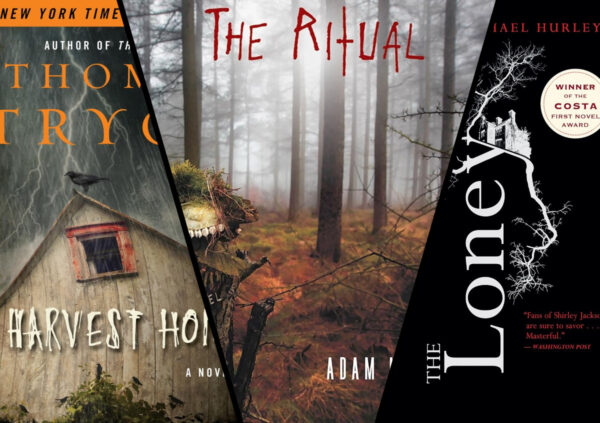
Read Harvest Home. It is the American folk horror novel and almost nobody has read it.
Then The Other, which is the better-reviewed of the two and the more conventional.
Note that availability is a genuine problem. Harvest Home has spent long stretches as an ebook only.
The Essential
Two of the Thomas Tryon books are horror and both came out in the first three years of the career, which is the shape of the whole thing.
Harvest Home (1973)
Thomas Tryon – Harvest Home
Ned Constantine leaves a New York advertising job to paint full time, and buys an eighteenth-century house in Cornwall Coombe, a Connecticut village that appears to have declined to participate in the twentieth century.
No televisions. No modern farming. Corn planted and harvested by hand, on a calendar nobody explains. The villagers are warm, welcoming, and pleased to have the family, and Ned’s wife and asthmatic teenage daughter both improve almost immediately.
Patience is the whole method. For two hundred pages you read a pleasant book about house restoration and neighborly acquaintance, while wrongness gathers at a rate calibrated to leave you exactly where Ned stands: sensing the off-ness, refusing to be the one who causes a scene over it.
Underneath, the village runs as a matriarchy, the element its folk horror descendants mostly abandoned. Cornwall Coombe’s men fill the offices with titles while the Widow Fortune governs in fact, women carry the knowledge between generations, and women administer the ritual at the book’s core. Its Harvest Lord is a young man appointed to a role that ends him.
The reputation it carries, as the American folk horror novel nobody read, is earned. It predates almost everything the label now describes on the American side, it was a New York Times bestseller, and it has been out of print in physical editions more often than in.
Filmed by NBC in 1978 as The Dark Secret of Harvest Home, with Bette Davis as the Widow.
Summer 1935, Connecticut again. The Perry twins, Niles and Holland, are thirteen: Niles gentle, Holland anything but, the father dead by accident, the mother unwell upstairs, and a Russian grandmother who has taught Niles a game of projecting his mind into other beings.
Then people start dying.
The withholding makes it work and makes it nearly impossible to discuss, both at once. At one precisely chosen moment the novel’s true operation surfaces, and every prior page changes meaning behind you.
It was a genuine critical success, unusual for horror in 1971, and it sold enormously. Tryon adapted it himself for the 1972 film, which he also produced, with Uta Hagen as the grandmother.
He published seven books across eighteen years and none of the later ones is horror in the way the first two are.
Lady (1974)
Thomas Tryon – Lady
The third of what he thought of as a Connecticut sequence, and it is not horror at all.
Woody Sprague is a boy in a small Connecticut town in the 1930s, and Lady Harleigh lives across the road: elegant, wealthy, widowed, and the person he cares most about in the world. The novel is his memory of that friendship, told forty years later, and of the summer he found out what had happened to her husband.
The disclosure is handled with real restraint, which is the surprise given what The Other does. There is no reveal engineered for effect. There is a fact about the past that Woody was too young to understand and too fond of her to want to.
It is quiet, warm and slow, and Tryon’s admirers argue no book of his is better written.
Readers who arrive from the first two novels expecting another one are frequently disappointed, and it is not that book.
Four novellas about Hollywood, and this is where the acting career pays off.
Tryon spent fifteen years as a contract player, and the industry material here is written from inside it rather than researched.
“Fedora” is the best known. A reclusive star of the silent and early sound era has not aged, a producer goes to Corfu to find out why, and the explanation is one of the more disturbing things Tryon wrote. Billy Wilder filmed it in 1978 as his penultimate picture.
“Bobbitt” is the cruelest of the four, following a former child star into middle age.
“Willie” draws on a famous Hollywood murder, and “Lorna” is the weakest.
The connecting subject is what the studio system did to the people it manufactured, and Tryon is writing about an industry that had chewed him up and that he had walked away from.
All That Glitters (1986) and The Night of the Moonbow (1989)
Thomas Tryon – The Night of the Moonbow
The last two, and the second is the one worth finding.
All That Glitters is more Hollywood material, five actresses across several decades, and it is considerably weaker than Crowned Heads. The formula is the same and the energy is not.
The Night of the Moonbow is his final novel and a late return to horror, and there is nothing supernatural in it.
A boys’ summer camp in Connecticut in 1938. Leo Joaquim is an outsider, awkward, musical, an orphan, and he does not fit, and a group of boys decide to correct that. What follows is a slow, methodical campaign of cruelty across a summer, and Tryon writes it with the same withholding he used in The Other.
It is his most straightforwardly cruel book and it has no consolation in it anywhere.
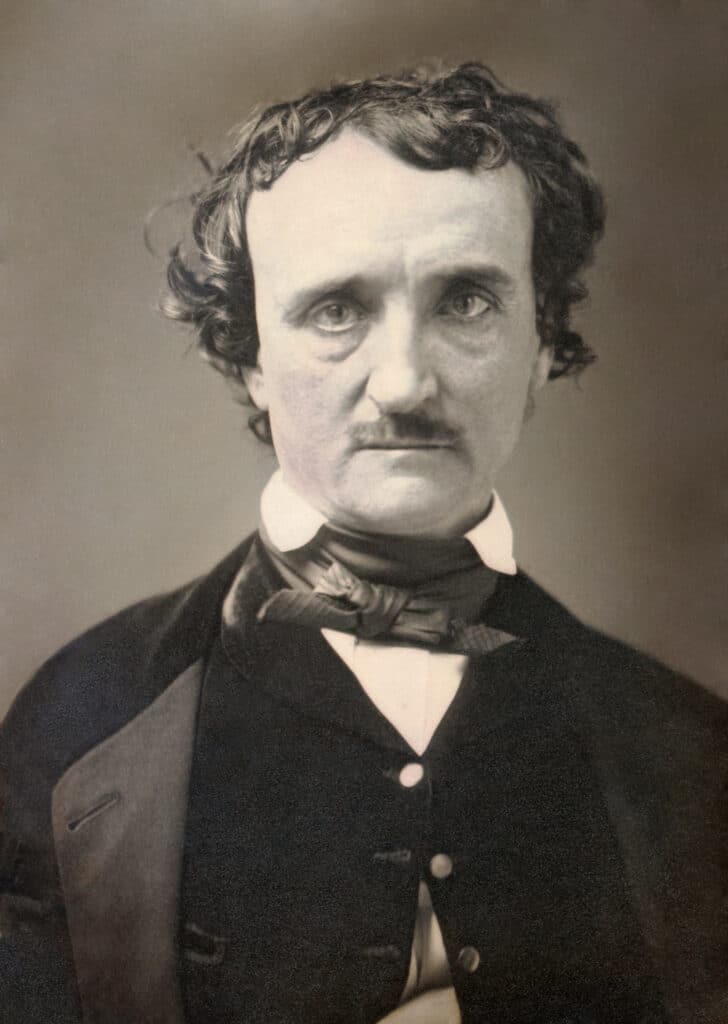
Poe thought of himself as a poet first, and the poems came first.
That’s easy to forget, because the stories are what survived into popular culture. But his first published book was poetry, he wrote verse from his late teens until the month he died, and even his prose reads like someone who couldn’t quite switch the meter off. Anyone who’s read “The Masque of the Red Death” out loud knows what I mean.
Edgar Allan Poe
The odd thing is that the Edgar Allan Poe poems are a much smaller and much more uneven body of work than the tales. He wrote maybe fifty of them worth reading. A fair few are apprentice pieces, some are occasional verse written to flatter women he was courting, and two or three are among the most famous things ever written in English.
This is a ranked guide to the sixteen worth your time. I’ve linked each one to a free text, since all of it is public domain, and I’ve tried to say something about why each poem works rather than just summarising it. Poe would have wanted that. He was, after all, the man who wrote an essay explaining exactly how he built his most famous poem, line by line, like a piece of furniture.
Read them out loud. This is not optional advice with Poe. The rhythms are the point, and a lot of what feels overwrought on the page becomes hypnotic when spoken. He wrote for the ear, sometimes explicitly, and Ulalume was composed as an elocution piece.
Expect the same obsession over and over. In The Philosophy of Composition he stated flatly that the death of a beautiful woman is the most poetical topic in the world, and then spent his career proving he meant it. Lenore, Ulalume, Annabel Lee, The Sleeper, The Raven. Same wound, opened repeatedly.
Some of it is genuinely bad. The early work in particular is imitation Byron and Coleridge with the volume turned up. I’ve included two of those anyway, because you can see him finding the voice in real time, and that’s interesting even where the poem isn’t.
16. Tamerlane
His first published work, in 1827, in a pamphlet of forty pages printed at his own expense with the author given as A Bostonian.
It sold perhaps fifty copies. Twelve are known to survive and one sold at auction in 2009 for six hundred and sixty-two thousand dollars, which makes it the most valuable book in American literature per page.
The poem itself is not good. It is four hundred lines of a dying Turkic conqueror confessing to a priest that he chose empire over a woman named Ada and that the ambition was worthless, and it is entirely Byron with the serial numbers filed off.
Poe was eighteen, had just left the University of Virginia over gambling debts, had enlisted in the army under a false name and a false age, and was writing about a man who had thrown away love for glory.
Read it as biography rather than as poetry, and read it last.
The angel Israfel is the one in Islamic tradition who will blow the trumpet at the resurrection, and in the Quran he has the sweetest voice of all God’s creatures.
Poe’s poem is a complaint about that.
The angel sings in heaven, unrivaled, and the stars stop to listen, and Poe’s argument across seven stanzas is that this is easy. Israfel is in heaven where love is a grown-up god and the flowers are perfect, so of course he sings well. There is nothing to overcome.
Then the last stanza makes the trade. If Poe were where Israfel is and Israfel were here, the angel could not manage a melody so wild, and Poe would sing better than the angel does.
That is a genuinely unusual position: that the mortal poet has the harder job and the better material because his world is broken.
It is the least gloomy thing he wrote and the most competitive.
Fifteen lines, three stanzas, and the one poem of his that critics who dislike him tend to concede.
It is a compliment. A woman’s beauty is compared to the ships of antiquity that carried a weary traveler home, and then to the glory that was Greece and the grandeur that was Rome, which is the line everybody knows and which is quoted constantly by people who have never read the rest.
Then the last stanza puts her in a niche, holding an agate lamp, and calls her Psyche from the regions which are Holy Land.
The Helen was Jane Stanard, the mother of a schoolfriend, who was kind to Poe when he was fourteen and died the following year at thirty-one. He visited her grave.
That is the pattern for everything he wrote afterwards, and it started here with a poem written by a boy about a woman who had been kind to him once.
Twenty-nine lines, published when he was twenty and originally titled “Visits of the Dead”, and the earliest poem on this list.
The instruction is to stand alone among the tombstones of a churchyard at night and not look at any of the stones, because the loneliness there is not solitude.
The dead who stood in life around you are there again in death, and their will overshadows you, and the poem’s word for it is that you shall be still.
Then the night’s tone changes. The breeze is described as the breath of God, the mist on the hill is shadowy and unbroken, and the poem’s last image is that it is a symbol and a token of something hanging on the trees, which it declines to name.
It feels unfinished, and nothing else in his verse comes closer to a genuine ghost story.
Nothing in it is explained and the effect depends on that.
Poe said this was better than The Raven and almost nobody agrees with him.
It is midnight in June under a mystic moon. An opiate vapor drips from the moon’s rim onto a valley, the rosemary nods on the grave, the lily leans on the wave, and the ruin molders into rest.
Then Irene is at her open window, asleep, and the narrator is outside looking in, and he asks whether she is not afraid, and remarks that the lady sleeps.
Except she is dead. The poem discloses that gradually and then commits to it: the last stanza is about the vault she will be sealed in, and the narrator’s wish that her sleep be as deep as it is sound.
The unsettling part is the position of the speaker. He is at a woman’s bedroom window at midnight, describing her body, and she cannot object.
Poe revised it repeatedly across twenty years, which suggests he knew it was not finished.
A traveler returns from a place he reaches by a route he describes as an obscure and lonely road haunted by ill angels, out of space and out of time.
What is there is a catalog: bottomless vales, boundless floods, chasms and caves and Titan woods, seas that restlessly aspire toward skies of fire, lakes that lie forever still, and snows of lily that droop into them.
And ghouls, and the shrouded forms of friends who have been given over to the earth.
The poem’s argument is that the region is where the bereaved go to see the dead again, that it is available only to those who have lost somebody, and that the traveler cannot look at it directly because the eye must be shut with fringed lid.
It is the most explicit statement anywhere in Poe of what his landscapes are for.
The refrain about Eidolon, named Night, ruling upright with a scepter, is the best line in his shorter verse.
Another poem inside a story. Ligeia recites it in the tale of the same name, having written it herself, shortly before dying.
The conceit is a theater. Angels sit weeping in the audience, watching a play in which mimes chase a phantom around and around and never catch it, driven by formless things that shift the scenery.
Then a crawling shape comes out of the wings, red as blood, and eats the mimes while the angels sob at its fangs.
The curtain comes down and the angels rise, pale, and say that the play is the tragedy Man and the hero is the Conqueror Worm.
It is a bleak little machine and it is doing something specific in the story, which is telling you that Ligeia understood exactly what she was facing and refused it anyway.
The worm is decay rather than a monster, and the poem is about the fact that nothing in the play was ever going anywhere.
No people in it, no dead woman, no narrator with a grief, and the closest Poe came to pure cosmic horror in verse.
A city stands in the west where Death has raised a throne. The towers, the shrines, the palaces and the walls are all there, complete, and the sea does not move around them. There is no wave, no ripple, no wind, and no tide.
Poe spends the whole poem establishing that stillness and then removes it. The waters glow redder, the hours breathe faintly, the towers begin to settle, and the city sinks, and Hell rises from a thousand thrones to do it reverence.
There is no explanation of what the city was or who built it or why it is being taken.
That refusal is why Lovecraft admired the poem and why R’lyeh is recognizably descended from it.
The dead woman who is named in The Raven gets her own poem, written years earlier, and the two are not the same piece of work.
The situation is a funeral. A young woman is on her bier, wealthy, and the poem is an argument at the graveside between Guy de Vere and the mourners about whether anybody present is entitled to grieve.
De Vere’s position is that they killed her. They loved her wealth and hated her, they wished her dead, and now they are performing a dirge, and he refuses to weep in front of them.
So he sings a paean instead, celebrating that she has escaped them, and tells them not to ring the bell.
It is the angriest thing Poe wrote, the one poem where the grief has a target rather than being weather.
It went through several versions across fifteen years and started as a longer piece called “A Paean”.
Twenty-four lines, written in 1849 during the California gold rush, and the only cheerful thing on this list until you look at it twice.
A gallant knight rides in sunshine and in shadow, singing, looking for Eldorado. He grows old. He meets a pilgrim shadow and asks where the land is.
The answer is that he must ride over the Mountains of the Moon, down the Valley of the Shadow, and ride boldly if he seeks for Eldorado.
Which is to say: it is not in this world and you get there by dying.
Poe wrote it the year he died, during a national mania in which thousands of men were abandoning everything to go west, and the poem is either an encouragement or an obituary depending on how you read the pilgrim shadow.
It is the least ornamented and most quotable of the short ones, and the meter is a riding rhythm that does not let up.
A poem inside a story, which is unusual and is why it is here rather than lower.
Roderick Usher performs it on the guitar in The Fall of the House of Usher, improvising, and the narrator records the words. So it functions twice: as a standalone lyric and as a symptom of the man singing it.
The palace is beautiful. It stands in a green valley, it has banners on the roof and windows through which spirits move to music, and a door of pearl and ruby through which echoes come.
Then the last two stanzas. Evil things in robes of sorrow assail the palace, the windows are now red-litten, and what moves through them is a hideous throng that laughs and does not smile.
The building is a head and Poe means it entirely literally. The windows are eyes, the door is a mouth, the banners are hair, and the throng is a mind coming apart.
Usher knows what he is describing. That is the horror in the story.
The strangest thing he wrote and the one that divides readers most sharply.
A man walks with his soul, which he calls Psyche, through a landscape of cypress and volcanic ash on a night in October, in a place he names Weir, by a lake he names Auber. Psyche is frightened and tries to turn him back. He insists on following a star. They arrive at a tomb.
Whose tomb it is he does not remember until he reads the name, and then the poem stops.
The invented geography is the trick. Nothing in it exists, the names are made up, and Poe is producing an interior landscape rather than describing anything, and the repetition of the false place names is what makes it work.
It is also the most sonically extreme thing he did. Almost every line ends on the same handful of sounds and the effect is closer to a chant than to speech.
He wrote it in 1847, the year after Virginia died. Aldous Huxley thought it was vulgar. Read it aloud.
Four sections and four kinds of bell, and it is a technical exercise about what a sound can be made to do.
Silver sleigh bells in the first, and the meter is fast and light. Golden wedding bells in the second, slower and fuller. Brazen alarm bells in the third, jangling and irregular and genuinely frantic on the page. And iron funeral bells in the fourth, which slows almost to a stop and stays there for the last twenty lines.
The onomatopoeia is relentless and completely deliberate. The word bells appears about sixty times, tinkle and clang and moan and knell are doing structural rather than decorative work, and the whole poem is engineered so the reading speed changes without the reader deciding to change it.
It is a party piece and it is a genuine achievement.
Rachmaninoff set it as a choral symphony in 1913 and considered it his finest work.
Twenty-four lines and the least ornamented thing he wrote.
A man says goodbye to somebody and admits that everything he has believed has been a mistake, and then he is on a shore, holding grains of sand, and they are falling through his fingers no matter how tightly he closes his hand, and he is weeping about it.
The question the poem ends on is whether anything he has experienced was real, and it is asked twice, and not answered.
What separates it from the rest of the verse is the restraint. There is no invented geography, no dead woman with a name, no bells and no bird. There is a beach, a hand, and sand.
That makes it the Poe poem most people can read without any tolerance for nineteenth-century ornament, and the one most often quoted by people who dislike his poetry.
It was assembled from an earlier fragment and published in 1849, the year he died.
The last poem he completed and it was published two days after he was buried.
A man loved a girl in a kingdom by the sea when they were both children, and she died, and the angels took her out of envy because their love was greater than anything in heaven. He sleeps beside her tomb by the sea every night.
The mechanism is simple and it works. Poe repeats the phrase kingdom by the sea six times, and Annabel Lee’s name seven, and the ballad meter is nursery-simple, so the poem lodges the way a song does rather than the way a poem does.
Then the last stanza tells you where he is sleeping.
Who Annabel Lee was is disputed. Virginia is the usual candidate, since she died two years earlier at twenty-four and Poe never recovered. Several other women have been proposed and there is no evidence for any of them.
It is the most anthologized poem in American literature.
The most famous poem written in America, and it made him nationally known and earned him about nine dollars.
A man is reading at midnight in December, trying not to think about a dead woman named Lenore. Something taps. He opens the window and a raven comes in and sits on the bust of Pallas above his door, and it says one word.
The construction is the reason it lasts. Poe wrote an essay afterwards, The Philosophy of Composition, claiming he built the whole thing backwards from the sound of the refrain, chose nevermore because the long o and the r were the most sonorous available, chose a raven because he needed a creature capable of speech without reason, and calculated the length at about a hundred lines because that is what a reader can hold in one sitting.
Whether that account is honest is argued about. It is certainly a poem that behaves as though it were engineered.
The horror is that the narrator works out the bird can only say one word and keeps asking questions anyway.
Edgar Allan Poe – The Raven and Other Favorite Poems
All of it is public domain and every poem above is linked to a free text, so buying is optional.
If you want a physical copy, the Dover Thrift edition of The Raven and Other Favorite Poems collects forty-one poems for almost nothing and covers everything on this list.
Read “The Raven” first, out loud, all of it. If it does nothing for you, the rest won’t either.
Then “Annabel Lee” for the same wound handled quietly, and “A Dream Within a Dream” for Poe without any of the gothic furniture.
If you want the weird rather than the grief, go to “Dream-Land” and “The City in the Sea”, which are the two Edgar Allan Poe poems that point straight at the century of cosmic horror that followed him.
And if you’ve read the tales, read “The Haunted Palace” next. It’s the key to “The Fall of the House of Usher” hiding in plain sight inside the story itself.
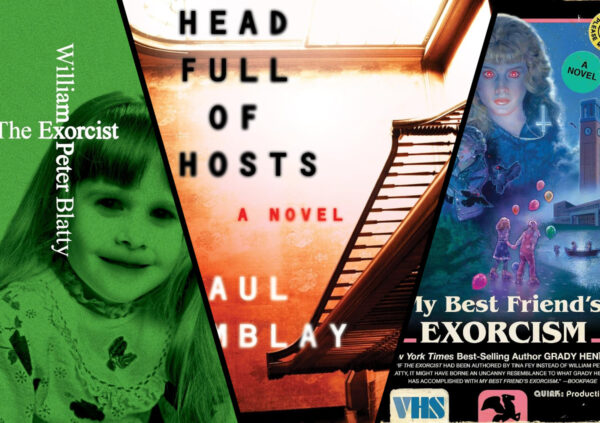
Paul Tremblay writes horror novels that refuse to tell you whether anything supernatural happened, and he has built an entire career on that refusal.
It’s a genuinely risky position, and it’s what unites all the Paul Tremblay books. A reader who wants a monster confirmed will finish A Head Full of Ghosts annoyed, and plenty do. What Tremblay is doing instead is treating ambiguity as the subject rather than as a device: his books are about people constructing explanations for things they cannot bear, and about who gets believed, and about how a story changes once somebody is selling it.
He was a math teacher for years, he sits on the Shirley Jackson Award board, and the influence is direct and acknowledged. If you have read The Haunting of Hill House and want the modern version of that specific unresolvability, this is where to go.
I haven’t read these. What follows is the critical consensus.
Read A Head Full of Ghosts. It won the Bram Stoker Award, it’s the book that made his name, and the last chapter reframes everything before it.
Then The Cabin at the End of the World if the ambiguity worked on you, and Survivor Song if you want the one with the most heart.
The Essential
A Head Full of Ghosts (2015)
Paul Tremblay – A Head Full of Ghosts
The Barrett family’s fourteen-year-old daughter Marjorie is behaving in ways nobody can explain. The family is broke, the father has found religion since losing his job, and a television production company has offered a great deal of money to film an exorcism as a reality series called The Possession.
The economics are what make it work. Every decision the family makes is explicable without any supernatural agency at all, because they need the money and the father needs to believe. The novel never confirms whether Marjorie is possessed, ill, or performing, and it gives you enough to build any of the three.
The frame is the second thing people talk about. Merry, the younger sister, tells the story in an interview fifteen years on, and between her chapters sit blog posts from a horror fan picking the television series apart. Those posts carry a great deal of quiet weight, and the final chapter recontextualizes the whole book.
It won the Bram Stoker Award for Best Novel. Stephen King’s line about it scaring the hell out of him is on most editions.
A couple and their seven-year-old daughter are on holiday at a remote New Hampshire cabin when four strangers arrive with improvised weapons and tell them that one of the family must be willingly sacrificed to prevent the end of the world.
It’s a single-location novel that runs on one impossible decision, and the entire book takes place over about a day. The intruders are not villains in any straightforward sense. They are frightened, apologetic and certain, and Tremblay makes their certainty the most disturbing thing in it.
It won the Bram Stoker Award for Best Novel. M. Night Shyamalan filmed it in 2023 as Knock at the Cabin and changed the ending, a change most readers count as gutting the whole idea.
A rabies-like virus with a very short incubation is spreading through Massachusetts. A paediatrician drives her pregnant best friend, who has just been bitten, across a collapsing state to find a hospital that will take her, against the clock of the infection.
It was published in July 2020, which was either the worst or best possible timing, and it was written before the pandemic. What distinguishes it from the rest of the subgenre is that it’s about friendship and competence rather than about societal collapse, and it is much warmer than his other books while being just as bleak.
Among his readers it gets called his most emotionally direct novel, and by a fair number, his best.
Tommy Sanderson, thirteen, goes into the woods at night with two friends and does not come back, and his mother starts finding pages of his diary appearing on the living room floor.
She also sees him standing in her bedroom doorway. Once, briefly, on the night he vanishes.
Tremblay’s method is the same as in A Head Full of Ghosts and it is applied to grief rather than possession. Everything has an explanation available. The pages are being left by one of the friends. The apparition is a mother who has not slept. And the diary, released in fragments across the novel, tells a story about the woods and an older man called Arnold that is worse than anything supernatural.
The mother is who you’ll remember. Elizabeth is exhausted, angry, and forced to run her own investigation, because the police decided early that the boy ran away.
It was a Bram Stoker nominee, losing the year Langan’s The Fisherman took the novel award, and it remains the least discussed of his novels and one of the best.
Art Barbara is a lonely, awkward teenager with scoliosis who starts a club at his high school to attend the funerals of people with no mourners, so he has something for his college applications.
Then Mercy Brown turns up. She is older, she takes photographs at the funerals, she attaches herself to him, and she stays in his life for the next twenty-five years, and Art becomes convinced she is a psychic vampire feeding on him.
The form is the joke and it works. The novel is Art’s memoir, and Mercy has read it and annotated it throughout in handwriting, correcting him, mocking him, disputing his account of events and occasionally being cruel about his prose.
So you get two unreliable narrators arguing in the same document, and no way to determine which is right.
Mercy Brown is a real name, from an 1892 Rhode Island vampire panic, which Art is aware of and Mercy claims is a coincidence.
In 1993 a small crew shot an independent horror film called Horror Movie in and around Boston. It was never finished, three scenes leaked online, and it acquired a following.
Thirty years later the only surviving cast member, who played the character called the Thin Kid, is consulting on a big-budget remake.
The novel alternates between his present-day account, his memories of the shoot, and the actual screenplay of the original, printed as a screenplay, which the reader assembles alongside him.
What happened during that production, and what the Thin Kid did, is disclosed slowly, and Tremblay’s usual ambiguity is present but tighter than usual because a screenplay cannot be unreliable in the same way a memory can.
It’s his most straightforwardly nasty book, and the screenplay sections are genuinely unpleasant.
His most commercially successful novel, and the film rights sold before publication.
Nineteen stories, and it is where the connections between his novels become visible.
The title story is two sisters barricaded in a house while plants grow over everything outside, told by the older to the younger, and it’s the very story Merry tells Marjorie in A Head Full of Ghosts, which means the collection contains a piece of fiction from inside another book.
“The Thirteenth Temple” returns to Merry as an adult, after the events of that novel and after the book she published about it, and it functions as a sequel.
“Notes for ‘The Barn in the Wild'” is a found-document piece about a hiker and a body in a barn in Maine.
“It’s Against the Law to Feed the Ducks” is the one people find hardest, and it is a family holiday during what appears to be a nuclear event, narrated by a child who does not understand what the adults are doing.
Won the Bram Stoker Award for best collection. The Beast You Are (2023) is the second collection, anchored by a novella-length animal fable told in verse, and it’s the deeper cut.
Read A Head Full of Ghosts, and read the blog post chapters carefully rather than skimming them, because they are not filler.
If the ending frustrates you, he is not going to stop doing that, and you should read Survivor Song instead, which is the least ambiguous of the Paul Tremblay books and the most moving.
If it works on you, read The Cabin at the End of the World next and avoid the film.
And read Growing Things if you want to see how much of the ambiguity is deliberate craft rather than evasion.
My best horror books list ranks the rest of the genre. A Head Full of Ghosts is arguing with everything on my possession books list.
Josh Malerman wrote Bird Box while touring as the frontman of a rock band, in vans and hotel rooms, and it sat unpublished for years alongside a dozen other completed novels before anyone bought it.
That’s the useful fact about him, because it explains the shape of the career. He had a large backlog when he arrived, he writes extremely fast, and the result is a catalog that is both prolific and wildly uneven. Among the Josh Malerman books there are three or four genuinely excellent ones and a great many that read like a very good idea executed at speed.
What the Josh Malerman books do better than almost anything else on the shelf is premise. A world where seeing something makes you kill yourself. A boys’ home where the outside world is a lie. A town where a thing hides in the corner of your eye. The ideas are consistently better than anything else on the shelf, and the execution is the variable.
He is still the frontman of the band. He writes with the album playing.
I haven’t read these. What follows is the critical consensus.
Read Bird Box. It’s the reason he has a career and the mechanism at the center of it is one of the best in modern horror.
Then Malorie if you want the sequel, or Goblin if you want the most atmospheric one.
The Essential
Bird Box (2014)
Josh Malerman – Bird Box
Something has appeared in the world. Anyone who sees it is driven immediately and violently to suicide, and nobody knows what it is because looking is fatal.
Malorie has spent four years in a boarded-up house with two children she has trained since birth to listen, and the novel alternates between that period and a single day: rowing twenty miles down a river, blindfolded, with both children, toward somewhere that may not exist.
The mechanism is what everyone rightly praises. The horror is never described, because describing it would require somebody to have seen it, so the entire novel is written around a hole. Every scene is constructed from sound, touch and the terror of an open window. It’s a formal constraint that generates real dread rather than merely being clever.
On two things nearly everyone agrees: the tension is extraordinary, and the ending divides people. The 2018 Netflix film made it a phenomenon and is considerably less frightening than the book.
Twelve years after Bird Box. Malorie and the two children, now teenagers, are living in an abandoned summer camp, and she has raised them under a discipline so total that neither has seen anything since they were four.
Then a man arrives with a census list of survivors, and two of the names on it are her parents.
The sequel’s actual subject is what she did to the children in order to keep them alive. Tom is sixteen and wants to build things, to experiment with visors and filters, to find out whether the rules can be tested. Olympia has been reading books she was not supposed to have. And Malorie’s rules are absolute and were correct and are now the thing damaging them.
The train sequence in the middle is genuinely tense.
The fair verdict: a good sequel to a book that needed none, justified mostly by the argument between Malorie and Tom.
This is the one I’ve read, and I’m going to disagree with almost everybody about it.
Two teenagers on a first date take a canoe across three connected lakes and find a house, fully furnished and intact, sitting at the bottom of the third one. They keep going back, diving into it room by room across a summer.
It is not a horror novel. It has liminal flavor, and there are some ghostly elements, and the image at the center is genuinely good. But the book is a romance. It is about two people falling in love in an unusual place, and the unusual place is the setting rather than the subject.
It’s also slow. It meanders, very little happens, and at a hundred and fifty pages that shouldn’t be possible.
It gets recommended constantly by people who have read all of Malerman, and I understand why: the premise is his best and the restraint is deliberate. But if you have come here wanting to be frightened, this will not do it, and I’d rather say so than pass along a recommendation I don’t agree with.
Read it if you want a strange, quiet love story with an extraordinary setting. Do not read it for scares.
Twenty-six boys are raised in a tower in a forest by a man they call D.A.D., who has told them there are no women anywhere in the world.
Elsewhere, twenty-six girls are raised in an identical tower by M.O.M.
The premise is that the experiment tests whether removing all knowledge of the opposite sex produces greater intellectual output, and the boys are being trained as prodigies. Then one of them sees something in the trees.
What makes it work is the inspections themselves. Every boy is examined daily, in detail, for any sign of what the staff call Rotten Tree, and the examination is described enough times that the reader understands what a childhood of it does.
The novel’s weakness is the second half, where the two towers meet and the plot becomes conventional.
The first hundred and fifty pages are the best sustained thing Malerman has written and the closed-world detail is superb.
Six novellas set in the same town, which is perpetually raining, has a police force with unusual powers, and does not appear on maps.
“A Man in Slices” is a man proving his love by removing parts of himself. “Kamp” is a man who has been terrified of ghosts since childhood attempting to cure himself by spending a night in the town’s worst house. “Happy Birthday, Hunter” is a big-game hunter pursuing the one animal in the Great Northern Forest he has never taken, which is protected by law for reasons nobody explains.
They connect loosely: a character crosses into another story, an event is mentioned twice, and the rain runs through all of it.
“Presto” and “A Mix-Up at the Zoo” are the weaker two.
It began as a limited-edition small-press object and was reissued in 2021, and it’s the best entry point to Malerman for readers who found Bird Box thin.
Carol Evers has a condition. Several times in her life she has fallen into a coma indistinguishable from death, lasting days, during which she is fully conscious and can hear everything.
Three people know. Her husband Dwight is one of them, and when it happens again he decides to bury her.
The setting is the invention. It is a western, with outlaws and a trail and a town, in a world that is not quite the American West and is never explained, and the outlaw who comes for Carol is a man called Smoke who sets people on fire.
The premature burial premise is Poe’s and Malerman uses it properly, which means the sections from inside the coma are the best in the book.
Most readers find the genre blend never fully coheres, and count James Moxie and Smoke among his better characters.
Narrated by Bela, who is eight, and the entire novel is in her voice.
She has a friend called Other Mommy who lives in the closet and in the walls and has been asking her the same question for a long time, which is whether Bela will let her into her heart. Bela keeps saying no. Other Mommy keeps asking.
Then Other Mommy starts appearing when the parents are in the room.
The child narrator is the whole achievement and Malerman sustains it completely. Bela does not have the vocabulary for what is happening, so she describes it literally, and the reader assembles the situation from a child’s account of things she finds normal.
Her parents’ marriage is failing in the background and she reports that in the same register.
It is his most frightening book and the one that finally delivered on the promise of Bird Box, and several critics named it the horror novel of its year.
Read Bird Box, and read it in as few sittings as you can, because it works on sustained tension rather than on incident.
If you want the atmospheric one, read Goblin. If you want the recent one, read Incidents Around the House.
A House at the Bottom of a Lake is the one everybody else will tell you to read next. I’d skip it unless a quiet romance in a strange setting is what you’re after, because it is not a horror novel and it is slower than its length should allow.
And go into the rest of the Josh Malerman books knowing that the premises are reliably excellent and the execution is not, which is a fair trade at his best and frustrating at his worst.
A note on support: this page mentions suicide. If you’re struggling, you don’t have to handle it alone. In the US you can call or text 988, the Suicide and Crisis Lifeline. Elsewhere, the International Association for Suicide Prevention keeps a directory of crisis centers at iasp.info.
For the wider canon, see my horror classics page. The stranger end of what he does belongs with my sci-fi horror list.
Ambrose Bierce walked into Mexico in 1913 at the age of seventy-one and was never seen again, which is a fittingly unhelpful ending for a writer who spent his career refusing to explain things.
He was called Bitter Bierce. He fought through the American Civil War as a Union topographical engineer, was shot in the head at Kennesaw Mountain, and came out of it with a view of human beings that never softened. Then he spent forty years as the most feared newspaperman in California, writing a satirical dictionary in installments and short stories that nobody quite knew what to do with.
Ambrose Bierce matters to horror far more than his output suggests. He wrote perhaps two dozen weird stories, and two of those Ambrose Bierce stories supplied names that Robert W. Chambers borrowed for The King in Yellow and that Lovecraft then folded into the mythos. Carcosa and Hastur are Bierce’s. He also, decades before anyone had the vocabulary, wrote genuine cosmic horror: stories in which the universe is indifferent, perception cannot be trusted, and nothing is explained at the end.
Almost everything is public domain, so I’ve linked to free texts throughout. Buy the collections if you want them on a shelf.
I haven’t read all of him. What follows is largely the critical consensus.
Ambrose Bierce was an extraordinarily prolific writer, with 249 stories and hundreds of other writings to his name. While his output is vast, he’s most famous for his dark Civil War realism and haunting psychological horror.
Below, I’ve highlighted some of his most essential and influential tales. You can read them all for free via Project Gutenberg, linked at the end of each entry.
If you want a physical trade edition for your library, the premier in-print volume is The Complete Short Stories of Ambrose Bierce.
It gives you his complete core-fiction as a single 500-page paperback.
The most anthologized short story in American literature and the one everybody was taught.
A Confederate sympathizer named Peyton Farquhar is standing on a railway bridge in northern Alabama with a rope around his neck and Union soldiers around him. The story opens with the preparations, described with total procedural calm, and Bierce spends a page on the arrangement of the men and the planking.
Then the rope breaks and he goes into the creek and escapes, and the escape occupies the middle third, and it is vivid in a way the opening is not: the water, the bullets, the forest, the road home, his wife on the veranda.
The last sentence is the reason it lasts.
What makes it more than a trick is the deterioration in the middle. Reread it and the escape is already wrong. The colors are too bright, the sounds are too precise, and the road is unnaturally straight.
Bierce fought at Shiloh and Chickamauga and wrote this twenty-five years later.
Six pages, published in 1886, and it supplied two of the most-borrowed names in weird fiction.
A man wakes on a desolate plain, ill and confused, and sets out to find his way back to the city of Carcosa, where he lives. The landscape is wrong. There are no landmarks he recognizes, the vegetation is unfamiliar, a lynx passes him without looking, and a man carrying a torch walks by and does not see him.
Then he finds a stone with an inscription on it.
The reveal is guessable and that is not the point. The story is a mood piece about a landscape that has stopped acknowledging you, and Bierce sustains it for its whole length with almost no incident.
Carcosa and Hastur both come from Bierce. Chambers took them for The King in Yellow nine years later and stripped out the meanings, and Lovecraft mentioned Hastur once, and everything the culture now attaches to those names is downstream of that theft.
A California cabin hosts a coroner’s inquest, a dead man on the table. Hugh Morgan’s friend testifies to the events of a quail hunt, before a coroner who has settled in advance on the testimony’s worthlessness.
What Morgan describes is grass flattening in a line moving toward them, and something knocking his friend down that he could not see.
Bierce’s explanation is the reason this story matters. The creature is colored outside the visible spectrum, and he argues it properly: there are sounds too high and too low for human ears, so there is no reason to assume the eye registers everything either. That is a physics argument rather than a supernatural one.
It is the first modern cosmic horror story by any reasonable definition, published thirty-four years before The Color Out of Space, and Lovecraft acknowledged the debt.
The inquest frame is the other achievement. The reader is positioned as a juror, the coroner’s contempt for the evidence is the story’s real subject, and the dead man’s diary is read out at the end and is worse than anything Morgan said.
Haïta is a young shepherd who lives simply, worships the god Hastur, and is content. Happiness appears to him as a woman, and she tells him she will stay as long as he does not ask her to, and every time he questions her or tries to hold her she vanishes.
That is the whole story and it is a straightforward moral fable in a pseudo-classical register.
Hastur here is a benign god of shepherds. Not a king, not unspeakable, not associated with Carcosa in any way, and not remotely sinister.
Chambers took the name for The King in Yellow and used it as a place or possibly a person, unexplained. Lovecraft listed it once in “The Whisperer in Darkness.” And August Derleth then built the entity everybody now means, after Lovecraft was dead.
So the chain is a shepherd’s god to an ambiguous fragment to a single name-drop to a Great Old One, and only the first link is Bierce’s.
The strangest thing he wrote and the one with the most direct influence on Lovecraft.
Halpin Frayser wakes in a wood, having been asleep on the ground, and remembers a dream. He speaks a name aloud, Catherine Larue, without knowing whose it is. He writes a poem in a notebook, in blood, and does not remember writing it.
Then he walks through the wood and meets his mother, who is dead, and she is not friendly.
The story is deliberately broken. It opens with a fake quotation from an invented occult text about the corpse being ridden by the soul that inhabited it. The chronology does not resolve. The relationship between Halpin and his mother is disturbing in a way the text implies and never states. And the final section is a police procedural that supplies facts which do not fit.
Lovecraft praised it specifically. The invented epigraph is a device he then used constantly.
Four men go to an abandoned house at night in a Tennessee town for what is meant to be a duel in the dark with bowie knives.
The house has a reputation. A man named Manton killed his wife and two children there years ago and disappeared, and the wife was found with a foot missing part of a toe.
Bierce constructs the story so that the reader is a full step ahead of everybody in it, which is the joke, and the punchline is delivered by a set of footprints in the dust.
The frame is a piece of misdirection. It opens as a story about a quarrel over an insult and a duel arranged with elaborate seconds and rules, and none of that turns out to matter.
It is short, mean and entirely mechanical, which is Bierce at his most characteristic.
The final image is one of the best in nineteenth-century horror and it is a description of dust on a floor.
A six-year-old boy wanders away from his father’s farm with a wooden sword, playing at soldiers, gets lost in the woods, falls asleep, and wakes in the dark.
He then encounters a large group of men moving slowly through the trees on their hands and knees. The boy thinks they are playing. He tries to ride one. He runs ahead of them waving his sword, leading them, delighted.
They are wounded men crawling away from a battle, and many of them have no lower jaws.
The child is deaf and mute, which Bierce does not disclose until near the end, and which is why he has heard nothing all day and does not understand what he is seeing.
Then he reaches the burning farm.
Bierce fought at Chickamauga in September 1863, where the Union army lost around sixteen thousand men across two days. He was twenty-one.
It is the most upsetting war story in American literature and it runs to eight pages.
He is a horror writer on this site and a war writer everywhere else, and the two are the same thing.
Tales of Soldiers and Civilians, published in 1891, is the collection, and Bierce was writing about the Civil War twenty-five years after fighting in it, from Shiloh through Chickamauga to Kennesaw Mountain, where he was shot in the head.
The stories are almost all built on one device: a man performs his duty correctly and the duty is monstrous. In “A Horseman in the Sky” a Union sentry recognizes the mounted officer he has been ordered to shoot. In “One of the Missing” a scout is pinned under rubble with his own rifle aimed at his face. And in “Killed at Resaca” an officer’s courage turns out to have a cause nobody would want.
There is no patriotism anywhere in them and no consolation, which was unusual in 1891 and is why he was disliked.
A satirical lexicon assembled from newspaper columns he wrote between 1881 and 1906, published as The Cynic’s Word Book in 1906 because his publisher refused the title he wanted, and issued under the correct title in 1911.
It is around a thousand definitions and the best of them are the meanest things written in American English. Politics is a conflict of interests masquerading as a contest of principles. A cynic is a blackguard whose faulty vision sees things as they are rather than as they ought to be. Peace is a period of cheating between two periods of fighting.
Many entries have verse attached, attributed to invented authors with absurd names, which Bierce wrote himself.
It is not horror and it is on this page because it is the same sensibility. The stories say the universe does not care and the dictionary says the people do not either.
Read it a page at a time. In bulk the relentlessness flattens it.
In October 1913, at seventy-one, Bierce traveled to Mexico to observe the revolution, attached himself to Pancho Villa’s army as an observer, and was at the Battle of Tierra Blanca in November.
His last known letter is dated the twenty-sixth of December 1913, from Chihuahua. It ends with a line about being sent to an unknown destination.
Nothing after that is verified. He was seventy-one, he had told friends he was going and that being shot in Mexico was a preferable way to go than old age, and no body was ever identified.
The theories run from execution at Icamole to suicide in the Grand Canyon to never having gone at all, and none has evidence.
What is worth saying is that he arranged it. He wrote farewell letters, settled his affairs, visited his daughter’s grave, and left.
Carlos Fuentes wrote a novel about it. So did several other people. The disappearance is now a larger part of his reputation than most of the work.
Where to Start
Read “An Occurrence at Owl Creek Bridge”, which takes fifteen minutes and is free.
Then “The Damned Thing” and “An Inhabitant of Carcosa”, the two Ambrose Bierce stories that between them contain the origin of a great deal of what came after.
If you want the one that will actually disturb you, read “Chickamauga”.
And if you want to understand why Chambers and Lovecraft mattered to each other, read “Haïta the Shepherd” and then go and find out what happened to the name.
Nobody buys an anthology for the writers. You buy it for the editor. That is the first rule of horror anthologies.
That sounds backwards and it’s the single most useful thing to know about this shelf. A horror anthology is one person’s argument about what the genre is, made by selection, and the good ones are coherent in a way that the tables of contents don’t reveal. David Hartwell thought horror was a form defined by three distinct traditions and built a book to prove it. Ellen Datlow has spent thirty-five years quietly setting the standard for what a good horror story looks like. Ann and Jeff VanderMeer decided the weird was a century-long tradition rather than a mood, assembled 750,000 words, and largely won the argument.
So this page is organized by editor, and I’ve said what each of them is actually arguing.
A note on scope. These are multi-author books. Single-author collections are a different purchase and mostly covered elsewhere on the site, though there’s a short section at the end pointing at the essential ones.
Some of these I own and have read through. Most I’ve read into rather than cover to cover, which is how anthologies work.
The best horror anthology ever assembled, and the reason is the argument rather than the contents.
Hartwell divides fifty-six stories into three sections representing what he considers the three distinct streams of the form. The moral allegorical, where evil is external and real and the story has a theology. The psychological metaphor, where the horror is generated inside a mind and may not be there at all. And the fantastic, where the reader is left unable to decide, which he takes from Todorov.
That structure is a genuine piece of criticism and it changes how you read everything else afterwards. Placing “The Yellow Wallpaper” and “The Beckoning Fair One” in the same category, or arguing that “Young Goodman Brown” and The Exorcist are doing the same thing, is a claim you can disagree with productively.
The contents run from Poe and Hawthorne to Ellison, Aickman, King, Campbell, Wolfe and Kafka.
It is nine hundred pages, it is in print, and if you buy one book on this page it should be this one.
Eleven hundred and twenty-six pages holding a hundred and ten stories, with ambitions no other anthology in the field matches.
The case the VanderMeers build: the weird has been international from the start. Accordingly the book spans 1908 to 2010 with translations out of Poland, Japan, Nigeria, Argentina, France, Germany, Italy and beyond, set against the English-language line.
The value sits exactly there. Kubin and Grabiński, Jean Ray and Schulz, Bernanos, Cortázar, Tutuola, Abe, shelved beside Lovecraft and Blackwood and Aickman and Campbell and Ligotti, with several of the translated names making their English debut in these pages.
Chronological order, which means you watch the mode develop rather than being sorted into themes.
The framing essays, Moorcock’s Foreweird and Miéville’s Afterweird, are both worth reading, and the coinages tell you the register the whole project is pitched in.
Enormous, unwieldy, and without any real counterpart. Wrists prefer the ebook.
The best selection of the English ghost story as a distinct national form, edited by two people who knew exactly what they were doing.
Cox and Gilbert restrict themselves to English writers and to the period from around 1830 to 1950, and the discipline is what makes it work. This is not a general horror anthology with ghosts in it. It is a survey of one tradition, arranged chronologically, tracing how the form developed from the Victorian magazine story through to its exhaustion in the mid-twentieth century.
The obvious names are here, M. R. James, Le Fanu, Benson, Wharton, Onions, but the value is in the ones that are not. Amelia Edwards, Mrs. Riddell, Margery Lawrence, and a number of writers who published a handful of stories and vanished.
The editorial notes are brief and useful, and there is a proper bibliography.
Cox also wrote M. R. James: An Informal Portrait, which is the standard biography, so the Jamesian material here is chosen by somebody who had read everything.
The anthology that taught most of the writers currently working, and it has been in print continuously since 1944.
Wise and Fraser assembled fifty-two stories in about eleven hundred pages, in two sections: tales of terror, which are the psychological and criminal ones, and tales of the supernatural.
The contents are the standard against which every later anthology has been measured. “The Monkey’s Paw,” “The Willows,” “Oh, Whistle,” “The Yellow Wallpaper,” “The Rats in the Walls,” “The Most Dangerous Game,” and Faulkner’s “A Rose for Emily” are all here, along with Balzac, Maupassant, Bierce, Wells, Kipling and Conrad.
It is the book King grew up on and has named repeatedly, and the same is true of a generation of others.
The one caveat is that its idea of contemporary stops in the early forties, so nothing after Lovecraft is represented. Buy it for the foundation and buy Hartwell for the argument.
Anthologies of new work, which is a different and much harder job than selecting.
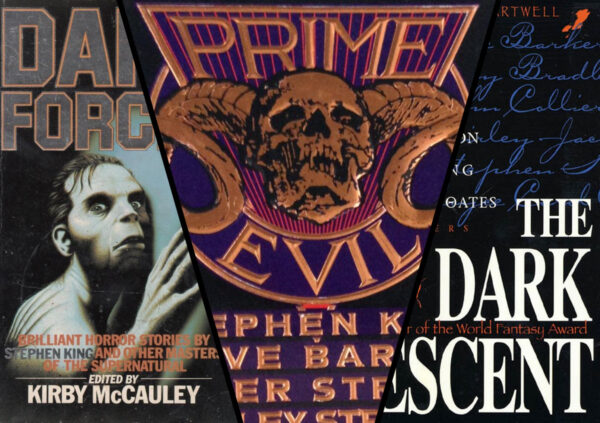
Dark Forces (1980)
Dark Forces
The most important original horror anthology ever published, and it arrived at exactly the right moment.
Kirby McCauley was a literary agent rather than an editor by trade, and he commissioned twenty-three new stories from the writers who were about to define the eighties boom. The advance was reportedly the largest ever paid for a horror anthology at that point, which is why he got the names.
The Mist is the reason to own it. King’s novella, about two hundred pages, debuted here, and nothing in his shorter work beats it: a supermarket, a fog bank, and people arguing about leaving while something outside gets on with it.
Around it are Ramsey Campbell, Karl Edward Wagner, Dennis Etchison, Robert Bloch, Gene Wolfe, Isaac Bashevis Singer and Joyce Carol Oates.
It won the World Fantasy Award, it proved horror could carry a hardcover anthology at literary prices, and everything in this section of the page followed from it.
Douglas Winter’s answer to Dark Forces eight years later, and the theme is the argument.
Winter’s position, stated in the introduction, is that horror is not a genre at all but an emotion, and that treating it as a marketing category has been bad for it. So he commissioned thirteen original stories from writers who mostly did not accept the label, and the book is his case.
King’s “The Night Flier” is here and became a film. Straub’s “The Juniper Tree” is the best thing in the volume and it is a story about childhood sexual abuse with nothing supernatural in it whatsoever, which is Winter’s argument made in practice.
Clive Barker, Ramsey Campbell, Dennis Etchison, Charles L. Grant, Whitley Strieber, Thomas Ligotti and Paul Hazel round it out, and the Ligotti is one of his earliest appearances in a mainstream anthology.
Buy it for the Straub, which has never been anthologized as widely as it deserves.
Charles L. Grant edited eleven volumes between 1978 and 1991, and the series is where quiet horror was defined as a thing.
The editorial line was stated openly and policed: gore out, explicit violence out, detailed monsters out, clean resolutions out. Grant wanted implication doing dread’s work, suggestion and atmosphere above all, and plenty of good fiction went back to its authors for the crime of directness.
That gives the series a house style, which is either its strength or its limitation depending on your taste. At its best it produced some of the finest short horror of the period. At its weakest it produced stories where very little happens quietly.
Ramsey Campbell, Dennis Etchison, Steve Rasnic Tem, Karl Edward Wagner and Al Sarrantonio appeared repeatedly, and several careers started here.
The series took the World Fantasy Award more than once.
They are out of print and secondhand copies are cheap. The Best of Shadows gathers the highlights into one book, the sensible purchase.
The document of a movement that lasted about five years and changed the field permanently.
Paul Sammon assembled it in 1990, at the point when splatterpunk had a name, a set of practitioners and a great deal of hostility from the establishment, and the book is part anthology and part manifesto.
The fiction is Clive Barker, Joe R. Lansdale, David J. Schow, John Skipp and Craig Spector, Richard Christian Matheson, Robert McCammon and Rex Miller. Schow coined the term at a convention in 1986, apparently as a joke.
Own it for the non-fiction. Sammon packs in the essays and interviews making the case, then reprints the attacks on the movement, handing you the fight in real time instead of a retrospective summary. The stance: horror had gone polite and evasive, and a body on the page deserved depicting as a body.
Splatterpunks II followed in 1995 and is weaker.
Both are out of print and the movement’s own writers mostly disowned the label within a decade.
Ellen Datlow has been editing a year’s best in one form or another since 1988, and this series is the current one and the one that matters.
The reason it is the essential subscription rather than merely a good one is the summation. Every volume opens with an essay running to thirty or forty pages covering the year’s novels, collections, anthologies, magazines, small presses, awards, and the people who died. Read fifteen years of those in sequence and you have the best available history of the field.
The honorable mentions list at the back is the other half of the value, and it is usually longer than the table of contents.
Datlow’s taste is literary, favors the quiet and the strange over the visceral, and has been consistent for thirty-five years. She has won more World Fantasy Awards than anybody.
Volume sixteen and onward moved to Night Shade after a publisher change, and the numbering can confuse. If you only track one thing in the field, track this.
Stephen Jones has been running the British year’s best since 1990, the useful counterweight to Datlow.
The selection leans British and leans toward the traditional. Ramsey Campbell, Kim Newman, Michael Marshall Smith, Christopher Fowler, Reggie Oliver and Joel Lane appear far more often here than in the American volumes, and a reader working only from Datlow would miss most of them.
Like hers, it opens with a long survey of the year, and the two summations together give you a genuinely complete picture because they cover different territory and disagree about what mattered.
Jones also compiles an obituary section that has become the field’s record of who died, and it is more thorough than anything else available.
Campbell co-edited the first five volumes.
The series has moved publishers repeatedly and volumes go in and out of print, which makes collecting it irritating. Buy whichever ones you find.
Datlow also edits themed originals, and they’re the most reliable purchase in contemporary horror. A representative few.
When Things Get Dark (2021)
When Things Get Dark
Eighteen original stories written in tribute to Shirley Jackson, edited by Ellen Datlow, and none of the modern themed anthologies comes close.
The reason it works is that the brief was interpreted loosely. Nobody was asked to write a Jackson pastiche. They were asked to write something in her spirit, which for most of the contributors meant domestic settings, unreliable women, communities that close ranks, and horror produced by social pressure rather than by anything supernatural.
Josh Malerman, Carmen Maria Machado, Paul Tremblay, Joyce Carol Oates, Elizabeth Hand, Cassandra Khaw, Stephen Graham Jones, Kelly Link and Laird Barron all appear, which is close to a roll call of who is worth reading now.
Machado’s contribution and Hand’s are the two people name most.
Won the Bram Stoker Award for anthology and the Shirley Jackson Award, which is a neat outcome.
If you want one volume representing the current state of the short form, this is it.
Twenty-nine original monster stories, edited by Ellen Datlow, and the brief was deliberately old-fashioned.
Datlow asked for monsters, and the contributors mostly interpreted that as a challenge to invent rather than to reuse. There are very few vampires and almost no werewolves. What there is instead is a run of things that have no name and no established folklore, by design.
Joyce Carol Oates, Stephen Graham Jones, Brian Evenson, Kaaron Warren, Priya Sharma, Alison Littlewood, Terry Dowling and Gemma Files all contribute, and Evenson’s is the strangest thing in it.
The volume is unusually consistent, which is rare at this length, and the reason is that a narrow brief tends to produce better anthologies than a broad one.
Six hundred pages, and the best modern monster anthology almost by default, because almost nobody else is commissioning them.
Read it alongside When Things Get Dark to see the range of what Datlow does with a theme.
Fifteen original stories set at sea or under it, edited by Ellen Datlow, and the theme does most of the work.
The ocean is the oldest setting in horror and the most reliably effective, because everything about it is genuinely hostile: the pressure, the dark, the cold, the depth, and the fact that nobody is coming. Datlow’s contributors mostly resist the temptation to invent a creature and instead use the water itself.
Seanan McGuire, Christopher Golden, Stephen Graham Jones, Michael Marshall Smith, John Langan and Terry Dowling contribute, and Langan’s is the standout, which will surprise nobody who has read The Fisherman.
There is a wide range of period and register: whaling, submarines, cruise ships, oil platforms, a lighthouse.
A Shirley Jackson Award nominee for anthology, and the most focused of Datlow’s themed volumes.
Short by anthology standards and it does not have a weak entry, which at fifteen stories is a genuine achievement.
Twenty original stories by Black writers, edited by Jordan Peele with John Joseph Adams, and no horror anthology in years has sold more.
The stories are not thematically restricted and that is the editorial decision that makes it work. There is no requirement that the horror be about race, and several of the strongest pieces are cosmic, science fictional or entirely domestic.
N. K. Jemisin, Nnedi Okorafor, Tananarive Due, P. Djèlí Clark, Rebecca Roanhorse, Chesya Burke and Terence Taylor are among the contributors, and Due’s is the one most readers name.
Peele’s introduction is short and mostly gets out of the way.
It hit the New York Times bestseller list, which almost no anthology does, and it has done more than anything to demonstrate that the audience for original short horror is larger than publishers had assumed.
A companion to Never Whistle at Night, and the two together are the clearest picture of where the short form is going.
Twenty-six original stories by Indigenous writers from across North America, edited by Shane Hawk and Theodore C. Van Alst Jr.
The title comes from a widely shared warning across several Indigenous cultures, and the anthology’s premise is that the horror tradition has spent a century using Indigenous material as set dressing without asking anybody.
Stephen Graham Jones, Rebecca Roanhorse, Waubgeshig Rice, Cherie Dimaline, Darcie Little Badger, Tommy Orange and Morgan Talty contribute, and the range is wide: body horror, revenge, folklore, the residential schools, and a great deal of humor, which readers rarely expect.
Jones’s foreword makes the argument directly and is worth reading on its own.
Won the Shirley Jackson Award and the Bram Stoker Award for anthology, and it sold considerably better than anthologies usually do.
The variety is the pitch. Nothing in it reads like anything else in it, and the collective effect is a demonstration that Indigenous horror is not a subgenre with a house style.
Different purchase, same shelf. Briefly, because these are covered properly elsewhere.
Books of Blood by Clive Barker, volumes one to three. The most influential horror collection since Poe. See the Clive Barker page.
Skeleton Crew by Stephen King, which is the best of his six and contains The Mist, “Survivor Type”, “The Jaunt” and “Gramma”. Full ranking at the Stephen King short story collections.
The Lottery and Other Stories by Shirley Jackson, which is rated higher by people who’ve read all of her than either famous novel.
Ghost Stories of an Antiquary by M. R. James, where some two hundred pages hold four or five of the finest ghost stories anyone has produced.
The October Country by Ray Bradbury, and The Bloody Chamber by Angela Carter.
Where to Start
Buy The Dark Descent. If you own one horror anthology it should be that one, and reading it in Hartwell’s order rather than dipping is worth the effort.
Then The Weird if you want the century-wide view, or the most recent Best Horror of the Year if you want to know what’s happening now.
If you want new fiction rather than reprints, When Things Get Dark and Never Whistle at Night are the two best original horror anthologies of recent years.
And if you can find a copy, Dark Forces is the historically important one.
Historical horror has an advantage no other subgenre gets handed to it, which is that the past is genuinely worse than anything you can invent.
Put a haunting in the present and you have to work to make the reader feel trapped, because they have a phone, a car and antibiotics. Put it in 1348, or on a ship in the Arctic in 1847, or in a Mississippi county in 1922, and the trap builds itself. There is no help coming. The nearest doctor is three days away and will make it worse. Everyone already believes in the thing that’s after you, and knowing that hasn’t saved anybody.
The other thing the good historical horror books understand is that the supernatural is usually the smaller horror. In almost every book below, the historical circumstance is doing more damage than the monster, and the monster is what makes you notice.
Historical horror set before 1700, which is mostly about plague, the Inquisition, and what a village could do to a woman with land.
Between Two Fires (2012)
Christopher Buehlman – Between Two Fires
France, 1348. The plague has emptied the countryside, the roads are unsafe, and a disgraced knight who abandoned his order at Crécy is travelling north with an orphaned girl who says she speaks with angels.
The history is exact, and the book works because of it. Buehlman researched the period properly: the mortality rates, the abandoned villages, the collapse of the harvest, the flagellant processions, the pogroms against Jewish communities blamed for the wells. Everything the characters encounter on the road is documented, and the supernatural arrives into a landscape that was already apocalyptic.
The theology is the other half. There is a war in heaven and the wrong side is winning, and Buehlman writes the demons as embodied, numerous, specific and physically present. Thomas is a bad knight with a broken arm, and the girl’s faith is correct rather than touching, which is the harder choice and the one that makes the novel land.
It is genuinely grim, the road episodes are episodic by design, and the last hundred pages are extraordinary.
A Benedictine abbey in northern Italy, 1327, seven days and seven deaths, and a library nobody is permitted to enter.
The historical horror is that Eco was a medievalist and refused to simplify anything. The dispute William of Baskerville has come to arbitrate, whether Christ owned the clothes he wore, was a real theological crisis with the Inquisition attached and papal politics behind it, and the novel treats it as the life-or-death matter it was. The Fraticelli, the Dolcinites, the burnings, the papal court at Avignon are all real.
The first hundred pages, by his own account, were built as a filter against thriller readers, and the filter is real: untranslated Latin, extended scholastic argument, and a long runway before the plot properly starts.
The library labyrinth and the blind librarian Jorge are the horror, and the argument at the center, about whether some knowledge is too dangerous to permit, is given to Jorge and made formidable.
Black Spring is a small town in the Hudson Valley, and Katherine van Wyler has been walking through it since the seventeenth century with her eyes and mouth sewn shut.
The historical horror is the accommodation. Four hundred years of arrangement: a town council, a surveillance network, a phone app tracking her position, protocols taught to children, and a rule that nobody who moves in is ever permitted to leave. What was done to Katherine in the 1600s is the debt, and the app is the joke, four centuries of management reduced to a notification.
What she was accused of, and what the town did to her son, comes out late and reframes the whole system.
The Dutch original was set in a Netherlands village called Beek. Olde Heuvelt rewrote it wholesale for the American edition, changing the setting, the history and the ending, which almost no translated novel does.
The closing fifty pages earn their reputation, and the town outdoes its witch.
Connecticut, 1666, in the second generation of the Puritan settlement, and Brom has done the reading on what that actually meant.
Abitha lands from England as bought goods for a farmer whose decency outlasts his health by very little, leaving her a widow with a debt to her brother-in-law, a farm she has no legal standing to keep, and a village that has already decided what a woman alone represents.
The historical horror is the procedure rather than the witchcraft. The accusation, the examination, the searching of her body for marks, the testimony of neighbors with reasons, and the fact that the land is what everybody actually wants. All of it is drawn from the documented mechanics of colonial witch trials, twenty-six years before Salem.
Father, the thing waking in the woods, is a genuine pre-Christian survival, and Brom’s position is that the Puritans are the ones importing a cosmology into a landscape that already had one.
Brom paints for a living, filled the book with his own plates, and the hardback is the version to own.
Historical horror set in the 1800s, which is where the research usually shows most, because the period keeps such good records.
The Terror (2007)
Dan Simmons – The Terror
In May 1845, HMS Erebus and HMS Terror left England for the Northwest Passage, and no European laid eyes on them again. The dead totaled a hundred and twenty-nine. To that documented record Simmons adds exactly one invention: out on the ice, something is hunting the crews.
Nearly every death belongs to history, which is the book’s whole case. Scurvy takes its share. Botulism arrives in tins a lowest-bid contractor sealed with lead solder. More lead rides the water system. Cold sinks past minus fifty. Deadliest of all is rank itself: procedure goes on being obeyed by officers even as procedure does the killing.
It works because of Crozier: Banbridge Irish, Catholic, twice denied command by English gentlemen certain to deny him again, whose whisky gives out a third of the way in, leaving a long stretch of the novel to a man in withdrawal responsible for keeping two hundred alive.
Adapted by AMC in 2018, shortened considerably, and very good.
1846, the westward trail, the Donner Party, and behind the wagon train, something keeping pace.
Katsu made one governing choice: no cannibalism set piece. Every reader opens the book knowing the lake camp’s history, and she declines to stage it, declines to linger. Her four hundred pages go instead to the chain of unremarkable choices that guaranteed the outcome: a shortcut taken, quarrels over pace, oxen lost, personalities grinding, whole days burned on standoffs no one would concede.
The historical work is thorough. The real party is here with the real names, Tamsen Donner, James Reed, Lewis Keseberg, and Katsu keeps to the documented timeline while inserting her supernatural element into the gaps.
What the thing on the trail actually is stays deliberately vague for most of the novel, and the reveal is less interesting than the deterioration around it, which several reviewers noted.
The group dynamics are the best material, arguing quietly that no monster was required.
A Mississippi steamboat in 1857, a captain who has lost his boat, and a wealthy pale passenger who offers to build him the fastest packet on the river in exchange for asking no questions about the hours he keeps.
The historical horror is the river itself. Martin researched steamboating exhaustively, the races, the wood-yards, the pilots, the boiler explosions, the economics of the packet trade, and Abner Marsh’s obsession with speed is the most convincing thing in the book.
And Martin gives his vampires a reformation: York, dosing his kind off human blood with a formula of his own, against Julian, for whom abstinence is heresy, the quarrel argued in a theological register.
The antebellum setting is doing deliberate work. Martin puts vampiric predation alongside slavery on the same river in the same decade without ever making the comparison explicit.
It stands with the best vampire fiction ever written, and Westeros has kept it invisible.
London, the last five years of Charles Dickens’s life, narrated by Wilkie Collins.
The historical hook is real. Dickens was in the Staplehurst rail crash in June 1865, climbed back into the wreckage to help the dying, and was never the same afterwards. He died five years later to the day. He left The Mystery of Edwin Drood unfinished. Simmons takes those facts and supplies a figure called Drood whom Dickens claims to have met among the carriages.
Professional envy, sustained for eight hundred pages. The laudanum Collins takes suffices to put a green-skinned woman on his staircase; a whole career has kept him the room’s second novelist; Dickens he loves, and Dickens he would like dead, and none of the three escapes his own notice.
The voice either sells the book or ends your reading of it; middle ground does not exist. The Victorian London research is superb and the opium dens and the undercity are the best sequences.
New York, 1896. A newspaper illustrator, a criminal psychologist and the first woman employed by the police department investigate the murders of boy prostitutes, at the invitation of the new Police Commissioner, Theodore Roosevelt.
The historical horror is the method. Kreizler is an alienist, which is what a psychologist was called then, and the premise is that he attempts to build a picture of the killer from the evidence, which is an idea nobody had systematized in 1896. Carr shows the reasoning being invented, badly, against resistance from a department that considers it nonsense.
The research is the reason to read it. The tenements, the Lower East Side, the corruption, the political machinery, the food, the transport, Delmonico’s, and the specific business of being a boy sold in a New York brothel in the 1890s, which the novel does not soften.
Roosevelt is a real presence rather than a cameo, and his position as a reformer surrounded by a police force he cannot control is historically accurate.
Long, dense, and the procedural detail is the pleasure.
Historical horror set within living memory or close to it, where the horror is frequently something a state or a community did legally.
1922 (2010)
Stephen King – 1922
Wilfred James farms a hundred acres in Nebraska in 1922 and his wife has inherited a hundred more, which she wants to sell to a hog-rendering company and move to Omaha. He does not.
So he recruits his fourteen-year-old son to help him kill her and put her down the old well.
The historical horror is the specificity of the period and the place. King is precise about the farming, the money, the isolation, the Depression that has not arrived yet but is coming, and about what happens to a boy in 1922 who has done that and has no way out of the county.
The rats are the supernatural element and King keeps them ambiguous, which is the right choice. Whether Arlette is coming back or Wilfred is disintegrating is left open, and the well produces both readings.
A novella from Full Dark, No Stars, about a hundred and thirty pages, and nothing King has written in twenty years is bleaker. Filmed by Netflix in 2017 with Thomas Jane, faithfully.
Southern Ohio and West Virginia between the end of the Second World War and 1965, in a stretch of country Pollock knew because he worked in a paper mill there for thirty-two years.
Several storylines run in parallel and converge. A veteran who lost his faith praying over his dying wife. Their son. A pair of travelling murderers who photograph their victims. A corrupt sheriff. And a preacher with a spider-handling ministry who ruins a girl.
The historical horror is the poverty and the religion, and Pollock refuses to romanticize either. The revival tents, the mill towns, the dirt roads, the drinking, and a Pentecostalism that is genuinely believed and genuinely destructive.
There is no supernatural element anywhere in it, which is why it appears here rather than elsewhere on this site. The horror is entirely what these people do and what the period permitted.
Pollock published his first book at fifty-three. Filmed by Netflix in 2020 with a large cast and much of the ugliness sanded down.
Zephyr, Alabama, 1964, and the year is doing real work rather than supplying nostalgia.
Cory Mackenson, twelve, is on the dawn milk run with his father when a car noses out of the trees ahead and slides into Saxon’s Lake, and the man his father finds cuffed to the wheel has been beaten, and wired.
The historical horror is the town in that particular year. The Klan is present. The four Black women at the edge of town are treated as folklore by people who would not think of them as neighbors. The civil rights movement is happening elsewhere and arriving slowly. And the mill is closing.
McCammon runs the full apparatus, church, river monster, secret, racial violence, without one cynical sentence, and readers repay it by loving this book more than nearly anything else the genre owns.
Stoker and World Fantasy both, a double almost nobody manages.
An Arctic expedition, 1937. Five men are meant to overwinter at Gruhuken in Spitsbergen, at seventy-nine degrees north, running scientific observations. Two leave. Then one more. Jack Miller is alone at the station with the dogs from October, in four months of continuous darkness.
The historical horror is the period detail and the isolation is genuine rather than contrived. Paver researched the equipment, the wireless procedures, the supply arrangements and the actual site, which has a documented and unpleasant history involving trappers, and she went to Spitsbergen herself.
The thing at Gruhuken is glimpsed at the edge of the lamplight and never explained, and Paver’s restraint is total. Jack’s journal is the whole novel and it is a slow, precise record of a man alone in the dark deciding whether he is imagining things.
It is a straightforward classical ghost story executed better than almost anything modern, and the dogs are what make the last section unbearable.
Short, and the best entry point to Paver for adults.
Suffolk, 1913. Maud Stearne is sixteen and lives at Wake’s End, a manor on the edge of a fen, with a father who is a medieval historian, a mother who is pregnant almost continuously, and a household run on his rules.
Edmund Stearne finds a medieval painting, a doom, in the churchyard, and begins keeping a notebook, and Maud reads it.
The historical horror is the fen and the doom together. Paver did the reading on both: the drainage of the East Anglian fens, the folklore that survived there, and the medieval doom paintings that were whitewashed over at the Reformation and are still being uncovered. The one Edmund finds is the trigger and the notebook records his deterioration.
What the novel is actually about is Maud’s position. She is intelligent, uneducated by design, has no money and no standing, and is watching her father lose his mind while being legally in his power.
The framing is 1966, with Maud elderly, and the reveal about what she did is very well handled.
1954, out of Chicago. Just home from Korea at twenty-two, Atticus Turner heads east in search of his vanished father, riding with his friend Letitia and his uncle George, publisher of The Safe Negro Travel Guide.
Driving is where the historical horror lives. Ruff names James Loewen’s Sundown Towns among his sources, and the research is visible on the page: counties no Black family could stop in past dark, fuel gauges weighed against remaining daylight, a sheriff escorting them to the county line as the sun goes down. Nothing supernatural happens in that sequence, and nothing in the book beats it.
George’s guide takes after the actual Negro Motorist Green Book, issued every year from 1936 to 1966, cataloging where eating and sleeping were safe.
Next to all that, the Order of the Ancient Dawn’s sorcerers rank as the smaller threat, a point the novel makes explicitly.
Eight connected stories stand where a continuous novel would, the format a residue of its television origins. HBO’s series departs from it substantially.
1924, Harlem. A guitar he can barely play hangs from Charles Thomas Tester’s shoulder as he works the errand routes of New York’s occult economy, transporting volumes he has the sense never to open.
What LaValle retells is “The Horror at Red Hook,” the most nakedly racist story in Lovecraft’s catalog, narrated this time from within the community the original targeted. One line of dedication holds the whole argument: for Lovecraft, with all my conflicted feelings.
The period detail is exact: 1924 Red Hook, tenement blocks, the immigrant neighborhoods that disgusted Lovecraft, and the particular logistics of being a Black man crossing Queens and Manhattan while a police detective develops an interest.
Structure does the heavy lifting: the first half belongs to Tommy, the second hands the narration to Detective Malone, Lovecraft’s original protagonist, and the same events replay across a police line’s two sides.
The finest sentence the corrective tradition has produced belongs to Tommy, weighing cosmic terror against the daily variety and finding the cosmic wanting. It took the Shirley Jackson and British Fantasy Awards.
Noemí Taboada is a socialite in Mexico City, going to parties, wanting to study anthropology against her father’s wishes, in a country that has been independent for over a century and modern for a generation. Then she is sent to High Place in the mountains, where an English family have been sitting on a silver mine since the previous century and behaving as though nothing has changed.
The historical horror is the extraction. The Doyles came for the silver, the mine killed local workers in numbers nobody recorded, and the patriarch’s bloodline talk is nineteenth-century eugenics served with the soup.
Nothing in the house is local: shipped furniture, shipped wallpaper going soft in the mountain damp, a mausoleum for English dead, and the Doyles, the least assimilable import of all.
Her larger point lands through the period itself: the pile was colonial infrastructure from the start, and a century of gothic novels politely declined to book the cost. Then the closing act veers somewhere the opening two never signposted.
The nonfiction anchor for this page, and the best account anybody has written of how these cases actually worked.
Loudun, France, 1634. The Ursuline convent reports a mass possession. The nuns convulse, blaspheme and name the parish priest Urbain Grandier as the cause. Public exorcisms are staged for paying audiences. Grandier is tortured, his legs crushed in the boot, and burned alive.
Huxley’s argument is that every element of it is explicable and none of it is fraudulent in a simple way. The nuns were enclosed, young, and largely there because their families had no dowry for them. The exorcists were performers with careers. And Cardinal Richelieu needed Grandier removed for entirely political reasons, because he had written against him and opposed the demolition of the town walls.
What makes it more than a debunking is that Huxley takes the nuns seriously as people rather than as symptoms, and Sister Jeanne des Anges is the most interesting figure in the book.
Ken Russell filmed it in 1971 and it remains partly censored.
The Lost World began at the Royal Geographical Society. On February 13, 1911, Percy Fawcett stood up there and described a plateau in South America, and monstrous tracks of unknown origin, and Conan Doyle was interested enough to ask him for more.
Fawcett’s own memoirs record it: Doyle wanted information for a novel about central South America, and The Lost World came out the following year.
Fourteen years after that lecture, Fawcett walked into the Mato Grosso looking for a lost city and was never seen again.
So the man who supplied the geography for the most famous lost-plateau novel in English disappeared into the same continent, and the search parties sent after him produced a second round of disappearances.
Serialized in the Strand from April to November 1912, with forty-six illustrations by the New Zealand artist Harry Rountree, and published as a book by Hodder and Stoughton on October 15, 1912.
It reached America first. The Sunday Magazine of the Philadelphia Press ran it with the photographs and the Washington Evening Star ran it with drawings, from March 24 to July 21, 1912, which puts the American serial in print a month before the British one.
Professor George Edward Challenger claims there is a plateau in the Amazon where prehistoric animals have survived. He is ridiculed. An expedition sets out to settle it: Challenger, the skeptical Professor Summerlee, the hunter Lord John Roxton, and a journalist called Malone who narrates.
They are betrayed by their guides, trapped on the plateau, and have to deal with dinosaurs and a tribe of ape-men.
The premise is as clean as premises get, and the book is faster than its reputation.
He Also Faked Photographs to Sell It
To publicize a novel about explorers finding living dinosaurs, Conan Doyle dressed up as his own Professor Challenger and had a series of staged photographs made.
They ran in the Strand in April and May 1912 and in the first English book edition. The sitters are named: Doyle himself, plus W. H. Ransford and Patrick Forbes.
This is the man who, a few years later, examined photographs of paper fairies cut out by two girls in Yorkshire and declared them genuine.
He knew exactly how easy a faked photograph was, because he had commissioned some.
Doyle’s second-best character, and the argument for reading it rather than watching an adaptation.
He is enormous, arrogant, physically violent with journalists, and right. He has already assaulted four or five reporters before Malone arrives, and Malone earns his respect by refusing to press charges after being assaulted too.
Holmes is cold and correct. Challenger is a bully who happens to be telling the truth, which is a much harder character to make likable and Doyle manages it.
This is the useful thing about the book and it is why it belongs in a science fiction list rather than a Holmes one.
Verne got there first. Journey to the Center of the Earth, 1864, has prehistoric creatures surviving underground.
Doyle extended it. One account puts it precisely: he wanted to take Verne’s idea further by combining dinosaurs and primitive ape-men in a single undiscovered place, and he chose South America. He read up for it too, working from the zoologist Ray Lankester’s Extinct Animals.
Then Burroughs took it further again with The Land That Time Forgot in 1918.
And Crichton used the title outright for the Jurassic Park sequel, as an acknowledgment.
Roxton Is Roger Casement, and the Slavers Are Real
Lord John Roxton’s backstory is not invention. It is journalism, lifted from a man Doyle knew.
Roger Casement was a British consul in South America who investigated the Peruvian Amazon Company in 1910 and again in 1911, and what he found there he had already found once before in the Congo.
Julio César Arana’s rubber company was registered in London in 1907. What it ran in the Putumayo was forced labor enforced by flogging, starvation, mutilation and murder. The scars left by the whip were known locally as the Mark of Arana. Estimates of the dead across the period run from thirty-two thousand upward, and roughly nine in ten of the affected Amazonian population did not survive it. Casement’s verdict was that it was not merely slavery but extermination.
Roxton is the Englishman who went there with a rifle.
He calls himself the flail of the Lord. And the line Doyle gives him is not adventure-novel swagger: there are times, young fellah, when every one of us must make a stand for human right and justice, or you never feel clean again.
Which reframes the book. The Lost World reads as a boys’ adventure about dinosaurs, and one of its four heroes is a lightly fictionalized humanitarian investigator carrying a real atrocity into a story about a plateau. Doyle put the Putumayo in a novel two years after Casement went there, and almost nobody reading it now knows.
And the Film Fed King Kong
The 1925 silent adaptation used stop-motion animation by Willis O’Brien, mixing actors and dinosaurs in the same frame, and was marketed as an event. Wallace Beery played Challenger.
O’Brien went on to make King Kong eight years later, and later trained Ray Harryhausen.
The resemblance between the two films is not subtle: a lost geography containing incompatible kinds of life, and something brought back that should not have been.
Filmed again in 1960, 1992, 1998, 2001 and 2005, with a television series from 1999 to 2002, and none of them is the one to watch.
The Footprints Were Real
In 1909 fossil iguanodon footprints were found in a quarry near Doyle’s home in Sussex, and it is generally believed that this is where the novel started.
An iguanodon duly appears in it, and Doyle puts a reference to a Sussex doctor puzzled by footprints into the text.
Somebody Used This Novel to Accuse Him of a Fraud
Worth knowing, because it is the strangest thing in the book’s afterlife.
Piltdown Man was the skull assembled from a human cranium and an orangutan jaw, presented in 1912 as a missing link, and exposed as a forgery in 1953. It is the most famous hoax in the history of paleontology, and it happened in Sussex, where Doyle lived, in the year he published a novel about ape-men.
The American historian Richard Milner took The Lost World as his starting point and argued that Conan Doyle was the forger, reading a cryptic confession into the text.
He was wrong, and the Doyle scholarship says so plainly.
But it is a real demonstration of what this novel does to people. A book about a scientific fraud that turns out to be true, published in the same county and the same year as a scientific truth that turned out to be a fraud, by a man who faked photographs to promote it and later authenticated fake photographs in earnest.
No wonder somebody went looking for a confession.
The Sequels
The Poison Belt, 1913, in which Challenger works out that the Earth is passing through a cloud of poisonous ether.
The Land of Mist, 1926, which is a supernatural novel and is Doyle’s spiritualism arriving in the fiction.
There are shorter Challenger pieces besides those two, and neither novel is as good. One publisher’s assessment is that neither is as successful or as interesting, and that is the consensus.
Horror writer René Rehn invites you into the realm of supernatural horror, where paranormal entities—ghosts, spirits, and twisted monsters—bring forth unsettling scenarios ...
Enter the realm of Disturbing Horror by René Rehn, featuring twisted stories about haunting journeys, bizarre scenarios, and the depths of human depravity ...
Follow horror writer René Rehn into the realm of emotional horror, where intense experiences replace traditional scares with heart-wrenching revelations ...
Hey there, I am René Rehn. Most of my stories belong to the horror genre, but I occasionally dip into others as well.
In my stories, I often try to write about unsettling and weird occurrences. I am not shy to admit that I am heavily inspired by the works of H.P. Lovecraft, Franz Kafka as well as the Japanese horror manga artist Junji Ito.
Writing and telling stories has been something I did for most of my life. I always felt that writing was my vocation, but for years I lacked the dedication and perseverance. This page was created to share my work with the world.
My stories have been featured multiple times on The NoSleep Podcast, one of the biggest horror fiction podcasts. Some of my featured episodes include:
Ethereal Writing participates in the Amazon Services LLC Associates Program, an affiliate advertising program designed to provide a means for sites to earn commissions by linking to Amazon. This simply means that whenever you buy a book on Amazon from a link on here, I get a small percentage of its price. With that you help support Ethereal Writing and it is very much appreciated.